
Basha Miao Village Photography: The Gunmen of Guizhou
Basha Miao village photography: the gun salute, the sickle haircut, portraits and village life, and how to photograph respectfully.
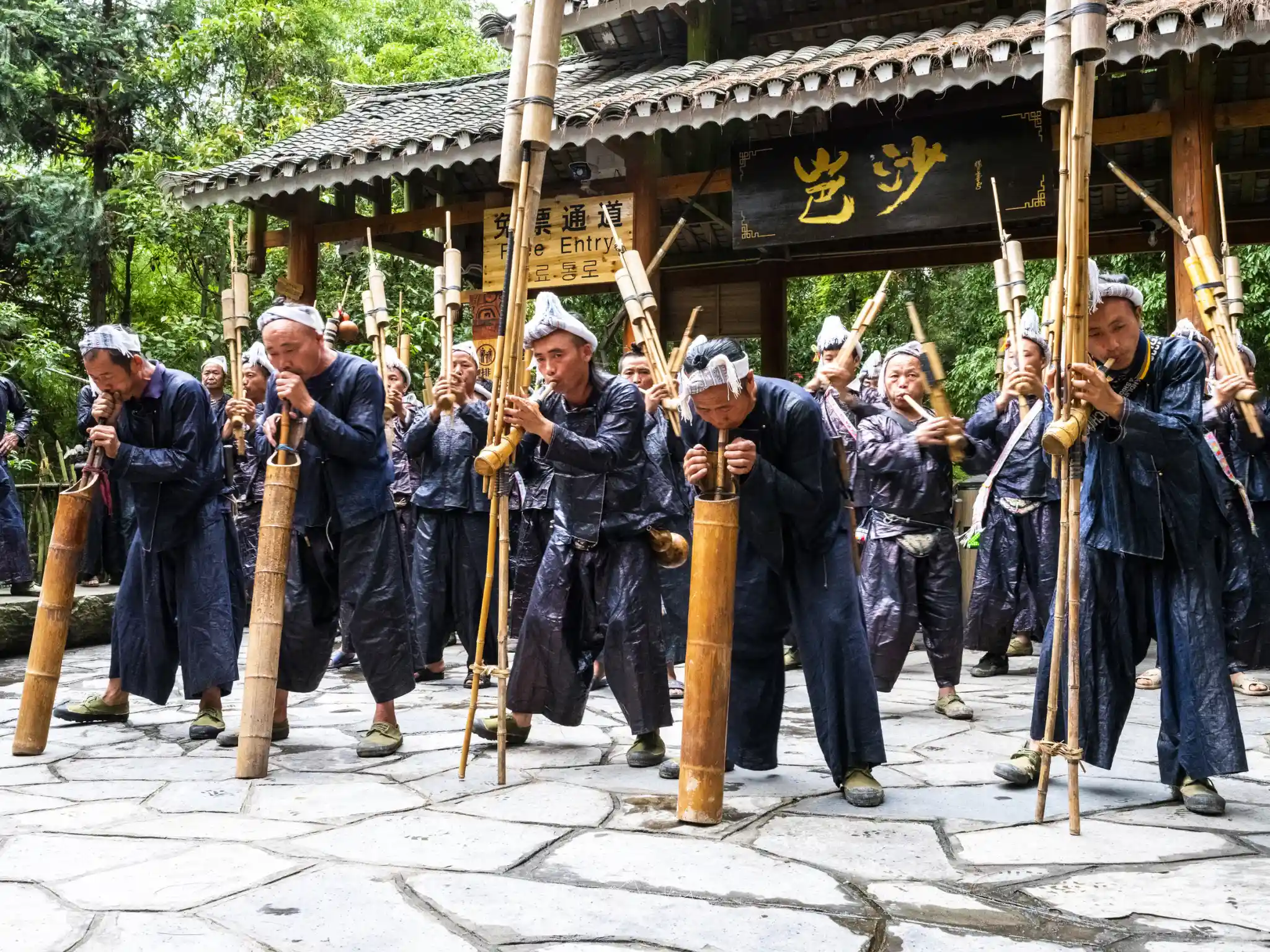
Basha Miao village photography means portraits and ritual more than landscape. Basha, a Miao village in the hills near Congjiang in south east Guizhou, is known as the home of the last gun carrying tribe in China: the men keep long hunting guns under a special permission and wear their hair in a topknot, the sides shaved with a sickle. Visitors are greeted with gunfire and a performance, and the best frames come afterwards. Here is how to photograph Basha well and respectfully.
Basha is one stop in our Guizhou photography tour guide.
Basha Miao village: who lives there
Basha, also written Biasha, is a cluster of Miao hamlets a short way from the county town of Congjiang. China Daily puts its population at more than 2,800 people. The village has kept customs that faded elsewhere in Miao country, and it is famous across China for one of them: the men carry guns. Villagers used them for hunting and to protect their fields from wild animals, and Chinese authorities allow them to keep the guns within their own mountains, although hunting itself has stopped, as Shine and China Daily have reported. The guns are now part of dress and ceremony.
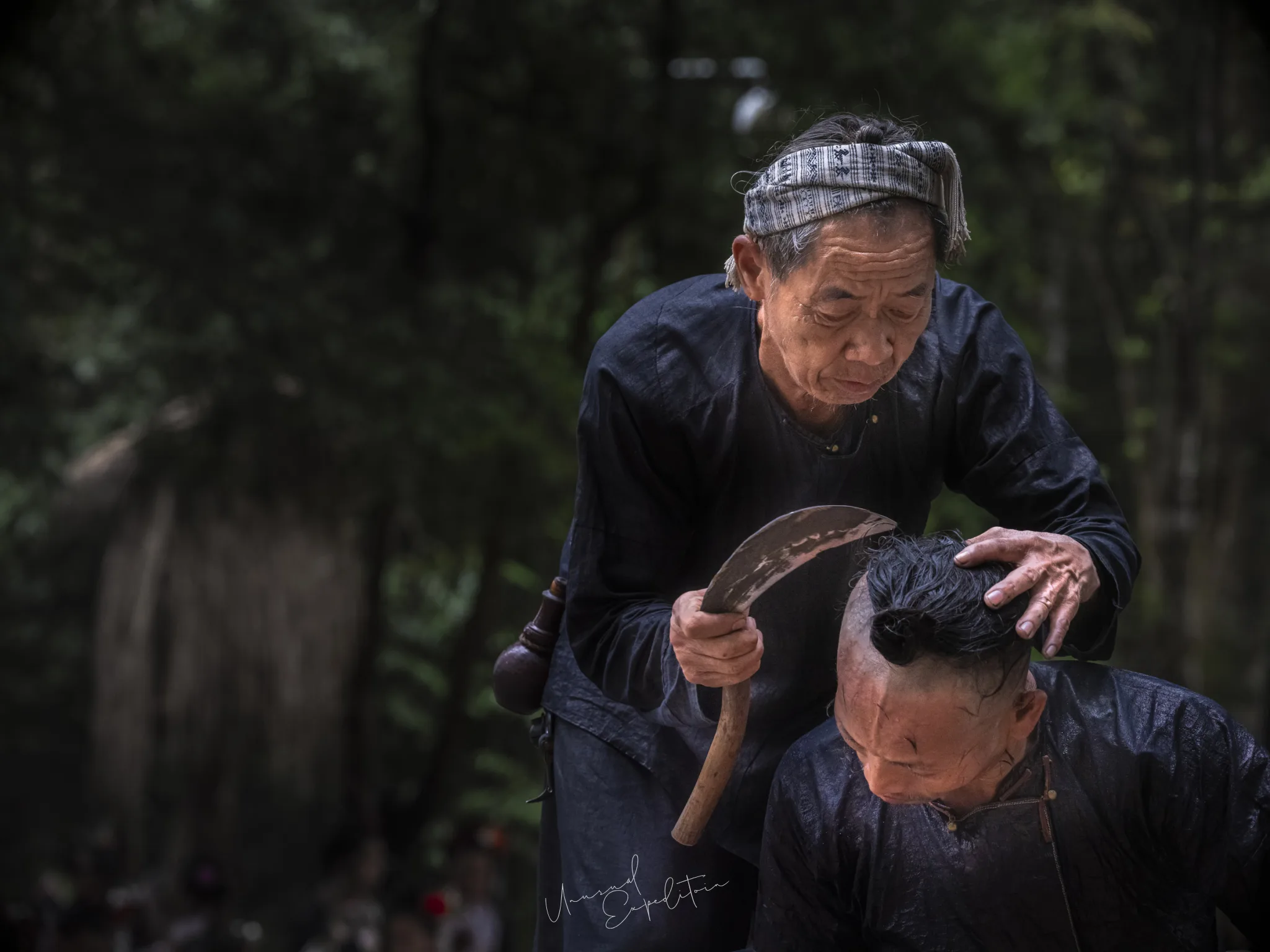
The second custom is the hairstyle. Men wear a topknot, called hugun, with the rest of the head shaved, and the shaving is done with a sickle. The first sickle haircut is a coming of age rite. Today it is also performed for visitors, as part of the welcome.
The welcome performance
Most visits begin at the village gate or square with a performance: a line of men in indigo jackets, guns on their shoulders, firing a salute into the air, followed by the lusheng reed pipes and dances. It is lively and noisy, and the gunfire is loud, so keep a little distance and warn anyone sensitive to noise. Shoot wide to place the men against the timber gate, and long to isolate faces and hands on the guns. The performance is staged, so caption it as one.
The sickle haircut
The sickle haircut is the moment many photographers come for. An elder takes a curved sickle and shaves a young man's head around the topknot, slowly, with water and a steady hand. Ask the guide where to stand, keep out of the way, and use a 70-200mm so you can stay back. The light is often low under the trees, so raise the ISO and keep the focus sharp.
Portraits among the houses
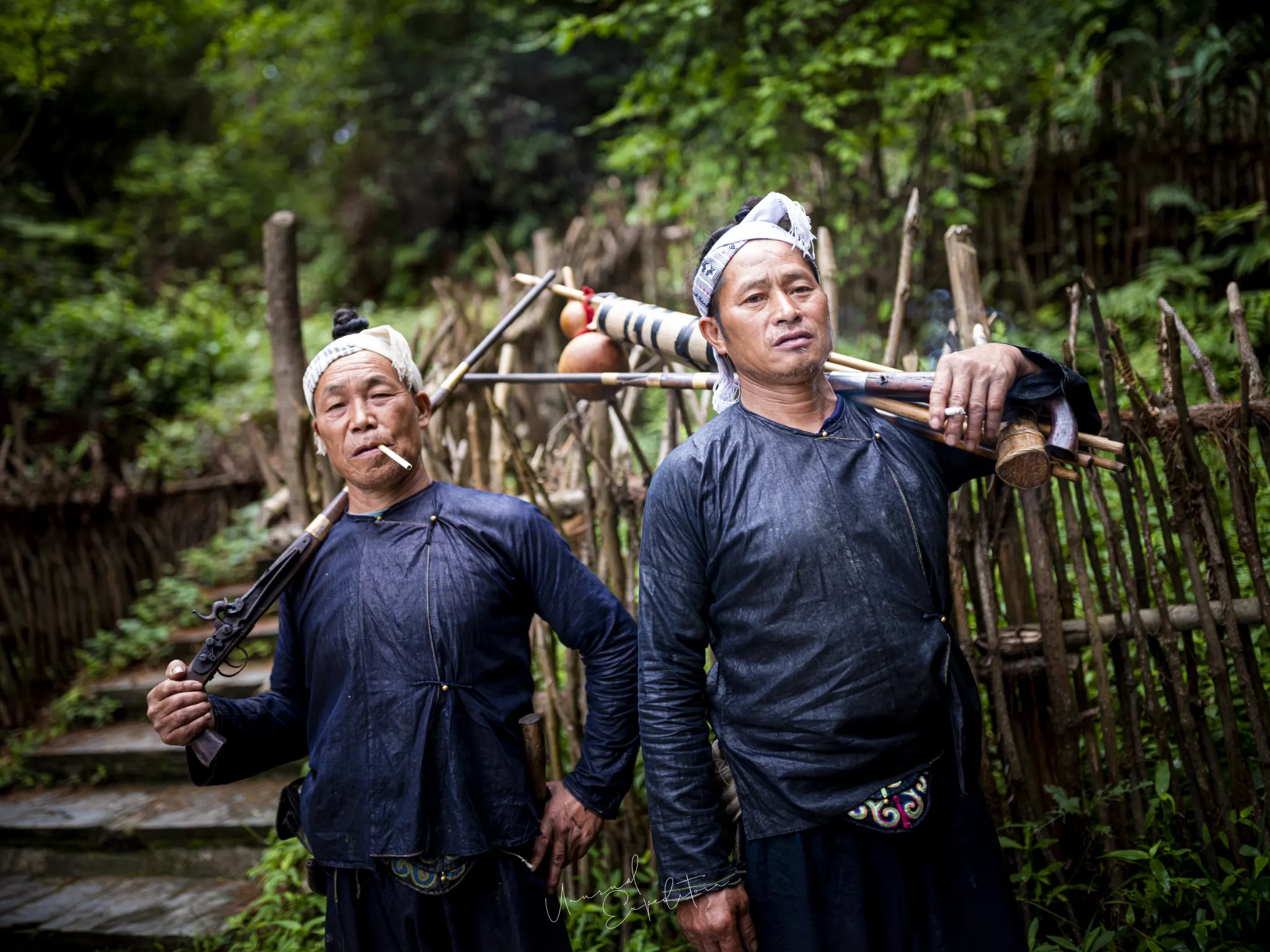
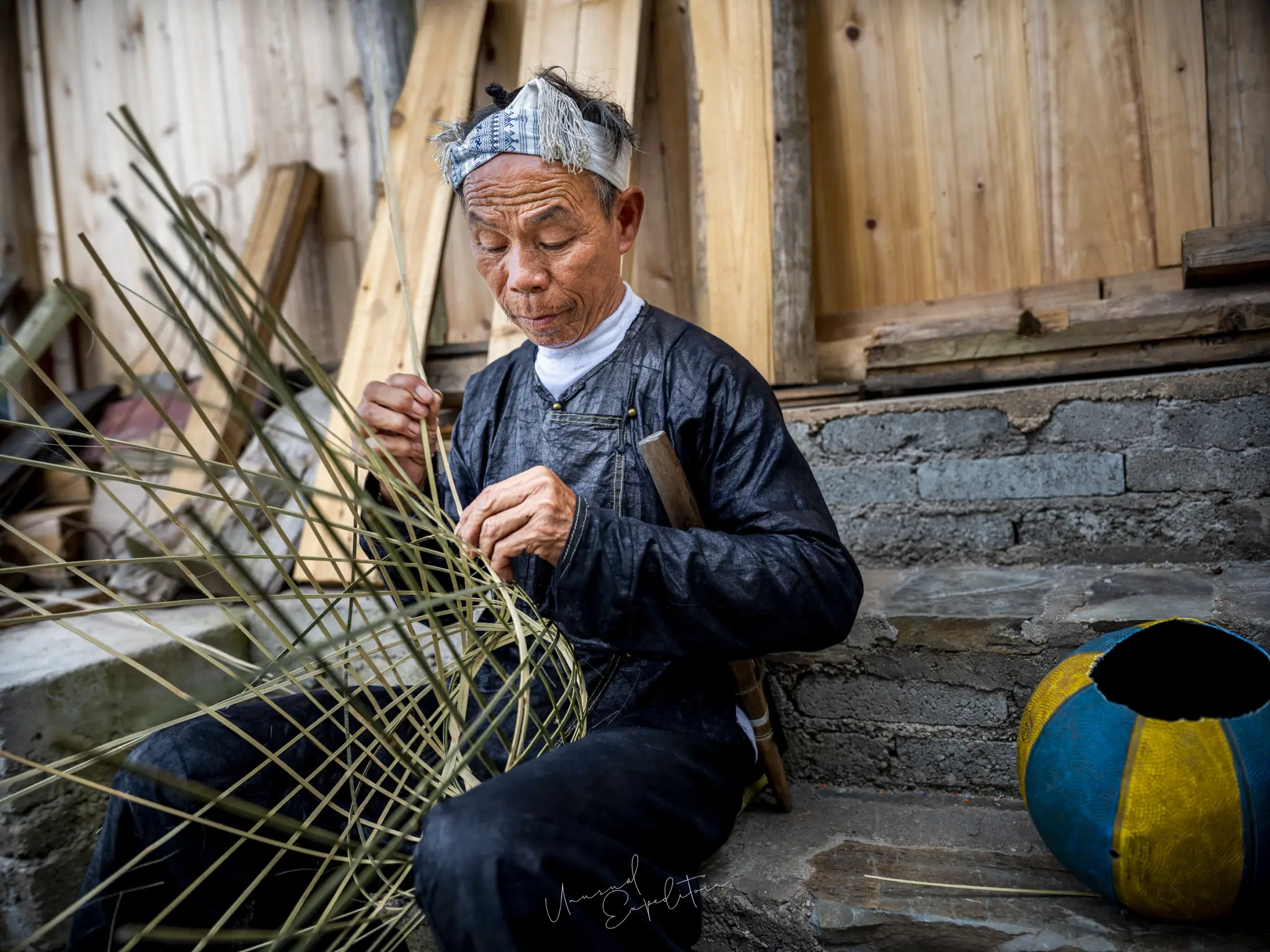
After the welcome, the village opens up. Men pose on the stone steps with their guns over their shoulders, elders smoke pipes on the benches, and craftsmen weave bamboo baskets in front of their houses. These portraits are the real reward of Basha. Ask with a gesture or through the guide, show people the picture on the back of the camera, and pay or buy where that is the custom. Work in open shade under the eaves for soft light on faces.
The performance is loud and quick. The pictures I keep from Basha came an hour later, sitting with an old man weaving a basket, who did not care about the camera at all.
Joseph Mak, tour leader, Unusual Expedition
Photographing Basha respectfully
| Situation | What to do |
|---|---|
| The gun salute | Stand where the guide says, never in front of the line |
| The haircut | Stay back with a long lens, no flash |
| Portraits | Ask first, show the picture, accept a no |
| Children | Ask a parent, and keep it brief |
| Inside homes | Only when invited |
| Guns | Do not touch or handle them |
Granaries, forest and village life
Basha is surrounded by forest, and many villagers still keep a strong tie to the trees, and by village tradition a tree is planted when a child is born. The raised wooden granaries, built on stilts to keep rice dry, the paths through the forest and the terraced fields around the hamlets are good quieter subjects. Look for indigo cloth drying, and for the light coming through the trees on to the paths.
Camera settings and gear
A 24-70mm and a 70-200mm cover almost everything. Under the forest canopy and in the eaves the light is low, so expect ISO 800 to 3200 and keep the shutter fast enough for moving hands. A reflector or simply placing people facing an open doorway lifts the faces. Leave the tripod in the vehicle. The air is humid, so bring a lens cloth.
Combining Basha with the rest of Guizhou
Basha sits between the Dong villages around Zhaoxing and the karst country to the west, so it fits naturally in a longer Guizhou route. North of it lies Xijiang, the largest Miao village in China, which we describe in Xijiang Miao village photos. For when to go, read the best time to visit Guizhou.
What to expect on the day
Basha is a scenic area with an entry ticket, and the welcome performance runs at set times, so check the schedule locally and arrive early to see the village before the groups. The hamlets are spread over a hillside, connected by stone paths and steps through the forest, and the walking is easy but can be slippery after rain. Many villagers are used to visitors and to cameras, and some earn part of their living from the performances and from posing. Others are simply going about their day and would rather not be photographed. Read the situation, follow your guide's lead, and remember that a respectful hour in Basha produces better pictures than a rushed circuit.
Photograph Basha with us
Basha is part of our Guizhou Blossom Photo Tour in spring, with time for portraits after the welcome, indicatively S$3,950 to S$4,500 per person depending on the room. See the China photography tours page for details.
Join the Guizhou photography tour
Inner Mongolia Winter Owl Photo Tour – China departs 01 Jan 2027 To 04 Jan 2027, led by Joseph Mak. Small group, photography first. All Guizhou photography tours.
Explore Guizhou in depth
- Guizhou Photography Tour: The Complete Guide to Miao Villages, Terraces and KarstChina
- Xijiang Miao Village Photos: Photographing the Thousand Household VillageChina
- Xijiang Miao Village Night View: How to Photograph the Lit ValleyChina
- Best Time to Visit Guizhou for Photography: Blossom, Terraces and MistChina
Upcoming Photo Tours
- Egypt Photo Tour – EgyptEgypt 12 Dec 2026 To 20 Dec 2026
- Inner Mongolia Winter Owl Photo Tour – ChinaChina 01 Jan 2027 To 04 Jan 2027
- Inner Mongolia Winter Photo Tour – ChinaChina 05 Jan 2027 To 11 Jan 2027
- Mekong And Central Highland Vietnam Photo Tour - VietnamVietnam 16 Jan 2027 To 24 Jan 2027