
Dazu Rock Carvings Photography: Baodingshan, Beishan and the Thousand-Armed Guanyin
Dazu Rock Carvings photography guide: Baodingshan, the Thousand-Armed Guanyin, reclining Buddha, Wheel of Rebirth, Beishan and tips.
The Dazu Rock Carvings are a group of Buddhist cliff sculptures in Dazu District, Chongqing, carved from the late ninth to the mid thirteenth century and listed by UNESCO as a World Heritage site in 1999. For photographers the highlight is Baodingshan, with the gilded Thousand-Armed Guanyin, the great reclining Buddha and the Wheel of Rebirth, all still bright with old paint. Soft light, a fast lens and patience with the crowds are what you need.
Dazu is the day trip in our Chongqing photography tour guide; read that for the city side.
What are the Dazu Rock Carvings?
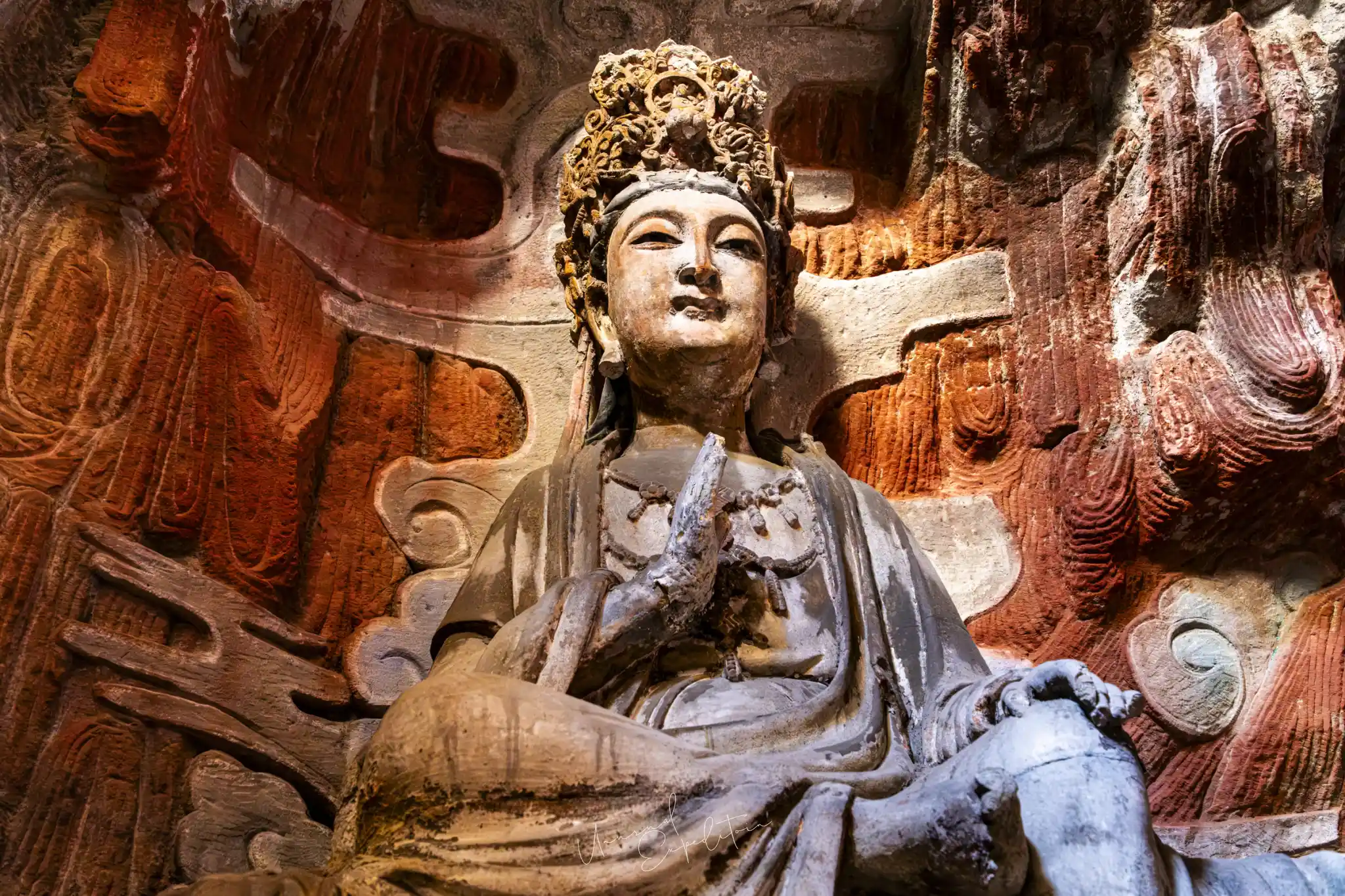
UNESCO describes the Dazu Rock Carvings as a series of cliff sculptures notable for their quality, their range of subjects drawn from secular life as well as religion, and the way they bring together Buddhism, Taoism and Confucianism. The World Heritage property covers five sites in Dazu District: Beishan, Baodingshan, Nanshan, Shizhuanshan and Shimenshan. Beishan holds the older carvings, begun in the late ninth century. Baodingshan was carved in the twelfth and thirteenth centuries under the monk Zhao Zhifeng, according to the Chongqing government, and was planned as a single great teaching site, which is why its scenes run on one after another around a horseshoe-shaped valley.
Baodingshan: the Thousand-Armed Guanyin
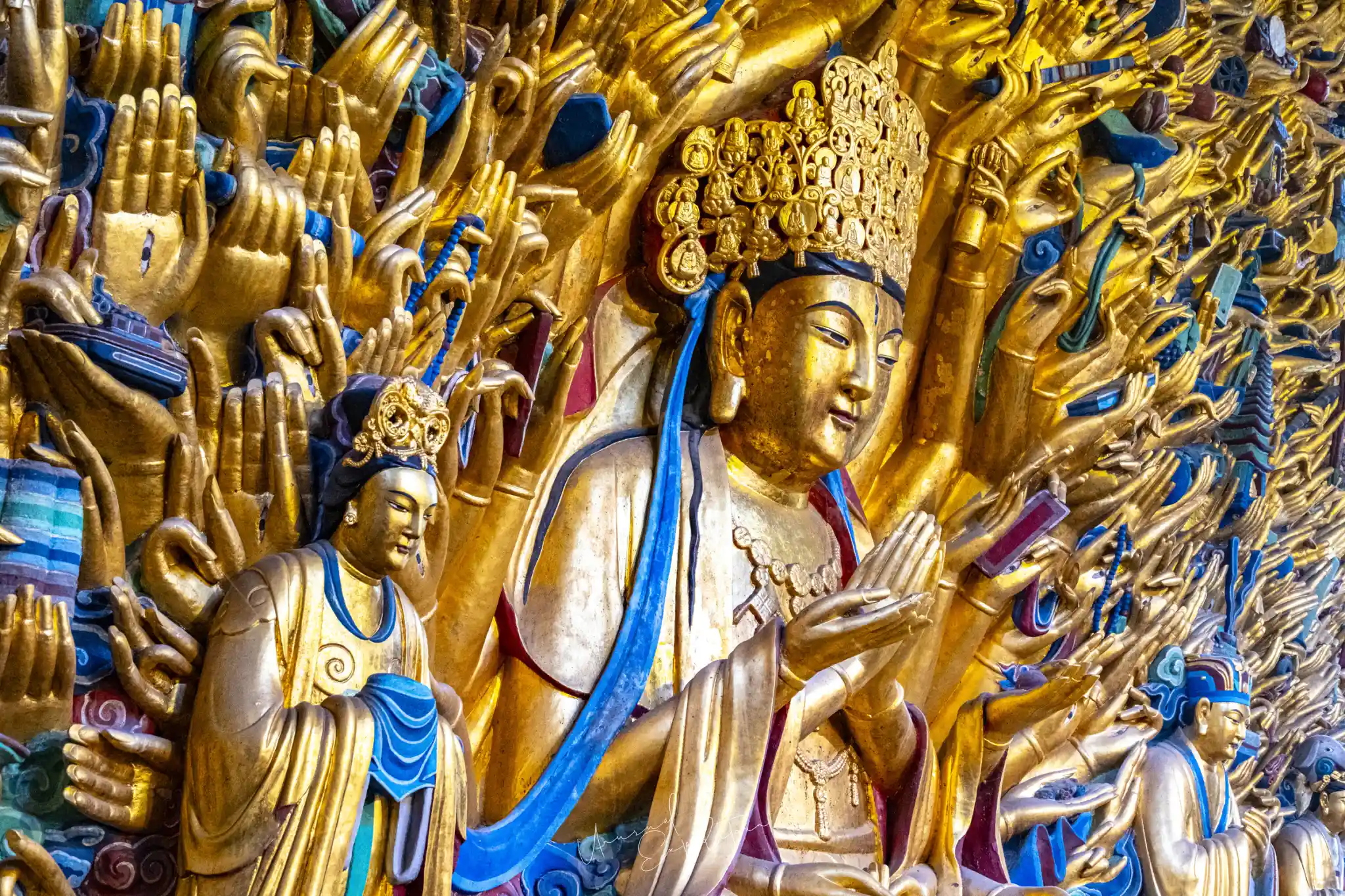
The Thousand-Armed Guanyin is the most famous single work at Dazu: a seated bodhisattva surrounded by a fan of gilded hands spreading across the rock face, each hand with an eye or holding an object. The Chongqing government counts 1,007 arms. It sits under a protective roof and was restored over several years to repair the gold. Lighting is controlled and the space in front is narrow, so arrive at opening time to stand close, use a 24-70mm for the whole fan and a longer lens for single hands and faces. Flash is not allowed, and you should not need it.
The reclining Buddha and the Wheel of Rebirth
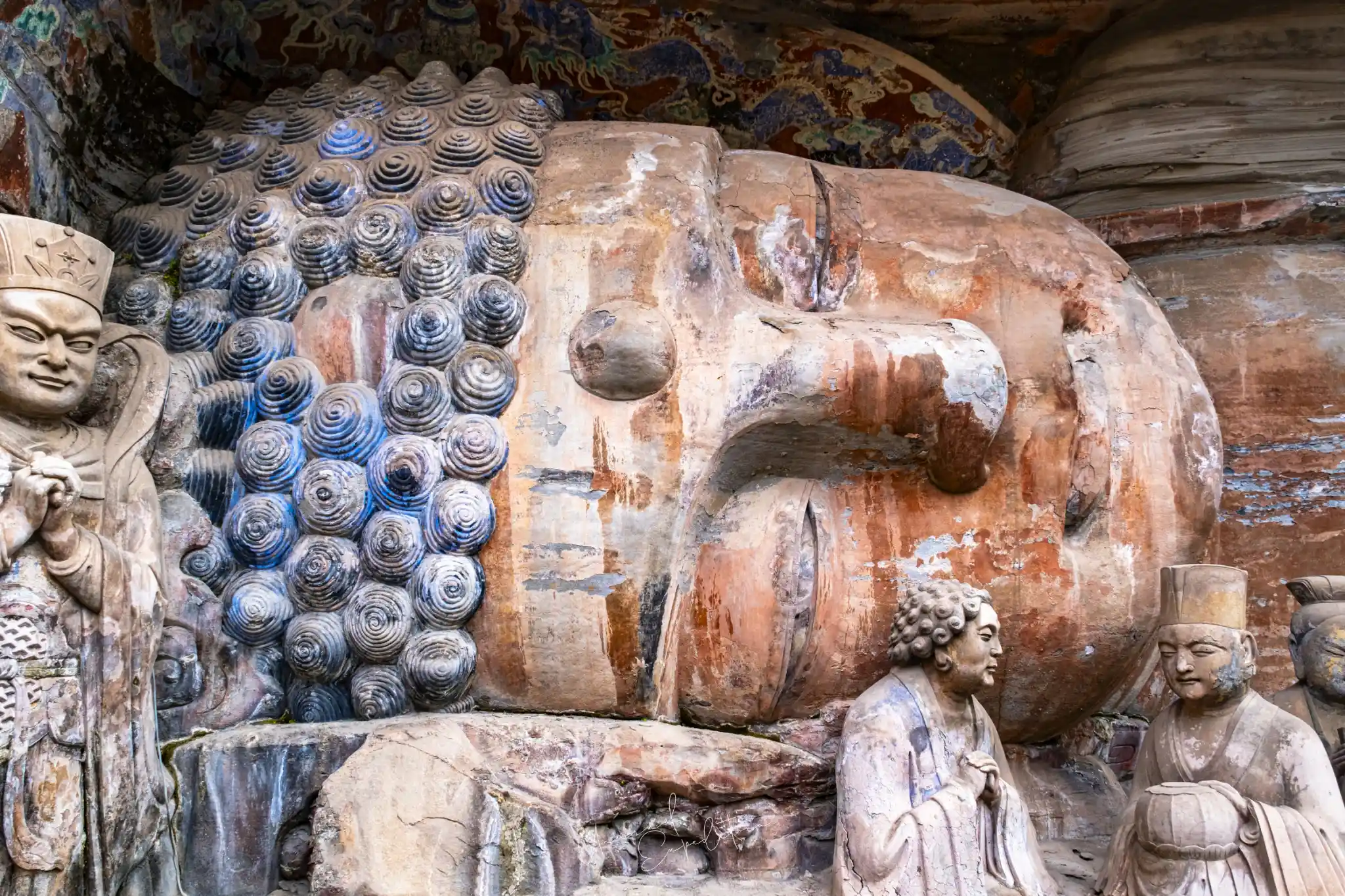
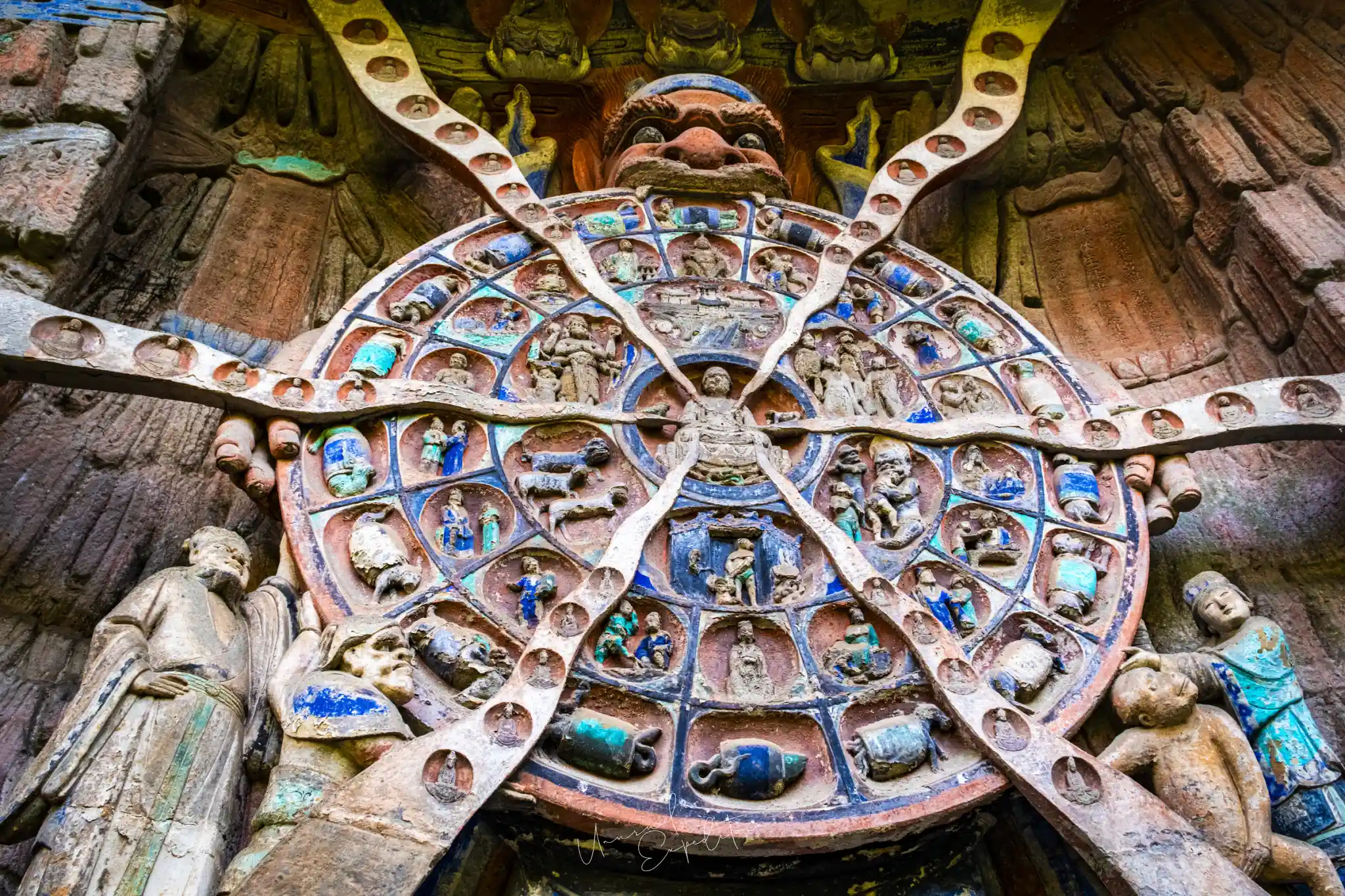
Along the cliff at Baodingshan, the reclining Buddha, showing the Buddha's passing into nirvana, is so large that only the upper body is carved, and the rest disappears into the rock. Disciples stand in a row in front of it, half its height. Further along, the Wheel of Rebirth is a great carved wheel held in the jaws and claws of a demon figure, with the six realms of existence carved in its sections. Both are big subjects in a confined space: step back as far as the walkway allows, keep verticals straight, and then move in for details, a face, a hand, a fold of robe.
Dazu Rock Carvings photography tips
The carvings are in sandstone, coloured with old pigments that have faded to soft reds, greens and blues. Overcast days or the open shade under the cliff give the best colour; harsh sun makes deep shadows across the faces. White balance matters, because warm sandstone and cool shade can fight in the same frame. Shoot raw and correct later. Keep ISO moderate and use a fast lens rather than a tripod, which is usually not practical on the narrow, busy walkways.
| Subject | Lens | Approach |
|---|---|---|
| Thousand-Armed Guanyin | 24-70mm, then 70-200mm | Arrive at opening, no flash |
| Reclining Buddha | 16-35mm | Step back, keep the disciples in line |
| Wheel of Rebirth | 24-70mm | Square on, straight verticals |
| Faces and details | 70-200mm or 85mm | Find the eyes and hands |
| Small niches at Beishan | 35mm or 50mm fast prime | Work in the shade |
Most frames at Dazu are about detail, so the longer lens earns its place even on a site of giant carvings.
People come for the Guanyin and leave after ten minutes. Stay for the small scenes along the cliff: a herdsman with his ox, a mother with her child. Somebody carved those faces eight hundred years ago, and they still look like people you know.
Joseph Mak, tour leader, Unusual Expedition
Beishan and the quieter sites
Beishan, closer to Dazu town, has hundreds of niches of smaller, finer carvings, and far fewer visitors than Baodingshan. It is the better place to slow down with a fast prime and work on individual figures. The smaller sites are quieter still. If you have the time, pair Baodingshan in the morning with Beishan in the afternoon.
How to get to Dazu from Chongqing
Dazu District lies to the west of central Chongqing, within the municipality, and most visitors go by road, either with a driver or on an organised day trip. There are also rail and bus connections to Dazu town; check current options before you go, because services change. Baodingshan lies outside Dazu town, so plan local transport from the town to the site as well. A driver makes it easier to combine Baodingshan and Beishan in one day and to arrive at opening time, which matters at the Thousand-Armed Guanyin.
Photography etiquette at Dazu
Dazu is a religious site as well as a museum. Some visitors come to pray, and incense is burned at several shrines. Keep your voice down, do not climb on railings or rocks for a better angle, and never touch the carvings: the painted surfaces are fragile and centuries old. Follow the site's rules on flash, tripods and drones, which are controlled. In narrow galleries, take your picture and move on so others can see. Patience usually pays: groups move in waves, and a minute after a tour party leaves you often have the gallery almost to yourself.
Is Dazu worth it from Chongqing?
For anyone interested in Buddhist art or simply in great sculpture, yes. It is a full day out from central Chongqing by road, and the contrast with the neon city is part of the appeal. Go on a weekday, outside the national holidays, and give yourself time at Baodingshan. Check opening hours and ticket arrangements before you go. Back in town, our Chongqing photo spots and Chongqing night photography guides take over.
See Dazu with us
We add Dazu to private Chongqing trips for small groups. Ask us about dates, and see scheduled departures on our China photography tours page.
Join the Chongqing photography tour
Inner Mongolia Winter Owl Photo Tour – China departs 01 Jan 2027 To 04 Jan 2027, led by Joseph Mak. Small group, photography first. All Chongqing photography tours.
Explore Chongqing in depth
- Chongqing Photography Tour: The Complete Guide to the Mountain CityChina
- Chongqing Photo Spots: Liziba, the Cableway, Viewpoints and ZhongshugeChina
- Chongqing Night Photography: Hongyadong, Qiansimen Bridge and the SkylineChina
- Best Time for Chongqing Photography: Fog, Clear Skies and Summer HeatChina
Upcoming Photo Tours
- Egypt Photo Tour – EgyptEgypt 12 Dec 2026 To 20 Dec 2026
- Inner Mongolia Winter Owl Photo Tour – ChinaChina 01 Jan 2027 To 04 Jan 2027
- Inner Mongolia Winter Photo Tour – ChinaChina 05 Jan 2027 To 11 Jan 2027
- Mekong And Central Highland Vietnam Photo Tour - VietnamVietnam 16 Jan 2027 To 24 Jan 2027