
Altai Mountains, Mongolia: Photographing the Far West in Winter
Altai mountains, Mongolia: is Mongolia mountainous, horse herds below the peaks, frozen rivers and the far west in winter.
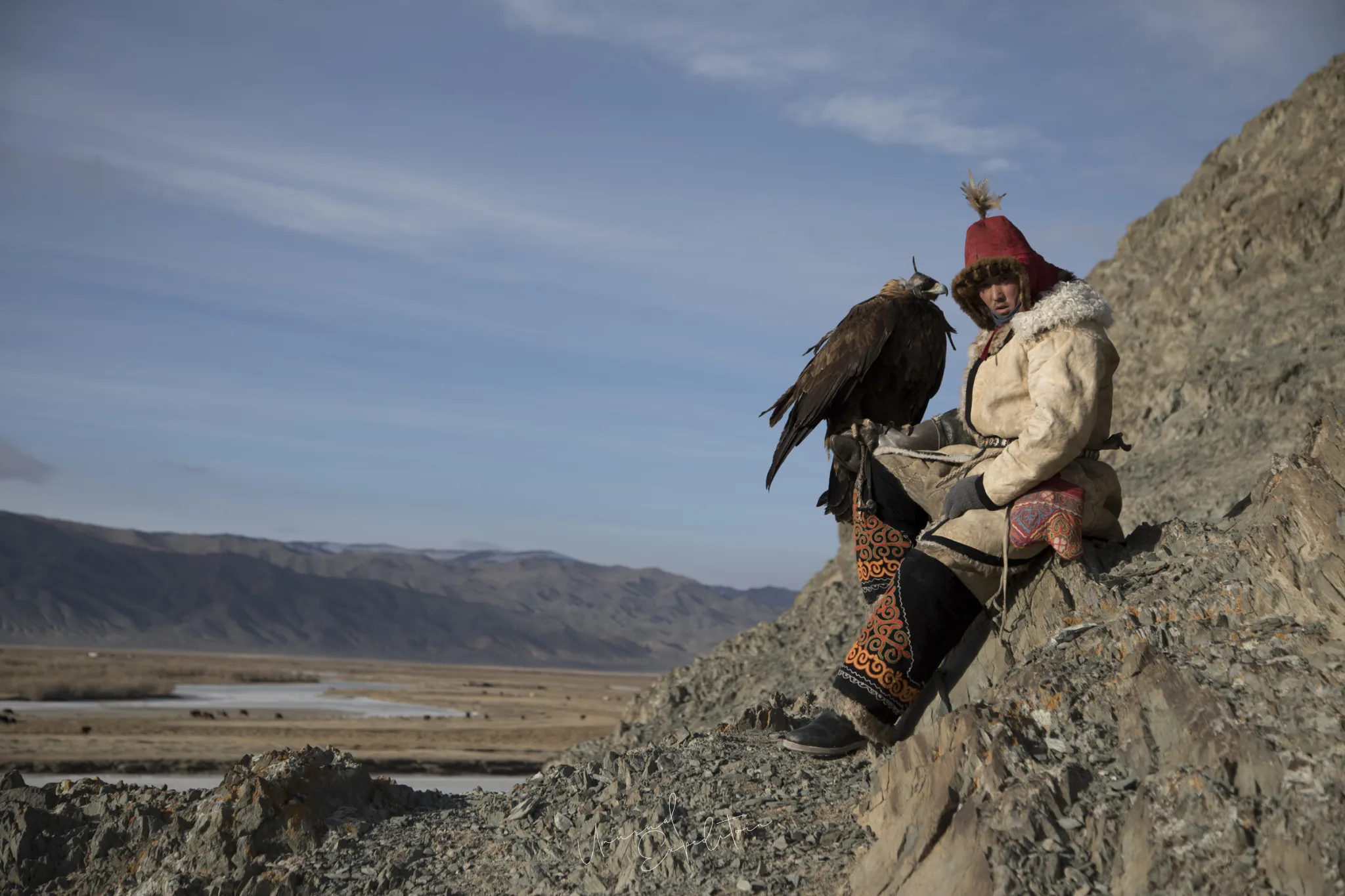
The Altai mountains of Mongolia fill the far west of the country, along the borders with China and Russia, and Bayan-Olgii lies at their feet. In winter they give you bare brown slopes, snow on the ridges, wide valleys with braided rivers frozen to blue ice, and horse herds raising dust on the plains. Mongolia's highest peak, Khüiten, stands in the Tavan Bogd massif of the Altai. For a photographer this is the backdrop to the eagle hunters and a subject in its own right.
This article is part of our Bayan-Olgii photography tour guide. It covers the landscape side of the far west: the mountains, the rivers, the herds and the light.
Is Mongolia mountainous?
More than most people expect. Britannica describes Mongolia as largely a plateau, with an average elevation of about 1,580 metres, and the west and north are ringed by real mountain ranges. The Altai are the highest. They run from the far west of Bayan-Olgii south-east towards the Gobi, and their highest point, Khüiten Peak, which Britannica gives as 4,374 metres, sits on the border between Bayan-Olgii and China in the Tavan Bogd massif. The central steppe has rolling hills and granite outcrops, and the Gobi in the south is desert and dry ranges. So a truer image of Mongolia is not a flat grassland but a high country of hills and mountains, with the flattest ground in the valleys between them.
The Altai in Bayan-Olgii: what the landscape looks like
Around Bayan-Olgii the valleys are wide and stony, with little grass by early winter, and the slopes above are brown, grey and rust, streaked with scree. Snow lies on the higher ridges and in the shadows, and the peaks in the distance are white. Rivers spread across the valley floors in many channels, and when they freeze they become sheets of blue and white ice with cracks and bubbles in them. Trees grow along some rivers, bare and pale in winter. There is very little that is man-made: a winter house, a stone corral, a track. That emptiness is what makes the hunters and their horses stand out so strongly against it.
Nature Mongolia photo ideas in the far west
| Subject | Where | Best light | Lens |
|---|---|---|---|
| Horse herds below the mountains | Open plains in the valleys | Late afternoon and sunset | 70-200mm to stack the herd against the peaks |
| Herds on the slopes from above | Ridges overlooking a valley | Soft light, overcast or low sun | 100-400mm for patterns |
| Frozen rivers and ice cracks | River flats | Dawn, blue hour | 16-35mm close to the ice |
| Riders and dust | Dry plains | Backlight, low sun | 70-200mm or a panorama |
| Hunters on the rocks | Steep slopes above the river | Side light | 24-70mm with the valley behind |
Landscapes here are about scale, so always look for something living to give the eye a measure.
Horse herds on the plains
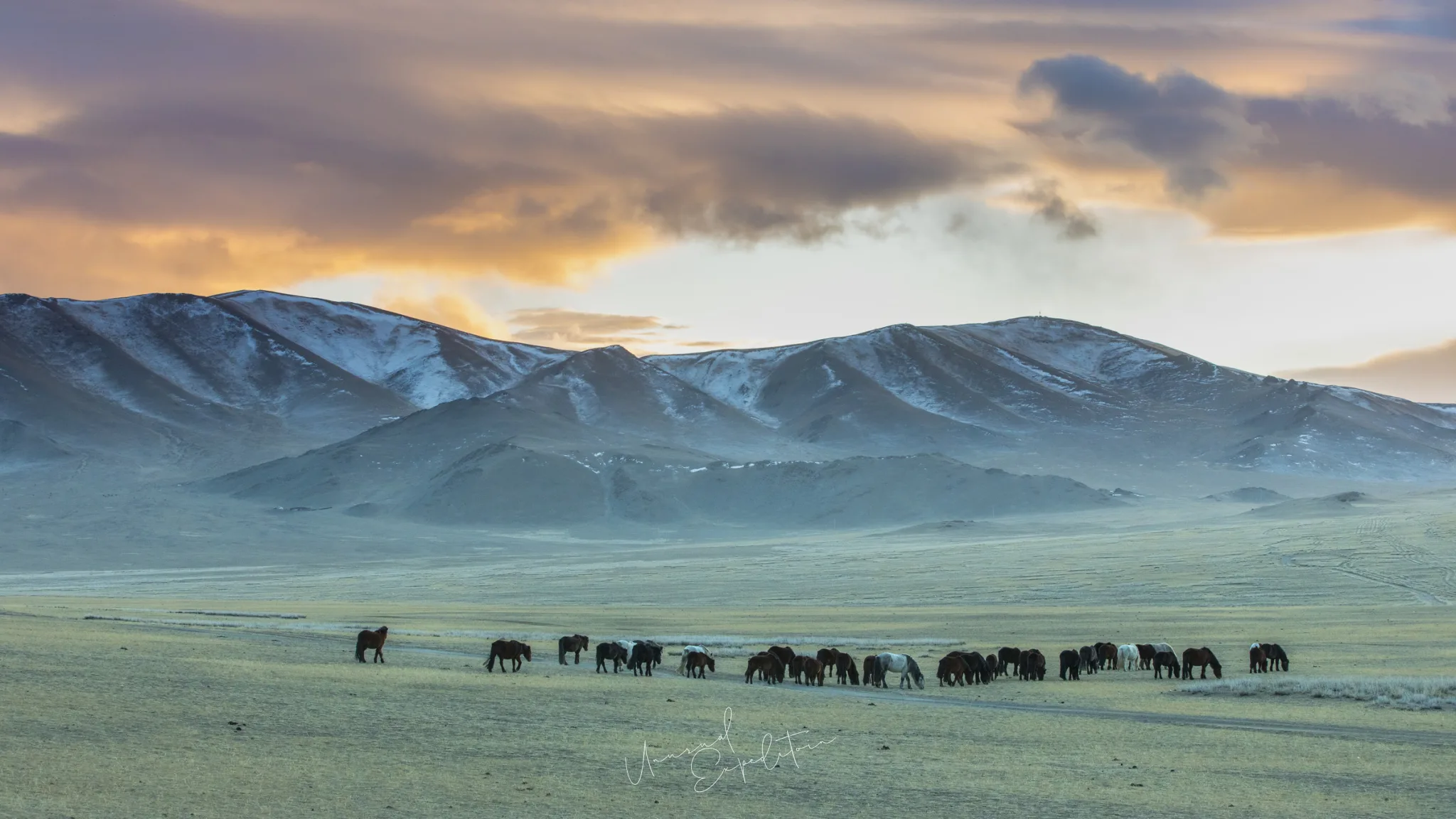
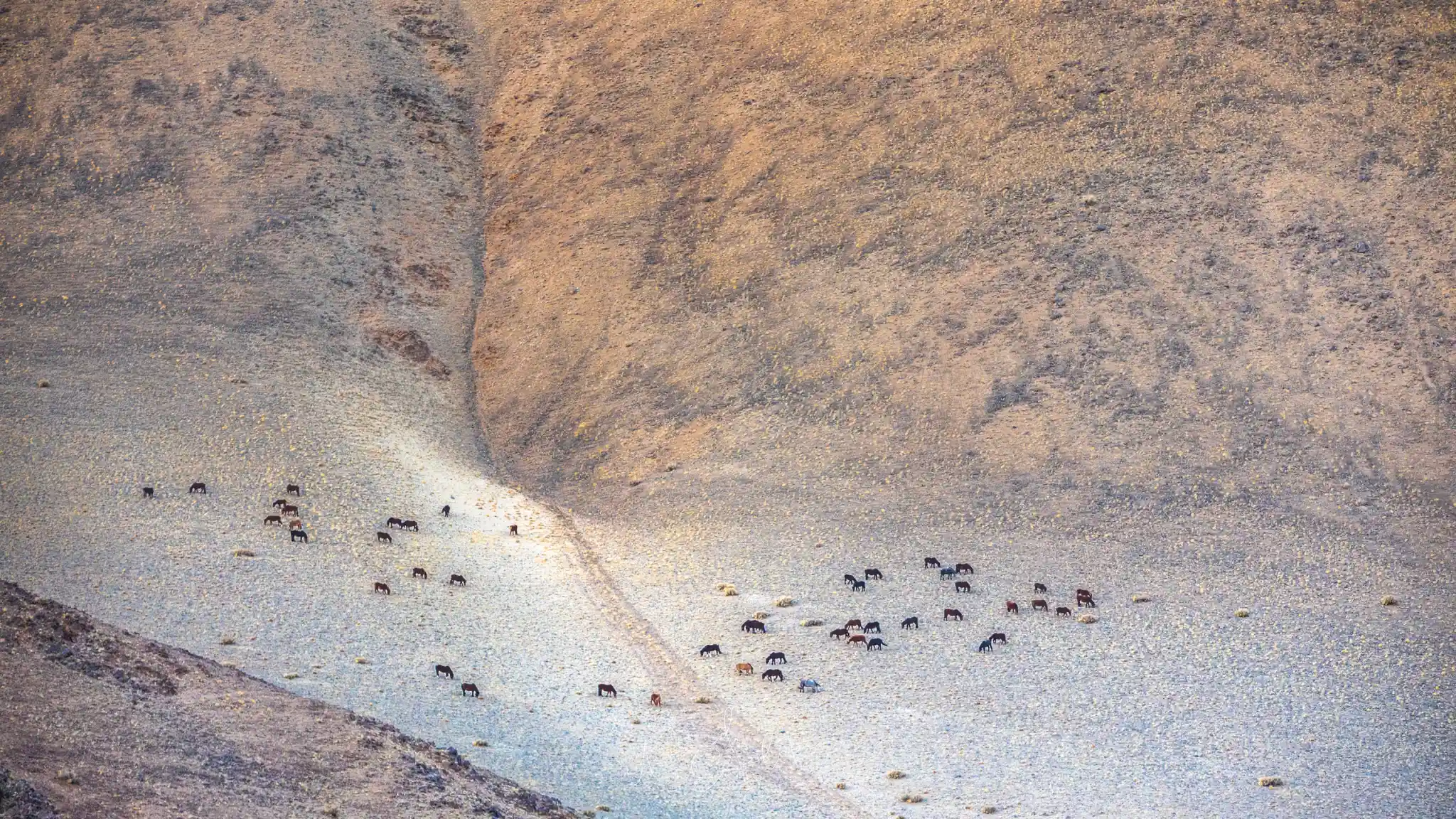
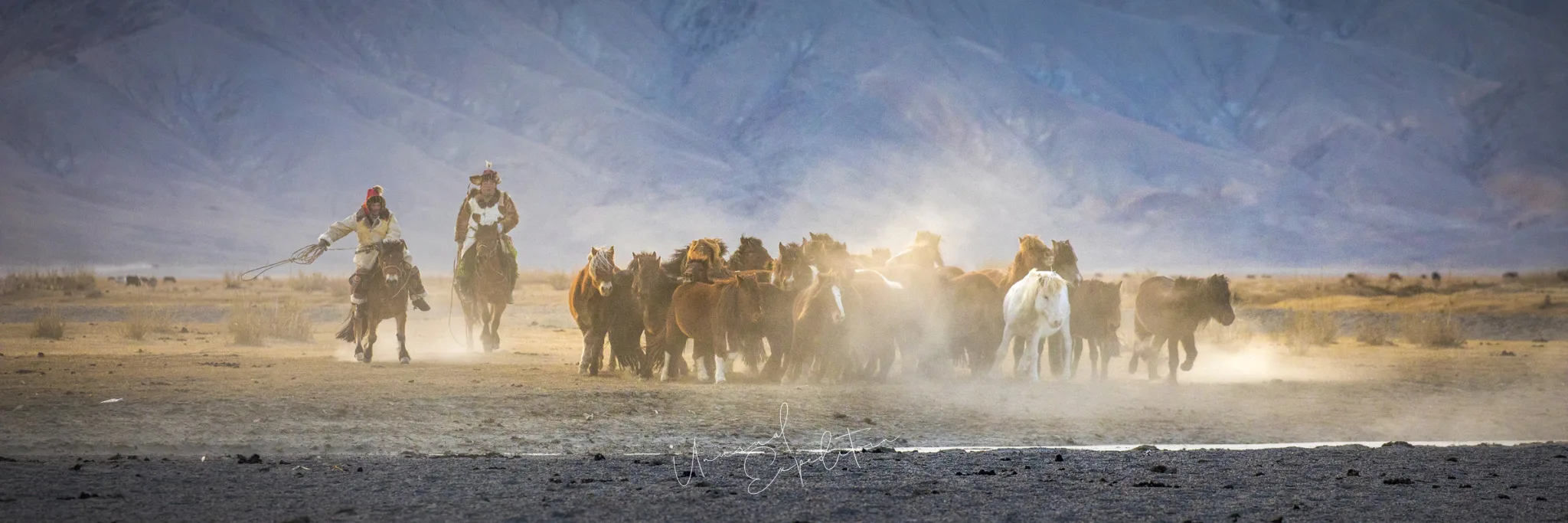
Horses are everywhere in the Altai, grazing loose in herds on the plains and the slopes. With a long lens from a little height, a herd strung out across the valley below snowy mountains is one of the classic frames of the far west, and at sunset the sky above the peaks can turn gold and violet. From a ridge, a 100-400mm finds patterns: dark horses scattered across a pale slope like marks on paper. When riders move a herd across dry ground, the dust catches the low sun, and a panorama is the natural format.
Mongolia alpine wildlife
The high Altai are home to wild sheep, ibex and snow leopards, according to Wikipedia's entry on Bayan-Olgii, and golden eagles hunt over the slopes. We did not photograph the mountain wildlife on our winter trip; our frames are of the people, their animals and the land. If wildlife is your aim, plan a separate trip with a specialist and a long stay in the high mountains. For wildlife on the central steppe, see Mongolia wildlife in our central Mongolia guides.
"In the Altai the land is so big that a big herd of horses looks like a scattering of seeds. I spent a whole evening just watching a herd cross the valley under the mountains while the sky changed colour."
Joseph Mak, tour leader, Unusual Expedition
Frozen rivers in early winter
In early winter the rivers of the far west freeze from the edges inward, and the ice holds patterns that change every day: cracks running in straight lines, white bubbles trapped under clear blue ice, snow drifting across the surface. Get down low with a 16-35mm and use the cracks as leading lines towards the hills. Dawn and blue hour give the ice its colour. Never walk on river ice unless a local tells you it is safe, and stay off it near open water. The hunters ride across frozen rivers, but they know which ones hold.
Hunters in the landscape
The strongest Altai frames often have a person in them. A hunter sitting on a steep rocky slope with his eagle beside him, the valley and its frozen river spread out below, says more about the place than an empty view. Ask the hunter to sit where he would wait for a fox, then step back and to the side until the valley opens up behind him. A 24-70mm keeps him large enough to read while showing the drop below. The same idea works with riders crossing a plain under the peaks, or a single horse on a ridge. For the hunters themselves, see Kazakh eagle hunters.
Weather and safety in the mountains
The Altai are colder and windier than the central steppe, and the weather changes quickly. Travel with a local driver in a vehicle that can handle rough tracks, carry warm clothes even for a short drive, and expect no phone signal in many valleys; the Singapore MFA notes that coverage may be limited in parts of Mongolia. Bayan-Olgii is an hour behind Ulaanbaatar, which matters when you plan around sunrise. Clothing advice is in Mongolian winter clothing, and the logistics in Mongolia eagle hunting tour.
Photograph the Altai with us
We run Bayan-Olgii as a private trip on request, with time for the landscapes as well as the eagle hunters. See private tours and the Mongolia photography tours page.
Bayan-Olgii photography tours
The next Bayan-Olgii departure is announced on the Bayan-Olgii photography tours page, with previous expeditions and all the planning guides.
Explore Bayan-Olgii in depth
- Bayan-Olgii Photography Tour Guide: Eagle Hunters of the Mongolian AltaiMongolia
- Mongolian Winter Clothing: The Eagle Hunters' Furs, Hats and CoatsMongolia
- Mongolian Eagle Hunters: What You Photograph in Bayan-OlgiiMongolia
- Mongolia Eagle Hunting Tour: Getting to Bayan-Olgii and Planning the TripMongolia
- Kazakh Eagle Hunters: Homes, Herds and Families in Western MongoliaMongolia
- Hunting with Golden Eagles in Mongolia: Photographing the FlightMongolia
- Golden Eagle Festival Mongolia or a Winter Hunt: Which to PhotographMongolia
Upcoming Photo Tours
- Egypt Photo Tour – EgyptEgypt 12 Dec 2026 To 20 Dec 2026
- Inner Mongolia Winter Owl Photo Tour – ChinaChina 01 Jan 2027 To 04 Jan 2027
- Inner Mongolia Winter Photo Tour – ChinaChina 05 Jan 2027 To 11 Jan 2027
- Mekong And Central Highland Vietnam Photo Tour - VietnamVietnam 16 Jan 2027 To 24 Jan 2027