
Amman Citadel: Temple of Hercules, the Hand and the Sunset View
Amman Citadel facts and photography: the Temple of Hercules at sunset, the Hand of Hercules and the view down to the Roman Theatre.
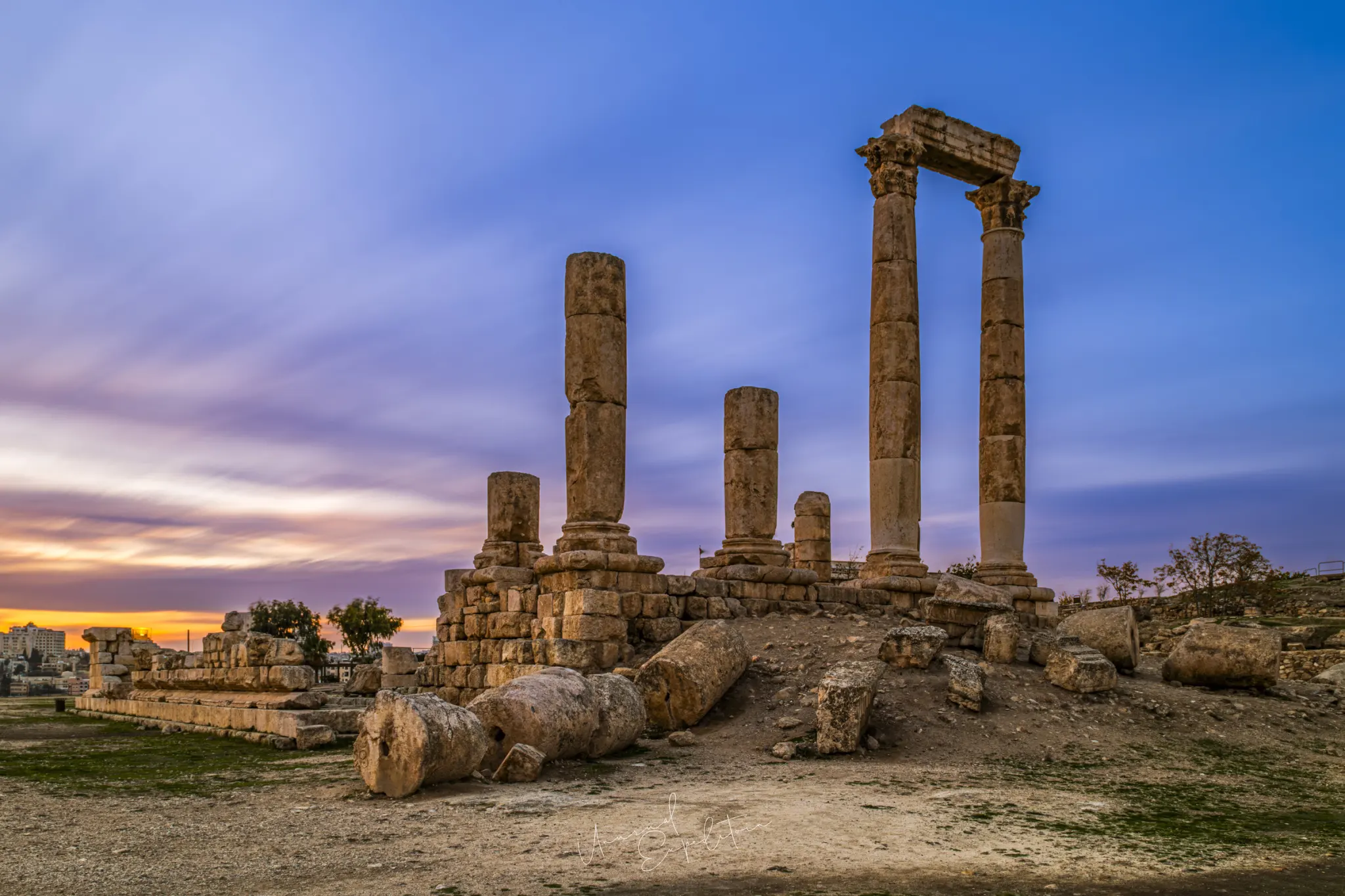
The Amman Citadel, Jabal al-Qal'a, is the hill at the centre of old Amman where people have built for thousands of years. Today it holds the columns of the Roman Temple of Hercules, the fingers of a colossal statue, the domed hall of an eighth century Umayyad palace and a small museum, with the whole city spread around it. For photographers it is the sunset viewpoint of Amman: the temple against the western sky, then the lights of the city and the Roman Theatre below.
The Citadel is one of the places covered in our Amman and Jerash photography tour guide, which links the rest of the area.
Amman Citadel: what you see on the hill
The Amman Citadel is a long hilltop ringed by remains of old walls, and its sites sit close together. At the southern end stands the Temple of Hercules, its tall columns raised on a high stone platform. Nearby lie the Hand of Hercules fragments, a Byzantine church, a small archaeological museum and, further north, the Umayyad Palace with its rebuilt domed entrance hall and a large cistern. The ground between is uneven, scattered with column drums and carved blocks, and the edges of the hill drop steeply to the city on three sides. From the southern edge you look straight down onto the Roman Theatre and the downtown streets. The Citadel is included in the Jordan Pass, which most visitors buy before they arrive.
Amman citadel facts
A few Amman citadel facts help you read what you are photographing. The Temple of Hercules dates from the reign of Marcus Aurelius in the second century, when Amman was the Roman city of Philadelphia; an inscription names the Roman governor of the time, and the link with Hercules comes from the city's coins, not from the temple itself. Of the colossal statue that probably stood near it, only three fingers and an elbow survive, which gives a sense of its size. The Umayyad Palace was built in the first half of the eighth century, during the Umayyad caliphate, and its domed hall was restored in modern times. Sources on these dates include the Columbia University architecture image archive and Lonely Planet's entry for the Citadel.
Photographing the Temple of Hercules at sunset
From much of the hilltop the sun sets behind the Temple of Hercules, which makes it the main sunset subject in Amman. Two approaches work. For a silhouette, walk round to the east of the columns, get low and put the sun between two of them; at a small aperture such as f/16 the sun turns into a star. For warm stone, stand with the sun behind you in the last hour before sunset, when the columns turn honey and orange against a deep blue sky. After the sun has gone, the sky behind the temple often glows pink and violet for a few minutes, and a longer exposure on a tripod can turn moving clouds into soft streaks above the columns.
Citadel of Amman: the Hand of Hercules
The Hand of Hercules is the strangest picture on the Citadel of Amman. Three giant stone fingers, still joined at the knuckles, rest near the temple, and the elbow of the same statue survives too. Photographed from low down with a 16-35mm, the fingers fill the foreground and the standing columns rise behind them, a picture that explains the scale of the lost statue better than any caption. The fragments are on a low base and visitors queue to pose with them, so arrive early or wait for a gap.
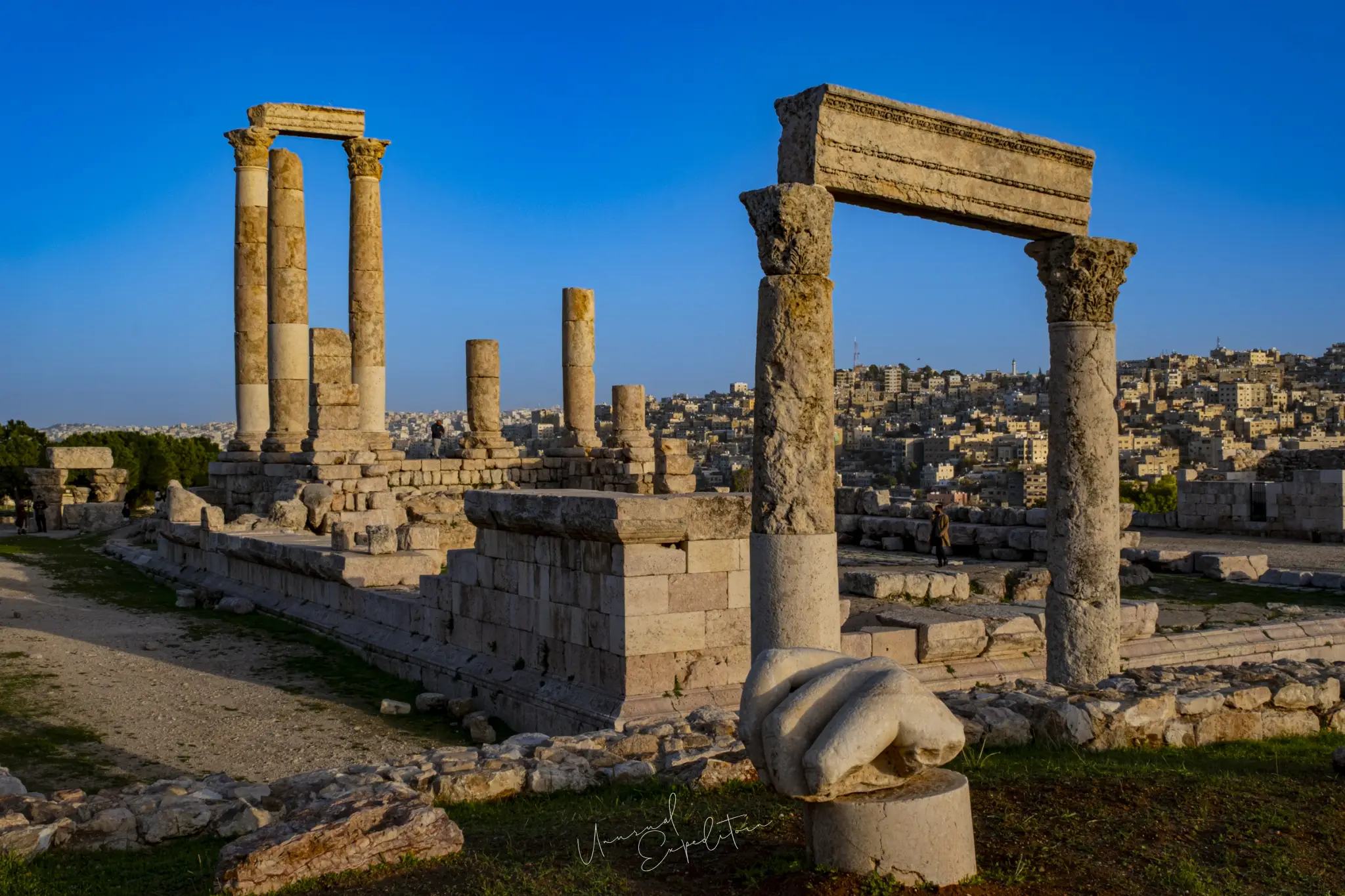
"Everyone photographs the columns. I always walk people over to the hand first, because once you have seen how big those fingers are, you look at the whole hill differently."
Joseph Mak, tour leader, Unusual Expedition
The view from the Citadel over Amman
The view from the Citadel is as important as the ruins. From the southern edge the city spreads over the hills on every side, and directly below lies the Roman Theatre in its hollow. Around sunset the houses on the facing hill catch the last light; a few minutes later the theatre's floodlights come on and the streets fill with car lights. A 70-200mm compresses the theatre and the hills into a dense, layered picture; a 24-70mm takes in the wider valley. Our Roman Theatre in Amman article covers the theatre from closer viewpoints, and our Amman photos article shows more of the city at this hour.
When to visit the Amman Citadel
| Time of day | What it gives | Lens |
|---|---|---|
| Morning | Quiet site, soft light on the Umayyad Palace and the museum | 24-70mm |
| Late afternoon | Warm stone on the temple, deep blue sky | 16-35mm |
| Sunset | Sunstar between the columns, coloured sky | 16-35mm, small aperture |
| After sunset | City lights and the floodlit theatre below | 70-200mm on a tripod |
The site closes around sunset or soon after, depending on the season, so check the current opening times on the day and plan to finish the city view from the edge before the gates shut.
Practical notes for the Citadel
The Citadel stands on one of the highest hills in central Amman, and the climb up from downtown on foot is steep, with many steps; most visitors take a taxi to the gate and walk down afterwards. The ground is uneven, so wear proper shoes, especially if you will be walking in the dusk. Bring a layer in winter: the hilltop is exposed and cold once the sun has gone. Tripods are generally fine on the open ground. The museum and the Umayyad Palace hall give shade and a quieter half hour while you wait for the light to warm. For the season and the light by month, see best time to visit Amman.
Watch the sun set on the Citadel with us
We run Amman and Jerash as a private trip on request, timed around the light. Read how private tours work and see the Jordan photography tours page.
Ask us about the Amman Citadel
Amman and Jerash photography tours
The next Amman and Jerash departure is announced on the Amman and Jerash photography tours page, with previous expeditions and all the planning guides.
Explore Amman and Jerash in depth
- Amman and Jerash Photography Tour Guide: the Citadel, the Roman Theatre and JerashJordan
- Roman Theatre Amman: Photographing It by Day and at Blue HourJordan
- Jerash Roman Ruins: What to Photograph and Where to StandJordan
- Downtown Amman: Souqs, Street Portraits and the Streets at NightJordan
- Day Trip to Jerash from Amman: Getting There and Timing the LightJordan
- Best Time to Visit Amman, Jordan, for Photography: Weather by MonthJordan
- Amman Photos: What the City Really Looks Like, Day and NightJordan
Upcoming Photo Tours
- Egypt Photo Tour – EgyptEgypt 12 Dec 2026 To 20 Dec 2026
- Inner Mongolia Winter Owl Photo Tour – ChinaChina 01 Jan 2027 To 04 Jan 2027
- Inner Mongolia Winter Photo Tour – ChinaChina 05 Jan 2027 To 11 Jan 2027
- Mekong And Central Highland Vietnam Photo Tour - VietnamVietnam 16 Jan 2027 To 24 Jan 2027