
Bayan-Olgii Province Photo Spots: Where to Stand in Western Mongolia
Bayan-Olgii province photo spots: release ridges, valley floors, herds below the Altai, frozen rivers, corrals and the Olgii festival.
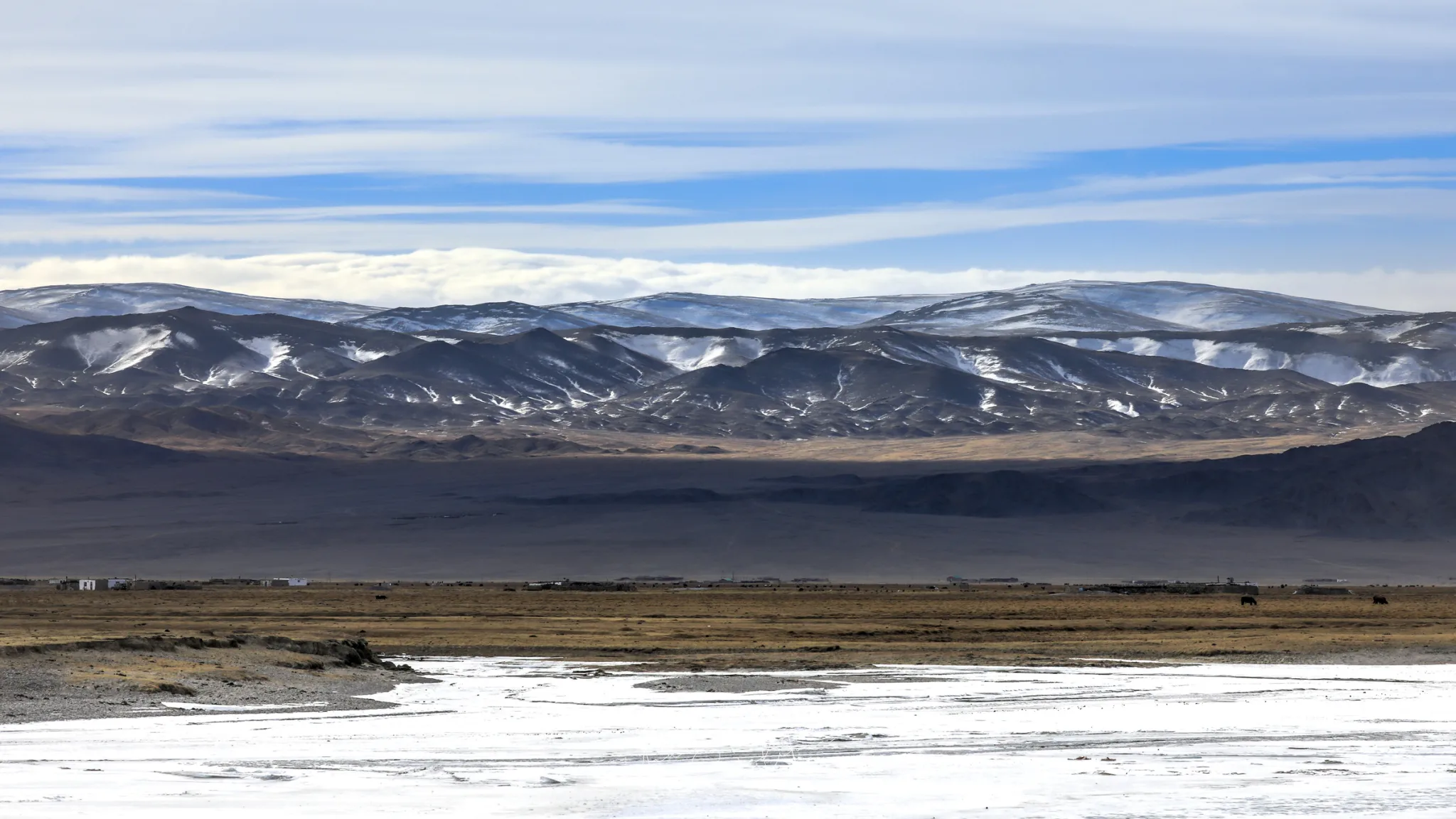
Bayan-Olgii province has no single famous viewpoint; its photo spots are kinds of ground. The best places to stand in western Mongolia are the rocky ridges where the Kazakh hunters release their eagles, the open valley floors where riders gallop with eagles on their arms, the plains where horse herds graze below the Altai, the frozen rivers, the winter homes and corrals, the festival ground in Olgii, and, further west, Altai Tavan Bogd National Park. Light, wind and the hunters decide which one works on a given day.
This spot guide sits under our Bayan-Olgii photography tour guide, which covers the trip as a whole. Here we stay with where to stand, which way the light falls, the lens, and the rules of each place. The spots we photographed on our early-winter trip come first; the others are described from public sources.
Photo spots in Bayan-Olgii province, western Mongolia
Bayan-Olgii is the westernmost aimag of Mongolia and the only one where Kazakhs are the majority, about nine in ten of its people according to Wikipedia. Its capital, Olgii, sits in a wide valley with the Altai running along the western edge of the province. Most of the photographs people come for are made outside town, in the valleys where the eagle hunters spend the winter. That shapes everything below: a "spot" here is usually a ridge, a plain or a riverbank that a local hunter or driver chooses on the day, not a signed viewpoint with a car park. Bayan-Olgii also runs one hour behind Ulaanbaatar, which matters when you plan around sunrise.
| Spot | What you get | Best light | Lens |
|---|---|---|---|
| Release ridges | Eagle leaving the glove, hunter against the sky | Morning, sun behind you | 24-70mm wide, 100-400mm for the flight |
| Valley floor | Riders galloping towards you with eagles | Low side light or backlit dust | 70-200mm |
| Plains below the Altai | Horse herds with mountains behind | Late afternoon | 70-200mm to stack herd and peaks |
| Frozen rivers | Ice, snow line, far ranges | Dawn and blue hour | 24-70mm |
| Winter homes and corrals | Goats, cattle, daily work | First light and dusk | 24-70mm |
| Olgii festival ground | Competitions, costume, crowds | Any, with care for the sun's angle | 70-200mm and 100-400mm |
Only the festival ground has a fixed place and a calendar; every other row depends on the family you work with.
The release ridges above the hunters' valleys
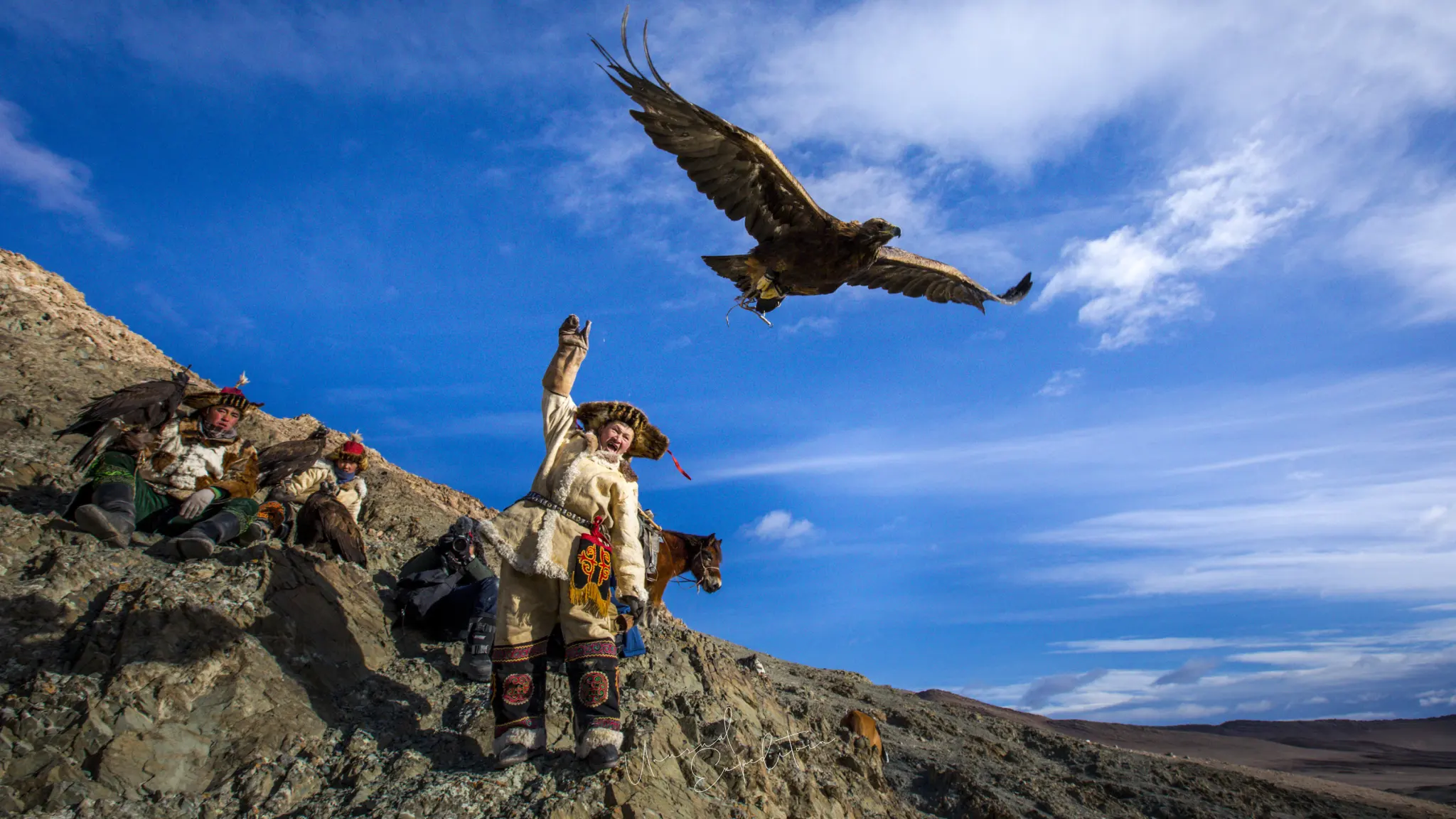
The classic Bayan-Olgii frame of an eagle leaving a hunter's arm is made on a ridge. The hunter climbs a rocky slope above the valley, unhoods the bird and releases it towards a lure dragged by a rider on the flat below. Stand a little below him and to one side, so he and the eagle sit against the sky, not the hillside. In the morning, with the sun behind you, the sky goes deep blue and the eagle's back lights up. A 24-70mm catches hunter and bird together at the moment of release; a 100-400mm follows the glide down. The ridges are steep scree, so wear boots with grip, keep your bag on your back and never step into the line of flight.
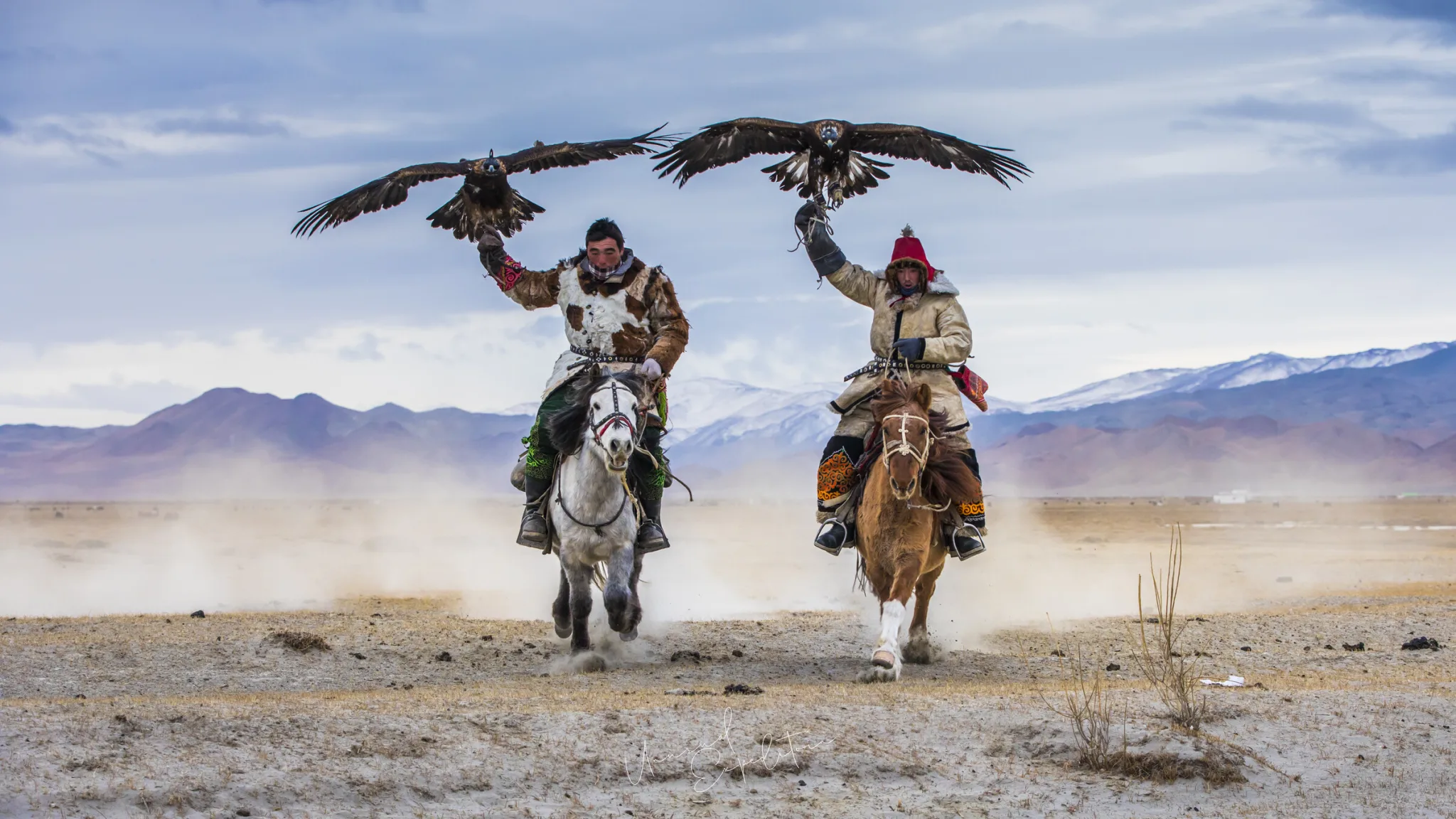
Riders on the open valley floor
Down on the valley floor the picture changes to speed. Two or three riders galloping straight at you with their eagles lifted and wings open is the frame that sells western Mongolia, and the flat stony plains give the horses room to run and the dust somewhere to go. Ask for the run to come across or towards the light, not straight out of the sun, and stand well off the line with a 70-200mm; the horses are fast and the ground is uneven. Late in the day the dust glows behind the riders, and the snowy Altai on the horizon finish the frame. For how the hunt itself works, read hunting with golden eagles in Mongolia.
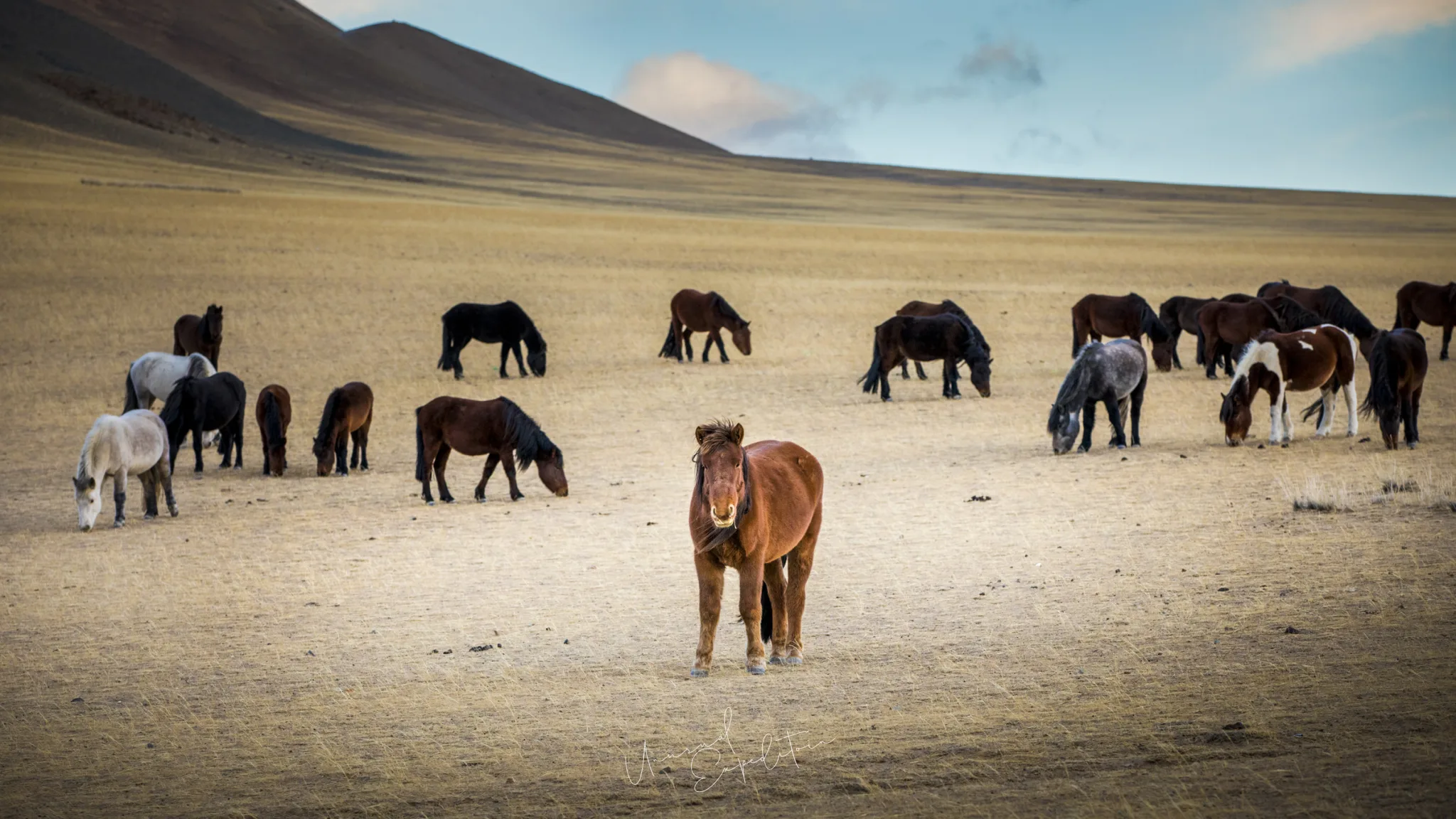
Horse herds on the plains below the Altai
Away from the hunters, the quietest photo spot in Bayan-Olgii is any open plain with a horse herd on it. The herds graze loose on pale winter grass with brown hills and the white ranges behind, and a herd strung across the frame gives the mountains their scale. A slight rise is enough height. With a 70-200mm you can compress the horses against the slopes, and if one animal turns to look at you, wait for it. The light is best late in the afternoon, when the low sun picks out manes and the hills turn warm. These are working animals that belong to families, so keep your vehicle at a distance and do not drive through a herd.
Frozen rivers and the snow line
In early winter the rivers of the far west freeze into wide sheets of white and blue, and a riverbank becomes one of the best landscape spots in the province. The flat ice gives a clean foreground, the brown valley sits in the middle, and the snow-streaked ranges of the Altai line the top of the frame. At dawn and in blue hour the ice takes the colour of the sky. A 24-70mm at the wide end is enough; get low to make the ice fill the bottom third. River ice can look solid when it is not, so stay on the bank unless a local tells you it holds. Our Altai mountains guide covers this landscape in more depth.
"In Bayan-Olgii I stopped looking for viewpoints after the first morning. The hunter picks the ridge, the eagle picks the line, and my job is to be standing in the right place before either of them moves."
Joseph Mak, tour leader, Unusual Expedition
Kazakh winter homes and corrals
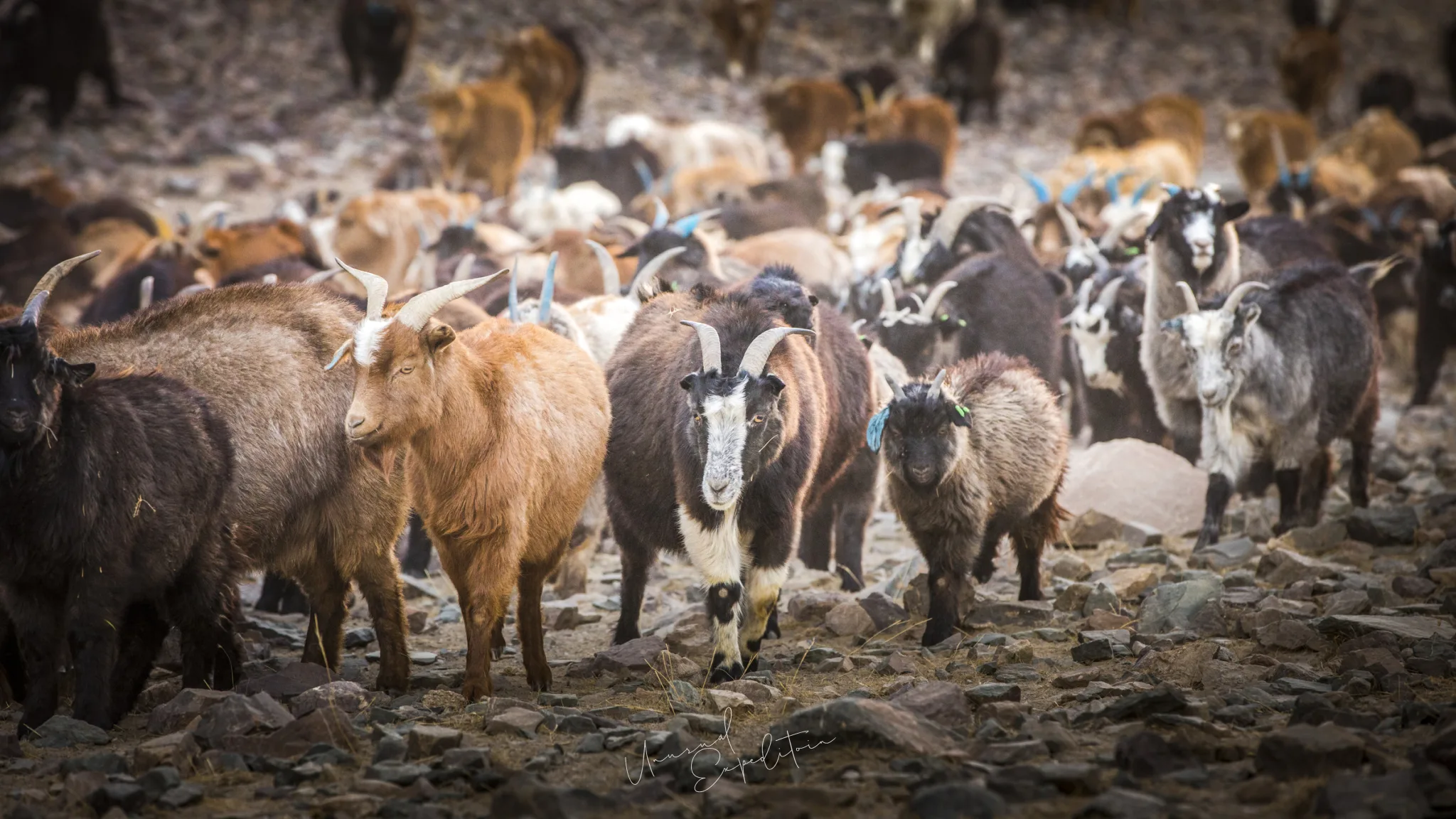
The winter homes of the hunting families are low houses with stone and wood corrals, set against a slope for shelter. At first light the goats and sheep pour out of the corral in a tight crowd, and at dusk they come back in a cloud of breath and dust. Stand by the corral gate, ask the family first, and use a 24-70mm close to the flock so the animals fill the frame. Inside the house, the light from a single window is beautiful, but it is a home: ask before every photograph, and leave the camera down at meals unless you are invited to shoot. Our Kazakh eagle hunters guide covers the families and how to photograph them with respect.
Olgii town and the Golden Eagle Festival ground
The one fixed photo spot with a calendar is the festival ground outside Olgii, where the Golden Eagle Festival is usually held on the first weekend of October; a separate Altai Kazakh Eagle Festival takes place in Sagsai in late September, and the dates change, so check them each year. The festival gives you many hunters in full costume in one place, eagle-calling competitions and horseback games. It is also crowded with cameras. Arrive early to choose your side with the sun behind you, bring a 100-400mm for the competitions, and look for portraits at the edges of the ground before and after the events. We photographed outside the festival season, so read our festival guide for the comparison.
Altai Tavan Bogd National Park
Altai Tavan Bogd National Park covers the far western tip of Bayan-Olgii, where Mongolia meets China and Russia. It holds the Tavan Bogd massif and Khüiten Peak, Mongolia's highest point, which Britannica gives as 4,374 metres, along with glaciers, lakes and summer pastures. We have not photographed the park, and it is a different trip from the eagle hunters: the access is long and rough, the season for it is summer, and because the park lies on the border, visitors need a border permit as well as a park permit. Lonely Planet says non-Mongolians must travel there with a Mongolian guide; rules change, so check with a licensed operator before you travel. For a photographer it is glacier and lake landscape with herders in summer camps, best with a wide lens and long days in the warmer months.
Plan your Bayan-Olgii photo spots with us
We run Bayan-Olgii as a private trip on request, with local hunting families and drivers who know which ridge and which river suit the light that day. See private tours and the Mongolia photography tours page.
Bayan-Olgii photography tours
The next Bayan-Olgii departure is announced on the Bayan-Olgii photography tours page, with previous expeditions and all the planning guides.
Explore Bayan-Olgii in depth
- Bayan-Olgii Photography Tour Guide: Eagle Hunters of the Mongolian AltaiMongolia
- Mongolian Winter Clothing: The Eagle Hunters' Furs, Hats and CoatsMongolia
- Mongolian Eagle Hunters: What You Photograph in Bayan-OlgiiMongolia
- Mongolia Eagle Hunting Tour: Getting to Bayan-Olgii and Planning the TripMongolia
- Kazakh Eagle Hunters: Homes, Herds and Families in Western MongoliaMongolia
- Hunting with Golden Eagles in Mongolia: Photographing the FlightMongolia
- Golden Eagle Festival Mongolia or a Winter Hunt: Which to PhotographMongolia
- Altai Mountains, Mongolia: Photographing the Far West in WinterMongolia
Upcoming Photo Tours
- Egypt Photo Tour – EgyptEgypt 12 Dec 2026 To 20 Dec 2026
- Inner Mongolia Winter Owl Photo Tour – ChinaChina 01 Jan 2027 To 04 Jan 2027
- Inner Mongolia Winter Photo Tour – ChinaChina 05 Jan 2027 To 11 Jan 2027
- Mekong And Central Highland Vietnam Photo Tour - VietnamVietnam 16 Jan 2027 To 24 Jan 2027