
Kyrgyzstan Eagle Hunter: Photographing a Berkutchi and His Golden Eagle
Eagle hunting in Kyrgyzstan: how a berkutchi demonstration runs near Issyk-Kul, where to stand, lenses and settings.
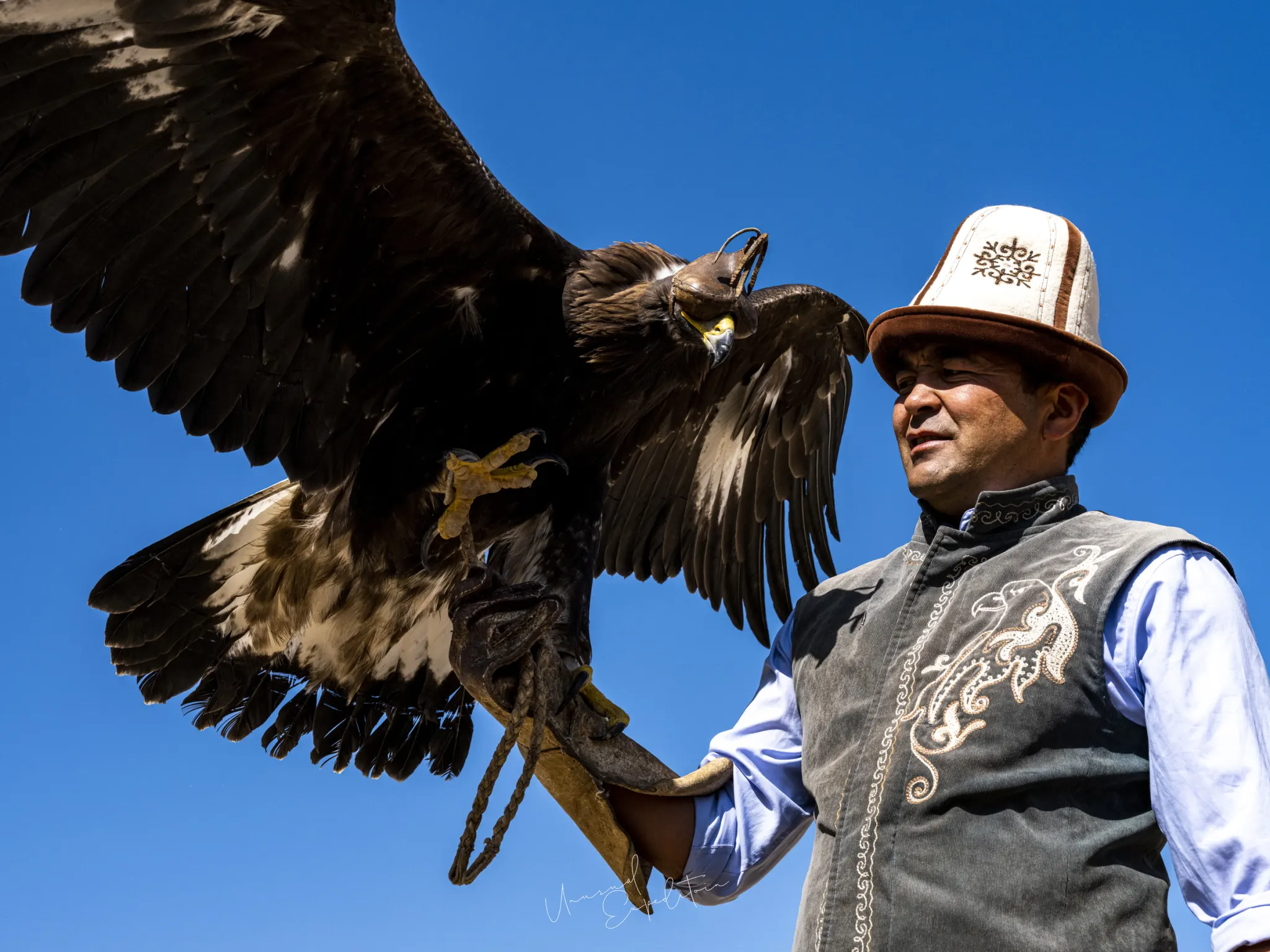
A Kyrgyzstan eagle hunter, a berkutchi, flies a golden eagle from a heavy leather glove, and photographing one is the most memorable morning you can spend near Lake Issyk-Kul. Hunters around the south shore show their birds to visitors: the eagle on the glove with its hood off, the wings opening against the sky, a flight to a lure or quarry on open ground, and close portraits of the bird. You need a 100-400mm, a 24-70mm, a low position and respect for a working bird and its trainer.
This guide belongs to our Kyrgyzstan photography tour guide, which covers the lake, Karakol and Jeti-Oguz. The photographs here are our own, taken with a berkutchi on dry ground near the lake; we hold the rights to them, and the notes below come from that morning and from what we know of the place.
Eagle hunting in Kyrgyzstan today
Hunting with golden eagles is old across the steppe and mountains of Central Asia, and Kyrgyzstan treats it as part of its national identity. In 2021 Kyrgyzstan joined UNESCO's multinational listing "Falconry, a living human heritage", alongside Kazakhstan, Mongolia and more than twenty other states. The number of men who still hunt through the winter with an eagle is small. Bradt Guides describes the practice around Bokonbaevo, on the south shore of Issyk-Kul, as fragile, kept alive by a few families who also show their birds to visitors. In summer the Salbuurun festival, reported by Euronews and the Associated Press to be held near Bokonbaevo, brings hunters together with archers and riders. For a photographer, the usual way in is a demonstration arranged through a local fixer: a hunter, his eagle, sometimes a horse, and a stretch of open ground.
Kyrgyzstan eagle hunter or Kazakh eagle hunter: what is the difference?
Both hunt with the same bird, the golden eagle, and both carry it on a thick leather glove. What changes for the camera is the setting and the season. The Kazakh eagle hunters of western Mongolia are usually photographed in winter, in fox-fur hats and long coats, on snow under the Altai; our guide to hunting with golden eagles in Mongolia covers that. A Kyrgyzstan eagle hunter is more often photographed in late summer or early autumn, in a felt kalpak hat and an embroidered waistcoat, on bare pale ground with brown hills behind. The light is harder and the sky deeper blue. That blue is the frame to plan around: shoot from low so the bird and the hat sit against it, not against the ground.
What happens at an eagle hunting demonstration
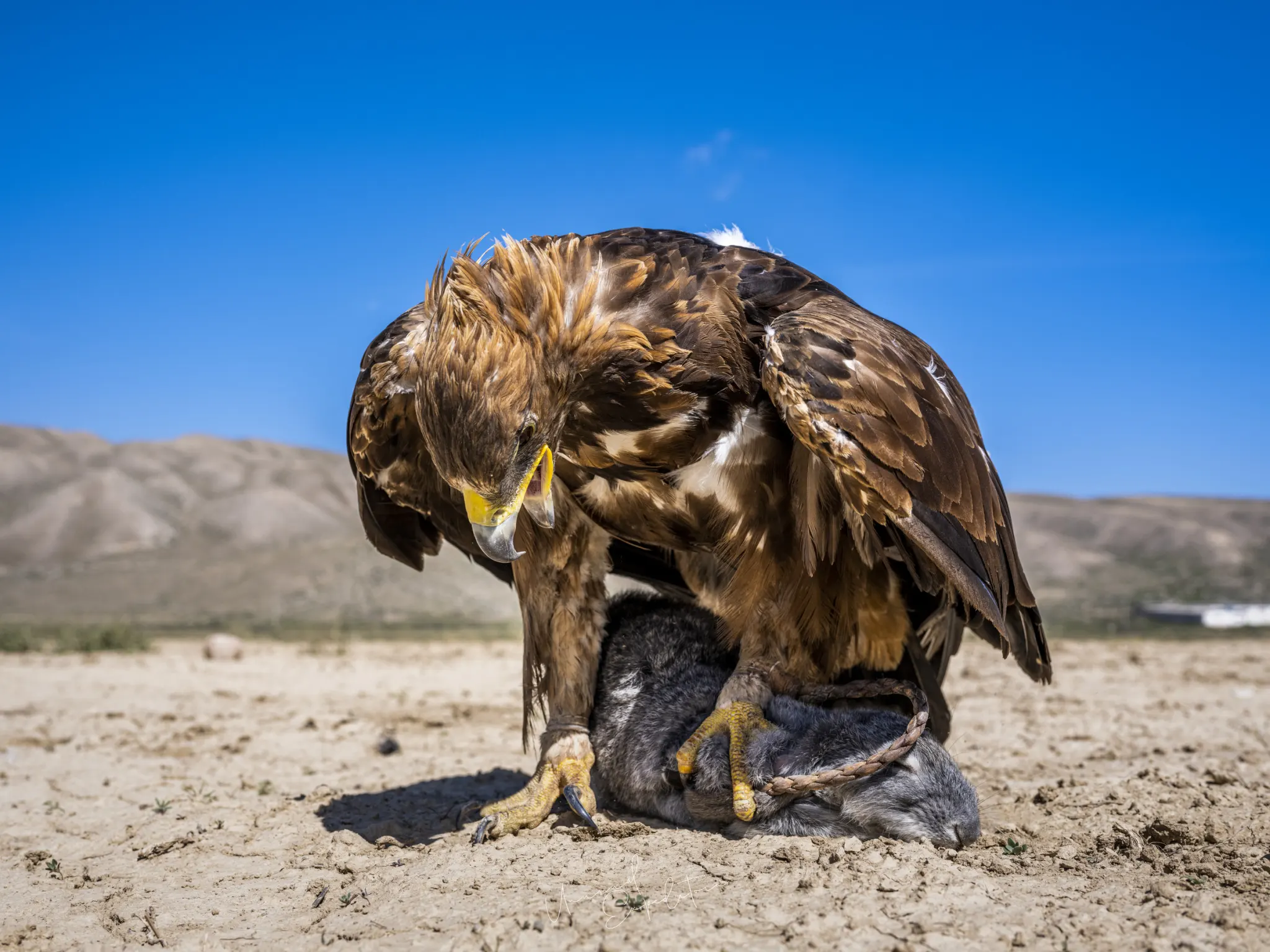
A demonstration near Issyk-Kul is short and follows the bird's pace. The hunter arrives with the eagle hooded on his arm, removes the hood, and lets it settle. Then he lifts it so it opens its wings for balance, which is when the best glove frames happen. For the flight, the eagle is carried to higher ground or held by a helper, and released towards a lure or quarry on the flat below, where it lands, covers its catch with spread wings and feeds. Some demonstrations use a skin lure and some use live quarry; ask in advance what yours will involve, and say so if you would rather not see a kill. Afterwards the hunter takes the bird back onto the glove, and there is usually time for close portraits while it calms. Pay the hunter what was agreed, and thank him: the bird is his living and his pride.
How to photograph a golden eagle on the glove
The glove frames are about wings and eyes. Kneel or sit so the camera is below the hunter's elbow; the sky becomes the background and the eagle's wings fill the frame when it opens them. A 24-70mm at the wide end, close to the hunter, gives the bird size and the man context. Use a fast shutter, at least 1/1000 of a second, and continuous focus on the eagle's head. Ask the hunter to turn so the sun is on his face and the bird's chest; a golden eagle against blue sky with the sun behind you is the classic frame. Keep a respectful distance: an eagle bates when startled, and a stranger stepping in close is the usual cause. Let the hunter decide when the bird has had enough.
| Moment | Lens | Where to stand | What to watch |
|---|---|---|---|
| Hood off, eagle on the glove | 24-70mm | Low and close, sun behind you | The eye and the hat in one plane of focus |
| Wings open on the glove | 24-70mm | Below the elbow, sky as background | Wing tips inside the frame |
| Release and flight | 100-400mm | To the side of the flight line, never in it | Track early, keep the shutter fast |
| Eagle on the lure or quarry | 100-400mm | Low, from a distance the hunter sets | Mantling wings, the bird's head up |
| Portrait of the eagle | 100-400mm | Several metres off, eye level with the bird | Catchlight in the eye, plain background |
The longer lens is for the moments when the bird is on its own; the short lens is for the bird with the man.
Photographing the flight and the catch
The flight across open ground is fast and short, so pre-focus on the landing area and track the bird early with a 100-400mm. On the flat, the eagle spreads its wings over its catch, mantling, and stays there while it feeds; this is the moment for a low frame with the hills behind it. Lie down if the ground allows. The shots of the eagle feeding are strong but can be hard to look at, so think about which ones you will actually use and how you caption them. Where we photographed, near the lake, the ground was cracked and pale, which made the brown of the eagle stand out without any help.
Close portraits of the golden eagle
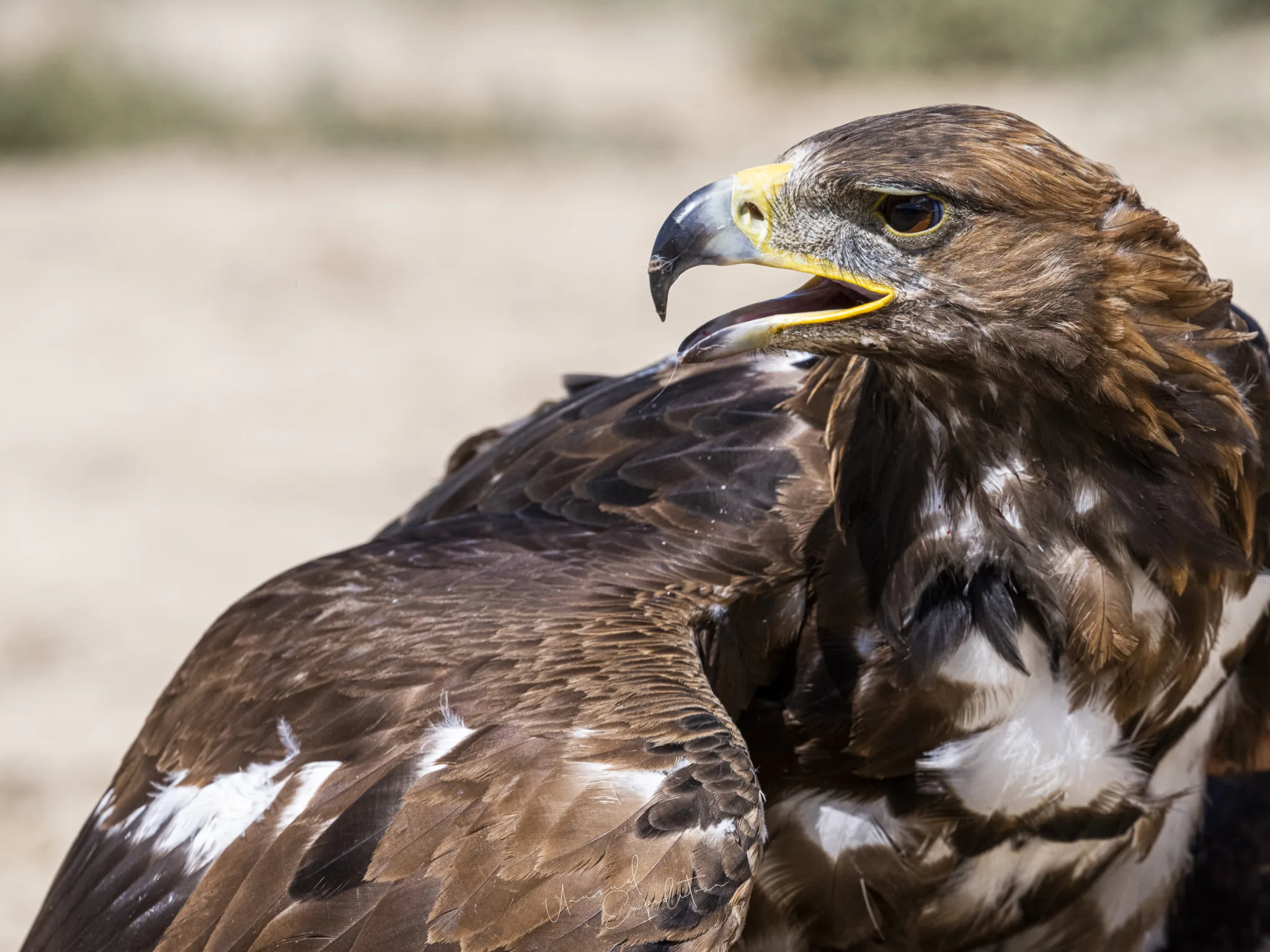
When the bird is back on the glove or resting on a perch, step back and use the long end of the lens. A golden eagle's head, with its hooked yellow beak and the amber eye, fills a frame from several metres away with a 100-400mm, and the distance keeps the bird calm. Wait for the head to turn so the eye catches the light. A wide aperture throws the dry ground behind into a soft beige, which suits the brown feathers. Ask the hunter before you photograph him close, and show him the frames afterwards; it is the easiest way to say thank you across a language gap.
The eagle decides how the morning goes. You can plan the light and the angle, but when the bird has had enough, the hunter hoods it and that is the end. Make the most of the first few minutes on the glove, when the bird is fresh and the sun is still kind.
Joseph Mak, tour leader, Unusual Expedition
Where to see eagle hunting in Kyrgyzstan
The south shore of Issyk-Kul, around Bokonbaevo, is the area most often named for eagle hunting demonstrations, and it is where the Salbuurun festival is reported to take place in summer. Kyrgyzstan also hosted the World Nomad Games again in 2026, and eagle hunting was part of the programme there. Outside festivals, a demonstration is arranged privately, which is better for photography: fewer people, and the hunter can work around the light. The rest of the basin, from Karakol to the red rocks of Jeti-Oguz, is covered in our Kyrgyzstan guide; for the horseback games often shown alongside the eagles, see our kok boru guide, and for seasons, the best time to visit Kyrgyzstan.
Photograph a berkutchi with us
We arrange eagle hunting in Kyrgyzstan as part of a private trip on request, timed for morning light and with a hunter who is happy to work with photographers. We take care of the logistics; a photographer or photography coaching can be added. See private tours and the Kyrgyzstan photography tours page.
Ask us about eagle hunting in Kyrgyzstan
Kyrgyzstan photography tours
The next Kyrgyzstan departure is announced on the Kyrgyzstan photography tours page, with previous expeditions and all the planning guides.
Explore Kyrgyzstan in depth
- Kyrgyzstan Photography Tour: Issyk-Kul, Karakol, Red Rocks, Eagle Hunters and Kok BoruKyrgyzstan
- Kok Boru in Kyrgyzstan: How to Photograph the Horseback GameKyrgyzstan
- How to Plan a Photography Trip to Kyrgyzstan: Entry, Flights, Money and SafetyKyrgyzstan
- Best Time to Visit Kyrgyzstan for Photography, Season by SeasonKyrgyzstan
Upcoming Photo Tours
- Egypt Photo Tour – EgyptEgypt 12 Dec 2026 To 20 Dec 2026
- Inner Mongolia Winter Owl Photo Tour – ChinaChina 01 Jan 2027 To 04 Jan 2027
- Inner Mongolia Winter Photo Tour – ChinaChina 05 Jan 2027 To 11 Jan 2027
- Mekong And Central Highland Vietnam Photo Tour - VietnamVietnam 16 Jan 2027 To 24 Jan 2027