
Kyrgyzstan Photography Tour: Issyk-Kul, Karakol, Red Rocks, Eagle Hunters and Kok Boru
Kyrgyzstan photography tour guide: Issyk-Kul at first light, Karakol, the red rocks of Jeti-Oguz, eagle hunters and kok boru.
The best Kyrgyzstan places to visit on a photography tour sit around Lake Issyk-Kul, in the north of the country. In a short loop you can photograph the lake at first light, the red sandstone of Jeti-Oguz, the wooden cathedral and street life of Karakol, a berkutchi with his golden eagle, and a game of kok boru on open pasture. Kyrgyzstan rewards a slow pace: the light is clean, the people are used to horses and cameras, and the mountains of the Tien Shan sit behind almost every frame.
We run Kyrgyzstan as a private photography trip on request, for photographers joining from any country. The photographs in this guide are our own, taken on our late-summer trip around Issyk-Kul; we hold the rights to them, and the notes come from knowing these places first hand. Each section below links to a longer destination guide: the Kyrgyzstan eagle hunter, the kok boru game, the best time to visit and how to plan the trip.
Kyrgyzstan places to visit with a camera
Kyrgyzstan is a mountain country, and most of it lies above the height where trees give up. For a first photography trip, the Issyk-Kul basin in the north-east gives the most variety for the least effort. The lake fills the middle of the basin, the Tien Shan ranges close it on both sides, and the places worth a camera sit on or just above its shores: the beaches and piers of the north shore, the town of Karakol at the eastern end, the red rocks of Jeti-Oguz in the valley south-west of Karakol, and the dry, open ground of the south shore where eagle hunters still keep their birds. Song-Kul, Tash Rabat and the south around Osh are fine places too, but we have not photographed them, so this guide does not cover them.
| Place or subject | What you photograph | Best light | Lens |
|---|---|---|---|
| Issyk-Kul north shore | Piers, beach shelters, still water, the ranges across the lake | Before sunrise, long exposure | 24-70mm or a tilt-shift on a tripod |
| Karakol | Holy Trinity Cathedral, shop fronts, the Sunday animal market | Morning and midday for colour | 24-70mm |
| Jeti-Oguz | The Seven Bulls ridge, red hills above the village | Afternoon, side light on the rock | 24-70mm, 70-200mm for details |
| South shore | A berkutchi and his golden eagle | Morning, low angle against the sky | 24-70mm and 100-400mm |
| Open pasture | Kok boru and er enish on horseback | Morning, before the dust rises | 100-400mm, 24-70mm at the edge |
Most of what matters fits around one lake, so the time goes into waiting for light, not into moving.
Issyk-Kul lake in Kyrgyzstan
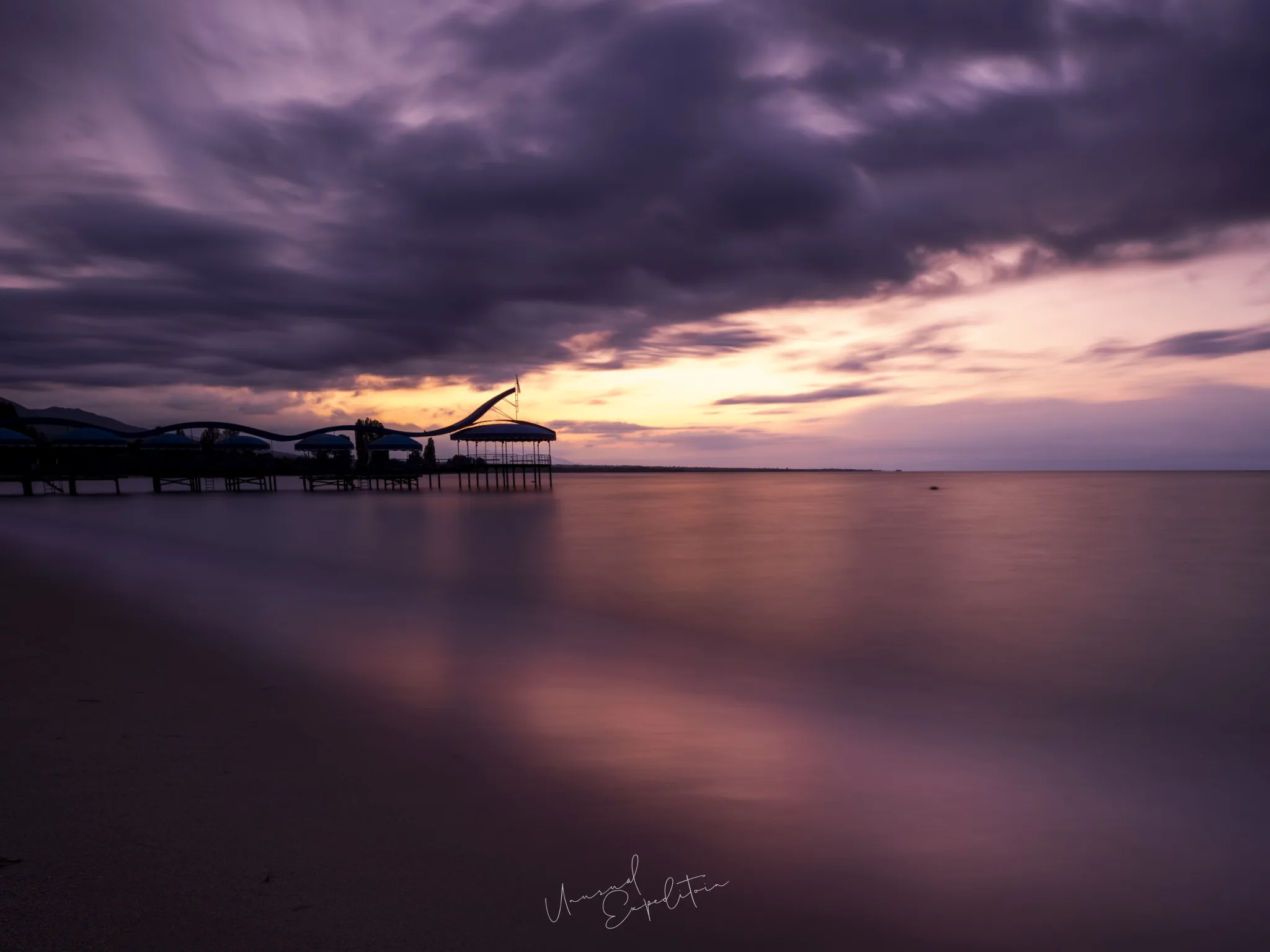
Issyk-Kul is the reason most visitors come to this corner of Kyrgyzstan. Britannica describes it as one of the largest mountain lakes in the world, lying in the northern Tien Shan, and notes that its Kyrgyz name means "hot lake" because it does not freeze in winter. For a photographer the north shore is the easier side: resort beaches with wooden piers, thatched shelters and loungers, and a long view south across the water to the snow line. Before sunrise the lake is usually calm, and a long exposure of a few minutes flattens the water into a sheet that holds the colour of the sky. We worked one of these piers with a tilt-shift lens on a tripod and stayed on it until the light went flat. By mid-morning the beaches fill and the wind picks up, so the lake is a first-light subject.
Things to do in Karakol with a camera
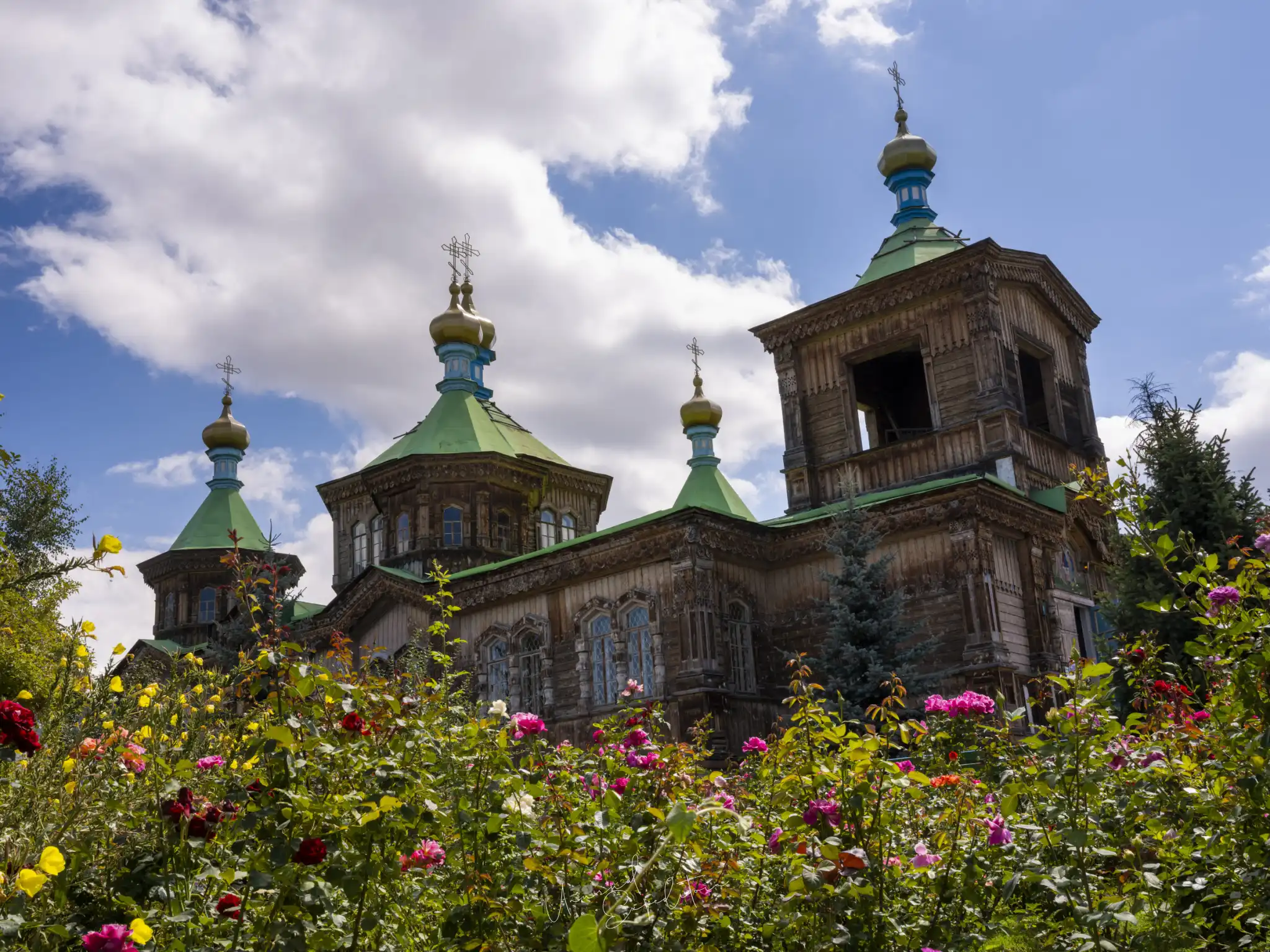
Karakol, at the eastern end of Issyk-Kul, is the town to base yourself in for the east of the lake. Its best-known building is the Holy Trinity Cathedral, a wooden Orthodox church completed in 1895 after an earthquake destroyed the stone church that stood there before; Lonely Planet and local guides record that it was turned into a club in the Soviet period and returned to worship after independence. In summer the churchyard is full of roses, and a low position puts the domes against the sky. Karakol is also a town of painted shop fronts and wooden houses, good for a midday walk. Early on Sunday mornings the Karakol animal market, which Lonely Planet lists among the biggest in the country, gathers horses, cattle and sheep on the edge of town. Ask before photographing faces there.
Jeti Oguz rocks: the Seven Bulls
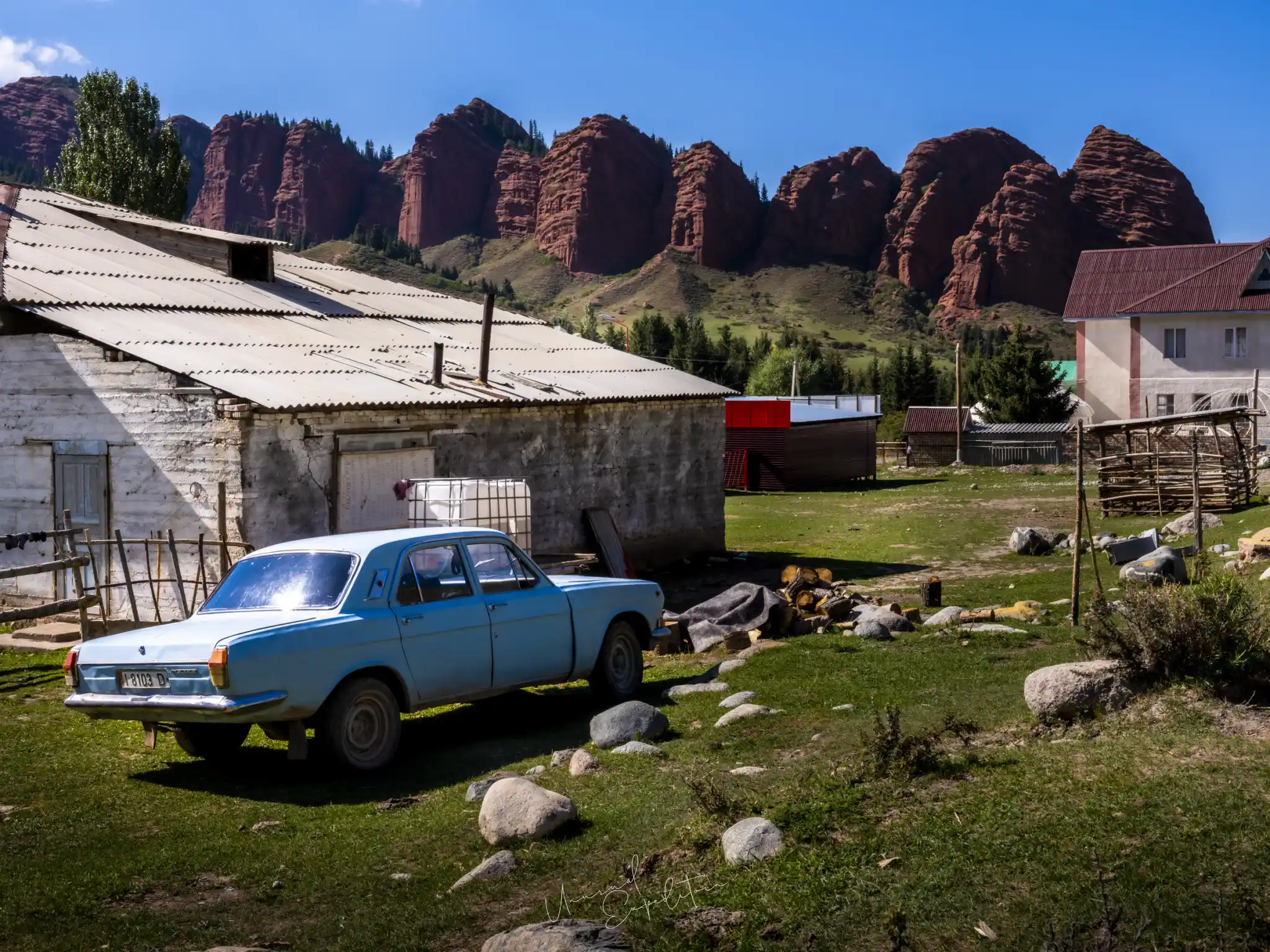
Jeti-Oguz is a valley south-west of Karakol where the hills turn a deep iron red. The ridge known as the Seven Bulls, a row of sandstone buttresses above the village, is described by Lonely Planet as one of the most photographed natural features in Kyrgyzstan, and the photograph at the top of this guide shows why. Village houses, a fence and an old Volga car sit in green grass below the cliffs, so the scale reads at once. Side light in the afternoon brings out the grooves in the rock; at midday the red goes flat. The village is small and people live there, so keep to the road and the edges of fields.
The Kyrgyzstan eagle hunter and kok boru
Two subjects make Kyrgyzstan different from its neighbours for a photographer. The first is the berkutchi, the eagle hunter, who flies a golden eagle from the glove. Kyrgyzstan is one of the states on UNESCO's 2021 listing of falconry as living heritage, and hunters near the south shore of Issyk-Kul still show their birds to visitors. Our eagle hunting guide covers how a demonstration runs and where to stand. The second is kok boru, the horseback game that UNESCO inscribed for Kyrgyzstan in 2017. A team of riders fights for a goat carcass on open ground, and the action comes close and fast. Our kok boru guide covers the lenses and the safe places to stand. If you have already photographed the Kazakh eagle hunters of western Mongolia, our Mongolia photography guide shows how different the two feel: winter and fur there, late summer and bare ground here.
Kyrgyzstan nomads, horses and herders
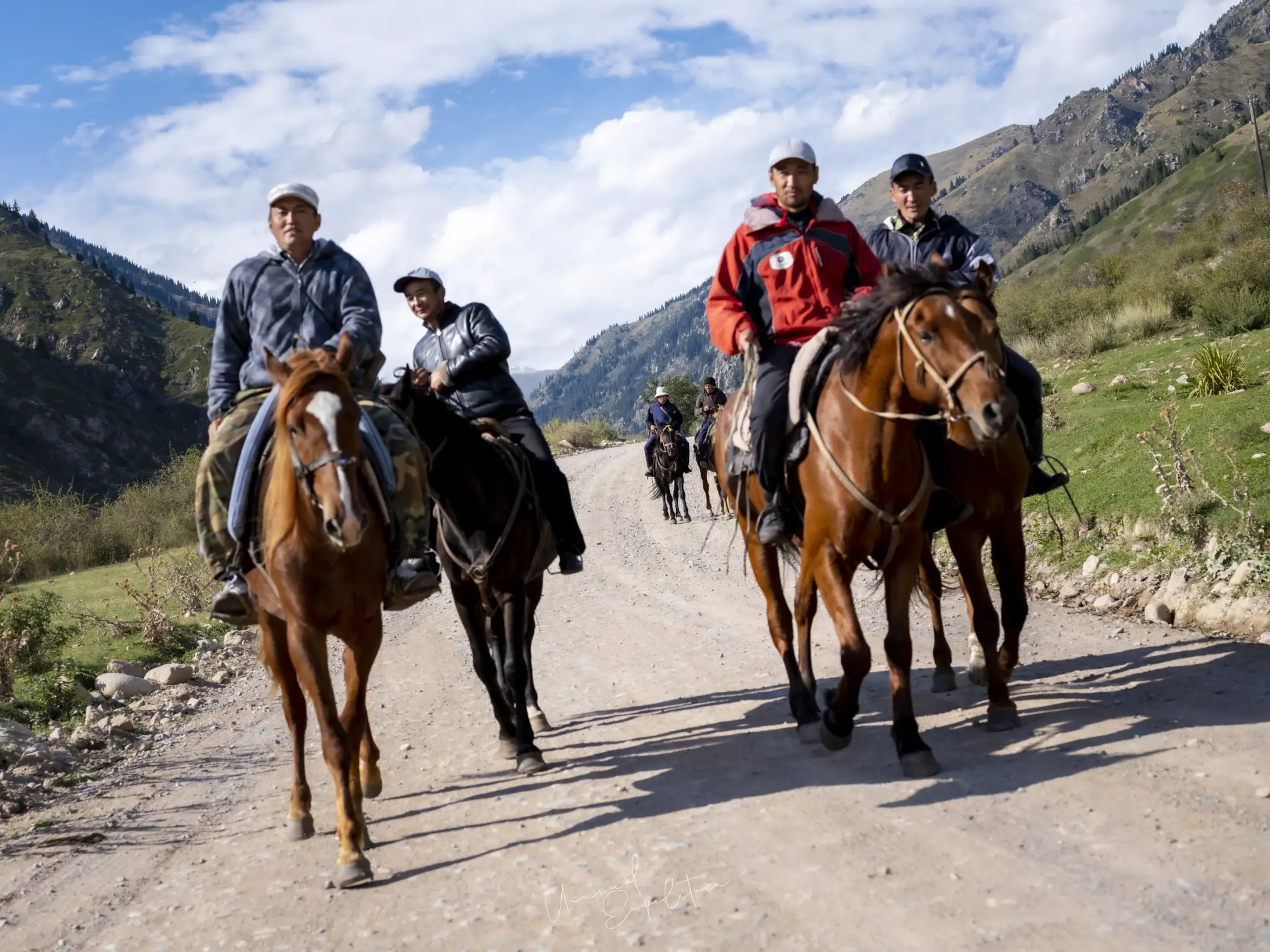
Horses are everywhere in rural Kyrgyzstan. On the side roads of the gorges that run down to Issyk-Kul you meet men riding to and from the high pastures, in caps and work jackets, often in loose groups that stop to talk. In late summer beekeepers park their hive trailers in mountain meadows and sell honey from the roadside. A nod and a question before raising the camera matters more than any setting. The summer pastures, the jailoo, are where many families still take their animals and live in yurts; the Tien Shan on the Chinese side has the same pattern, and our Xinjiang grassland guide shows those valleys. A 24-70mm covers most encounters on the road; a 70-200mm lets you work from a polite distance.
Kyrgyzstan landscape: light and lenses
The air in the Issyk-Kul basin is clear and the sun is strong, so the useful light comes early and late, with a hard, bright middle of the day that suits colour and people more than landscape. Bring a 24-70mm as the working lens, a 100-400mm for the eagle and the horse games, and a tripod with a dark filter for long exposures on the lake.
Kyrgyzstan surprised me. I came for the eagle and the horse game, and went home with as many frames of the lake before dawn and the red rock in the afternoon. Everything is close together, so you can afford to wait for the light.
Joseph Mak, tour leader, Unusual Expedition
Is it safe to visit Kyrgyzstan?
For most travellers, yes. As at November 2026 neither the Singapore Ministry of Foreign Affairs nor the UK Foreign, Commonwealth and Development Office advises against travel to any part of Kyrgyzstan; both ask for care near the border with Tajikistan, far from Issyk-Kul. Entry, flights, money and the advisories are covered in our guide to planning a photography trip to Kyrgyzstan.
Explore Kyrgyzstan in depth
- Kyrgyzstan eagle hunter: photographing a berkutchi and his golden eagle
- Kok boru in Kyrgyzstan: how to photograph the horseback game
- Best time to visit Kyrgyzstan for photography
- How to plan a photography trip to Kyrgyzstan
Photograph Kyrgyzstan with us
There is no scheduled Kyrgyzstan departure at the moment. We run it as a private trip on request, for individuals, couples, families and photographers who want to work at their own pace, and we arrange the logistics around what you want to photograph. Because no tour leader travels, a private trip can cost less than a group tour; a photographer or photography coaching can be added. Ask at least two months ahead, though shorter notice can sometimes be arranged. See private tours and the Kyrgyzstan photography tours page.
Kyrgyzstan photography tours
The next Kyrgyzstan departure is announced on the Kyrgyzstan photography tours page, with previous expeditions and all the planning guides.
Explore Kyrgyzstan in depth
- Kok Boru in Kyrgyzstan: How to Photograph the Horseback GameKyrgyzstan
- How to Plan a Photography Trip to Kyrgyzstan: Entry, Flights, Money and SafetyKyrgyzstan
- Kyrgyzstan Eagle Hunter: Photographing a Berkutchi and His Golden EagleKyrgyzstan
- Best Time to Visit Kyrgyzstan for Photography, Season by SeasonKyrgyzstan
Upcoming Photo Tours
- Egypt Photo Tour – EgyptEgypt 12 Dec 2026 To 20 Dec 2026
- Inner Mongolia Winter Owl Photo Tour – ChinaChina 01 Jan 2027 To 04 Jan 2027
- Inner Mongolia Winter Photo Tour – ChinaChina 05 Jan 2027 To 11 Jan 2027
- Mekong And Central Highland Vietnam Photo Tour - VietnamVietnam 16 Jan 2027 To 24 Jan 2027