
Everest Base Camp Tibet: Photographing the North Face
Everest Base Camp Tibet: altitude, weather, the north face at sunset, stars over Rongbuk, and Tibet vs Nepal for photographers.
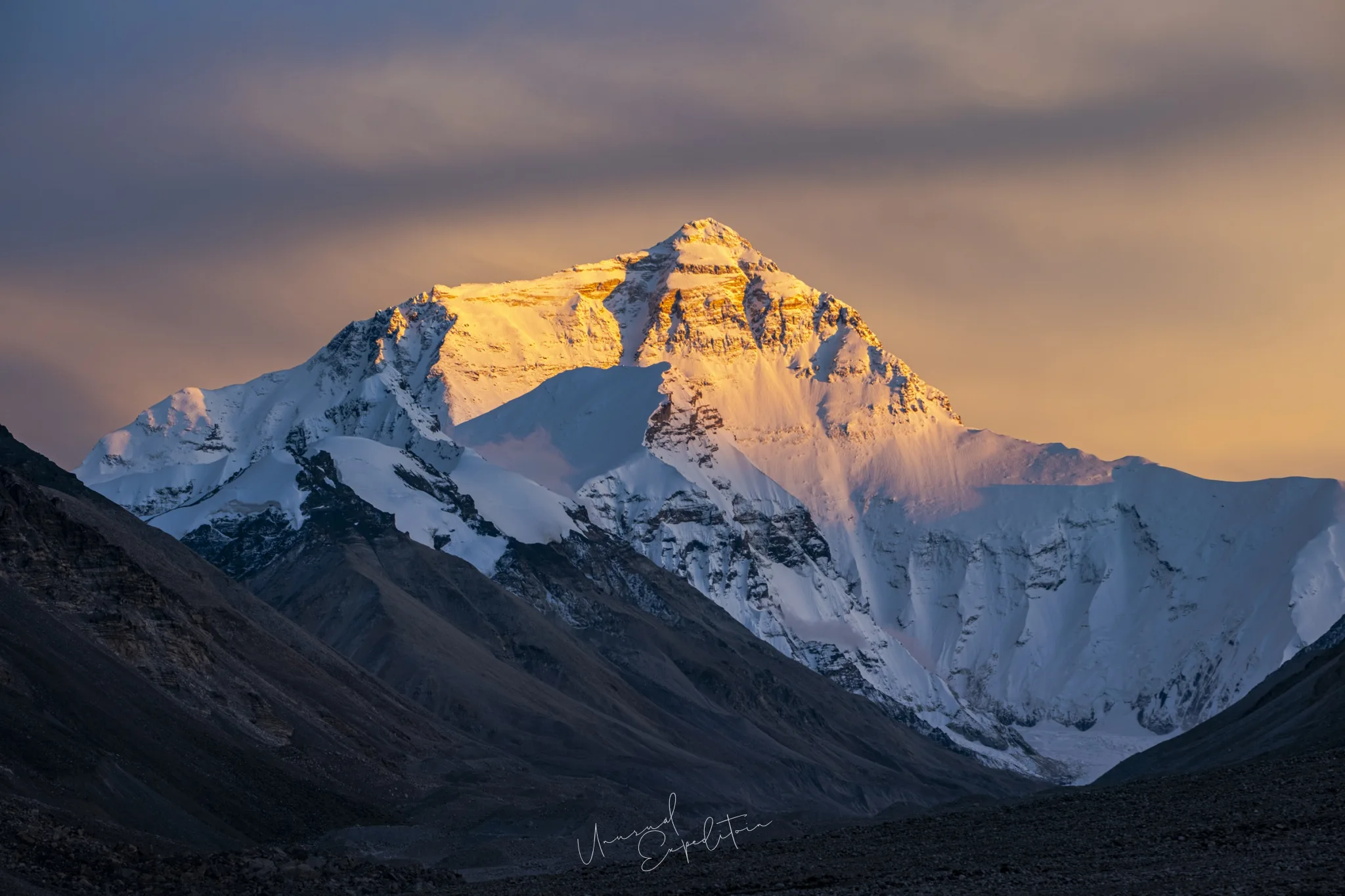
Everest Base Camp Tibet is the north side camp below the Rongbuk Glacier, at about 5,200 metres, and it gives the most complete view of Everest anywhere you can reach by road: the whole north face, framed by the Rongbuk valley, turning gold and then pink at sunset. You need a Tibet Travel Permit, a further permit for the Everest area and a licensed guide. The clearest weeks are in late spring and from September into October.
Everest is the high point, literally, of the route in our Tibet photography tour guide. Below: how to photograph it, how high it is, the weather and how the Tibet side compares with Nepal.
Everest Base Camp Tibet: what you see
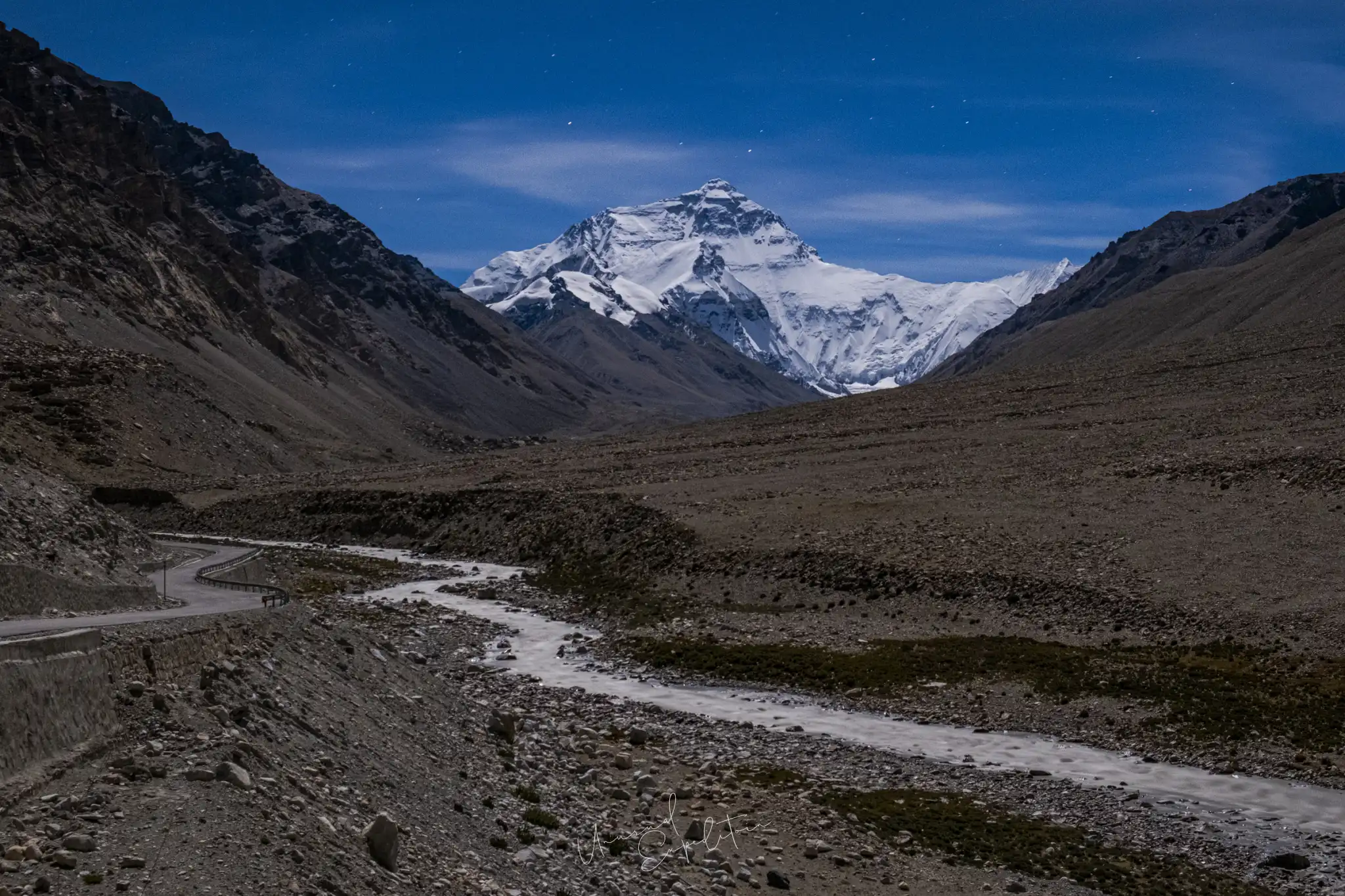
From the Tibetan side Everest stands alone at the head of the Rongbuk valley, its north face a wide pyramid of rock and snow with nothing in front of it. That is what makes it so photogenic. On the Nepal side the summit is hidden behind its neighbours from most of the trekking route; in Tibet you see the whole mountain from the road, from the guesthouses and from the camp.
The road climbs the valley in long curves, and the mountain grows at every bend. Visitors stay in the tent guesthouses run by local families near Rongbuk Monastery or in the guesthouse at the monastery, and go up to the viewing area at the base camp by the authorised shuttle. The monument at the camp, with the height of Everest, 8,848.86 metres, carved into it, is the picture almost everyone takes.
Everest Base Camp Tibet altitude
The Everest Base Camp Tibet altitude is about 5,150 to 5,200 metres depending on the source; the stone at the camp reads 5,200. Rongbuk Monastery, just below, sits at about 4,980 metres. That is higher than anywhere else on most Tibet trips, so the visit comes after several nights at lower altitude, starting in Lhasa at about 3,650 metres. At this height you walk slowly, sleep lightly and feel the cold more. Keep the visit short, drink water, and tell the guide early if a headache becomes worse.
Photographing the north face at sunset
The north face of Everest catches the last light of the day. In clear weather the summit turns gold while the valley falls into shadow, then the colour moves to pink and fades to blue as the sun sets behind the western ridges. Those few minutes are the reason to be here.
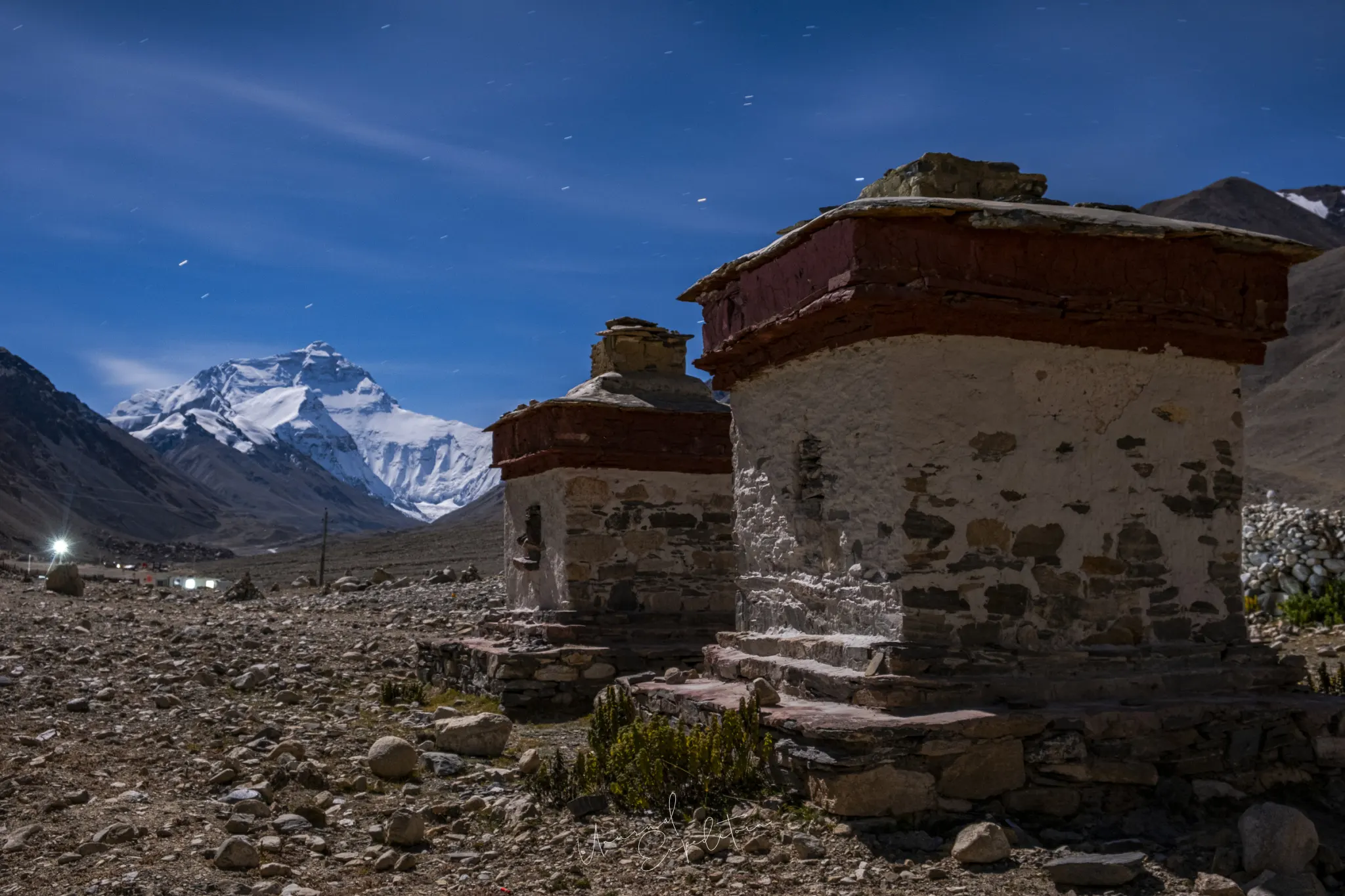
Set up early, ideally with a foreground: the chortens near the monastery, the curve of the road, or simply the bare moraine of the valley. A 70-200mm fills the frame with the face and the snow plume; a 24-70mm keeps the valley and the sky. Expose for the snow, which is much brighter than the valley in that light, and bracket if you want to blend detail later. The wind at the camp is strong and cold, so a sturdy tripod and gloves you can work in make a difference.
Night photography at Rongbuk
After dark the sky over Rongbuk is one of the clearest you will ever see. There is almost no light pollution, the air is thin and dry, and on a moonless night the Milky Way rises over the valley. Everest stays faintly visible under starlight, a pale shape at the head of the valley. Chortens and the stupa at the monastery make strong foregrounds.
Use a wide lens at its widest aperture, a tripod and exposures of fifteen to twenty-five seconds. Keep spare batteries inside your jacket, since the cold drains them quickly. Sleep comes hard at this altitude anyway, which makes a short session under the stars easier to justify.
"The first time Everest turns gold above you, people forget their cameras for a second. Then they remember. I tell them to make one frame fast and safe, then slow down and work the rest of the light."
Joseph Mak, tour leader, Unusual Expedition
Everest Base Camp Tibet weather
Everest Base Camp Tibet weather is cold and windy in every season. Even in September the nights fall well below freezing and the wind at the camp cuts through thin layers. Spring brings clear mornings and strong wind; summer, roughly July and August, brings clouds that can hide the mountain for days; autumn is the clearest season; winter is bitterly cold but often clear. Our September visit gave a clear evening and a golden north face. Read the best time to visit Tibet for photography for the season by season detail.
| Season | Everest views | Conditions at base camp |
|---|---|---|
| Spring, April to May | Often clear | Cold, windy, climbing season |
| Summer, June to August | Often clouded | Mildest, wet season on the plateau |
| Autumn, September to October | Clearest | Cold nights, stable weather |
| Winter, November to March | Often clear | Very cold, facilities limited |
Autumn is why we choose September and October for Tibet.
Everest Base Camp Tibet vs Nepal
Everest Base Camp Tibet vs Nepal is a choice between a road and a trek. In Nepal you walk for days up the Khumbu valley from Lukla, through Sherpa villages, and see Everest only from certain points; the camp itself sits below the Khumbu Icefall with the summit hidden. In Tibet you drive to the camp with a guide and permits and see the whole north face from the valley. For a photographer who wants the mountain itself, at sunset, without a long trek at altitude, the Tibet side is the stronger choice. For a long walk through Sherpa country, Nepal.
Staying near Everest Base Camp
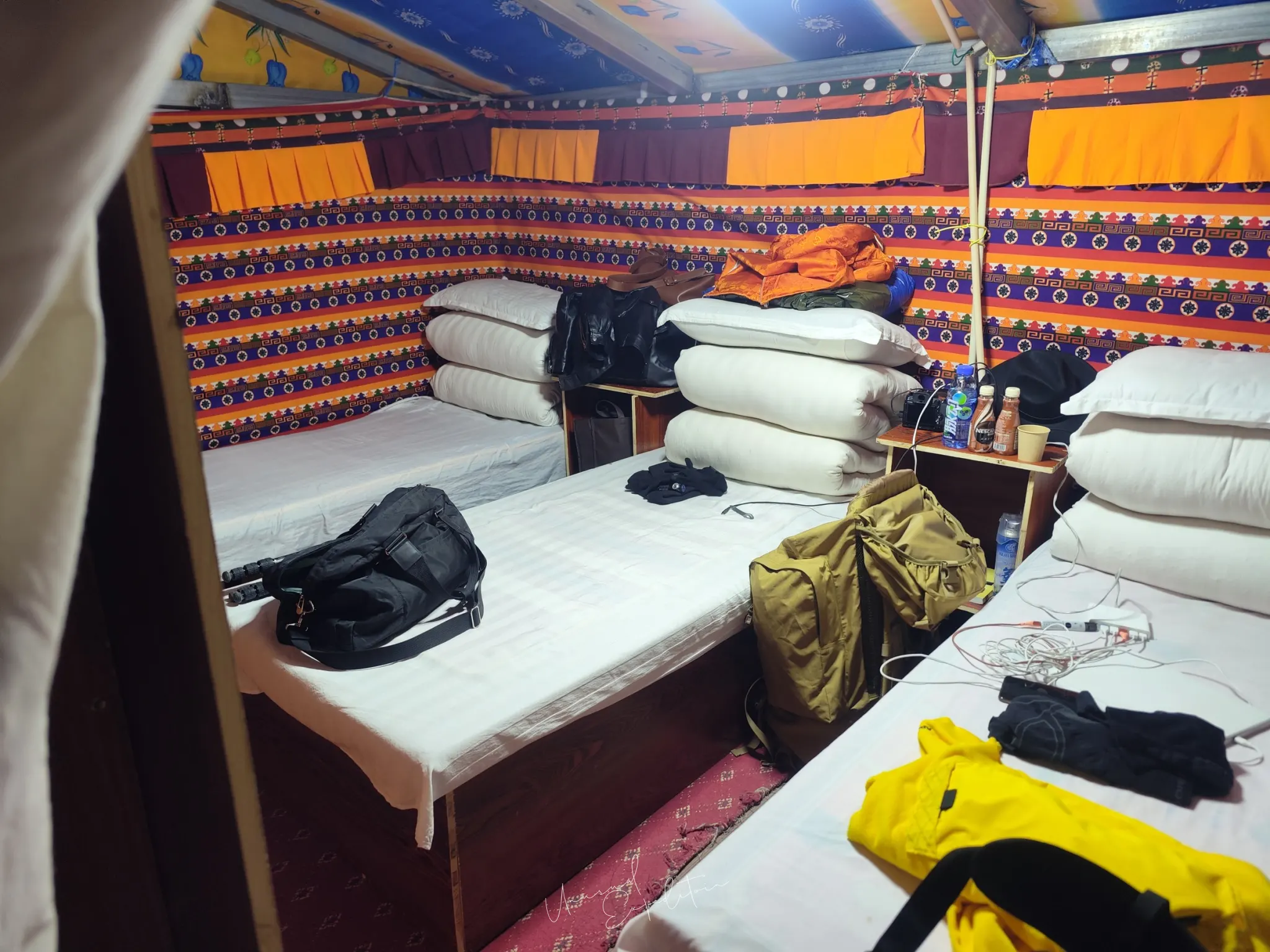
Accommodation near the camp is basic, in the tent guesthouses near Rongbuk, warm with a stove and lined with rugs and benches, and the monastery guesthouse. Expect shared toilets, little heating beyond the stove and a cold night. It is part of the experience, and it puts you in place for sunset and the stars. Pack a warm hat and a down jacket even for the walk to the toilet.
Permits and how to get there
The Everest area needs more than the Tibet Travel Permit: the agency also arranges the further permit for the region beyond Lhasa, and you show your passport at several checkpoints on the way. Independent travel is not allowed. The sequence of permits, flights and altitude planning from Singapore is in our Tibet tour from Singapore guide, and the rest of the Tibet route, from Lhasa to Yamdrok Lake, is covered in Lhasa photos.
See Everest from Tibet with us
Everest is the high point of our private Tibet trips. Departures across China are listed on our China photography tours page; write to us and we will tell you when we next plan Tibet.
Join the Tibet photography tour
Inner Mongolia Winter Owl Photo Tour – China departs 01 Jan 2027 To 04 Jan 2027, led by Joseph Mak. Small group, photography first. All Tibet photography tours.
Explore Tibet in depth
- Tibet Photography Tour: The Complete GuideChina
- Tibet Tour from Singapore: Permits, Altitude and FlightsChina
- Lhasa Photos: Potala Palace, Jokhang and Sera MonasteryChina
- Best Time to Visit Tibet for PhotographyChina
Upcoming Photo Tours
- Egypt Photo Tour – EgyptEgypt 12 Dec 2026 To 20 Dec 2026
- Inner Mongolia Winter Owl Photo Tour – ChinaChina 01 Jan 2027 To 04 Jan 2027
- Inner Mongolia Winter Photo Tour – ChinaChina 05 Jan 2027 To 11 Jan 2027
- Mekong And Central Highland Vietnam Photo Tour - VietnamVietnam 16 Jan 2027 To 24 Jan 2027