
Hoi An Fishing Village Photos: the Port, the Beach Boats and Lagoon Net Fishing
Hoi An fishing village photos: the port at dawn, the fleet on the Cua Dai river, basket boats on the beach and net fishing on the lagoons.
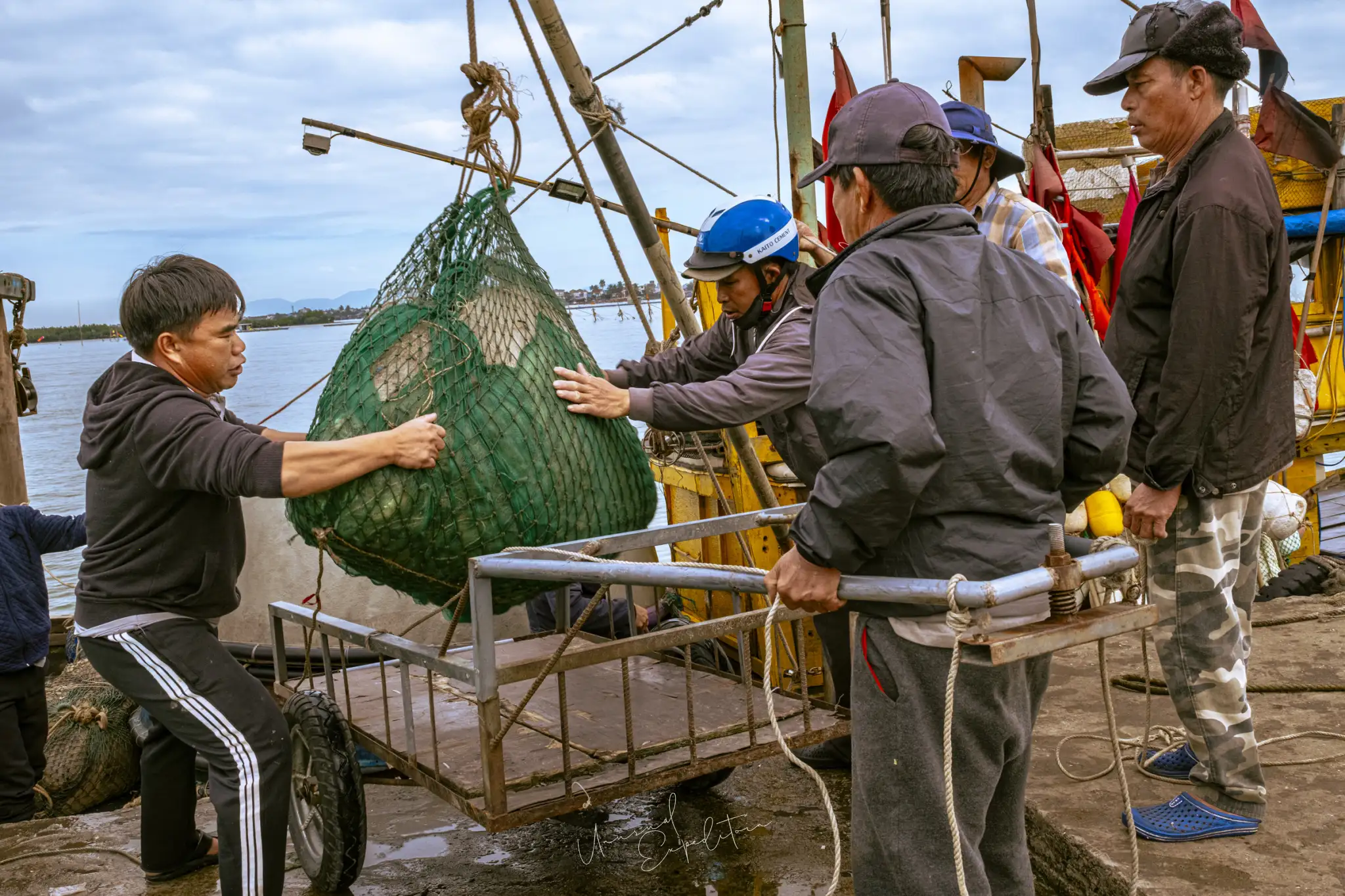
The Hoi An fishing village most photographers miss is not one village but a working stretch of coast below the old town: a fishing port on the lower Thu Bon where trawlers unload at dawn, a fleet of painted boats at rest towards Cua Dai, beaches where basket boats are dragged up the sand before sunrise, and lagoons where a single fisherman works his nets among bamboo stakes. None of it is ticketed and none of it performs for visitors.
The coast is one of the four subjects in our Hoi An photography tour guide. The frames here are Joseph's own, most of them from a grey, wet morning in the cool season when every fisherman on the quay wore a rain jacket.
Hoi An fishing village photos: where the coast works
Hoi An grew rich as a river port, and the UNESCO World Heritage Centre lists the old town for exactly that history. The fishing has simply moved downstream. Between the town and the sea the Thu Bon spreads into channels, sandbanks and brackish lagoons, and UNESCO's Man and the Biosphere programme recognised the Cu Lao Cham and Hoi An Biosphere Reserve in 2009, taking in the river mouth, the nipa palm wetlands and the islands offshore. For a photographer this means three different places within reach of town: the port, the beaches and the lagoons. Each has its own hour, and all three are early.
The fishing port at dawn
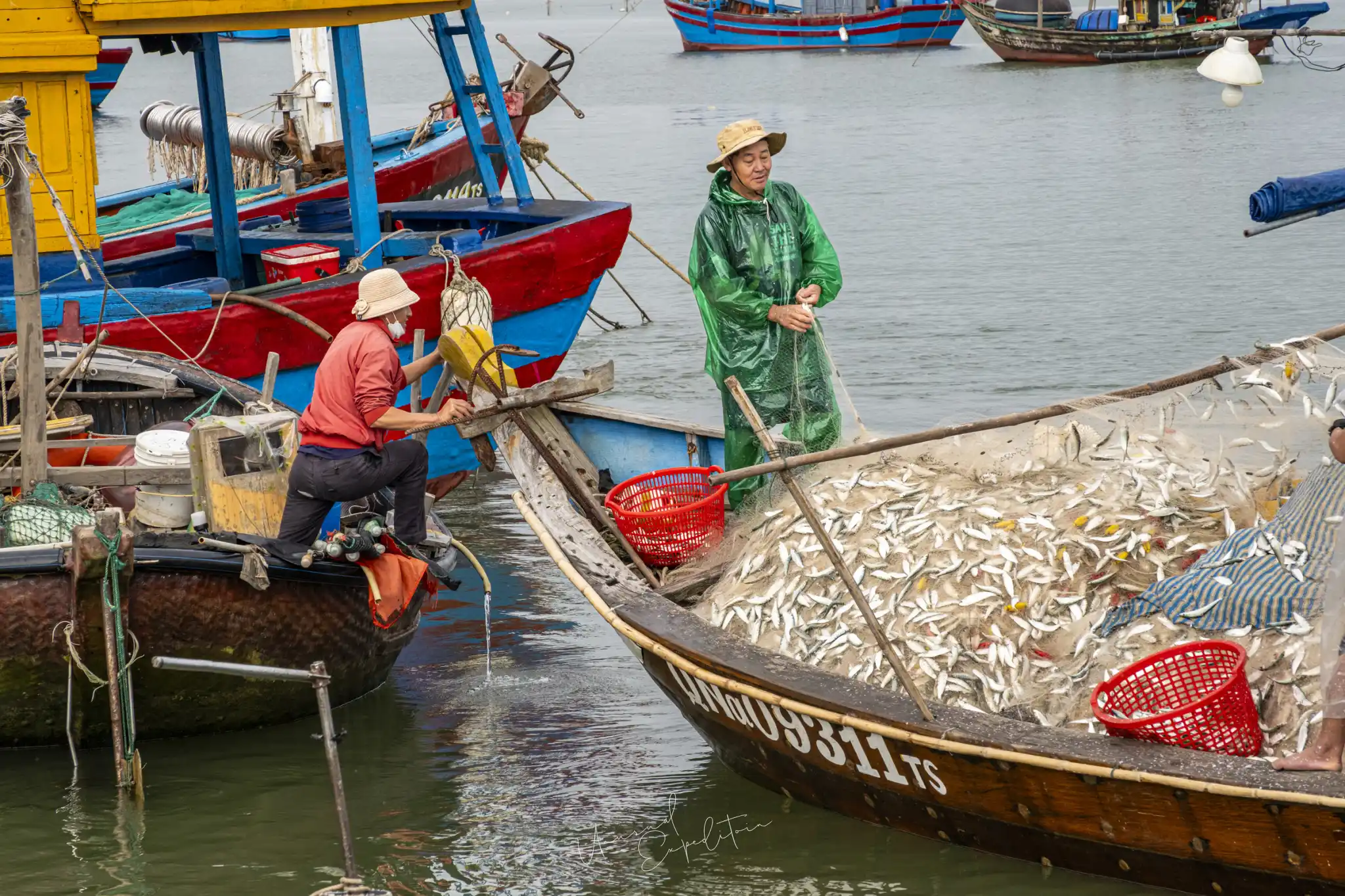
When the trawlers come back from a night at sea, the quay of the fishing port near Hoi An turns into a production line. Nets bulging with fish are swung off the decks on a boom and lowered onto hand carts, men in boots wrestle them across the wet concrete, and women in plastic raincoats sort the catch into red baskets. Small open boats come alongside piled with silver fish, and their owners bail and shovel them straight into tubs. Everything moves fast. A 24-70mm from the edge of the quay covers the boom and the carts, and a 70-200mm picks out faces and hands without putting you in the way. Grey skies help here: they keep the whites of the fish from burning out and give the painted hulls their full colour.
Cua Dai river and the fleet at rest
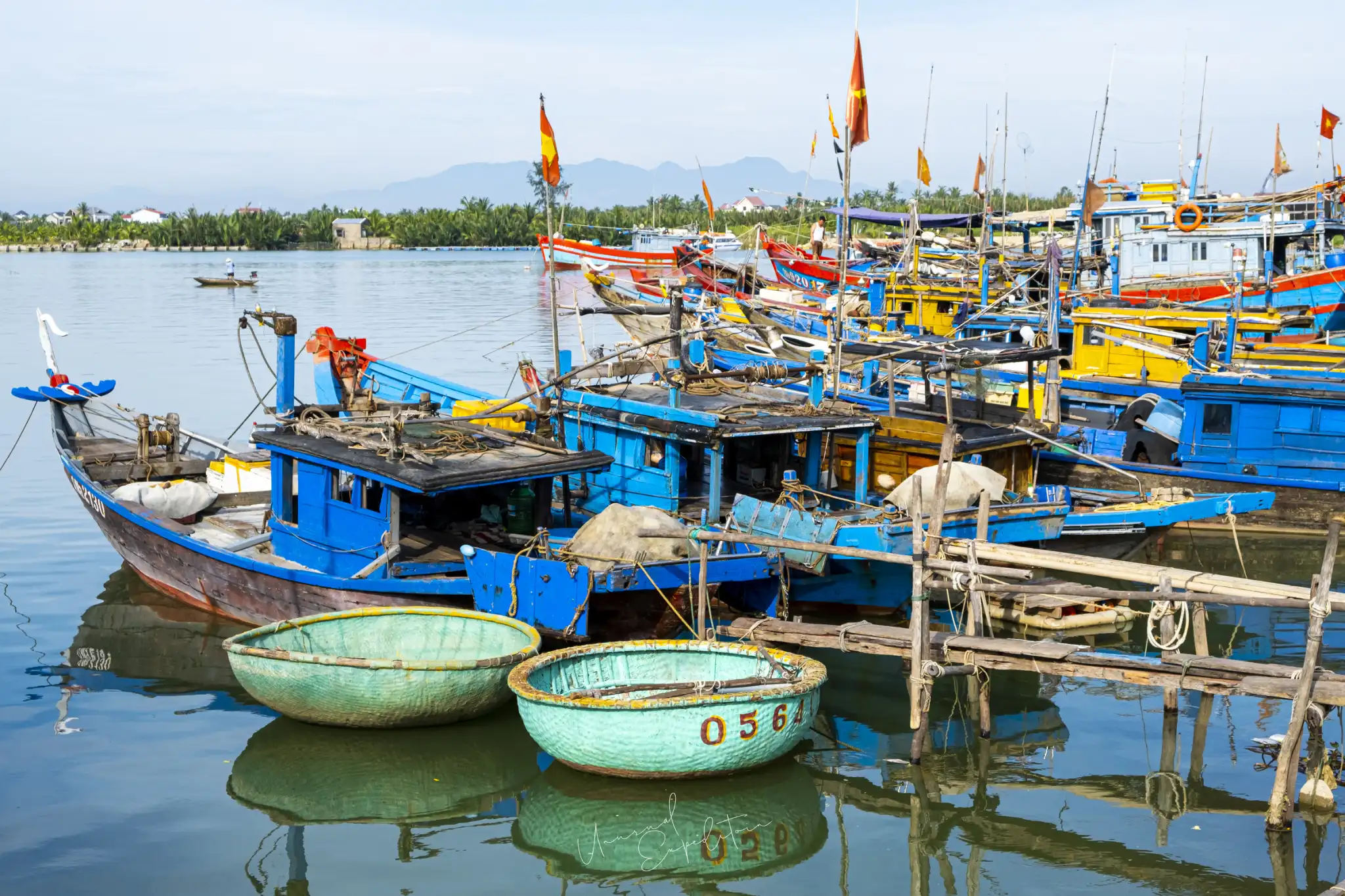
By late morning the port is quiet, and the boats lie moored along the Cua Dai river in rows, blue and red and yellow, with round basket boats tied alongside as tenders and the hills of the mainland behind. This is the colour picture of the Hoi An coast, and it works best in the late afternoon when the light comes from the side and the water is calm enough to hold reflections. The bridge over the river mouth gives a raised position for the whole fleet. Look for the eyes painted on the bows, which fishermen along this coast have long used to watch over the boat at sea, and for the national flags flying from every mast.
Cua Dai beach and the basket boats
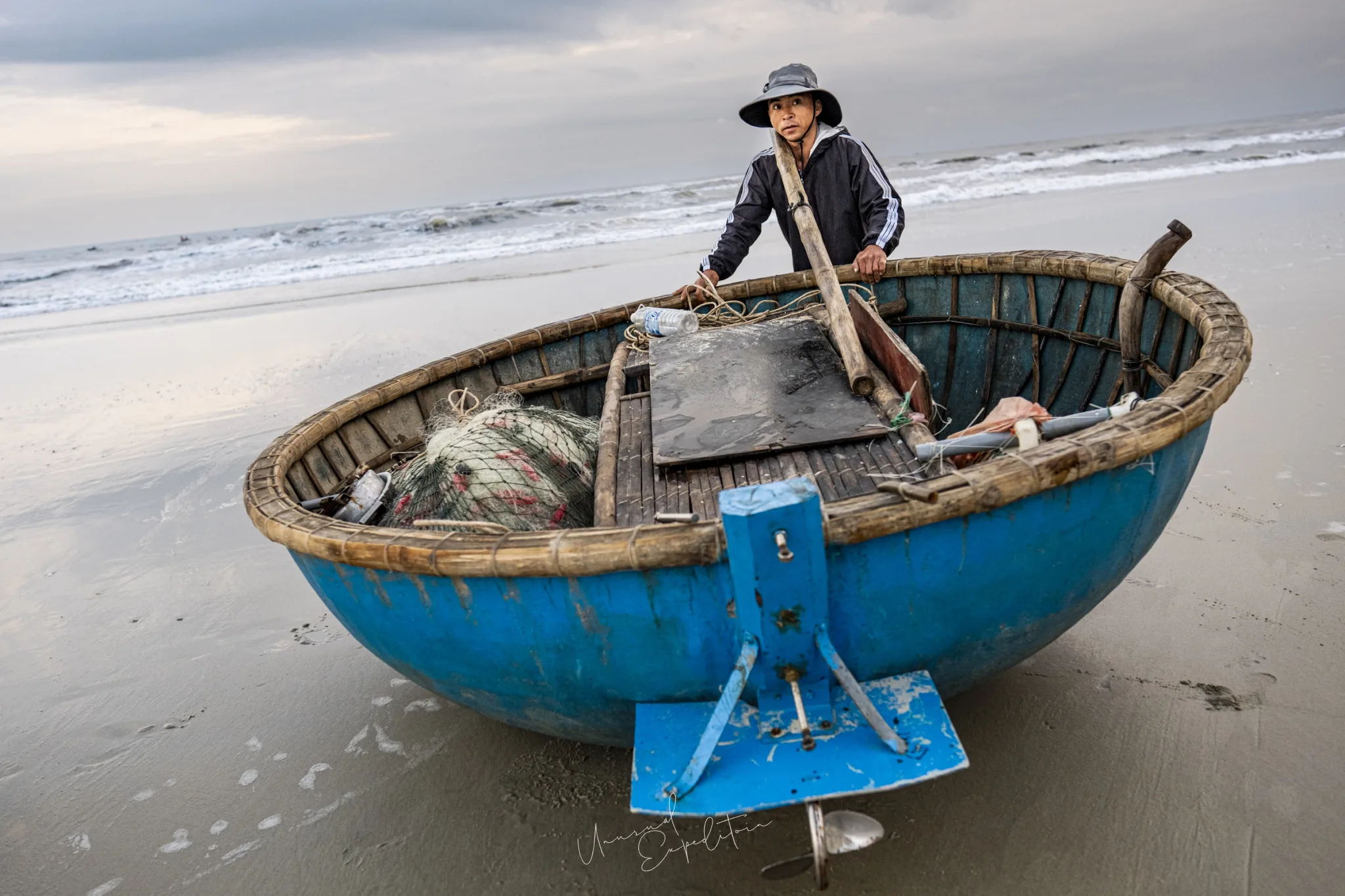
North of the river mouth, along Cua Dai beach and the beaches beyond it, the small-scale fishermen still work from round basket boats. Before sunrise they come in through the surf, and the boats are dragged up the sand with the catch and the nets inside. Photographed low, at the waterline, a single fisherman and his blue coracle against a pale sea is the simplest picture on this coast. The beach is wide and flat, so a 24-70mm at the wide end gives the scale, and the wet sand turns into a mirror when the tide is out. The painted tourist coracles of the coconut forest are a different subject, covered in Hoi An basket boats and the coconut forest.
Lagoon net fishing
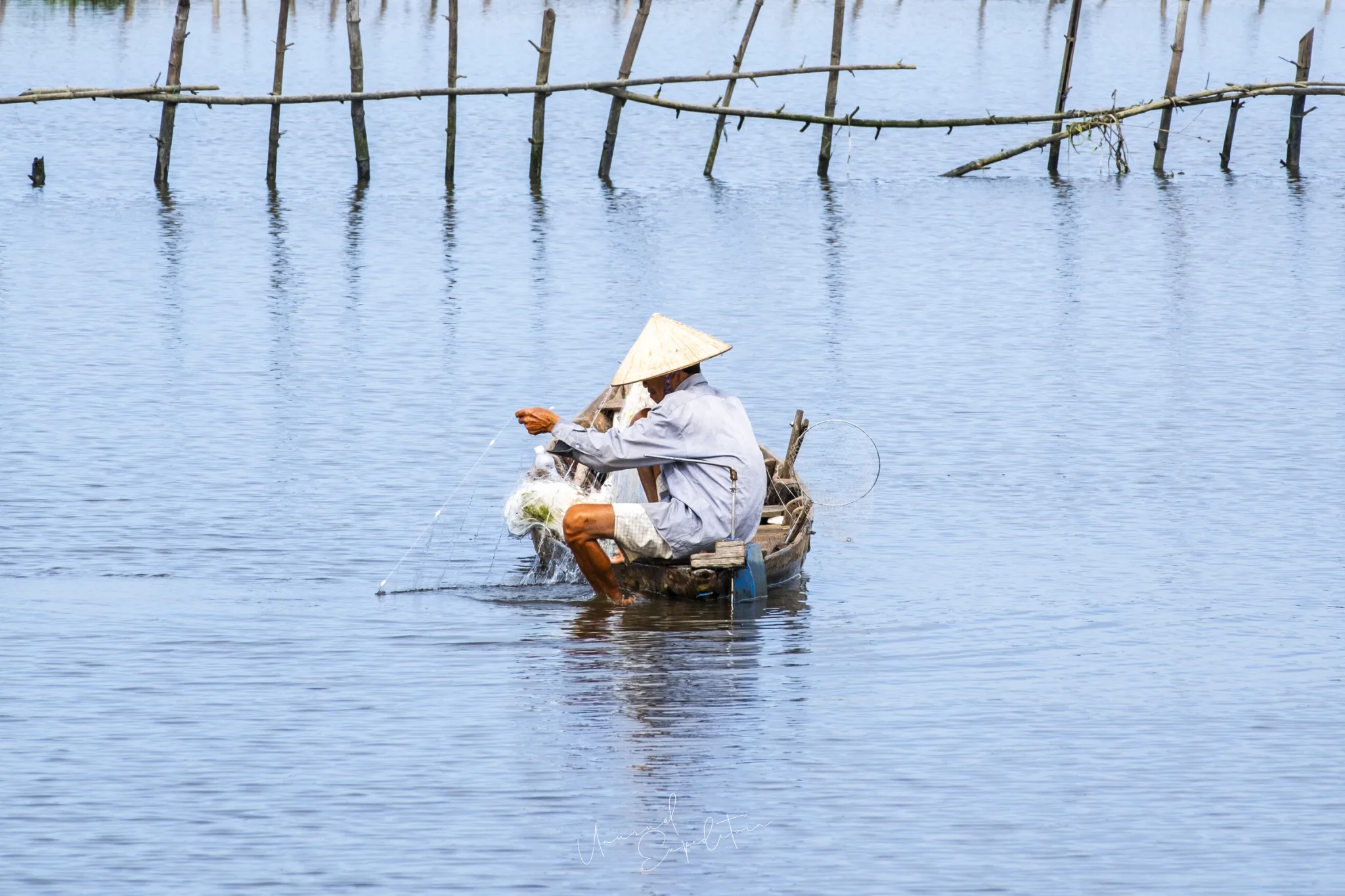
Inland from the beaches, the lagoons and channels of the estuary are fenced with lines of bamboo stakes. Some carry fixed nets that trap fish as the tide turns; others mark the ground of families who fish the same patch every morning. A fisherman stands or sits in a small boat, pulls his net hand over hand and drops it back, and the water around him is flat and grey. Lagoon net fishing gives the most minimal frames in the Hoi An area, and they work best on overcast mornings when there is no horizon line to speak of. Use a 70-200mm from the bank to compress the stakes behind the boat, and keep a fast shutter, because the boat is always moving. Our Hoi An photo tour article shows the same channels from a bridge.
| Subject | Where | Light | Lens |
|---|---|---|---|
| Unloading the catch | Fishing port on the lower Thu Bon | Dawn, overcast is fine | 24-70mm, 70-200mm |
| Fleet at rest | Cua Dai river, the bridge | Late afternoon side light | 24-70mm |
| Basket boats on the sand | Cua Dai beach and north | Before sunrise | 24-70mm at the waterline |
| Net fishing among stakes | Estuary lagoons and channels | Early morning, grey sky | 70-200mm from the bank |
Three of the four subjects are over soon after sunrise, so the coast always gets the first light of the day.
"That morning at the port it rained on and off, and I nearly stayed in the van. Then the first net of fish swung over the quay and nobody on the dock looked up. I shot it on a 24-70mm with water running off the lens hood. It is one of my favourite Vietnam frames."
Joseph Mak, tour leader, Unusual Expedition
Is a Hoi An fishing tour worth it for photographers?
A Hoi An fishing tour, as sold in town, usually means a basket boat ride, a fisherman casting a round net for the camera and a go at crab fishing with a stick. It is pleasant and it puts money into the villages, but the pictures are staged. For a photographer the better choice is to be at the port and the beach at first light, when nobody is putting on a show, and to keep the paid boat ride for the nipa palm channels. If you do book a fishing tour, tell the boatman you are there for photographs and ask him to work at his own pace.
Weather and the fishing calendar
The central coast is calmest from about February to August, when the boats go out most nights and the beaches are busy at dawn. From September to December the rains and the typhoon season keep fleets in port for days at a time; Vietnam's National Centre for Hydro-Meteorological Forecasting issues the storm warnings the fishermen follow. The cool months around the Lunar New Year bring grey skies and drizzle, which suit the port and the lagoons more than you might expect. Our scheduled Central Vietnam departure comes in late May, in the settled season.
Manners on a working coast
The port is a dangerous place to stand still in the wrong spot: booms swing, carts run on wet concrete, and nobody has time to warn you. Stay at the edge, ask before close portraits, and buy something at the market where the fish ends up, described in Hoi An market photos.
Come down to the coast with us
The fishing port and the lagoon mornings are part of the Hoi An days on our Central Vietnam photo tour. See the Vietnam photography tours page for the current departure.
Join the Hoi An photography tour
Mekong And Central Highland Vietnam Photo Tour - Vietnam departs 16 Jan 2027 To 24 Jan 2027, led by Joseph Mak. Small group, photography first. All Hoi An photography tours.
Explore Hoi An in depth
- Hoi An Photography Tour Guide: the Old Town, the River, the Coast and the VillagesVietnam
- Hoi An Market Photos: the Dawn Market, the Central Market and the Tet Flower StallsVietnam
- Hoi An Basket Boats and the Coconut Forest: Photos and How It WorksVietnam
- Hoi An Lantern Photo Spots: the Bridge, the River and the Full Moon NightsVietnam
- Hoi An Photo Tour: Where We Shoot and the Best Photo SpotsVietnam
- Hoi An Photos: What the Ancient Town Really Looks LikeVietnam
- Hoi An Private Tour for Couples: Photo Spots and Quiet Hours for TwoVietnam
Upcoming Photo Tours
- Egypt Photo Tour – EgyptEgypt 12 Dec 2026 To 20 Dec 2026
- Inner Mongolia Winter Owl Photo Tour – ChinaChina 01 Jan 2027 To 04 Jan 2027
- Inner Mongolia Winter Photo Tour – ChinaChina 05 Jan 2027 To 11 Jan 2027
- Mekong And Central Highland Vietnam Photo Tour - VietnamVietnam 16 Jan 2027 To 24 Jan 2027