
La Catrina Photos: a Portrait Session in Pátzcuaro
La Catrina photos near Pátzcuaro: the figure's history, Catrina make-up as a subject, settings, light, lenses and poses that work.
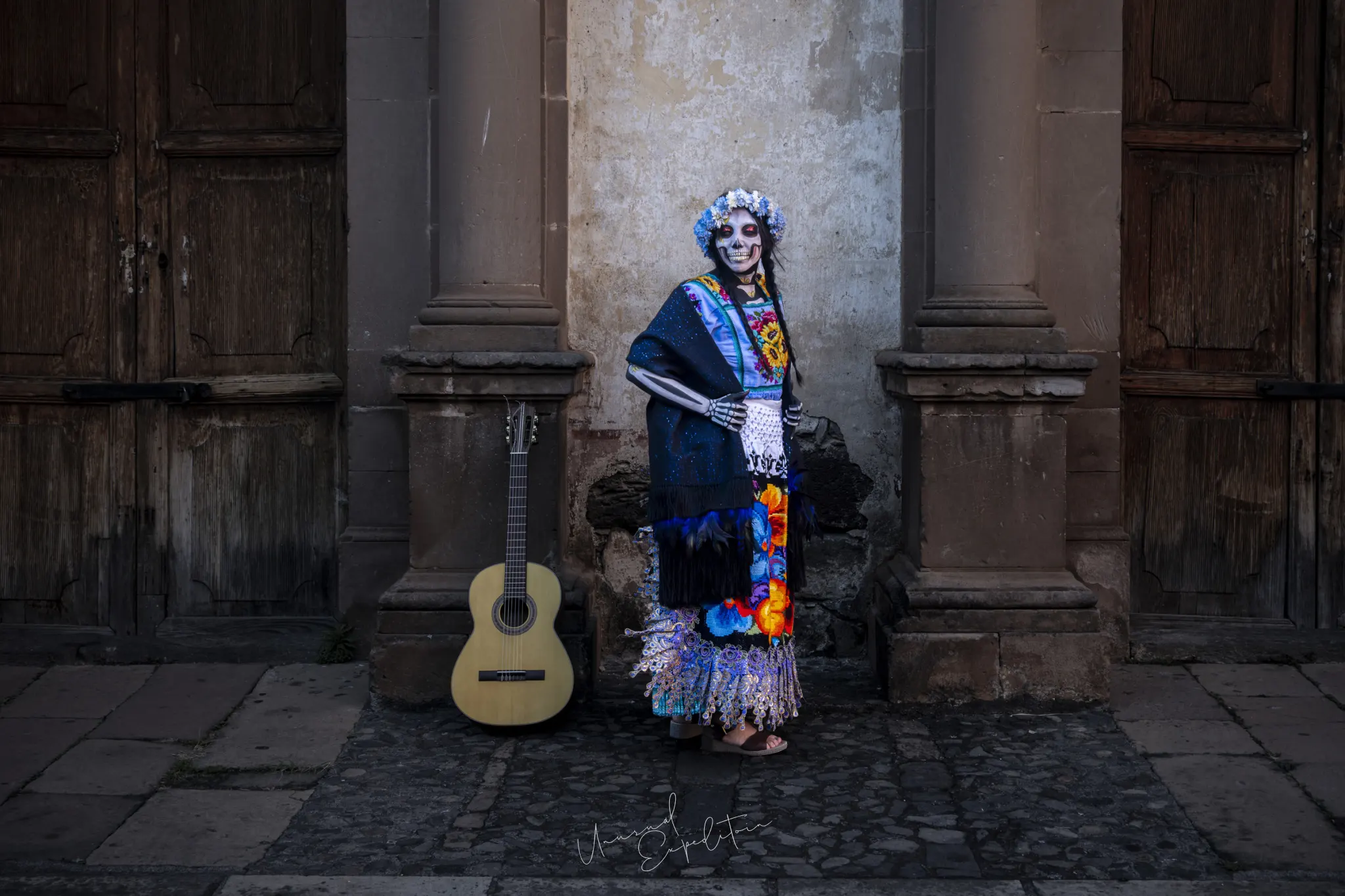
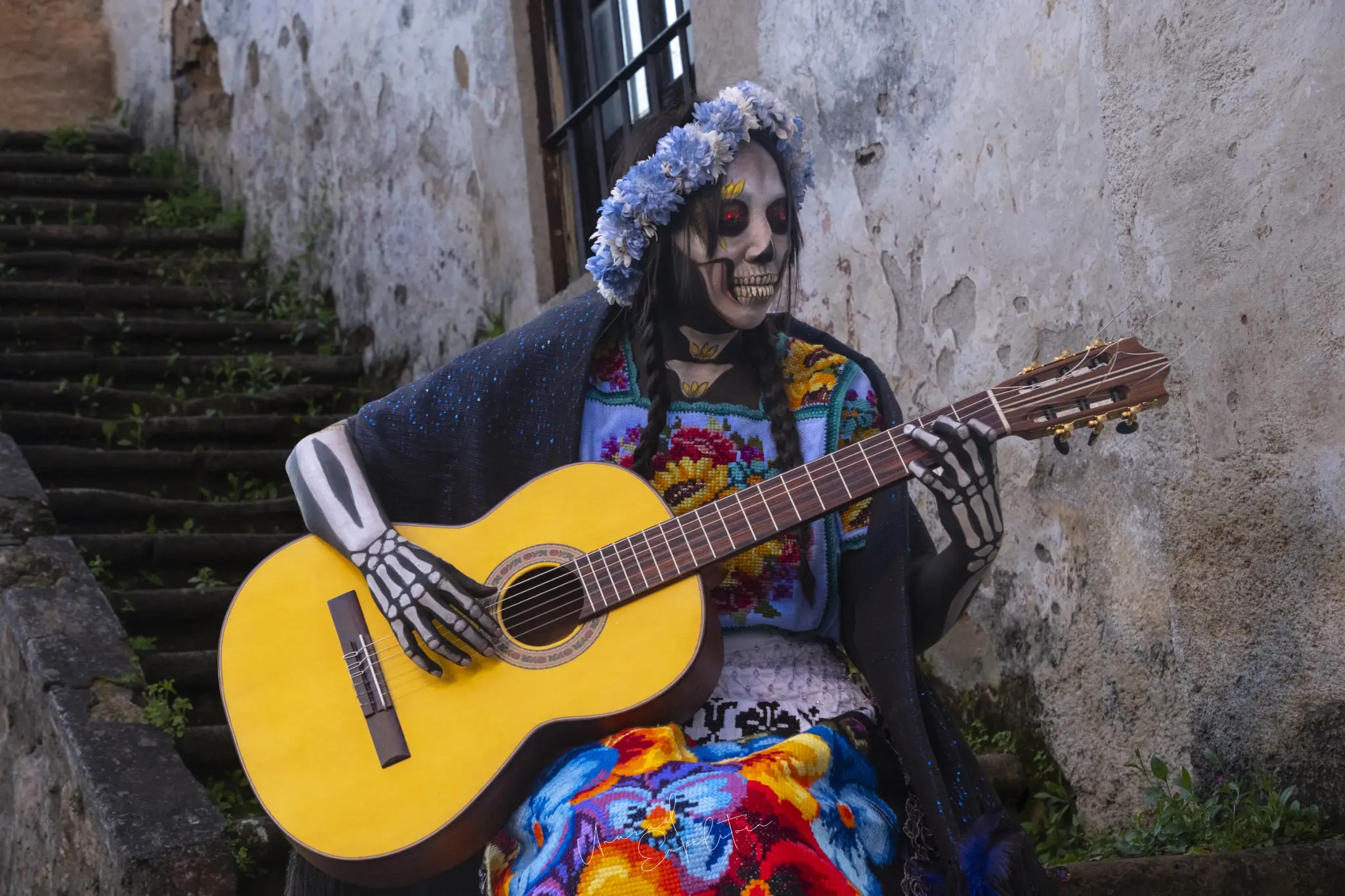
La Catrina photos are easiest to make well in a planned portrait session: a model in Catrina make-up and costume, old stone walls and doorways for a set, open shade for light, and time to work without pressing a stranger in a crowd. That is how we photograph the Catrina near Pátzcuaro in Michoacán. The skull face, the flower crown and the embroidered dress are the subject, and the setting is chosen to let them stand out rather than compete.
The session is part of our Michoacán photography tour guide, the lake chapter of our Day of the Dead route. Below are the history of the figure, how the make-up and costume work as a photographic subject, and the light, lenses and poses that gave us our best frames.
Who is La Catrina?
La Catrina began as a print. The Mexican engraver José Guadalupe Posada made a zinc etching of a female skeleton in a large, flowered hat in the early 1910s, calling her La Calavera Garbancera: a mockery of people who dressed in European fashion to hide their roots. Decades later Diego Rivera gave her a full body, an elegant dress and a feather boa in his mural Sueño de una tarde dominical en la Alameda Central, placing her between Posada and a child version of himself, and the name Catrina, from catrín, a dandy, stuck. Britannica and the Mexican government both tell the story this way. Today she is the best known face of the Day of the Dead, and painting a Catrina face is one of the festival's most popular traditions.
Catrina make-up as a subject
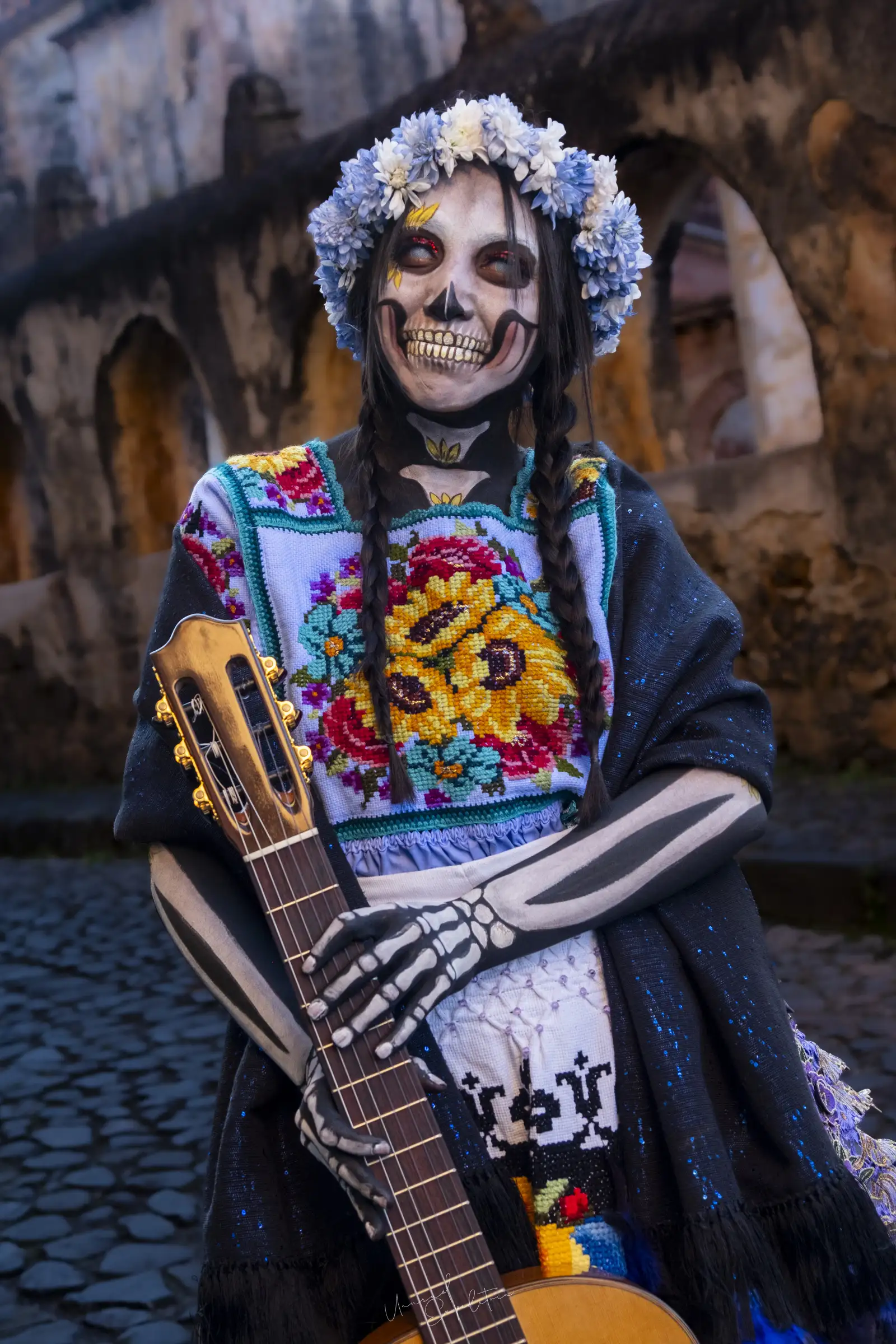
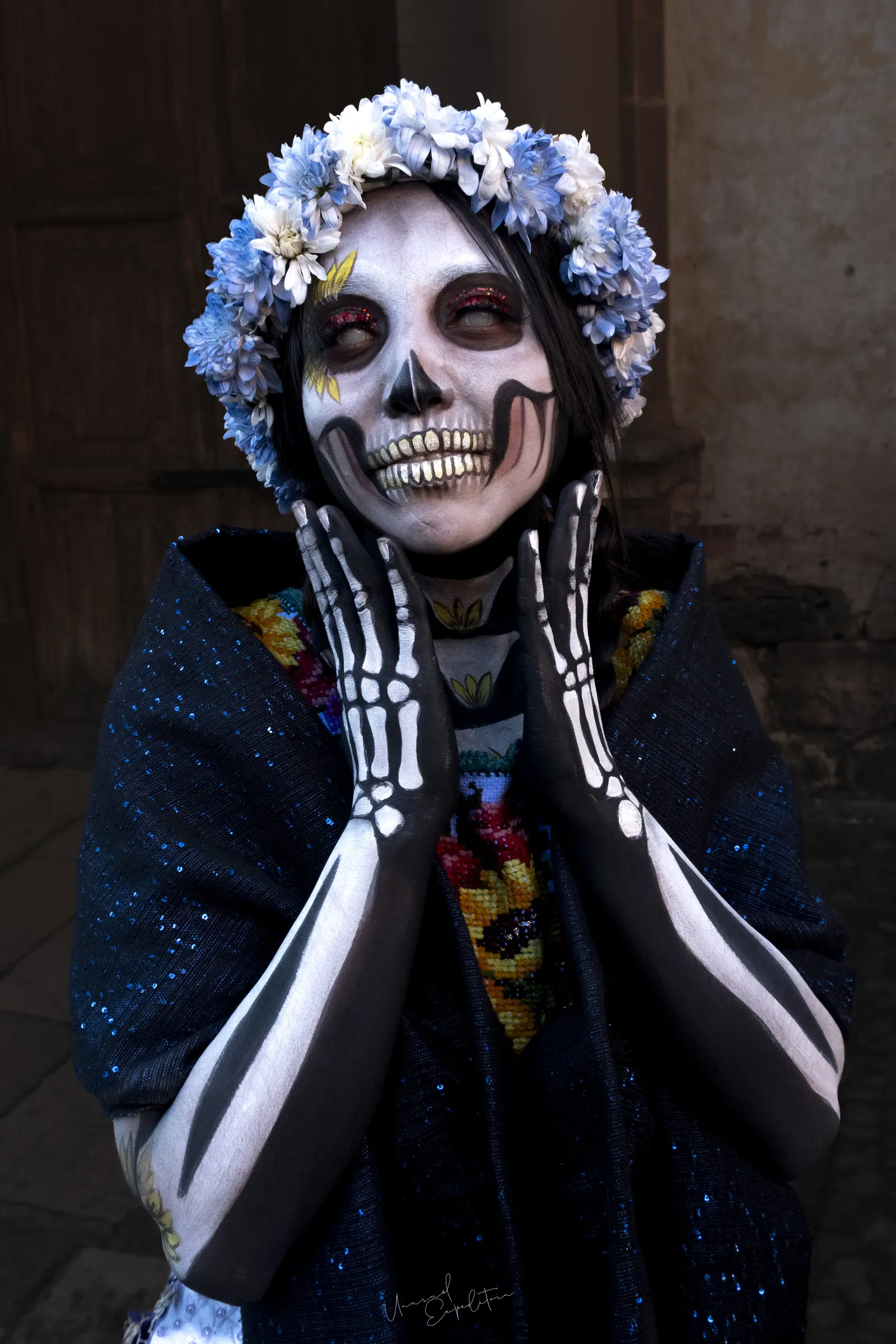
The make-up is the heart of the picture. A white base covers the face, the eyes are ringed in black or colour, the nose becomes a dark heart or triangle, and teeth are drawn across the lips and cheeks; flowers, swirls and dots decorate the forehead and chin. In our session the model also had skeleton bones painted in white on her hands and forearms, which gave us a second subject: hands framing the face, hands on the guitar. For the camera this means a very bright face against darker clothes and walls. Expose for the white make-up, not for the scene, and let the background fall a stop or two darker. Check the highlights on the forehead and nose; once the white burns out, the painted detail is gone.
Photo de la Catrina: flower crowns and an embroidered dress
Our model wore a crown of pale blue flowers, long dark braids, a dark rebozo shawl and a blouse and skirt embroidered with large flowers in the style of the region. The costume carries as much colour as the face, so frame for both: a full-length picture against plain stone shows the dress and the shape of the figure, a three-quarter frame balances face and embroidery, and a tight portrait is all make-up and flowers. The guitar was a prop, and a useful one: it gives the hands something to do and adds a warm wooden colour to a palette of white, black and blue.
Where to photograph a Catrina near Pátzcuaro
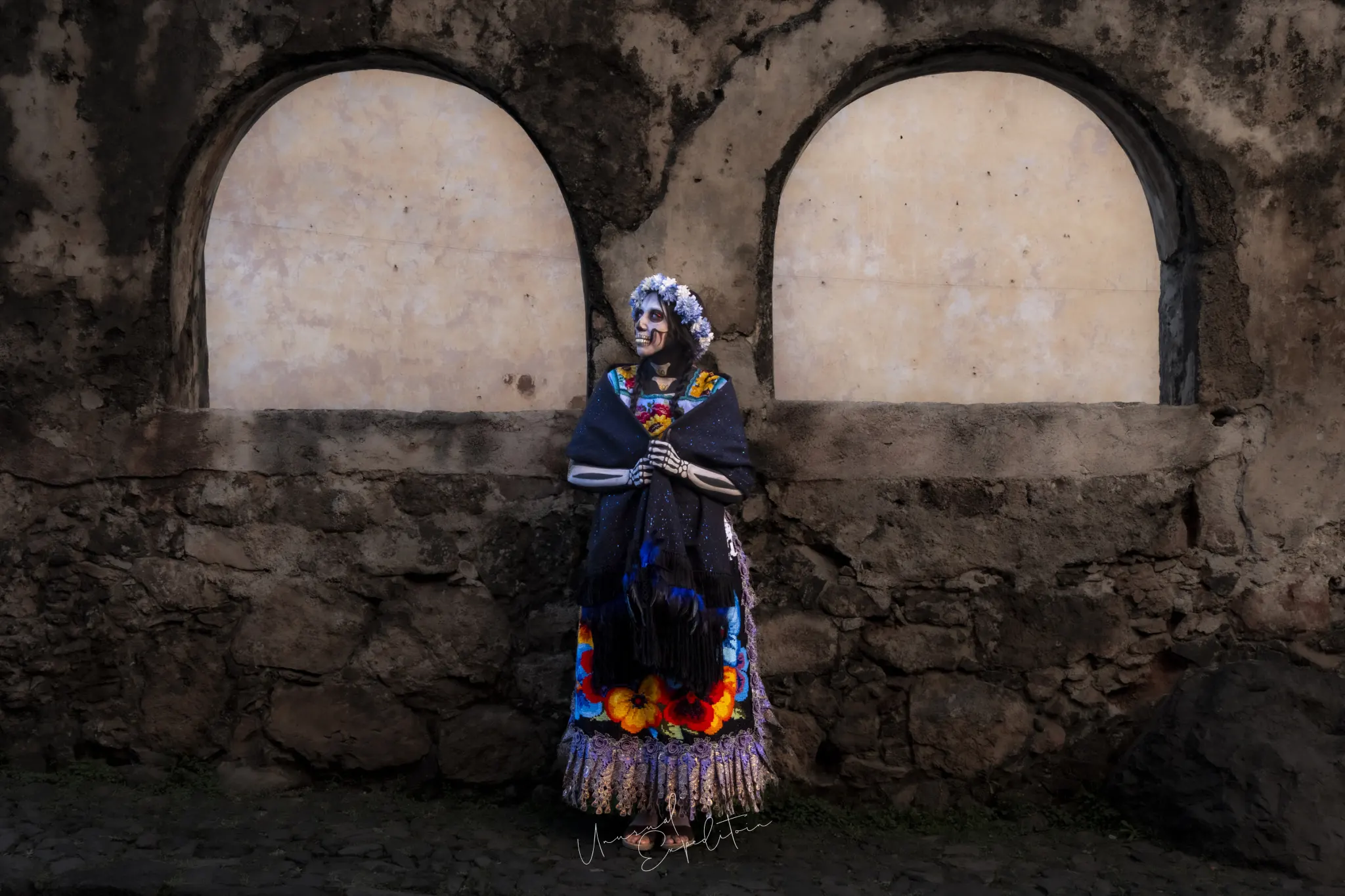
We worked among old stone walls, doorways and stairs near Pátzcuaro, the kind of setting the whole lake region offers: dark wooden doors, stone columns, worn steps and plaster in grey and ochre. These backgrounds are quiet, which is what a Catrina needs; a busy street of red-and-white houses would fight the costume. Look for three things in a set. A frame such as an arch, a pair of columns or a doorway, so the figure has a place to stand. Even shade, so the white face does not carry hard shadows. And texture without colour, so the make-up and the embroidery hold the eye. In festival week, ask before using a church front or a private doorway.
La Catrina photos: light and settings
Open shade is the light for this subject: the shadow of a building on a bright day, a deep doorway, a covered stair. It wraps the face softly and keeps the white base from glaring. We worked late in the afternoon, when the walls themselves were in shade but the sky still lit them. Our frames were made with apertures from f/2.8 to f/4 at short telephoto focal lengths, which keeps the eyes sharp and lets stone behind the model soften. If the shade is very deep, raise the ISO and keep the aperture; the depth of field on a painted face matters more than a clean file. A small reflector or a white wall opposite lifts the eye sockets, which the make-up darkens.
"With a Catrina, everybody wants the close-up first. I make people start wide, with the whole figure in a doorway, because that is the picture that shows where she is. The face can wait; the make-up will still be there."
Joseph Mak, tour leader, Unusual Expedition
Poses that worked
Simple poses suit the character. Standing still and upright in an arch or between columns, hands folded or holding the shawl, gives the formal portrait. Seated on a step with the guitar, head turned towards the instrument, gives a quieter scene with a story in it. Hands raised to the cheeks, palms out, shows the painted bones and turns the portrait playful. Ask the model to hold each pose and make small changes, a turn of the head, a lift of the chin, and keep the movement slow; with painted faces, small changes in angle change the shape of the skull. Keep talking and show the model the back of the camera now and then.
Catrina day of the dead: photographing strangers in costume
Outside a planned session, the festival is full of people in Catrina make-up: in parades, in the plazas, at the cemetery gates. Many enjoy being photographed, and some expect a small tip, but always ask first, and remember that a painted face at a cemetery may belong to a mourner rather than a performer. A planned session avoids that uncertainty: the model is there by arrangement and knows what the pictures are for. The costumes of the Mexico City parade are a different subject, in a crowd and in motion; for the lake region itself, see things to do in Pátzcuaro and Janitzio and the butterfly fishermen, and for the whole country, the Mexico photography tour guide.
Catrina portrait settings at a glance
| Frame | Setting | Focal length | Aperture |
|---|---|---|---|
| Full length | Arch, columns or doorway | 24-70mm | f/4 |
| Three-quarter | Stone wall, open shade | 50mm to 70mm | f/2.8 to f/4 |
| Tight portrait | Dark doorway | 85mm to 90mm | f/2.8 |
| Seated with guitar | Steps, stair wall | 35mm to 50mm | f/4 |
Start wide and work in; the full-length frame sets the scene that the close-ups depend on.
Photograph a Catrina with us
The Catrina session is one afternoon of our Day of the Dead trip through Mexico, with small groups and photographers joining from around the world. Find the next departure on the Mexico photography tours page.
Michoacan photography tours
The next Michoacan departure is announced on the Michoacan photography tours page, with previous expeditions and all the planning guides.
Explore Michoacan in depth
- Michoacán Photography Tour: Lake Pátzcuaro, Janitzio and MoreliaMexico
- Things to Do in Pátzcuaro for PhotographersMexico
- Janitzio Photos: The Island, the Cemetery and the Boat from PátzcuaroMexico
- Janitzio and the Butterfly Fishermen of Lake PátzcuaroMexico
Upcoming Photo Tours
- Egypt Photo Tour – EgyptEgypt 12 Dec 2026 To 20 Dec 2026
- Inner Mongolia Winter Owl Photo Tour – ChinaChina 01 Jan 2027 To 04 Jan 2027
- Inner Mongolia Winter Photo Tour – ChinaChina 05 Jan 2027 To 11 Jan 2027
- Mekong And Central Highland Vietnam Photo Tour - VietnamVietnam 16 Jan 2027 To 24 Jan 2027