
Mount Fuji Photography Tour Guide: Shizuoka, Izu and Fujiyoshida
Mount Fuji photography from three sides: Shizuoka tea and city views, the west Izu coast and snowy Fujiyoshida.
Mount Fuji photography works best when you treat the mountain as a backdrop that changes with the side you stand on. From Shizuoka it rises over tea fields, a busy city and Suruga Bay; from the west coast of the Izu Peninsula it floats above the sea; from Fujiyoshida in Yamanashi it towers over snowy streets and shrines. Winter mornings give the clearest views. Below are the three sides, the places nearby worth a frame of their own, and how we plan a trip around the weather.
The photographs in this guide are our own, taken on our trips around the mountain; we hold the rights to them, and the notes come from knowing these places first hand. For entry rules, money and flights, start with the Japan photography tour guide, which covers the whole country and its other regions.
Mount Fuji photography: what are you really photographing?
Mount Fuji is a single cone, so the variety in your pictures comes from the foreground and the light, not from the peak. A tele lens on a clear morning gives you the classic snow-capped summit. A wide lens puts the mountain small above a street, a tea terrace or a harbour, and those are the frames people remember. On our trips we spend more time choosing foregrounds than chasing the summit, because the summit is the same everywhere and the cloud decides whether you see it at all. Plan two or three spots for every morning, so a cloud bank on one side is not the end of the day.
Where is Mount Fuji, and which side should you shoot from?
Mount Fuji stands on the border of Shizuoka and Yamanashi prefectures, about 100 km south-west of Tokyo according to UNESCO, and rises to 3,776 m. Photographers usually pick between three sides. The Yamanashi side, around Fujiyoshida and the Fuji Five Lakes, is the closest and the busiest. The Shizuoka side looks up at the mountain over cities, tea country and the bay. The Izu Peninsula, also in Shizuoka, puts the sea in front of it. Each side has its own weather, and on a day when one is in cloud another can be clear.
| Side | Typical foreground | Feel | Destination guide |
|---|---|---|---|
| Fujiyoshida, Yamanashi | Streets, shrines, snowy forest | Close and big, crowded at famous spots | Mount Fuji photo spots |
| Shizuoka city and Nihondaira | City, port, Suruga Bay | Wide views from high ground | Mount Fuji photo spots |
| Shizuoka tea country | Tea rows, terraces | Quiet, best at sunrise | Tea fields in Shizuoka |
| West Izu coast | Sea stacks, coves | Mountain over water | This guide, below |
If you only have one clear morning, spend it where the foreground matters most to you; the peak will look much the same from all four.
Is Mount Fuji worth visiting for photographers?
Yes, if you build the trip around the weather and not around one viewpoint. Mount Fuji is worth visiting because it combines a world-famous subject with very different settings within a short distance: fishing ports, tea terraces, cherry blossom, old railways and snowy shrines. The risk is cloud. In summer the mountain can stay hidden for days, so a short summer visit often ends with no summit at all. In winter the odds are far better, and the snow cap is at its fullest. Our best time to see Mount Fuji guide goes through the months.
The Shizuoka side: Nihondaira, tea fields and the bay
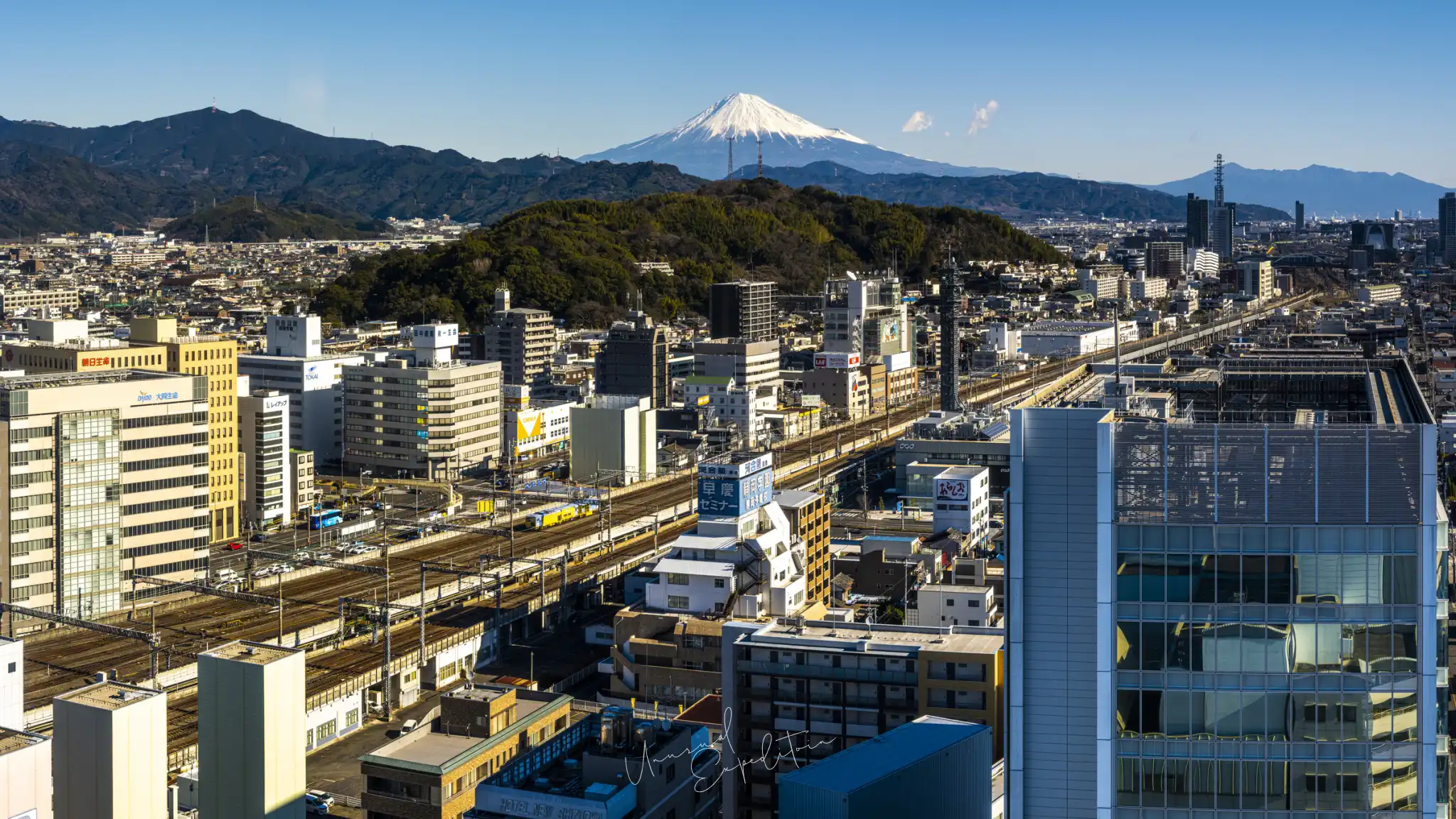
Shizuoka is the side most visitors from abroad skip, and it is the side we like most. Nihondaira, a plateau above Shizuoka city, looks across the city and the port to the mountain; the Nihondaira Yume Terrace, an observation building designed by Kengo Kuma and Associates, sits on its summit. Inland, the tea fields roll over the hills, and at sunrise a terrace above the rows gives you Fuji, mist in the valley and green leaves in one frame. The tea fields in Shizuoka guide covers that morning, and the Japanese tea ceremony experience guide covers the tea master we photographed in the fields.
Mount Fuji from the ocean: the west Izu coast
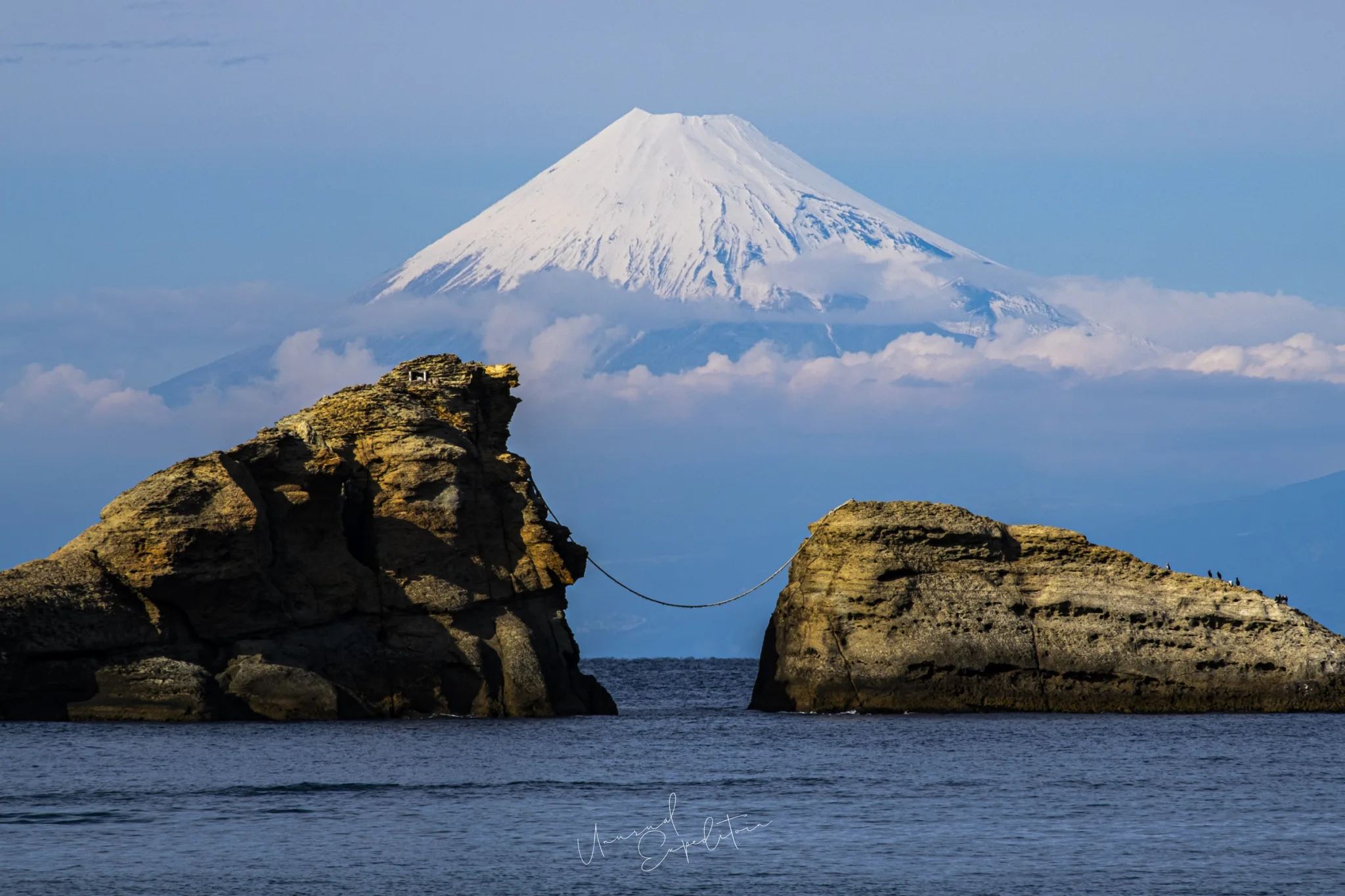
Mount Fuji from the ocean is a different picture. From the west coast of the Izu Peninsula, the mountain sits across Suruga Bay above a line of cliffs, coves and sea stacks. The peninsula has been a UNESCO Global Geopark since 2018, and its western shore is known for eroded volcanic rock, which gives you strong shapes in front of a soft white cone. A pair of rocks tied together by a sacred shimenawa rope, with Fuji between them, was the frame we waited longest for. Fishing boats crossing the gap add scale. Afternoon is often fine here, because the light falls on the rocks from the west while the mountain stays clear across the water.
The Fujiyoshida side in snow
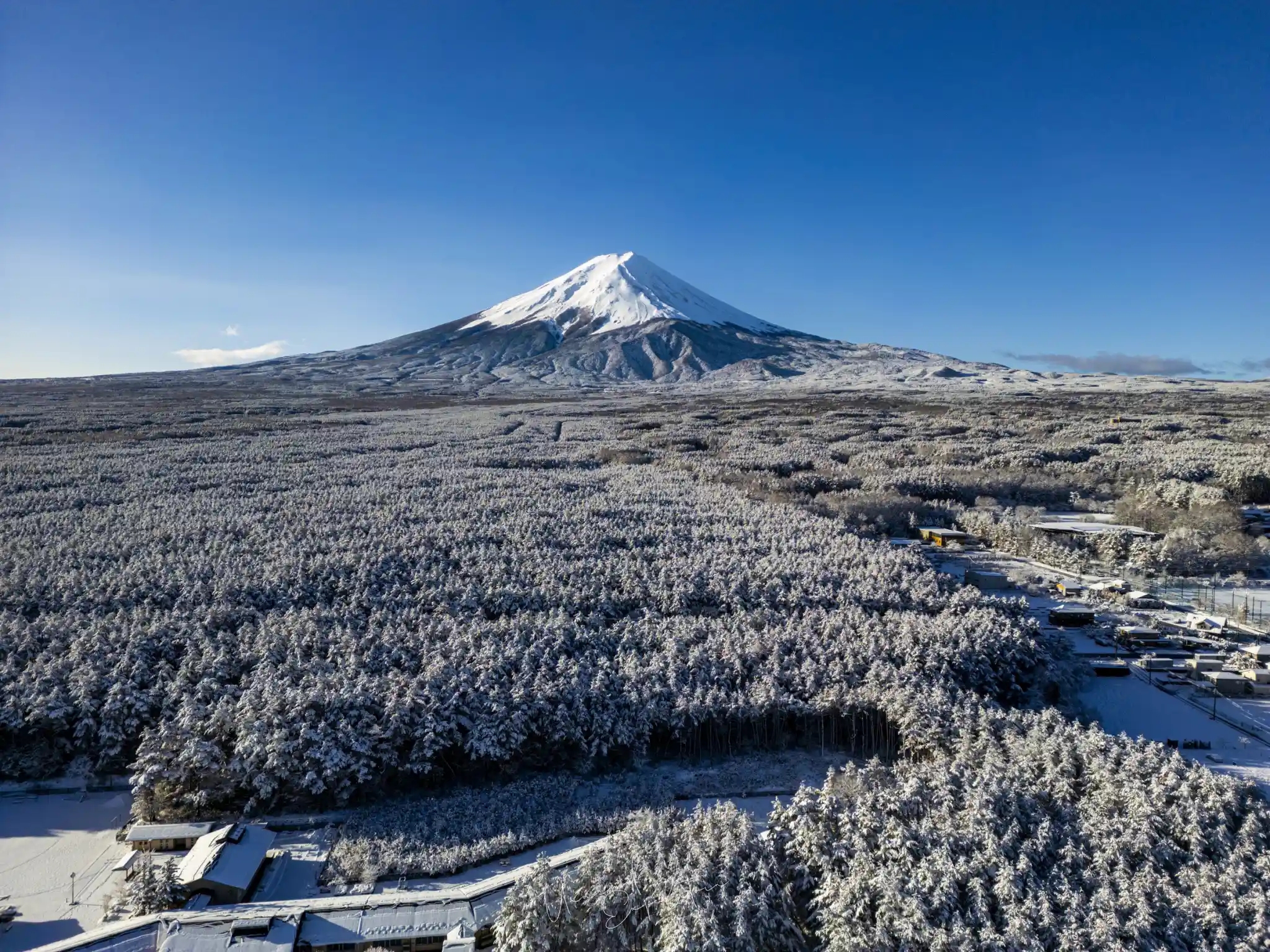
Fujiyoshida, on the Yamanashi side, is where the famous street and shrine views are, and it is busy. After fresh snow the town is quieter at dawn and the forest at the foot of the mountain turns white. We photographed Honcho street, the Arakura Fuji Sengen Shrine and the snowy woods in one cold morning. The Mount Fuji photo spots guide gives the positions, the light and the local rules, which matter here more than anywhere else around the mountain.
Beyond the mountain: Yaizu, Kawazu and the Oi River
Some of our best frames around Fuji have no mountain in them. Before sunrise at Yaizu Port, the Ogawa fish market unloads mackerel from the boats by conveyor, a working scene the Yaizu fish market guide describes. In February the Kawazu cherry trees on the Izu Peninsula bloom about a month before most of Honshu; see the Kawazu cherry blossom festival guide. Inland, the Oigawa Railway runs up a river valley of tea fields, red bridges and emerald dam lakes.
Mount Fuji world heritage site: why the shrines matter
UNESCO lists the mountain as "Fujisan, sacred place and source of artistic inspiration", inscribed in 2013. The listing is not only the cone: it includes 25 component sites, among them Sengen shrines, pilgrim routes, lakes and springs, and it cites the prints of Hokusai and Hiroshige. That is useful for photographers. The shrines and torii gates around the base are part of what made Fuji famous, so a frame with a shrine in front is not a cliché but the subject UNESCO describes. Be quiet and quick at working shrines, and keep tripods off the paths.
What camera gear do you need for Mount Fuji?
A standard 24-70mm covers streets, terraces and markets. A 70-200mm or longer pulls the summit up behind a foreground from a distance, which is how the sea and street frames work. Bring a tripod for dawn and dusk, and a polariser for the sea views. In winter, carry spare batteries in an inner pocket; dawn on the Yamanashi side is well below freezing after snow. Japan's drone rules are set by the Ministry of Land, Infrastructure, Transport and Tourism; check them and any local restrictions before you fly.
People ask me where the best Fuji view is. I tell them to have three, on different sides. The mountain does not care about your plan, so the plan has to include a second and a third place to stand.
Joseph Mak, tour leader, Unusual Expedition
Mount Fuji private tour: how we run it
We have no scheduled Mount Fuji departure, so we run the mountain and its surroundings as a private tour on request, timed for winter clarity or for the blossom, and built around the sides you want to photograph. The Japan private tour guide explains how private trips to Japan work from Singapore.
Explore Mount Fuji in depth
- Mount Fuji photo spots
- Best time to see Mount Fuji
- Tea fields in Shizuoka
- Japanese tea ceremony experience in Shizuoka
- Yaizu fish market
- Kawazu cherry blossom festival
- Oigawa Railway
Photograph Mount Fuji with us
We arrange Mount Fuji, Shizuoka and Izu as a private trip for individuals, couples, families and photographers, at your own pace, with all logistics arranged to your needs. A private trip can cost less than our group tours because no tour leader travels, and a photographer or photography coaching can be added at extra cost. Ask at least two months ahead; last-minute trips can often be arranged too. See private tours and our Japan photography tours page.
Join the Mount Fuji photography tour
Kyushu, Shikoku And Setouchi Photography Journey departs 25 Sep 2027 To 05 Oct 2027, led by Joseph Mak. Small group, photography first. All Mount Fuji photography tours.
Explore Mount Fuji in depth
- Yaizu Fish Market: Photographing the Ogawa Fish Market at DawnJapan
- Tea Fields in Shizuoka, Japan: Sunrise Terraces, Tea Farms and Mount FujiJapan
- Oigawa Railway: Photographing the Oi River Valley, Bridges and TeaJapan
- Mount Fuji Photo Spots: Fujiyoshida, Nihondaira and the Izu CoastJapan
- Kawazu Cherry Blossom Festival: Photographing Kawazu-zakura on IzuJapan
- Japanese Tea Ceremony Experience in Shizuoka: Sencha with a Tea MasterJapan
- Best Time to See Mount Fuji: Visibility by Month for PhotographersJapan
Upcoming Photo Tours
- Egypt Photo Tour – EgyptEgypt 12 Dec 2026 To 20 Dec 2026
- Inner Mongolia Winter Owl Photo Tour – ChinaChina 01 Jan 2027 To 04 Jan 2027
- Inner Mongolia Winter Photo Tour – ChinaChina 05 Jan 2027 To 11 Jan 2027
- Mekong And Central Highland Vietnam Photo Tour - VietnamVietnam 16 Jan 2027 To 24 Jan 2027