
Pienza, Italy: Photographing the Renaissance Town Above the Val d'Orcia
Pienza, Italy: what it is known for, the town on its ridge from the valley, its cathedral lanes, morning streets and dusk views.
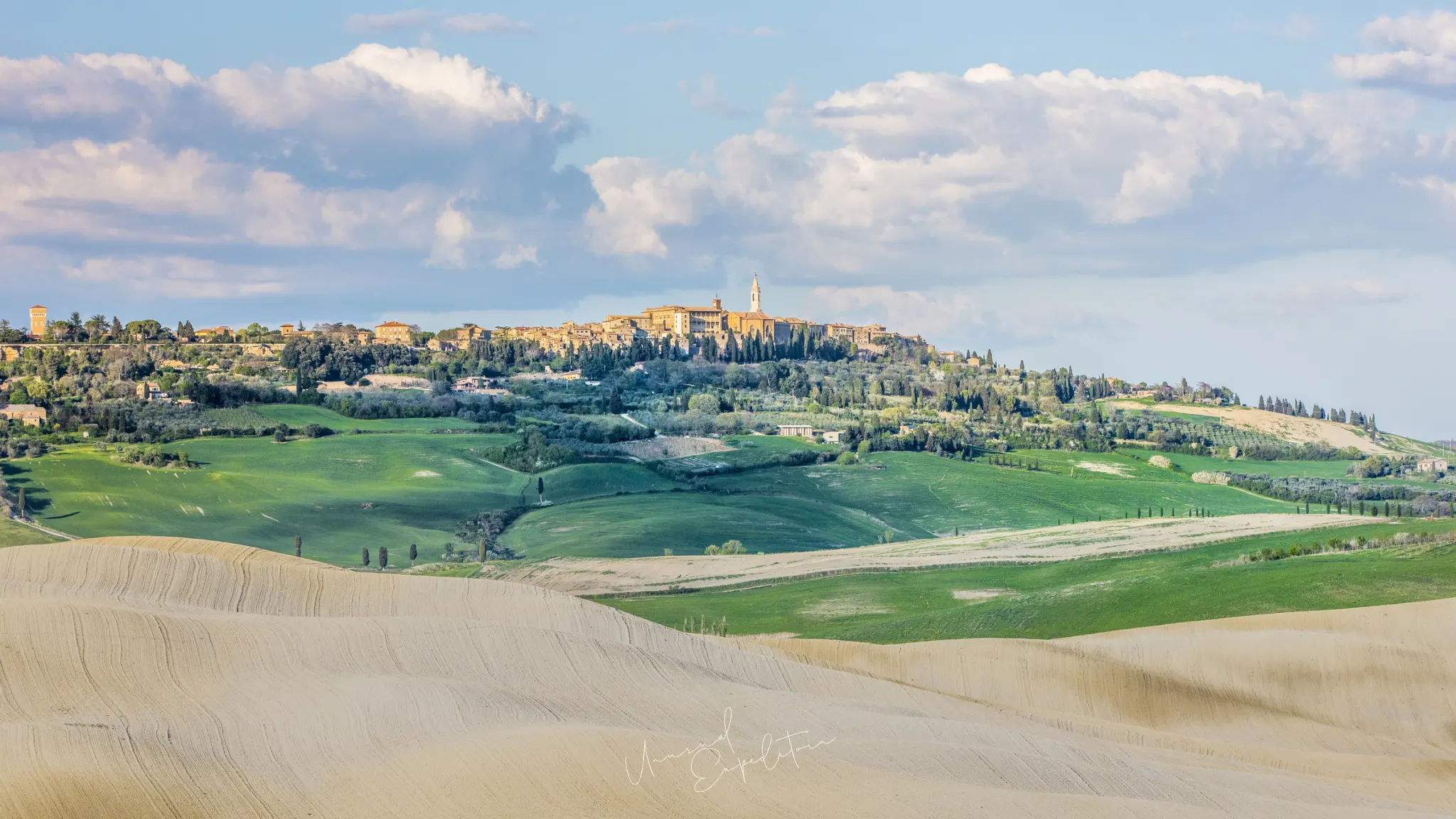
Pienza, Italy, is a small hill town on a ridge above the Val d'Orcia, rebuilt in the 15th century by Pope Pius II as a model Renaissance town and listed by UNESCO as a World Heritage Site in 1996. For photographers it works two ways: from the valley, as a long line of walls and towers on its ridge above the fields, and from inside, as a few quiet streets of honey-coloured stone around a perfect little square. Mornings suit both.
Pienza sits at the heart of the area in our Tuscany photography tour guide, between the Belvedere, the Vitaleta chapel and the white roads described in Val d'Orcia viewpoints.
What is Pienza known for?
Pienza is known first for its history. Enea Silvio Piccolomini was born in the village, then called Corsignano, and after he was elected pope as Pius II he had its centre rebuilt and renamed after himself. UNESCO describes it as the place where Renaissance ideas of town planning were first put into practice, with the architect Bernardo Rossellino laying out a cathedral, a papal palace and a town hall around one square. The town is also known for its pecorino cheese and for its views: the walk along the southern walls looks straight across the Val d'Orcia to Monte Amiata. All three show up in pictures, whether you set out to photograph them or not.
Pienza, Val d'Orcia: the town from the valley
The best picture of Pienza in the Val d'Orcia is not taken in the town but from the fields below it. From the roads to the south and west, the whole of Pienza appears on its ridge: the long run of walls, the roofs stepping up behind them, the cathedral bell tower at one end. In spring the foreground is green wheat and pale strips of bare clay, which gives you layers of colour below the town. A 70-200mm is the lens: it pulls the town forward and lets you choose how much field and sky to include. Side light, early or late in the day, gives the walls and roofs their shape; under a high sun the town flattens into one pale line.
Pienza cathedral and the lanes around it
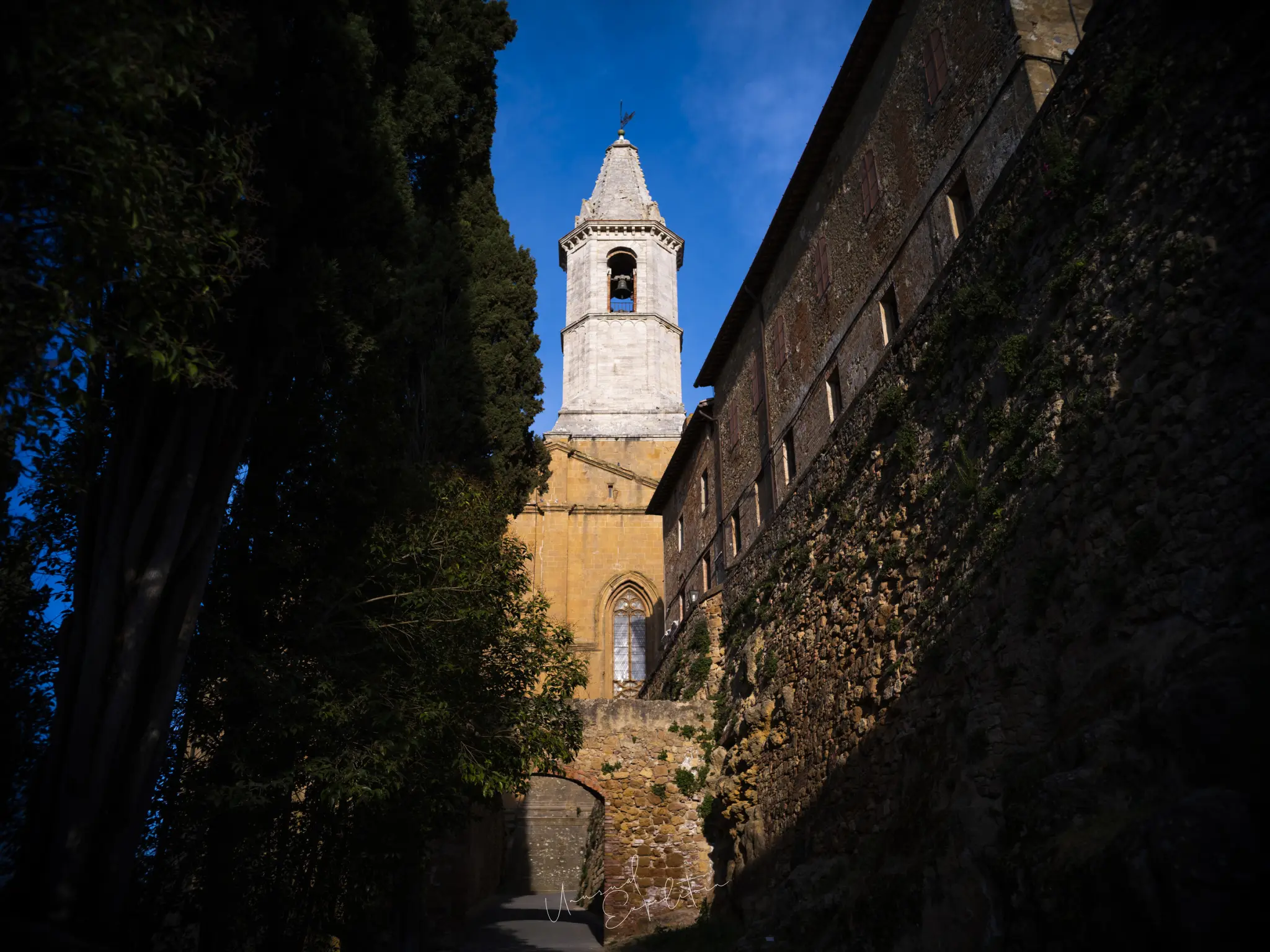
Inside the walls, the subject is light in narrow spaces. Pienza cathedral, the Duomo, stands on the main square with the Palazzo Piccolomini beside it; behind and around them, lanes of stone and brick run between high walls, and the bell tower appears above the rooftops at the end of them. In the morning the sun reaches down only in places, so the tower is lit against a deep blue sky while the lane is still in shadow. Expose for the bright tower and let the walls fall dark, or bracket and blend. A wide lens close to one wall makes the lane a frame for the tower.
Pienza, Tuscany: stone houses and morning streets
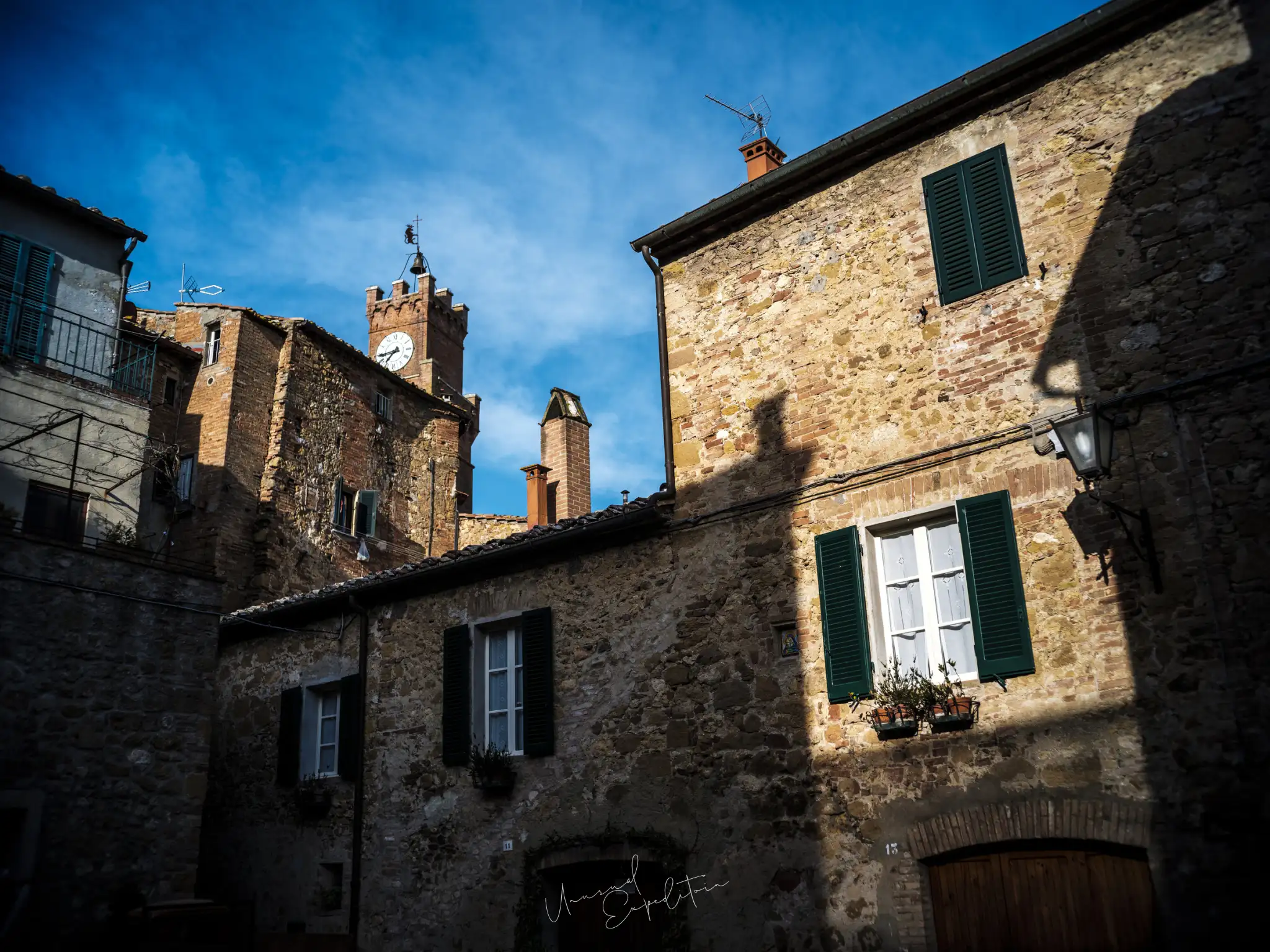
The rest of Pienza, Tuscany, is a few parallel streets of stone houses with green shutters, flower boxes and archways, small enough to walk end to end many times over. The light changes the streets more than anything else. Early in the morning, before the shops open and the coaches arrive, the sun comes in low along the east-west streets and throws long shadows on the paving, and people of the town go about their day. That is when to be there. A 24-70mm covers most of it; a longer lens picks out a window, a doorway or a clock tower above the roofs.
"Pienza is so small that you can walk it in the time the light changes. I like to be inside the walls early in the morning. The streets are empty, the sun comes in sideways, and every few steps there is another picture."
Joseph Mak, tour leader, Unusual Expedition
Pienza, Italy, photos with people
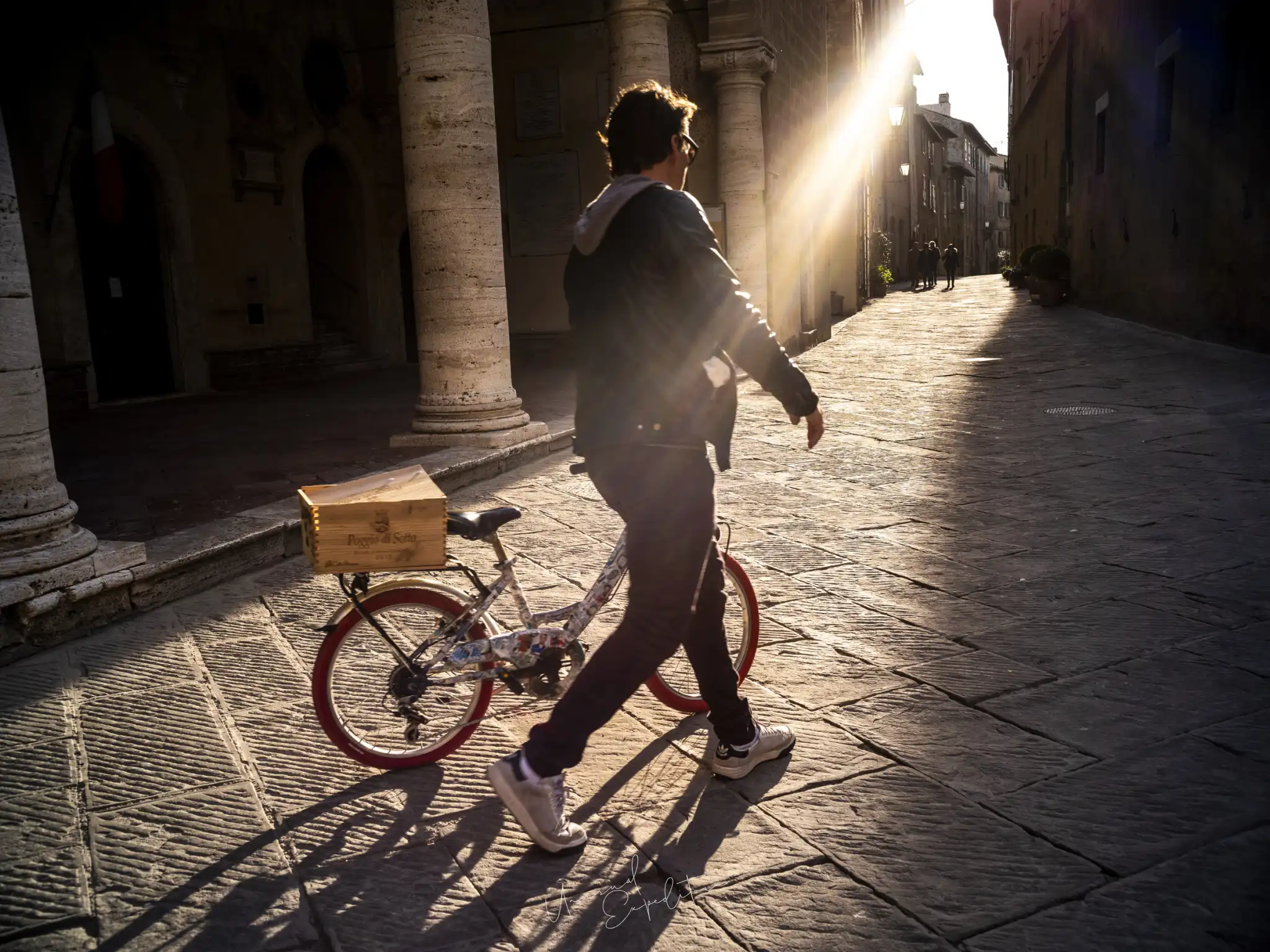
Pienza, Italy, photos come alive with a figure in them: someone crossing a patch of light, a bicycle leaning on a wall, a delivery being made. In the low morning sun, the trick is to stand on the shadow side and wait for someone to walk into the light, then expose for the bright paving so the person becomes a silhouette. That keeps the picture about the street and keeps strangers anonymous. If you want a portrait, ask first and show the picture afterwards; most people in a small town are used to cameras and generous with a smile, but they are going about their lives.
Pienza palazzo Piccolomini and the hanging garden
The Palazzo Piccolomini, the papal palace Pius II built beside the cathedral, turns its back on the square and its face to the valley. On the south side, a loggia of three storeys opens onto a small hanging garden, and through its arches the Val d'Orcia spreads out to Monte Amiata. It is the view Rossellino designed the building around, and it is one of the few places where you can frame the landscape with Renaissance architecture in the same picture. A 24-70mm through one of the arches, exposed for the bright valley, turns the arch itself into a dark frame. Visits to the palace are guided at set times, so check the official site before you travel if the garden is on your list.
Pienza or Montepulciano?
| Pienza | Montepulciano | |
|---|---|---|
| Size | Small, a few streets | Larger, steep main street |
| Known for | Renaissance square, pecorino, valley views | Vino Nobile wine, palaces, cellars |
| Best picture | The town on its ridge from the valley | The town on its hilltop from the plain |
| Best light | Morning | Late afternoon |
Both are worth a visit, but if you have time for only one at sunrise, Pienza is closer to the classic valley viewpoints.
Pienza at dusk from the walls
At the end of the day, come back to the walls. The walk along the southern edge of Pienza looks out over the Val d'Orcia, and as the sun drops the valley turns from green to blue and the farms on the far ridges catch the last light. It is a place for a tripod and patience; the light after sunset often beats the sunset itself. For the views from the valley floor, see Val d'Orcia viewpoints; for the season, Tuscany in spring.
Photograph Pienza with us
We include Pienza in private Tuscany trips on request, planned around the morning light and your own pace; a photographer or photography coaching can be added at extra cost. See private tours and our Italy photography tours.
Tuscany photography tours
The next Tuscany departure is announced on the Tuscany photography tours page, with previous expeditions and all the planning guides.
Explore Tuscany in depth
- Tuscany Photography Tours: The Val d'Orcia, Crete Senesi, Abbeys and Hill TownsItaly
- Val d'Orcia Viewpoints: Belvedere, the Cypresses, Vitaleta and the White RoadsItaly
- Tuscany Landscape Photos: Lone Trees, Farmhouses and Hills in Side LightItaly
- Tuscany in Spring: Green Wheat, Mist and When the Hills Turn GoldItaly
- San Galgano Abbey: Photographing Tuscany's Roofless Abbey and MontesiepiItaly
- Cypress Road Tuscany: Photographing the Baccoleno Curve and Cypress AvenuesItaly
- Best Photo Spots in Florence: The Arno, Ponte Vecchio and Views From AboveItaly
Upcoming Photo Tours
- Egypt Photo Tour – EgyptEgypt 12 Dec 2026 To 20 Dec 2026
- Inner Mongolia Winter Owl Photo Tour – ChinaChina 01 Jan 2027 To 04 Jan 2027
- Inner Mongolia Winter Photo Tour – ChinaChina 05 Jan 2027 To 11 Jan 2027
- Mekong And Central Highland Vietnam Photo Tour - VietnamVietnam 16 Jan 2027 To 24 Jan 2027