
Pietrapertosa, Italy: Dawn Over the Village in the Rock
Pietrapertosa Italy at dawn: the village under its sandstone rock, the castle and the Arabata, Castelmezzano and the zip line.
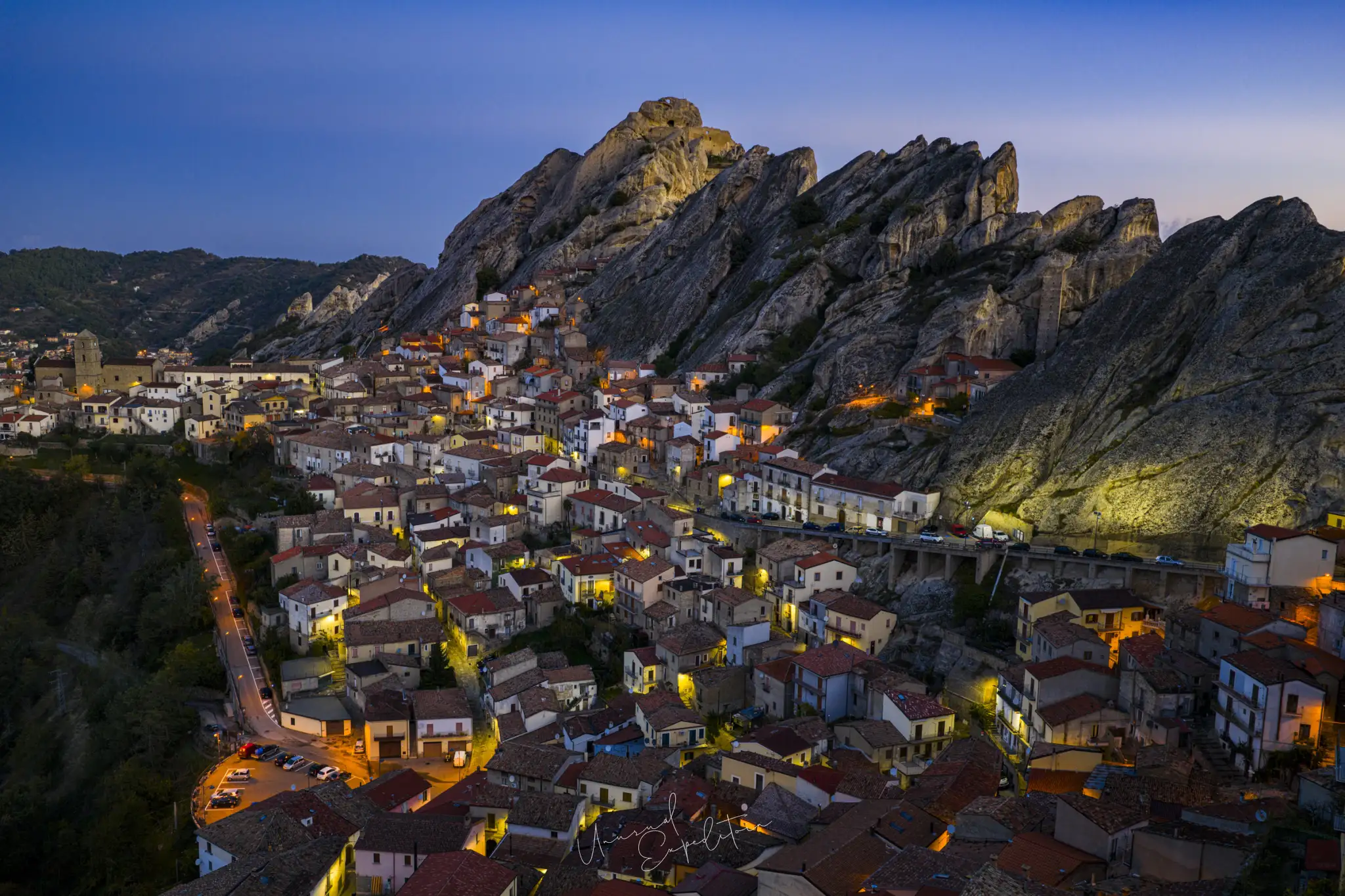
Pietrapertosa, Italy, is a village in Basilicata built against a great wall of sandstone in the Lucanian Dolomites, with a ruined castle on the rock and the old Arabata quarter below it. Italia.it calls it the highest village in the region. For photographers it is a dawn place: the lamps still burn in the lanes while the sky turns pink behind the peaks, then the first sun lights the top of the rock. Here is where to look, what to know and how it pairs with Castelmezzano.
Pietrapertosa shares its ridge and its regional park with Castelmezzano, and our Basilicata photography tour guide covers the two villages together, the park, the seasons and the way in. The photographs here are our own, made in the village and above it; we hold the rights to them.
Pietrapertosa Italy: the village in the rock
Pietrapertosa takes its name from a pierced stone, a rock with a hole through it at the entrance to the village, according to I Borghi più belli d'Italia, the association of Italy's most beautiful villages, which counts it as a member. The village is built straight onto bare rock at more than 1,000 metres. Seen from the road below, the houses fill a slope that ends in a jagged ridge of sandstone, and the village seems small against it: a few hundred roofs, a church tower, a road on a viaduct cut along the cliff. That scale is the subject. Whatever the light, include enough rock above the houses to show where they are, and enough sky to give the peaks room. The ridge runs across the top of the village, so a wide frame from the side shows its whole saw-toothed line.
Pietrapertosa at dawn
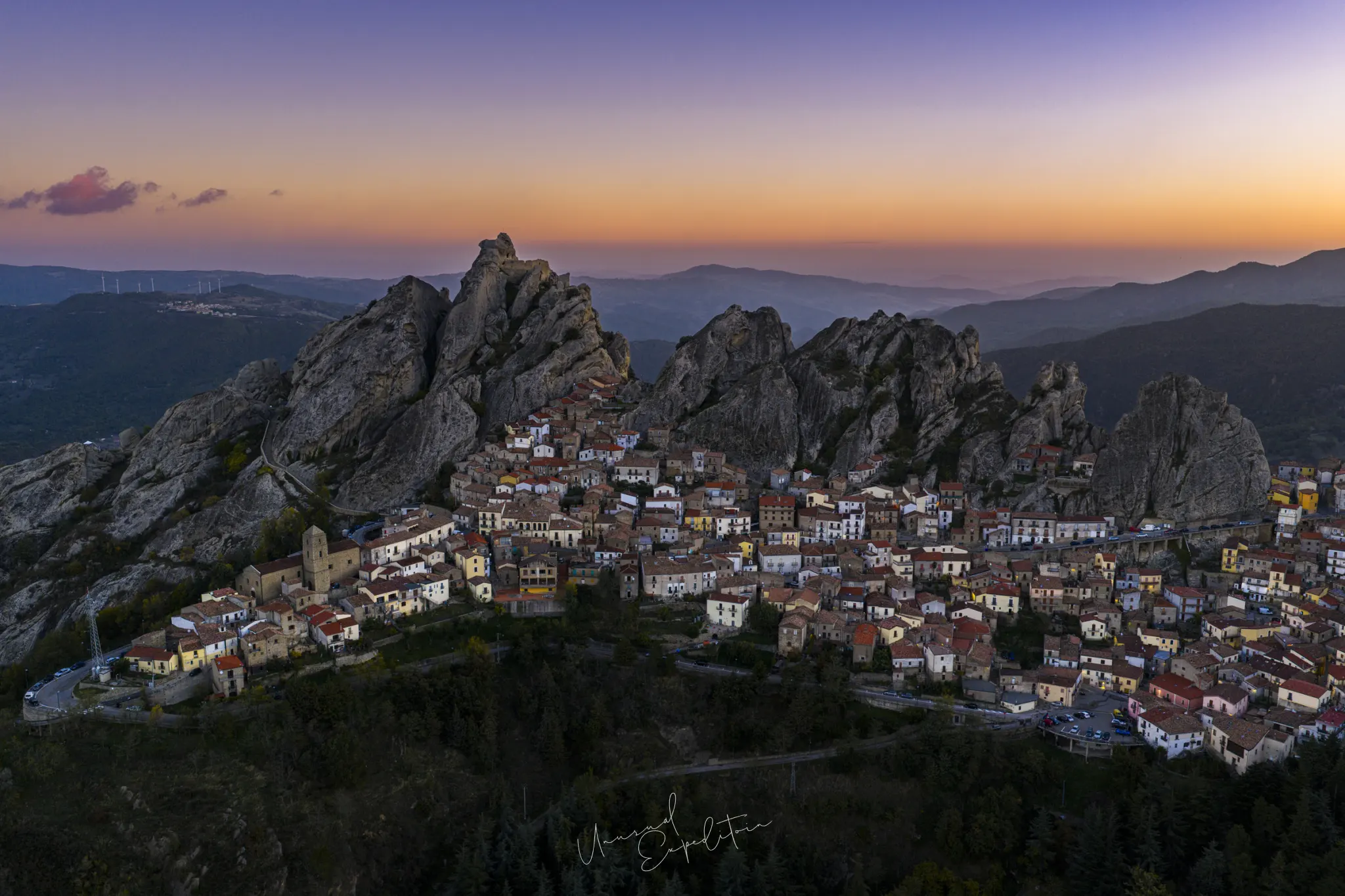
Pietrapertosa at dawn is when the village looks its best, and it is the light we chose for the feature photograph. Before sunrise the street lamps are still on, a long wall of rock above the road is lit from below, and the sky behind the peaks goes from deep blue to rose. The window is short. Arrive in the dark, set up while the lamps are on, and keep shooting as the sky warms, because the balance between lamps and sky lasts only a few minutes. As the light grows, step further back: from a distance the whole saw-toothed ridge stands against a sky going from violet to orange, with the hills of Basilicata fading behind it in layers, as in the frame below. Soon after, the first sun touches the summit of the rock before it reaches the houses. A 24-70mm covers the village and the ridge; a 70-200mm stacks the distant hills. Dress warmly: at this height autumn and winter dawns are cold.
The old town, the church tower and the Arabata
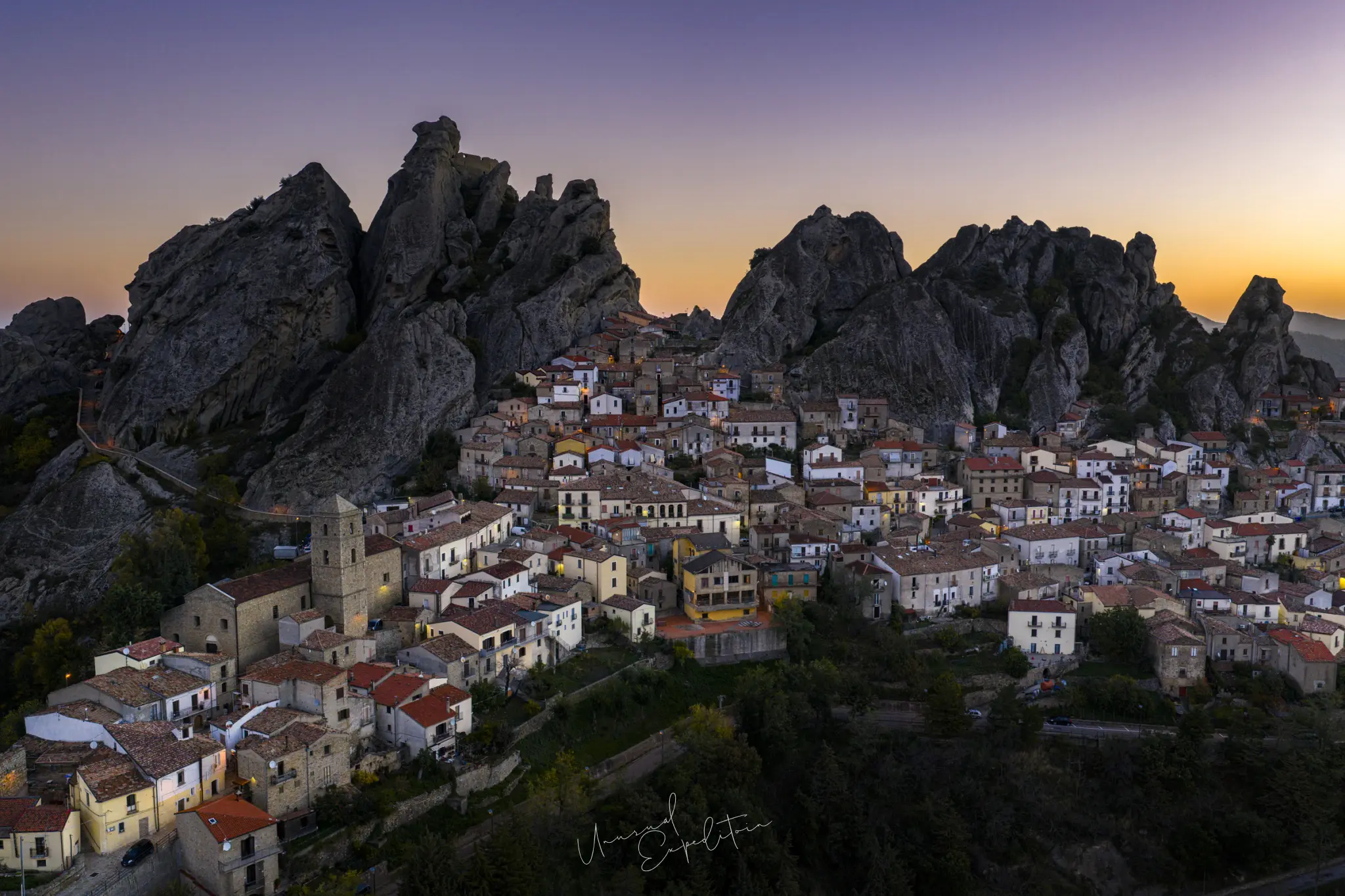
The old town of Pietrapertosa climbs from the church to the castle. A stone bell tower rises out of the lower village, and above it the lanes narrow into the Arabata, the oldest quarter, which I Borghi più belli d'Italia describes as a maze of steep alleys and stairways with small houses built against the rock, of Arab origin. In the half light before sunrise the tower stands out against the dark houses and the peaks go black against an orange sky, a frame that works from a little further down the slope, as below. On foot, the Arabata is a place for close work: worn steps, doors set into the rock, a window under an overhang. Treat it as a neighbourhood people live in, keep voices down early in the morning and ask before photographing anyone at their door.
Pietrapertosa castello: the castle on the rock
The Pietrapertosa castello sits at the highest point of the village. Italia.it dates it to the 11th century, when Prince Bomar built it as a Saracen fortress and made it his residence; the Normans and then the Swabians took it over, and it is known today as the Norman-Swabian castle. What remains are walls, a tower, the dungeons and two cisterns, with a natural rock arch and a lookout over the Basento valley. A staircase set against the houses leads up to it. For photographs, the castle is better as a viewpoint than as a subject: from the top, the roofs of the Arabata fall away below and the ridge continues on either side. Check opening on the spot or with the village before you climb.
Pietrapertosa and Castelmezzano: the two villages
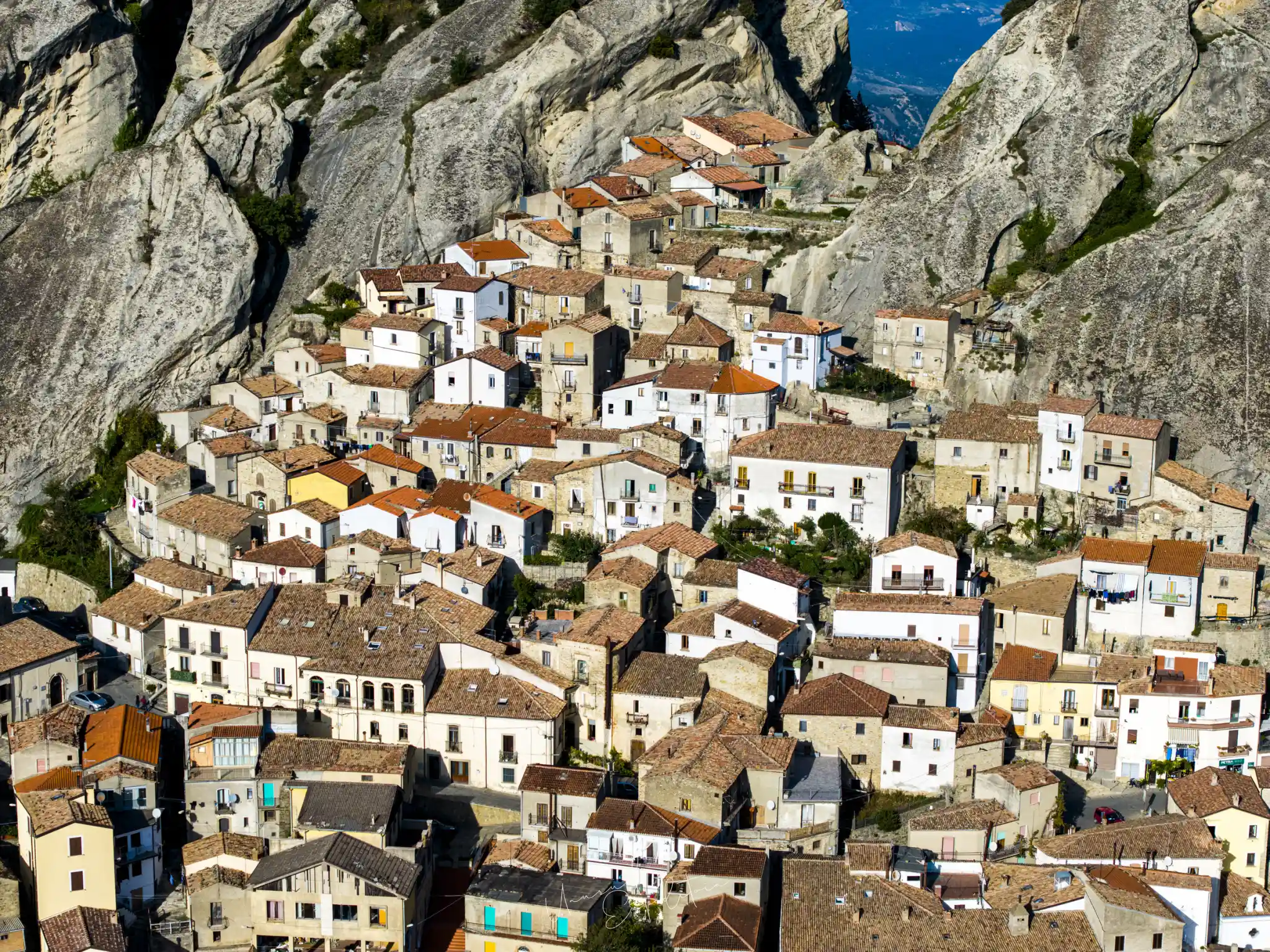
Pietrapertosa and Castelmezzano face each other across the same group of peaks, and most visitors see both. Castelmezzano is the more famous view: a steep village packed into a hollow between rock walls, best at dusk from across the slope, as our pillar guide shows. From the air it looks different again, a tight mass of roofs squeezed between two grey cliffs, as in the photograph below. Between the villages runs the Percorso delle Sette Pietre, the Path of the Seven Stones, an old country track with seven installations on local tales of witches and flight. Walk it in the morning, after the dawn in Pietrapertosa, and keep the evening for Castelmezzano. For Matera, the other great stone town of Basilicata, see our Sassi di Matera article.
Volo dell'Angelo Pietrapertosa
The Volo dell'Angelo starts in Pietrapertosa on one of its two lines. Italia.it gives the San Martino line as about 1.4 kilometres from Pietrapertosa to Castelmezzano at up to 110 km/h, with the Peschiere line coming back; a ticket covers both, with a shuttle between the villages. The operator, volodellangelo.com, takes bookings online only and publishes its calendar of open days each season, from spring into early winter. Riders are tiny against the rock, so photograph them with a long lens from a terrace in the village, not from the launch.
Pietrapertosa altitude and weather
Pietrapertosa altitude is given as just over 1,000 metres by Italia.it and as about 1,088 metres for the village by I Borghi più belli d'Italia; either way, it is high for southern Italy. Summers are warm and dry, with haze in the middle of the day. Spring and autumn bring clearer air and the best chance of a coloured dawn. Winters are cold, and snow is possible in the village and on the peaks, which makes for fine pictures but harder roads; check conditions before you drive up. Whatever the season, the light worth the climb comes at the two ends of the day, so plan to be in position early.
| Subject | Where from | Light | Lens |
|---|---|---|---|
| Village and ridge | Slopes and terraces below the village, or the air | Before sunrise | 24-70mm |
| Summit of the rock | Below the village | First sun | 70-200mm |
| Church tower and peaks | Lower slope | Dawn, silhouettes | 24-70mm |
| Arabata lanes | On foot in the old quarter | Open shade, morning | 24-70mm |
One dawn covers the first three; the lanes can wait until later in the morning.
"In Pietrapertosa I get up in the dark. The lamps are still on, the rock is lit from below, and then the sun hits the very top of the peak while the village is still blue. That is the picture."
Joseph Mak, tour leader, Unusual Expedition
Is Pietrapertosa worth visiting?
Is Pietrapertosa worth visiting? For a photographer, yes, as long as you stay the night or arrive before dawn. By day it is a quiet hill village with a castle and a view; at dawn it becomes one of the strongest pictures in southern Italy. Pair it with Castelmezzano for the evening light, add Matera for the night, and the interior of Basilicata gives a short trip three very different kinds of stone town. The Italy photography tour guide covers entry, money and the rest of the country.
See Pietrapertosa at dawn with us
We run Basilicata as a private trip on request, timed around the dawns and the evenings, and we arrange all the logistics to your needs. See private tours and our Italy photography tours page.
Basilicata photography tours
The next Basilicata departure is announced on the Basilicata photography tours page, with previous expeditions and all the planning guides.
Explore Basilicata in depth
Upcoming Photo Tours
- Egypt Photo Tour – EgyptEgypt 12 Dec 2026 To 20 Dec 2026
- Inner Mongolia Winter Owl Photo Tour – ChinaChina 01 Jan 2027 To 04 Jan 2027
- Inner Mongolia Winter Photo Tour – ChinaChina 05 Jan 2027 To 11 Jan 2027
- Mekong And Central Highland Vietnam Photo Tour - VietnamVietnam 16 Jan 2027 To 24 Jan 2027