
Sassi di Matera: The Viewpoints, Sunset and Matera at Night
Sassi di Matera in Basilicata: the viewpoints over the cave town, Matera at sunset and at night, drones and camera settings.
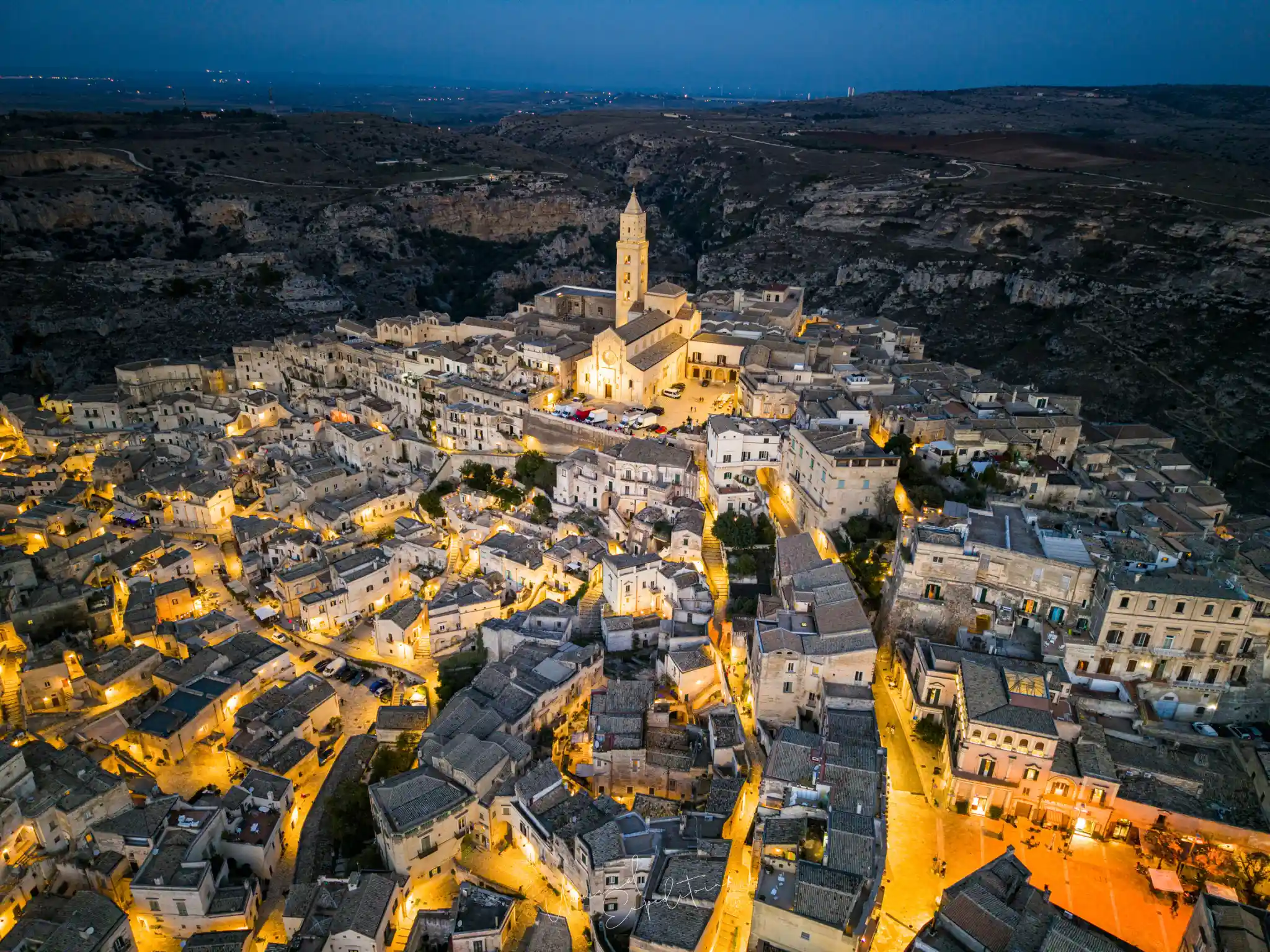
The Sassi di Matera are the two ancient cave districts of Matera, in Basilicata, where houses, churches and stairways are cut into and stacked against the limestone wall of a ravine, crowned by the cathedral on the ridge between them. They are best photographed at the end of the day, when the stone turns gold, then blue, and the lights come on along the alleys. Where to stand, how to shoot Matera at night and how it fits with a Puglia trip are below.
Matera is in Basilicata, not Puglia, but it lies close to the border and most people visit it with the trulli country. Our Puglia photography tour guide covers the region around it, the seasons and getting there, and the Italy photography tour guide the country as a whole.
Sassi di Matera: what you are looking at
The Sassi di Matera are two districts, the Sasso Barisano and the Sasso Caveoso, on the slopes of a deep ravine, the Gravina, with the Civita, the old hill topped by the cathedral, between them. People have lived in caves here since prehistory, and over centuries the caves were extended with built facades, so that what looks like a town of stone houses is often a front for rooms dug into the rock. The districts were emptied in the twentieth century because of poverty and poor living conditions, then slowly restored, and UNESCO inscribed the Sassi and the park of rock-cut churches as World Heritage in 1993. For a photographer that history shows in the texture: layer upon layer of roofs, stairs and doorways, all in the same honey-coloured stone, with the bell tower rising above it.
Matera photos: the viewpoints
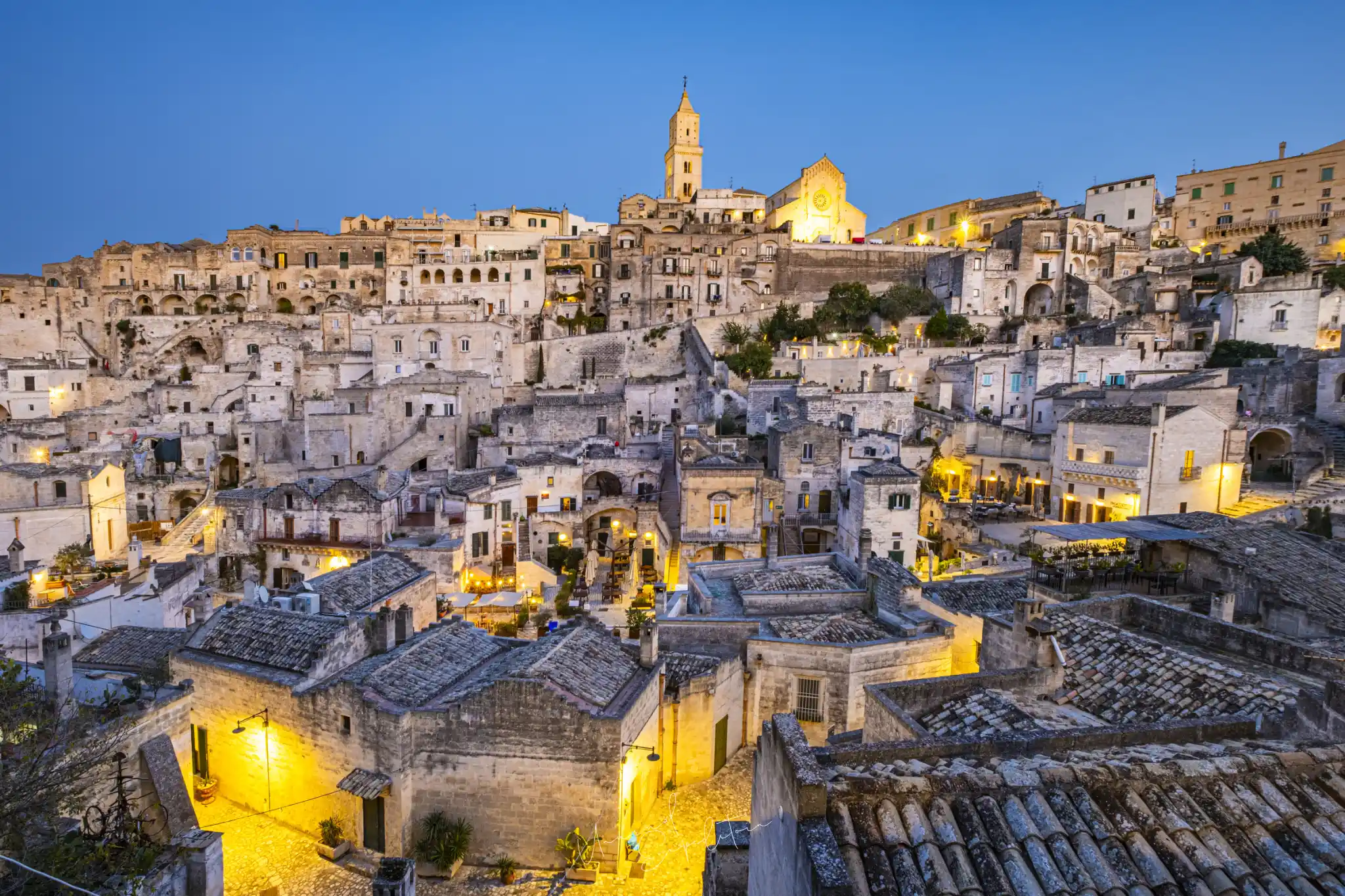
Matera photos come mostly from above, because the Sassi fill a bowl and the best views look down into it. The edge of the newer town, at the top of the slope, has several terraces and lookouts over the Sasso Barisano and the cathedral, such as Piazzetta Pascoli and the belvedere off Piazza Vittorio Veneto, and the lanes and stairways of the Sassi themselves open up new views at every turn. Across the ravine, the Murgia plateau opposite the town gives the whole of Matera on its cliff, which suits a longer lens and sunrise light. We photographed the cathedral above the rooftops from the top of the slope at blue hour, and from the air at dusk and after dark. Walk the Sassi in daylight first to find your frame, because in the evening the alleys are dark and the stairs uneven.
Matera at night
Matera at night is the picture most people come for. As the sky darkens, warm street lamps come on along the alleys and stairways of both Sassi, and the cathedral is floodlit on its ridge, so the whole bowl of stone glows against a deep blue sky. The best time is the blue hour, when the lamps and the sky are in balance; a little later the sky turns black and the contrast grows. From the terraces at the top of the slope, a tripod and exposures of a few seconds give clean, detailed frames. From the air the effect is stronger still: the lit lanes trace the shape of the districts like veins in the rock, as in our feature photograph. Stay into the night anyway, because the empty, lamplit alleys are a quieter subject of their own.
"Matera does not need a sunset. Wait until the lamps come on in the Sassi. The stone holds the last light and the alleys light up, and for a few minutes the whole town looks carved out of gold."
Joseph Mak, tour leader, Unusual Expedition
Matera at sunset
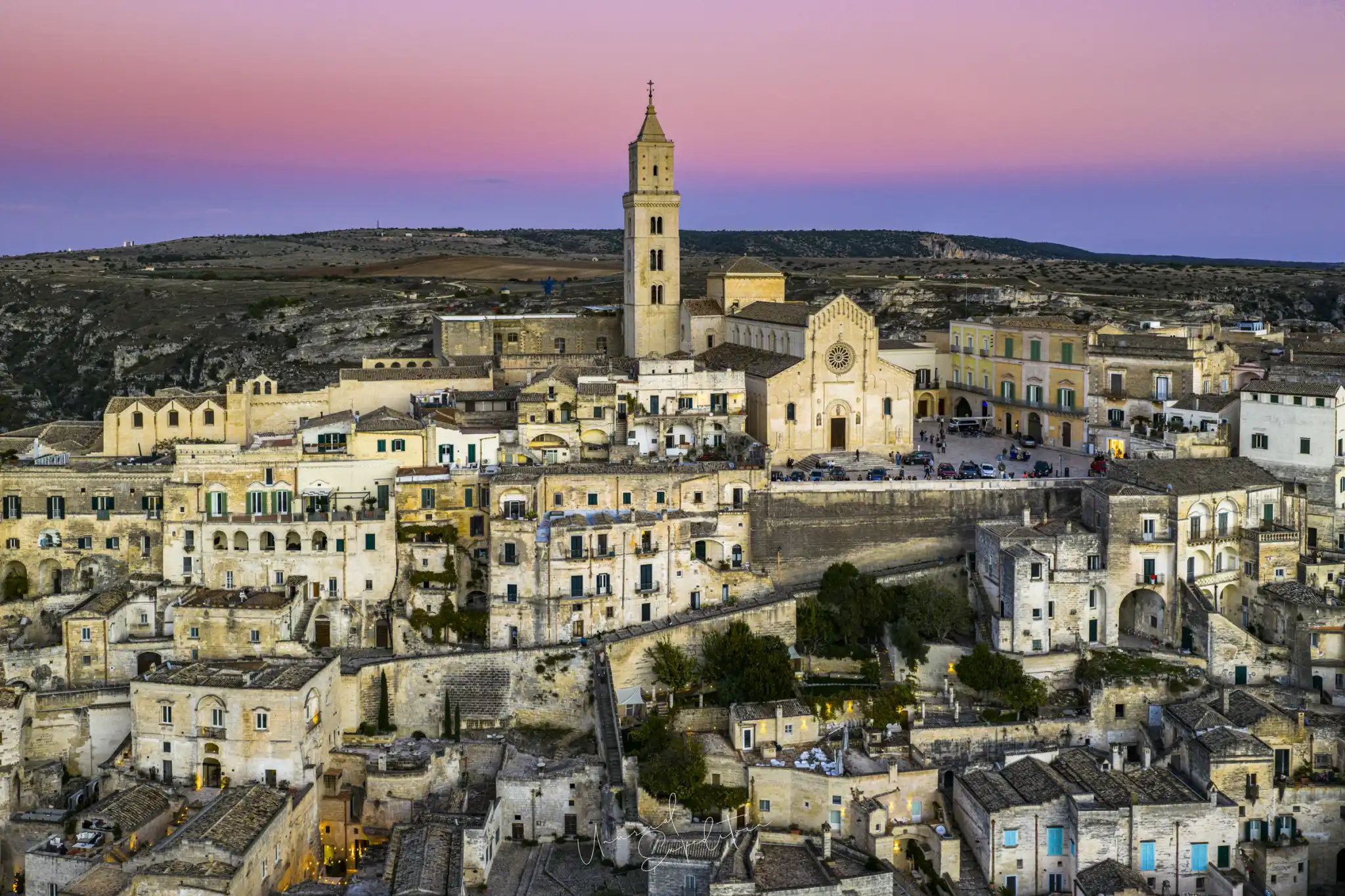
Matera at sunset gives a softer version of the same view. The sun goes down behind the newer town, so the Sassi and the Gravina fall into shade early while the sky above fills with pink and orange, and the stone takes on that colour by reflection. From an elevated position, the bell tower and the cathedral facade stand out against the coloured sky, as in the frame below, made at dusk on our second visit. The light is short, so be in position well before the sun goes and choose whether you want the warm afterglow or the blue hour that follows. If you have two evenings, try one of each, and keep one morning for the view from across the ravine.
Is Matera worth visiting?
Is Matera worth visiting? For photographers, yes, and it deserves at least one night. Few places in Europe show so many centuries of living in one view, and the stone town changes completely between noon, dusk and dark. Day visitors arrive from Bari and the Puglia coast and leave in the late afternoon, so evenings are calmer than the middle of the day suggests. Matera is also compact: the viewpoints at the top of the slope are a short walk from each other, and the stairways down into the Sassi lead to churches cut into the rock and to quiet corners away from the busiest lanes. Combine it with the trulli of the Valle d'Itria, covered in our trulli of Alberobello article, for a trip that mixes very different kinds of stone.
Photographing the Sassi by day
Photographing the Sassi by day is about texture and detail. The midday light is flat on the stone, but the alleys, stairs, doorways and rooftops make good frames in open shade, and the rock-cut churches, several open to visitors with a ticket, hold old frescoes in dim interiors where a fast lens helps. Respect private homes, guest houses and cave rooms that are still lived in, and ask before photographing people at their door. Shoes with grip matter: the stone steps are worn smooth and can be slippery after rain.
Drones over the Sassi
Some of our Matera frames were made with a drone, which shows the shape of the districts better than any viewpoint. Italy follows the EU drone rules: the aviation authority ENAC requires operators to register on its D-Flight portal, which also maps restricted zones, and pilots from outside the EU need the EU open-category certificate. Over a town, keep well clear of people, check D-Flight for restrictions before every flight, and ask locally, because rules for historic centres can be stricter than the general ones.
Camera settings for Matera at night
For Matera at night, use a tripod, a low ISO and an aperture of f/8 to f/11, and bracket: the floodlit cathedral is far brighter than the shaded alleys below it. Keep the white balance on daylight or a little cooler to keep the sky blue and the lamps warm. A 24-70mm frames the cathedral and the Sasso Barisano from the top of the slope; a 70-200mm picks out the bell tower or a single lit stairway. A remote release avoids shake on stone parapets. For the region's other subject, the white trulli in daylight, see our trulli of Alberobello article.
See Matera at dusk with us
We run Puglia and Matera as a private trip on request, with the evenings planned around Matera's light. See private tours and our Italy photography tours page.
Puglia photography tours
The next Puglia departure is announced on the Puglia photography tours page, with previous expeditions and all the planning guides.
Explore Puglia in depth
- Puglia Photography Tour Guide: Trulli, White Towns and Matera at DuskItaly
- Trulli of Alberobello: The Lanes, the Districts and the Trulli in the FieldsItaly
Upcoming Photo Tours
- Egypt Photo Tour – EgyptEgypt 12 Dec 2026 To 20 Dec 2026
- Inner Mongolia Winter Owl Photo Tour – ChinaChina 01 Jan 2027 To 04 Jan 2027
- Inner Mongolia Winter Photo Tour – ChinaChina 05 Jan 2027 To 11 Jan 2027
- Mekong And Central Highland Vietnam Photo Tour - VietnamVietnam 16 Jan 2027 To 24 Jan 2027