
Santorini Photography Tour Guide: Caldera, Oia and the Blue Domes
Santorini photography guide: the caldera, Oia, Firostefani and Fira, the best light at each, crowds, getting there and what to bring.
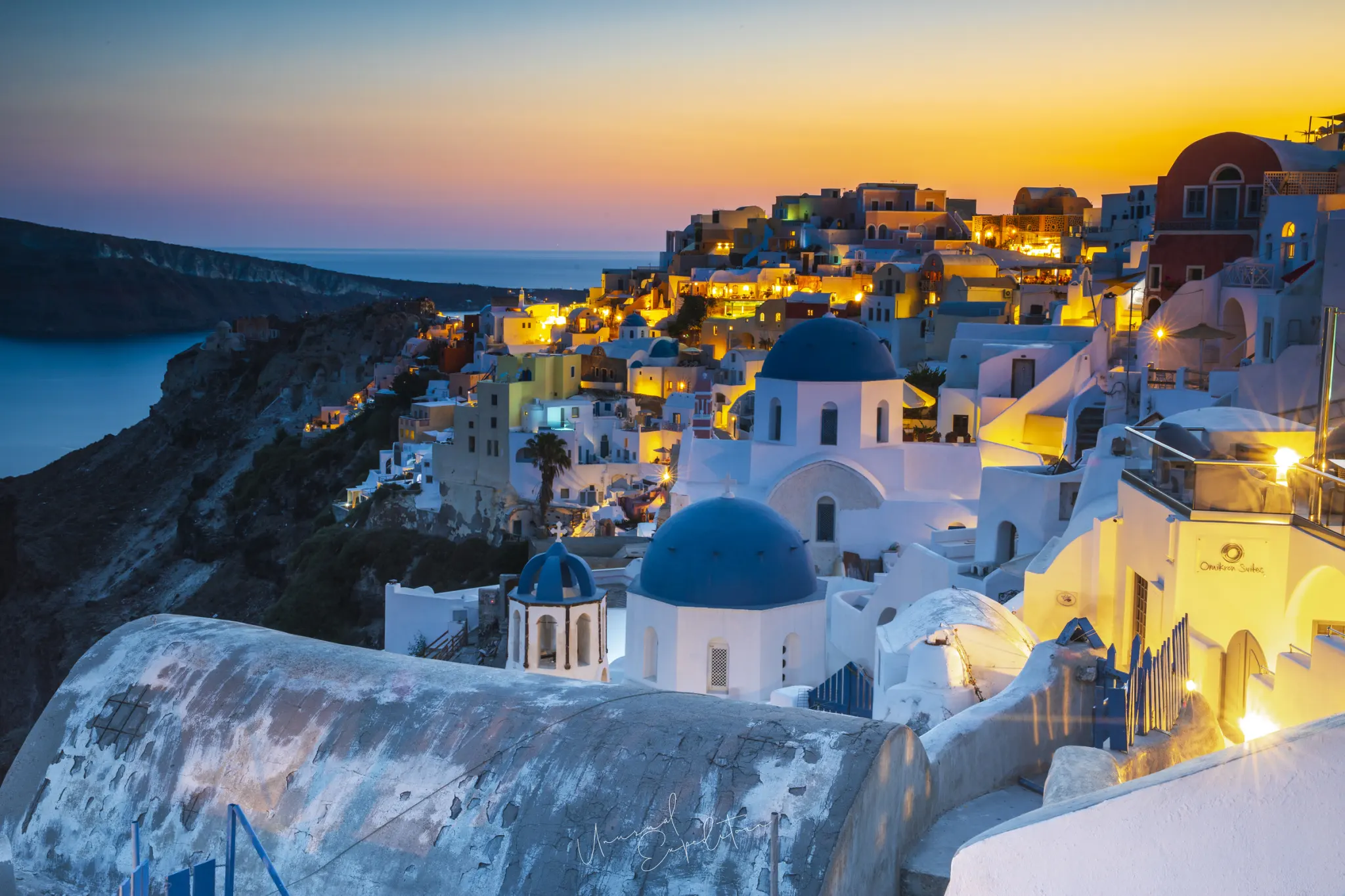
Santorini photography is photography on the rim of a drowned volcano. The villages of Oia, Imerovigli, Firostefani and Fira hang along the top of a cliff above a flooded caldera, so almost every view has a drop, white houses stacked on dark rock, blue domes and the sea far below. The island is at its best at dawn, at sunset and in the blue hour after it, and it rewards anyone willing to work around the crowds. This guide is the start of our Santorini set.
Santorini is one part of our Greece photography tour guide, which covers Athens, Meteora and Mykonos too. The photographs in these Santorini articles are our own, taken on our Greece trip; we hold the rights to them, and the notes come from knowing the island first hand.
Santorini Greece photography: what makes the island different
Santorini Greece photography is different from the other Cycladic islands because of the shape of the land. On most islands the villages sit in a bay or on a gentle hill; here they sit on the lip of a cliff that drops to the sea, with the dark island of Nea Kameni in the middle of the water. That gives a natural vantage point everywhere you walk. Houses are cut into the soft volcanic rock as caves, painted white, and joined by stairways, so lines and curves lead the eye down the slope. The colours are simple: white walls, blue domes and doors, the brown and red of the cliff, and a sea that turns from turquoise near the rocks to deep navy in the caldera.
Santorini caldera: the view that shapes every picture
The Santorini caldera was formed by the Late Bronze Age eruption that blew out the centre of the island about 3,500 years ago, the date the Smithsonian Institution's Global Volcanism Program gives; a 2024 study in Nature Geoscience ranks it among the largest eruptions since the last ice age. The sea flooded in, and later, smaller eruptions built the dark islands of Nea Kameni and Palea Kameni in the middle. For a photographer the caldera is a stage set: it faces west, so the villages on the rim catch the evening light and the sun sets over the open sea beyond, while at dawn the light comes from behind the villages and the caldera fills with soft, even colour.
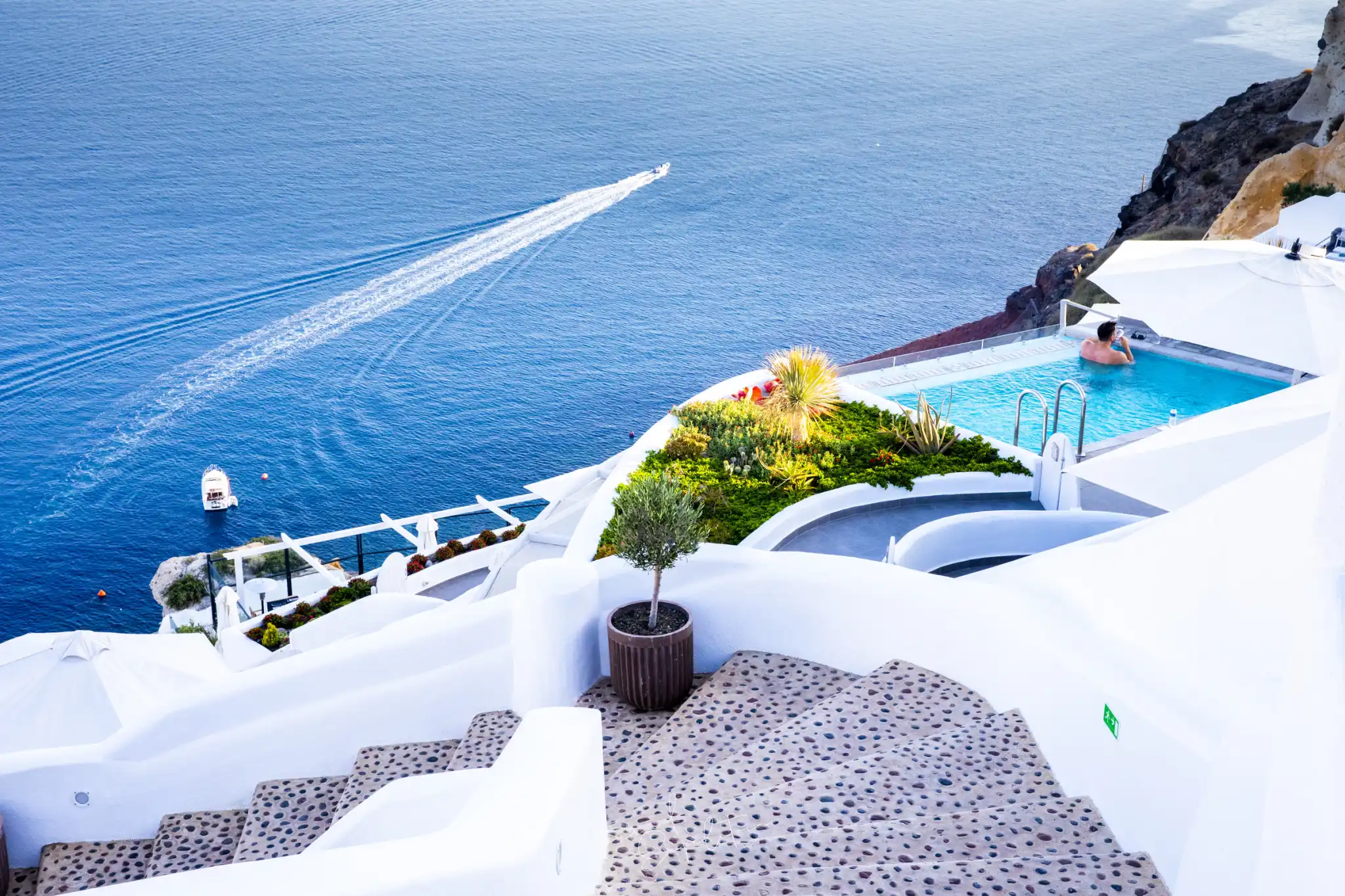
Santorini photography, village by village
| Village | What you photograph | Best light |
|---|---|---|
| Oia | Blue domes, windmills, the castle viewpoint, cave houses down the cliff | Sunset and blue hour |
| Imerovigli | Skaros Rock and the highest stretch of the caldera rim | Sunset, quieter than Oia |
| Firostefani | The Three Bells of Fira and the view to Nea Kameni | Dawn |
| Fira | The old port, the cable car, cruise ships in the caldera, lanes at night | Morning and evening |
Oia takes most of the attention, but the rim path from Fira through Firostefani and Imerovigli gives as many pictures with far fewer people. The individual viewpoints, and where to stand at each, are in Santorini photo spots.
Sunsets, dawns and the blue hour
The Oia sunset is the most photographed moment in Greece, and it is worth seeing once. It is also crowded, and the light on the village itself is often better a little after the sun goes down, when the lamps come on and the sky turns pink and blue. Dawn is the quiet alternative: the caldera is calm and pastel, the lanes are empty and the light is soft. Our Santorini sunset article compares Oia with Imerovigli and with watching from a boat.
"Everybody comes for the Oia sunset, and so do we, once. The pictures I like most from Santorini were made at first light in Firostefani and in the blue hour after the crowds have gone home."
Joseph Mak, tour leader, Unusual Expedition
People and music in the lanes
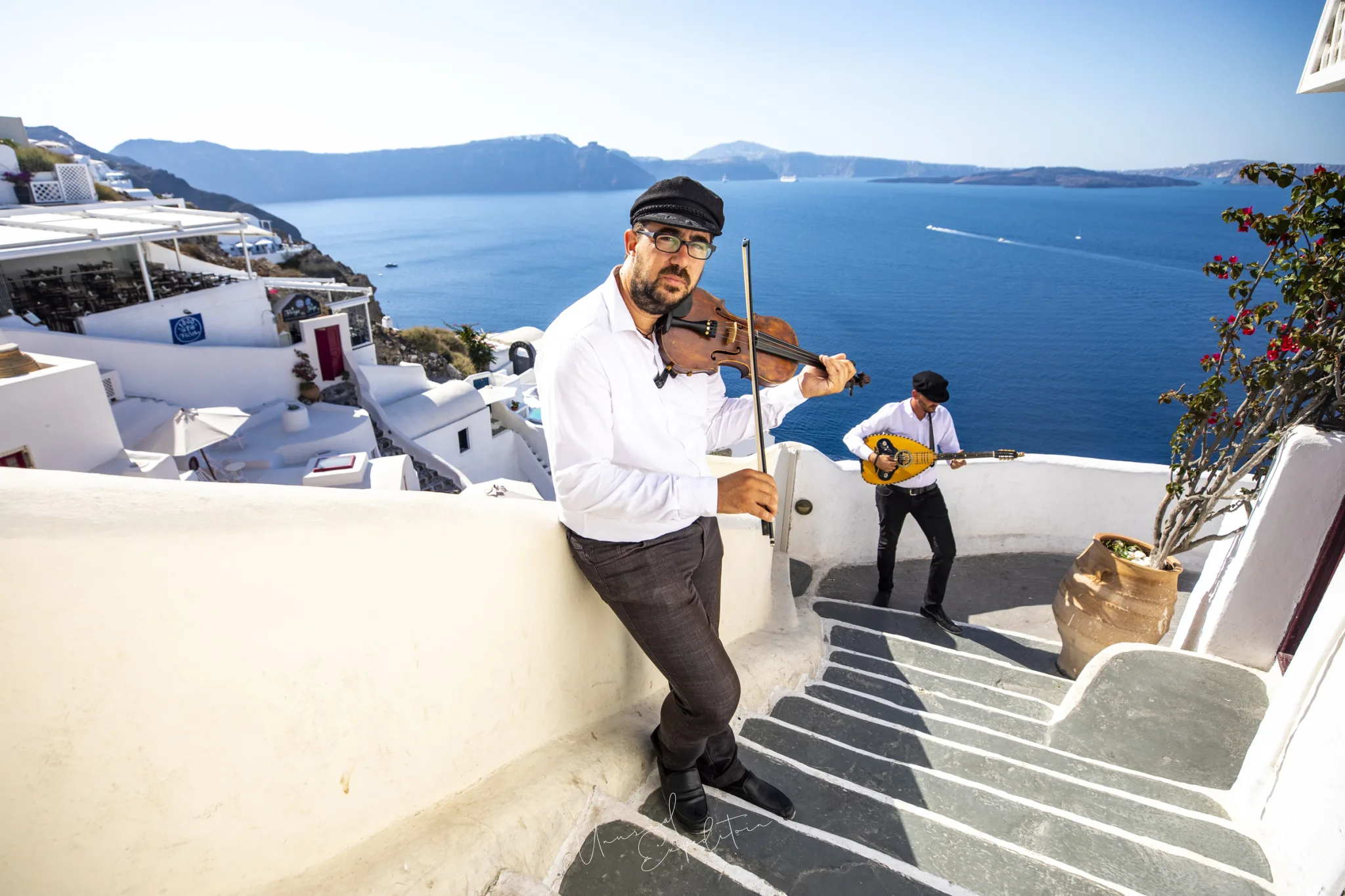
Santorini is not only views. In the lanes of Oia we photographed two musicians, a violinist and a lute player, playing on the whitewashed steps above the caldera, and in the mornings the island's working life, deliveries, cleaners, fishermen's catch, goes on before the visitors arrive. Ask before you photograph anyone up close, and a smile and a few words of Greek go a long way. Santorini is also one of the world's favourite places for couples' pre-wedding photography; we have photographed couples here, and the same rules of light apply: early or late, never at midday.
Is Santorini worth it?
Is Santorini worth it for a photographer? Yes, if you plan for its two problems, crowds and hard midday light. In high summer the lanes of Oia fill well before sunset and cruise ships anchor in the caldera through the day. Stay on the caldera rim rather than in a beach town, so you can walk out at dawn and back in the evening; rest in the middle of the day; and choose the shoulder months. Done that way, it is one of the most rewarding islands in the Mediterranean to photograph. The season-by-season detail is in best time to visit Santorini.
How to get to Santorini from Athens
How to get to Santorini from Athens: by a short domestic flight to the island's airport, or by ferry from the Athens ports of Piraeus or Rafina, either a fast boat or a slower conventional ferry. Ferries arrive at the new port of Athinios below the cliff, and the road climbs from there to Fira. Ferries also link Santorini with Mykonos and the other Cyclades in the main season, which makes it easy to combine islands. Entry rules and flights from Singapore are in our guide to planning a trip to Greece.
What to bring
A 24-70mm covers most of Santorini: the domes, the lanes, the caldera from the rim. A 16-35mm helps on the narrow stairways and for the caldera from Oia castle, and a 70-200mm picks out windmills, domes and boats across the water. A light tripod is useful at blue hour; set it up out of people's way, as the lanes are narrow. A polariser deepens the sea and cuts the glare off white walls. Bring comfortable shoes, because almost everything is steps.
Explore Santorini in depth
- Santorini photo spots
- Santorini sunset: Oia, Imerovigli and from the water
- Santorini photos: white houses, blue domes and the lanes
- Best time to visit Santorini
Photograph Santorini with us
We have no scheduled Santorini departure at the moment, so we run it as a private trip on request, on its own or as part of a wider Greece trip: for individuals, couples, families and photographers at their own pace. We arrange all the logistics to your needs, the cost can be lower than our group tours because no tour leader travels, and a photographer or photography coaching can be added at extra cost. Ask at least two months ahead if you can, though last-minute trips can be arranged. See our private tours and the Greece photography tours page.
Santorini photography tours
The next Santorini departure is announced on the Santorini photography tours page, with previous expeditions and all the planning guides.
Explore Santorini in depth
- Santorini Sunset: Oia, Imerovigli or a CatamaranGreece
- Santorini Photos: White Houses, Blue Domes and the LanesGreece
- Best Photo Spots in Santorini: Oia, the Three Bells and the Caldera RimGreece
- Best Time to Visit Santorini for Photography, and How to Avoid the CrowdsGreece
Upcoming Photo Tours
- Egypt Photo Tour – EgyptEgypt 12 Dec 2026 To 20 Dec 2026
- Inner Mongolia Winter Owl Photo Tour – ChinaChina 01 Jan 2027 To 04 Jan 2027
- Inner Mongolia Winter Photo Tour – ChinaChina 05 Jan 2027 To 11 Jan 2027
- Mekong And Central Highland Vietnam Photo Tour - VietnamVietnam 16 Jan 2027 To 24 Jan 2027