
Wuyuan and Huangshan Photography Tour Guide
Huangshan photography tour guide with Wuyuan: Huizhou villages, Huangling shaiqiu, rapeseed, Hongcun and the sea of clouds.
A Huangshan photography tour that also takes in Wuyuan gives you two very different Chinas a short train ride apart: the white-walled Huizhou villages of Wuyuan in Jiangxi, with rapeseed terraces in March and crops drying on rooftops in autumn, and the granite peaks of Huangshan in Anhui, where the pines grow out of bare rock and the sea of clouds fills the valleys at sunrise. We have photographed both in spring and in late autumn; this is how we see the region.
Every article in our Wuyuan and Huangshan set links back here. For how this region fits with the rest of the country, start with our China photography tour guide.
Wuyuan Huangshan: why photograph the two together
Wuyuan county sits in the northeast corner of Jiangxi, right against the Anhui border, and Huangshan rises just across it. Historically both belonged to the old Huizhou region, which is why the villages on either side share the same architecture: whitewashed walls, black tile roofs and the stepped horse-head gables that were built as firebreaks. That shared look is what makes the region work as one trip. You spend the soft hours in villages, on river banks and above terraces, then you go up the mountain for the hard, graphic light of granite and cloud.
The two halves also balance each other on bad days. Fog that ruins a Huangshan sunrise is exactly what you want in a Wuyuan river valley, and a flat grey day in the villages is good for lanes, doorways and interiors.
Wuyuan China: the villages and what they offer the camera
Wuyuan is not one village but a county of hundreds, scattered along rivers and up hillsides. The names you will see most often are Huangling, Jiangling, Shicheng, Likeng, Wangkou and Xiaoqi. Each has a different strength. Jiangling is a valley of terraced fields seen from viewpoints above. Huangling hangs on a slope and is famous for drying crops on racks. Shicheng is known for autumn mist and old maples. The river villages are best from a drone or from the opposite bank.
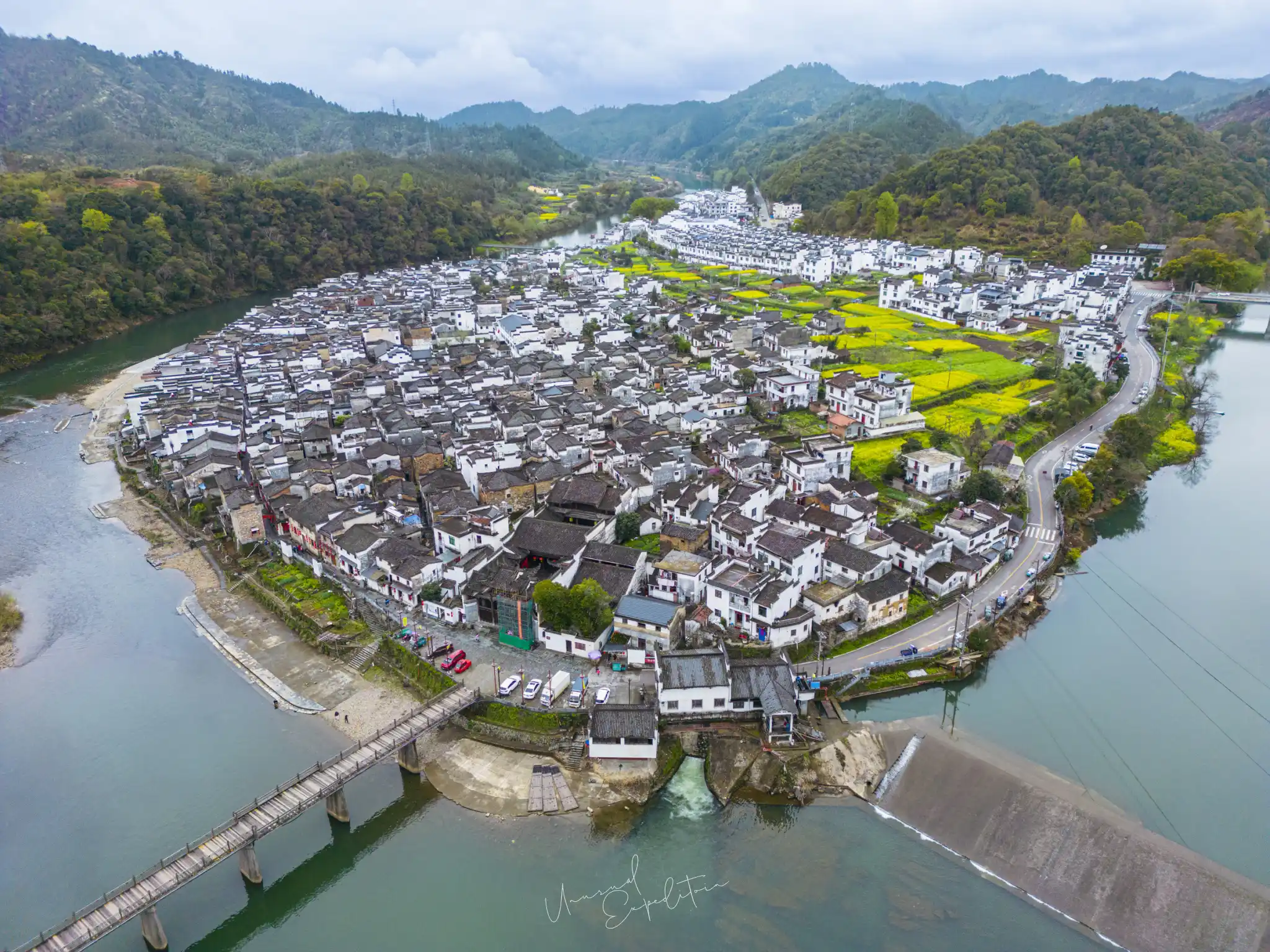
For a spot-by-spot look at what each village looks like through a lens, see our Wuyuan photos guide.
Wuyuan Huangling and the shaiqiu racks
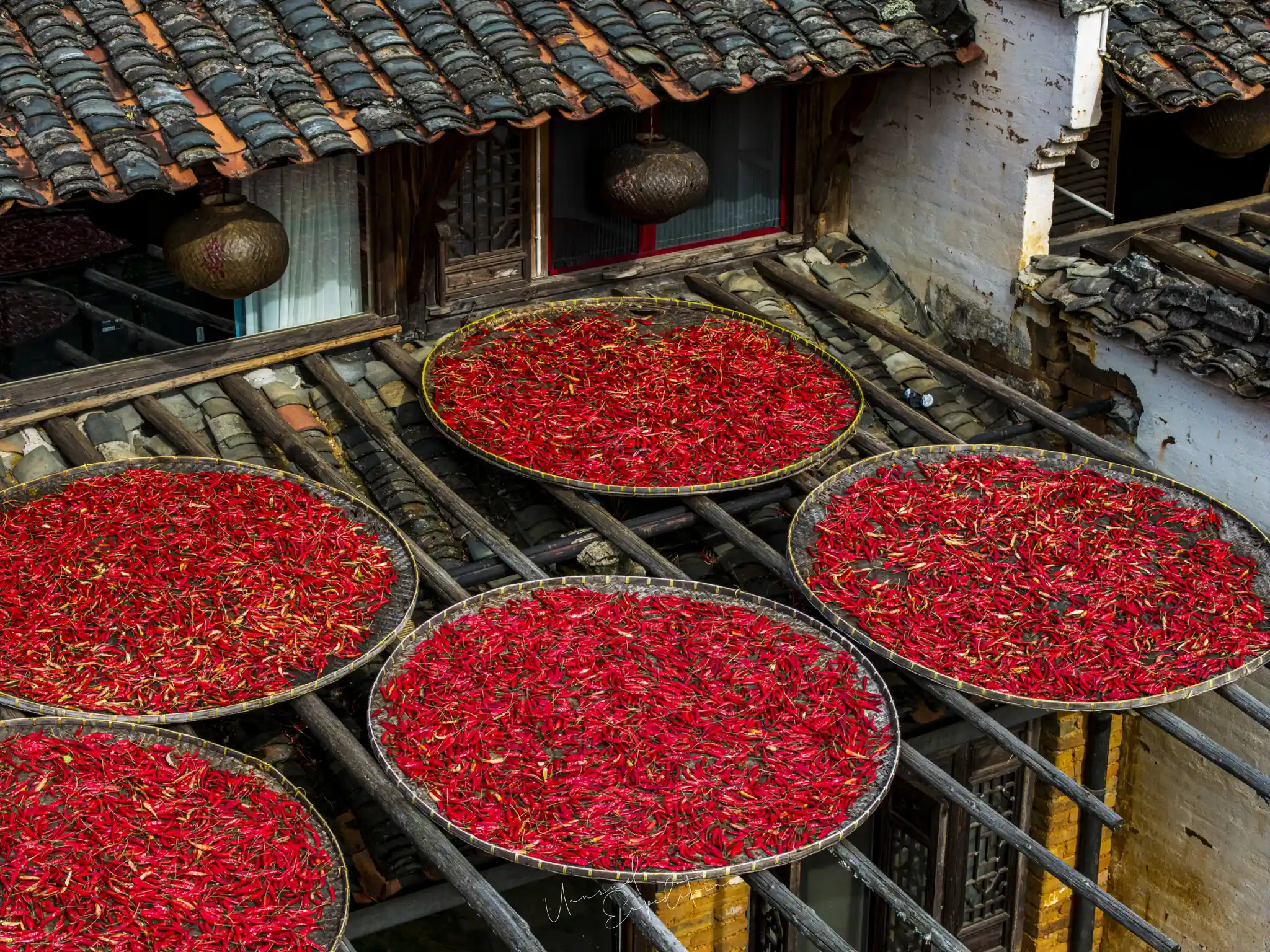
Huangling is the village most people mean when they search for Wuyuan. In autumn its households lay out chillies, maize, soybeans and yellow chrysanthemum in round bamboo trays on wooden racks fixed to the house walls, a custom called shaiqiu, literally sun-drying the autumn. From the lanes above, the trays become circles of red and gold stacked against black tiles. The best frames come when the sun is low and side-on, which picks out the texture of each tray.
Huangshan photography: peaks, pines and cloud
Huangshan, the Yellow Mountain, is a UNESCO World Heritage site listed for both its scenery and its place in Chinese painting and poetry. The mountain is a field of granite spires rather than a single summit, with Lotus Peak, Bright Summit and Celestial Capital Peak the best known. Its pines grow straight out of cracks in the rock, bent flat by wind, and when cloud fills the valleys below the peaks seem to float. That is the picture every Chinese landscape painter tried to make, and it is still the one to come for.
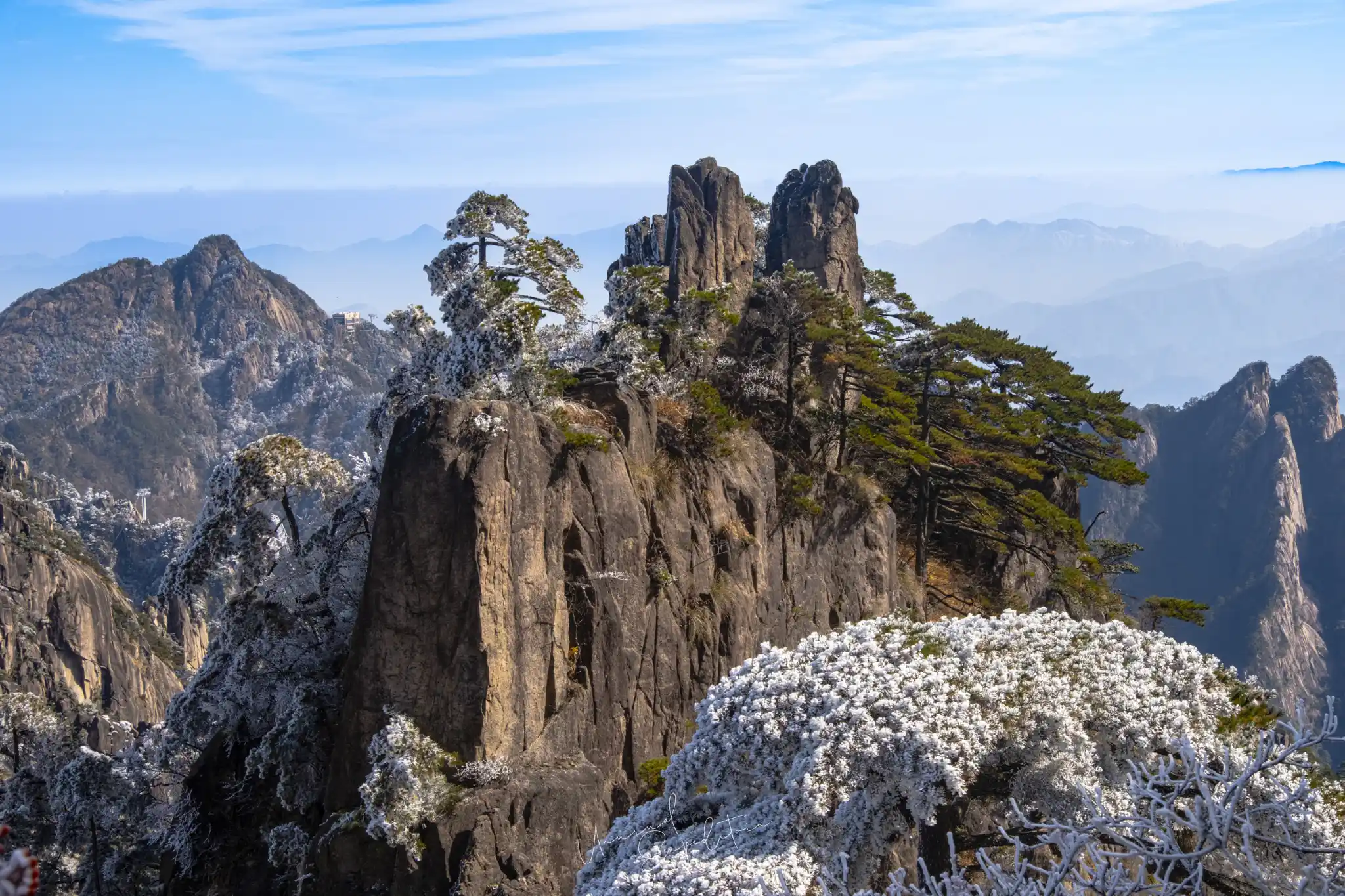
Sunrise and the sea of clouds have their own article: Huangshan sunrise, photo spots and winter rime.
Hongcun village, the Anhui side
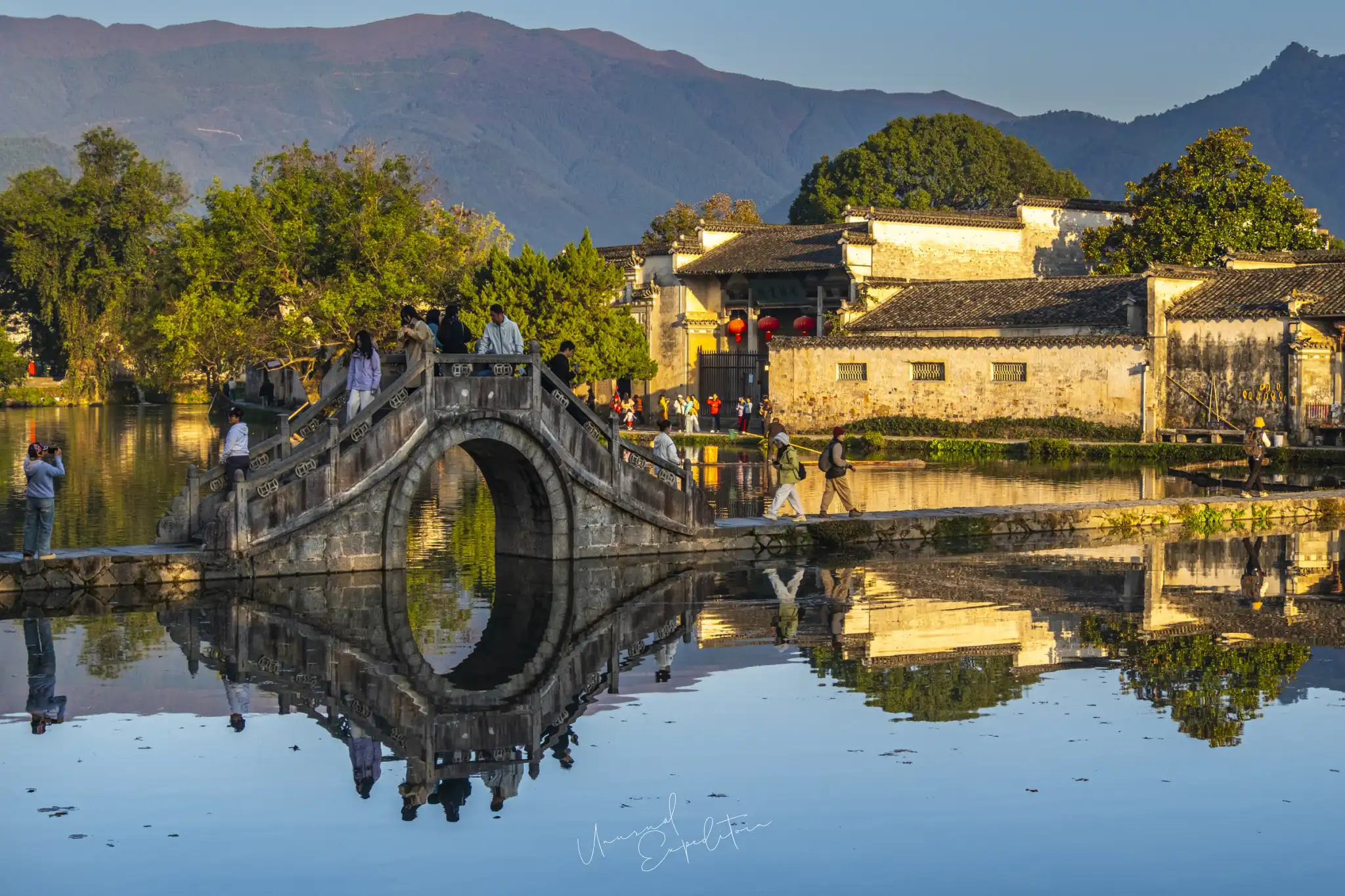
Below the mountain on the Anhui side are Hongcun and Xidi, listed together by UNESCO as the Ancient Villages in Southern Anhui. Hongcun is the one built around water: a crescent-shaped pond at its centre and South Lake at its edge, with an arched stone bridge whose reflection completes the circle on still mornings. Arrive before the student painters set up their easels along the lake, and before the tour groups, and the reflections are yours.
When to go: spring rapeseed or autumn shaiqiu
There are two seasons that matter and they are completely different trips.
| Season | Wuyuan | Huangshan |
|---|---|---|
| March to early April | Rapeseed in bloom on the terraces, peach and pear blossom against white walls | Cool, often misty, good sea of clouds chances |
| Late October to November | Shaiqiu drying racks, autumn colour, morning mist in the valleys | Clear cold mornings, rime on the pines after a cold front |
| December to February | Quiet villages, occasional snow | Snow and rime, very cold at sunrise |
| Summer | Green and humid, heavy rain spells | Thunderstorms, hazy views |
If you can only go once, late autumn gives the widest range of pictures in a single visit. Our Wuyuan best time to visit article goes month by month.
What a Huangshan photography tour with us looks like
We work the villages at dawn and in the last light, and keep the middle of the day for lanes, doorways and portraits of the people who live there. On the mountain we stay up top so that sunrise is a short walk rather than a dark climb, and we watch the forecast for the morning when cloud sits below the peaks. Group sizes stay small so that everyone fits on the narrow viewing platforms.
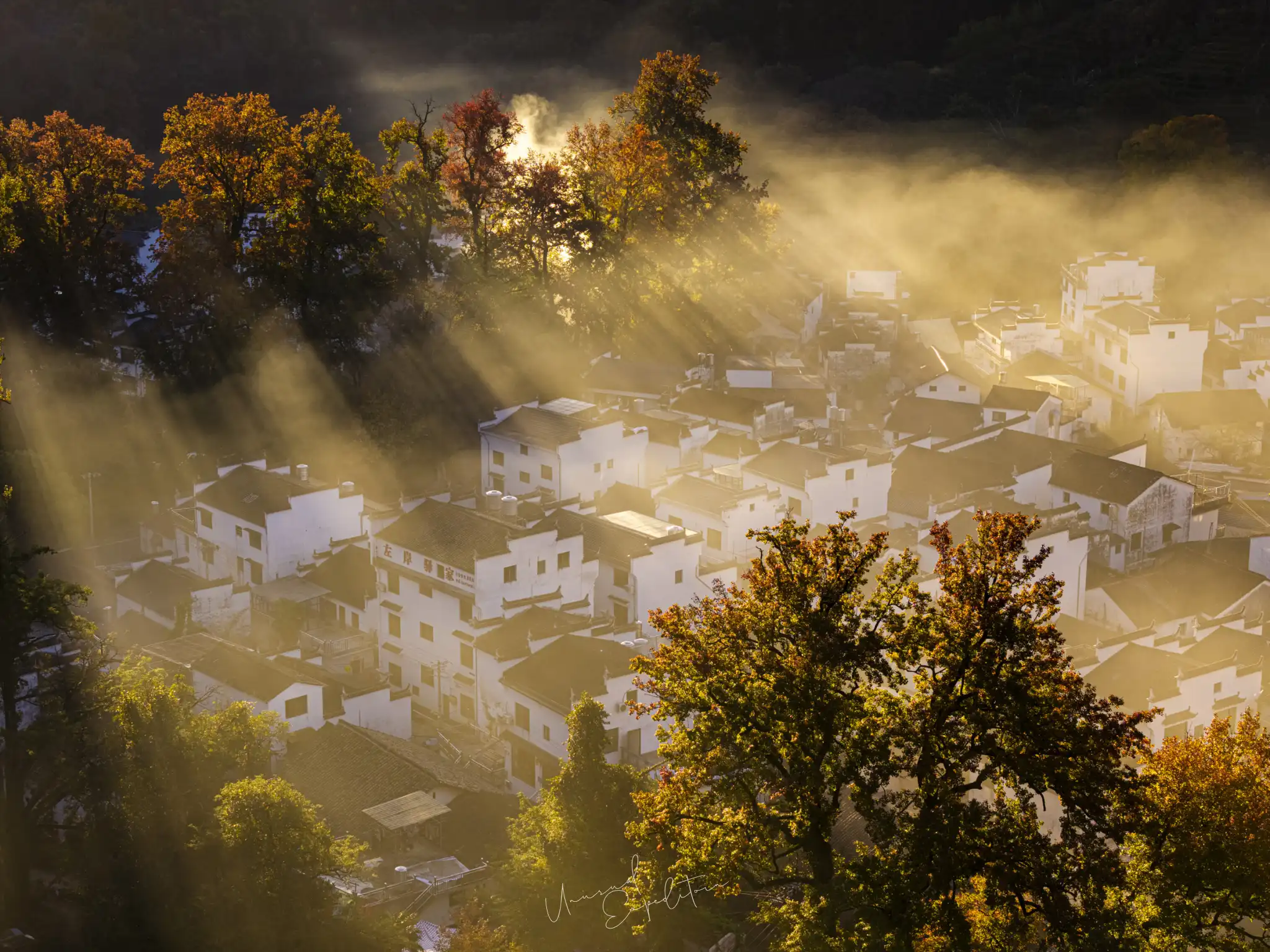
Wuyuan taught me to love fog. The first morning I was disappointed because the river was grey, then a fisherman pushed out into it and the whole valley turned into an ink painting.
Joseph Mak, tour leader, Unusual Expedition
Camera kit for Wuyuan and Huangshan
A 24-70mm covers most of the villages. Bring a 70-200mm for Huangshan, where the best compositions isolate one peak and one pine against cloud, and for compressing the drying racks in Huangling. A 16-35mm helps in tight lanes and for the arched bridge at Hongcun. A drone is useful in Wuyuan for the river-bend villages. Many Chinese scenic areas restrict drones, so check with the Huangshan Scenic Area administration before flying there and register the drone under China's real-name rules before you go. Pack a light tripod and warm layers: Huangshan at sunrise in November can be below freezing.
Getting there from Singapore
There is no direct flight from Singapore into the region. Most people fly to Shanghai or Hangzhou and continue by high-speed train to Wuyuan or Huangshan North. Singapore passport holders can currently enter mainland China visa-free for up to 30 days under the mutual exemption announced by Singapore's Immigration and Checkpoints Authority. The details are in how to get to Huangshan and Wuyuan from Singapore.
Explore Wuyuan and Huangshan in depth
- Wuyuan photos: Huangling, Jiangling and the river villages
- Wuyuan best time to visit: rapeseed in March or shaiqiu in November
- Huangshan sunrise: photo spots, sea of clouds and winter rime
- How to get to Huangshan and Wuyuan from Singapore
Photograph Wuyuan and Huangshan with us
We run Wuyuan and Huangshan as private photography trips on request, timed for the rapeseed or for shaiqiu and the first rime, and we announce scheduled China departures on our China photography tours page. Tell us which season you want and we will plan around it.
Join the Wuyuan and Huangshan photography tour
Inner Mongolia Winter Owl Photo Tour – China departs 01 Jan 2027 To 04 Jan 2027, led by Joseph Mak. Small group, photography first. All Wuyuan and Huangshan photography tours.
Explore Wuyuan and Huangshan in depth
- Wuyuan Photos: Huangling, Jiangling and the River VillagesChina
- Huangshan Sunrise: Photo Spots, Sea of Clouds and Winter RimeChina
- How to Get to Huangshan and Wuyuan from SingaporeChina
- Wuyuan Best Time to Visit: Rapeseed in March or Shaiqiu in NovemberChina
Upcoming Photo Tours
- Egypt Photo Tour – EgyptEgypt 12 Dec 2026 To 20 Dec 2026
- Inner Mongolia Winter Owl Photo Tour – ChinaChina 01 Jan 2027 To 04 Jan 2027
- Inner Mongolia Winter Photo Tour – ChinaChina 05 Jan 2027 To 11 Jan 2027
- Mekong And Central Highland Vietnam Photo Tour - VietnamVietnam 16 Jan 2027 To 24 Jan 2027