
Abu Simbel Photos: Photographing the Great Temple and the Temple of Nefertari
Abu Simbel temples photos: sunrise on the facades, where to stand, the temples that moved, and is Abu Simbel worth visiting.
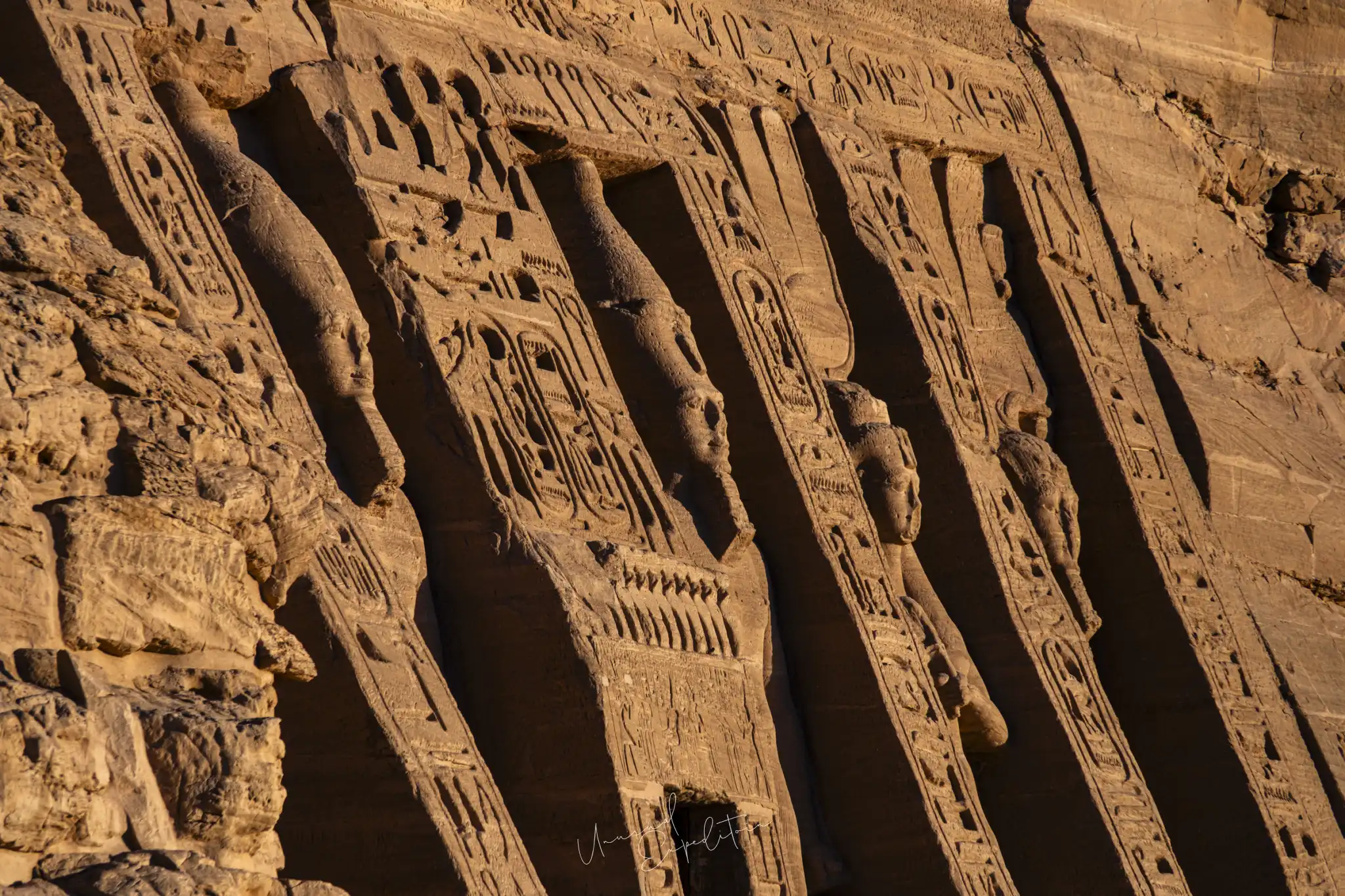
Abu Simbel temples photos are made at sunrise, when the first sun comes over Lake Nasser and lights the east-facing facades of both temples: the four seated colossi of Ramesses II on the Great Temple and the standing statues of Nefertari and her king on the Small Temple. In that first hour the sandstone glows orange, every carved line throws a shadow, and the sky behind is still a deep blue. By mid-morning the light is flat and the forecourt is full.
This is one of the destination guides in our Aswan and Abu Simbel photography tour guide. The photographs in it are our own, taken on our trips to Abu Simbel; we hold the rights to them, and the notes come from standing in front of these facades with a camera.
Abu Simbel temples photos: the two temples
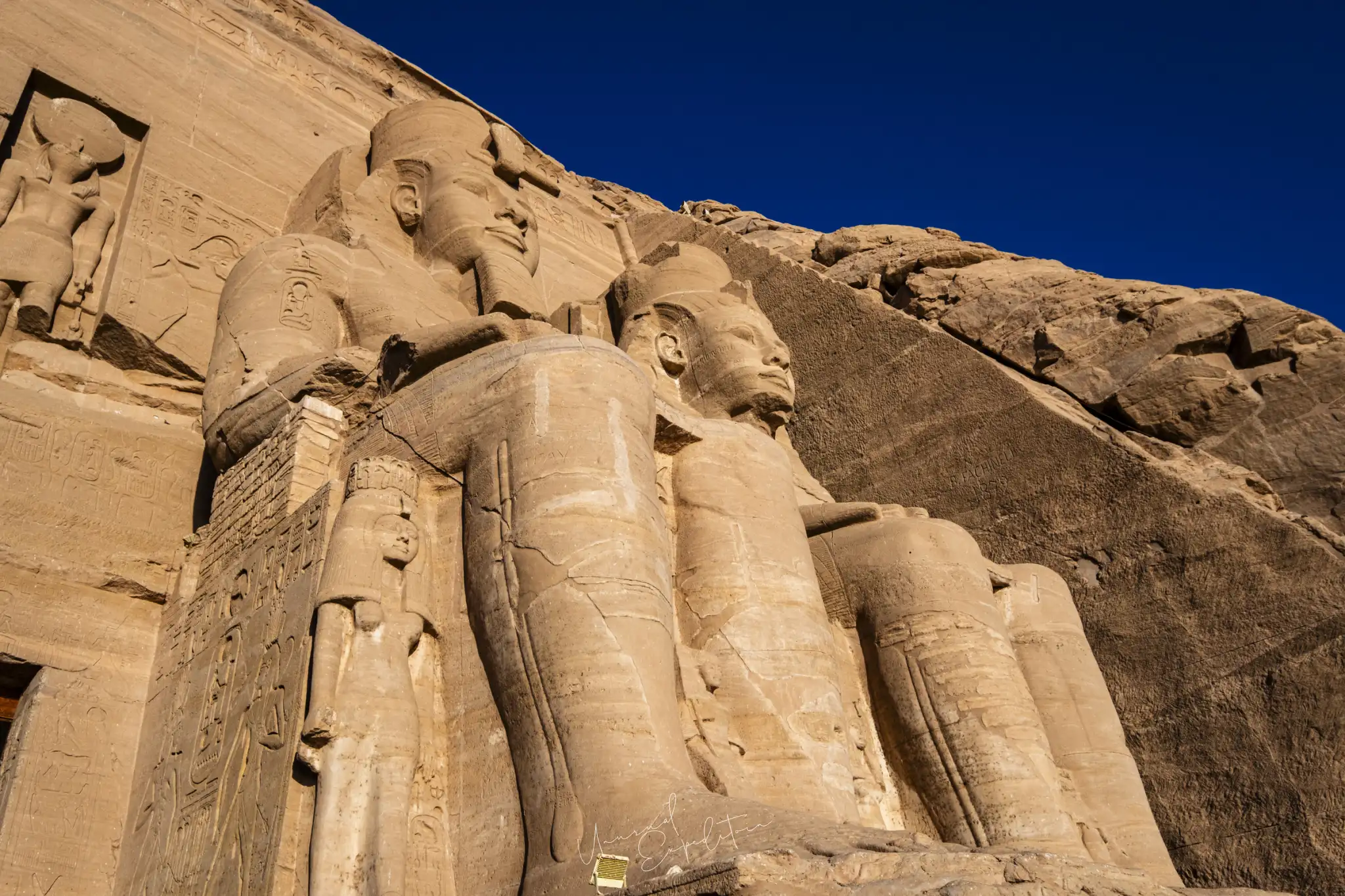
Abu Simbel photos almost always show the Great Temple, and for good reason. Britannica describes four enormous statues of Ramesses II seated across its front, each about 20 metres high, with smaller figures of his family standing between their legs and a row of baboons greeting the sun along the top. One colossus lost its head and upper body in an ancient earthquake, and the fallen pieces still lie at its feet. A short walk north, the Small Temple is dedicated to Hathor and to Nefertari, and its facade has six standing statues about 10 metres high, four of the king and two of the queen, cut between buttresses that throw strong vertical shadows. The two together make the shape of the site: a broad, seated wall of kings and a narrower, rhythmic facade beside it, both cut into the same sandstone hill above the water.
Where to stand at Abu Simbel
At Abu Simbel the forecourt in front of the Great Temple gives the full facade with a 24-70mm, square on, with the four colossi in a row. Step to the north or south side and shoot along the facade instead, and the statues overlap into a line of giant knees and faces receding into the hill, which is the frame we like most. Close in, a wide lens below one colossus shows the scale against the figures at its feet; a longer lens picks out a face, the crown, or the line of baboons. At the Small Temple, stand back far enough to keep the six statues upright and let the morning shadows between the buttresses do the work. Low walls and blocks around the forecourt are good places to brace a camera.
Light and timing
| Time | Great Temple | Small Temple |
|---|---|---|
| Sunrise | Colossi glow orange, deep blue sky | Facade lit, strong shadows between statues |
| Mid-morning | Flat front light, busy forecourt | Flatter, still good for detail |
| Afternoon | Facade in shade, soft and even | In shade, quiet |
| After dark | Floodlit for the show | Floodlit for the show |
The facades face east, so be in place before sunrise and expect the best light to last well under an hour.
Most visitors come on day trips from Aswan, and those groups reach Abu Simbel after the first light; staying overnight at Abu Simbel is what makes the sunrise possible. The afternoon, with the facades in shade, suits careful detail and fewer people.
The temples that moved
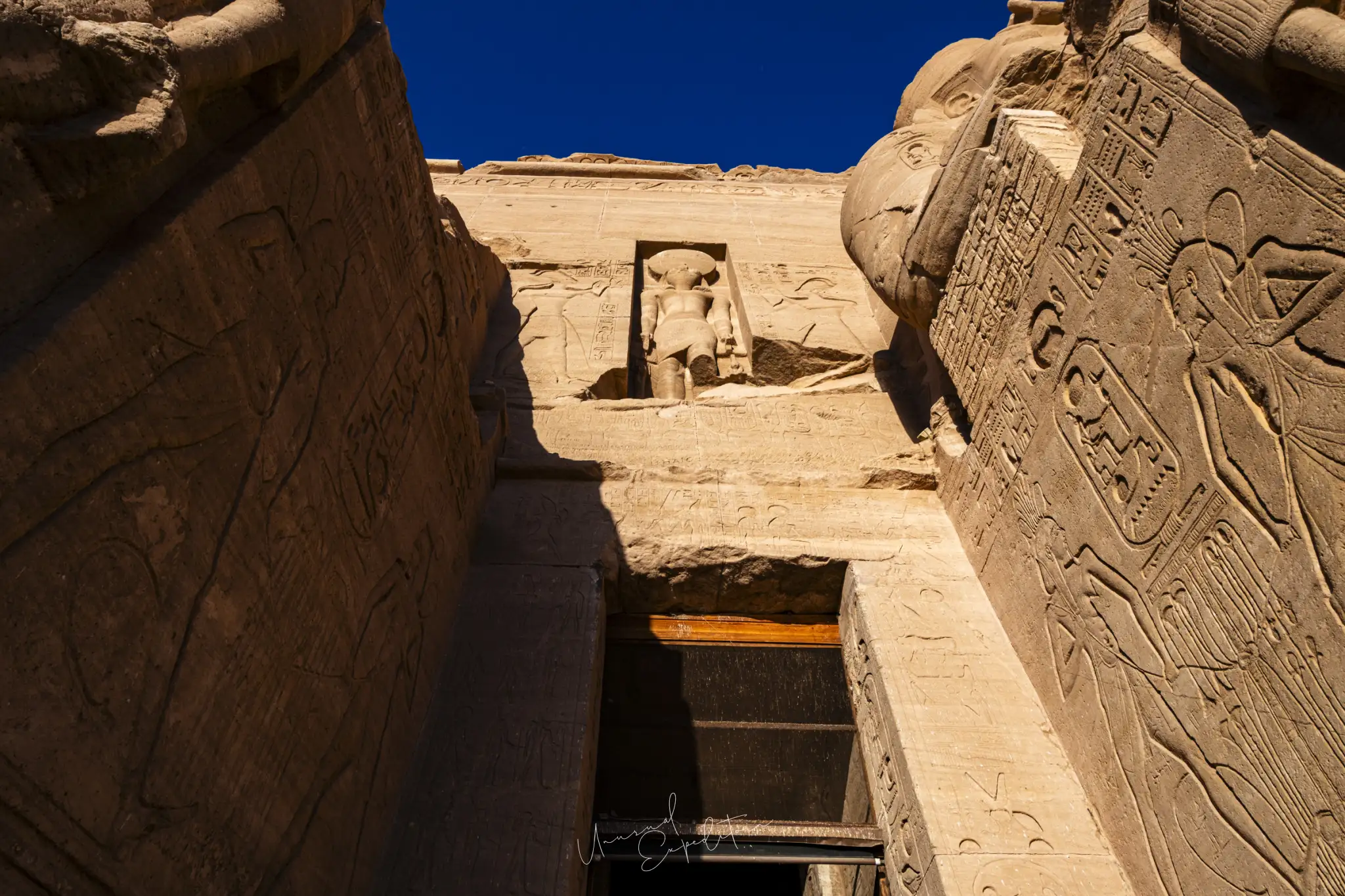
Every picture of Abu Simbel is also a picture of a rescue. When the Aswan High Dam was built, the rising waters of Lake Nasser would have drowned the temples, and UNESCO's International Campaign to Save the Monuments of Nubia, launched in 1960, paid to cut them into large blocks, lift them up the hill and rebuild them inside an artificial mountain; UNESCO records the new site opening in 1968. The joins are hard to see on the facades, but inside the hill behind them is a concrete dome. Live Science's account of "the temples that moved" is a readable introduction. The move is also why the dates of the famous sun festival are reported to have shifted by a day, which we cover in the best time to visit Aswan.
Is Abu Simbel worth visiting?
Abu Simbel is worth visiting for any photographer, even though it is far from everything else. It is the most dramatic temple front in Egypt, it sits alone on the edge of a lake in the desert, and at sunrise it is one of the great architectural subjects anywhere. The question is how. A day trip from Aswan gives you the temples in flat late-morning light among the crowds; a night at Abu Simbel gives you sunset on the lake, the temples floodlit after dark and sunrise on the facades with far fewer people. If you can, stay the night.
Camera gear for the facades
For the Abu Simbel facades a 24-70mm does most of the work, from the full Great Temple front to the Small Temple's six statues. A wide zoom such as a 16-35mm is the lens for standing at the feet of a colossus and looking up, and for the hall inside. A 70-200mm isolates faces, crowns, cartouches and the row of baboons along the top, and from the lakeshore compresses the temples against the hill. A polariser deepens the blue of the morning sky behind the sandstone, but use it gently with a wide lens, where it can darken one side of the sky more than the other. Sand blows across the forecourt, so change lenses inside your bag or with your back to the wind.
"At Abu Simbel I always tell people to walk to the side of the Great Temple and look along the four kings instead of at them. Square on it is a postcard; from the side it is a procession."
Joseph Mak, tour leader, Unusual Expedition
Practical notes
Personal photography without flash is allowed at Abu Simbel under the Supreme Council of Antiquities rules, including inside the temples, which we cover in inside Abu Simbel temple. Abu Simbel has its own small airport served by domestic flights, and the road from Aswan crosses open desert. Bring water and a hat for the forecourt, and a jacket for the cool desert morning in winter. The Abu Simbel sound and light show guide covers the evening.
Photograph Abu Simbel with us
Our Egypt Photo Tour includes Abu Simbel with the evening sound and light show, Aswan and Philae, Luxor, Cairo and Giza. The current departure and rate are on the Egypt photography tours page.
Join the Aswan and Abu Simbel photography tour
Egypt Photo Tour – Egypt departs 12 Dec 2026 To 20 Dec 2026, led by Joseph Mak. Small group, photography first. All Aswan and Abu Simbel photography tours.
Explore Aswan and Abu Simbel in depth
- Aswan and Abu Simbel Photography Tour Guide: Temples, Sails and VillagesEgypt
- Philae Temple, Aswan: Photographing the Temple of Isis by Day and NightEgypt
- Nubian Village, Aswan: Photographing Colour and People with RespectEgypt
- Inside Abu Simbel Temple: The Great Hall, the Sanctuary and the CustodiansEgypt
- Best Time to Visit Aswan and Abu Simbel: Weather, Winter and the Sun FestivalEgypt
- Aswan Felucca: Photographing the Sails of the Nile and Elephantine IslandEgypt
- Abu Simbel Sound and Light Show: Photographing the Temples at NightEgypt
Upcoming Photo Tours
- Egypt Photo Tour – EgyptEgypt 12 Dec 2026 To 20 Dec 2026
- Inner Mongolia Winter Owl Photo Tour – ChinaChina 01 Jan 2027 To 04 Jan 2027
- Inner Mongolia Winter Photo Tour – ChinaChina 05 Jan 2027 To 11 Jan 2027
- Mekong And Central Highland Vietnam Photo Tour - VietnamVietnam 16 Jan 2027 To 24 Jan 2027