
Athens Photography Tour Guide: the Acropolis, Rooftops and Photo Spots
Athens photography guide: the best photo spots, the Acropolis at night, Areopagus Hill and how many days the city needs.
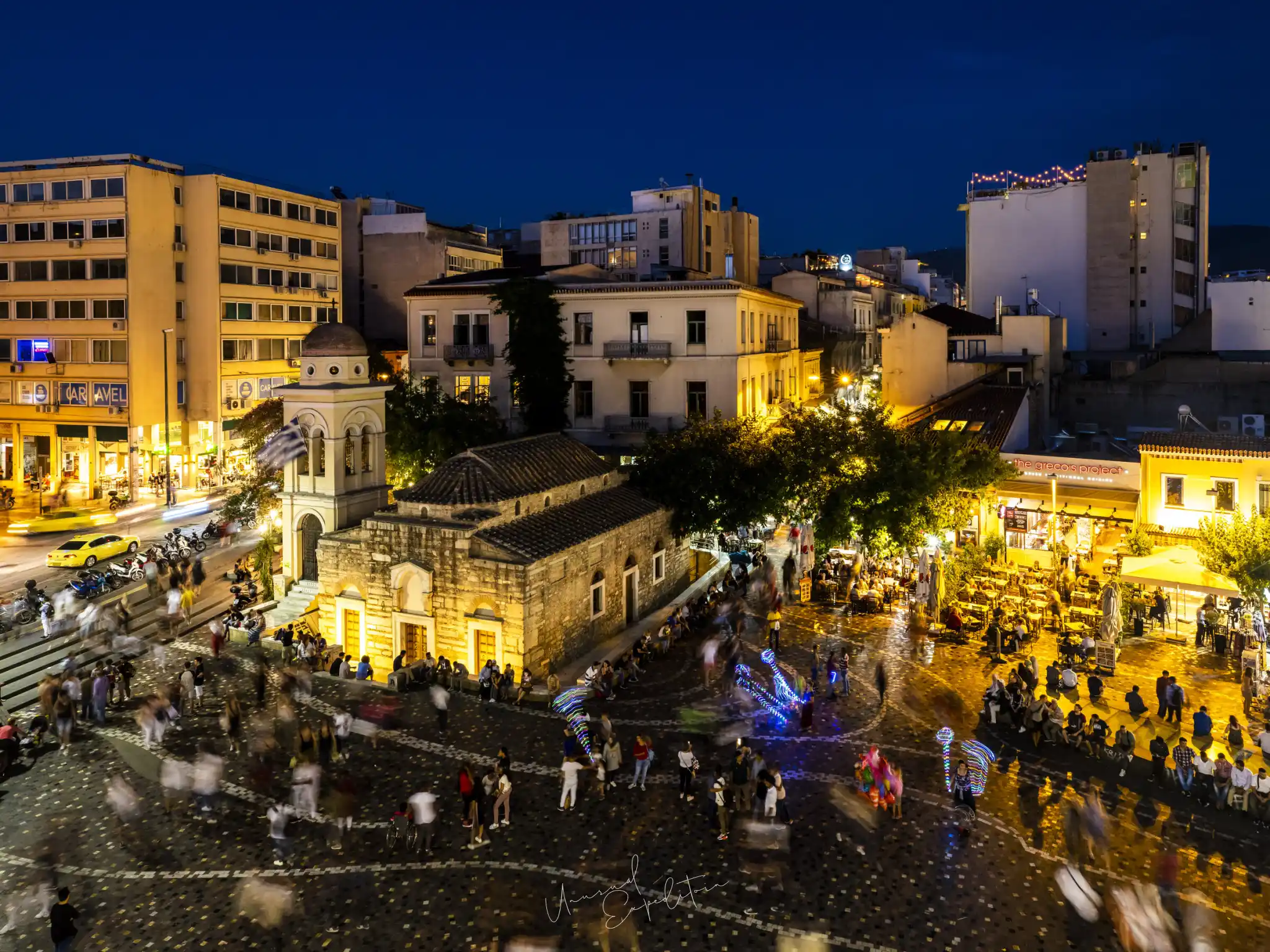
Athens photography is mostly about one rock and the city around it: the Acropolis from the hills to its south-west and west as the sun goes down, from inside the site in the morning, and from the rooftops of Plaka and Monastiraki when the floodlights come on. Add the Temple of Olympian Zeus, Hadrian's Library and the old lanes below the hill, and a photographer can fill two evenings and a dawn without repeating a frame. This is the hub of our Athens destination guides.
Athens is one part of a wider Greek trip, and our Greece photography tour guide sets it beside Santorini, Mykonos and Meteora. The photographs in this guide are our own, taken on our trips here; we hold the rights to them, and the notes come from knowing these places first hand.
Athens photography: what the city gives you
Athens photography works on three levels at once. At the top is the Acropolis, a limestone hill with the Parthenon, the Propylaia gateway, the Erechtheion and the small Temple of Athena Nike, listed by UNESCO as a World Heritage Site since 1987. Around its foot are the old quarters, Plaka and Monastiraki, with their tiled roofs, Byzantine churches and Roman ruins. Beyond them is the modern city, white apartment blocks spreading to the mountains, which is what makes the ancient monuments read as part of a living place. The strongest Athens pictures usually hold two of these levels in one frame: the floodlit rock over the rooftops, the columns of a Roman library in front of the Plaka houses, a marble gateway with the crowd on its steps. A 24-70mm covers most of it, and a 70-200mm is the lens that pulls the hill close over the streets.
Best photo spots in Athens
The best photo spots in Athens are mostly outside the paid sites, and most of them are free. The table sets out the ones we use and the light that suits each.
| Spot | What you photograph | Best light | Lens |
|---|---|---|---|
| Philopappos Hill (south-west) | The classic profile of the Acropolis with pines in front | Late afternoon and sunset; at dawn the rock is backlit | 24-70mm, 70-200mm |
| Areopagus Hill (west and north-west) | The Propylaia and the west side of the Acropolis close up | Late afternoon and sunset | 70-200mm |
| Inside the Acropolis | Columns, marble blocks, the Temple of Athena Nike | Opening time and early morning | 16-35mm, 24-70mm |
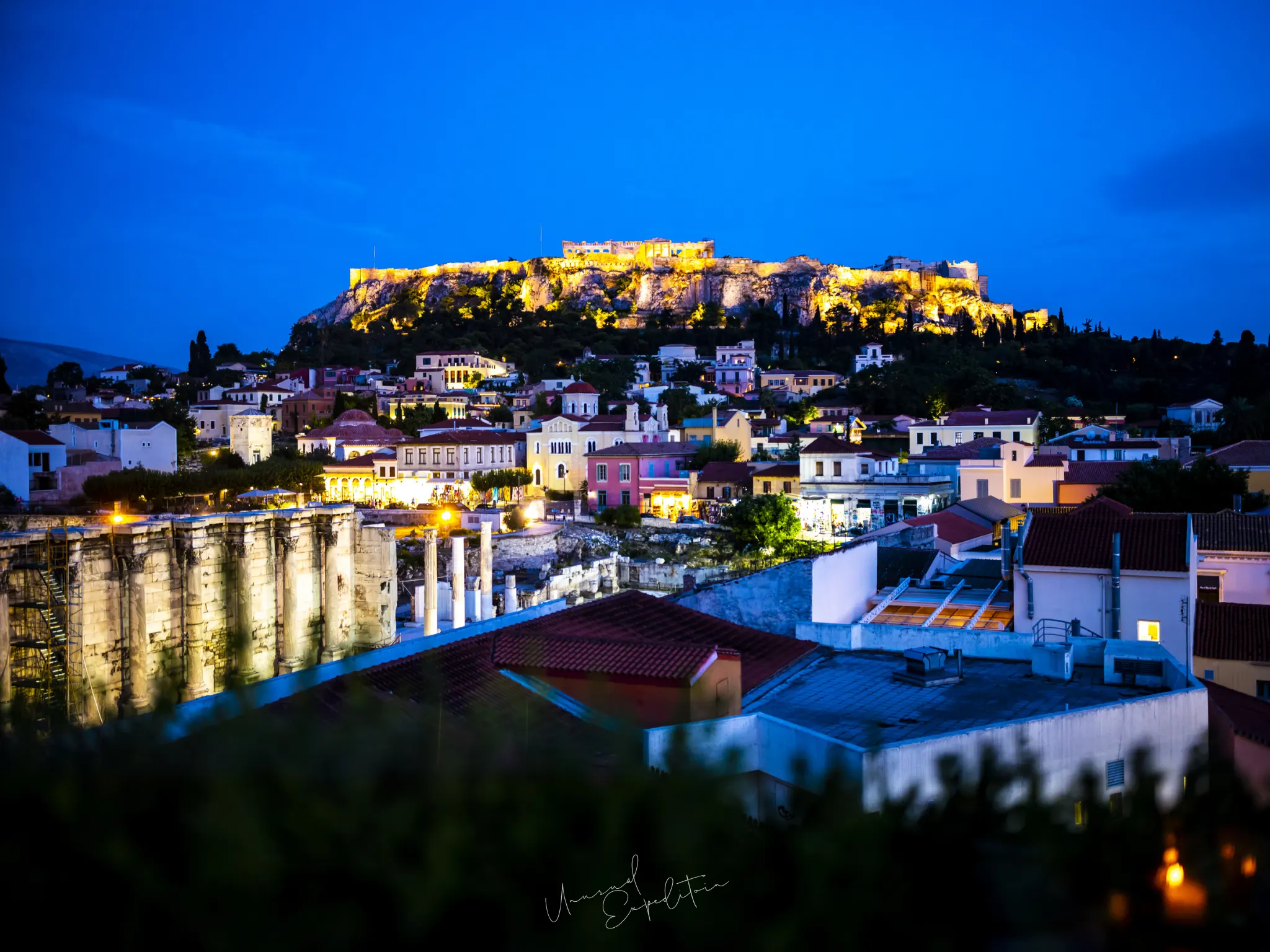
| Rooftops of Monastiraki and Plaka (north) | The floodlit Acropolis over the old town | Blue hour | 24-70mm, 70-200mm |
| Temple of Olympian Zeus (south-east) | Columns with Lycabettus Hill behind, to the north-east | Blue hour | 24-70mm |
Philopappos to the south-west and Areopagus to the west and north-west look at the sides of the rock that take the afternoon sun, and the rooftops look up at it from the north, which is why the end of the day matters so much in Athens.
Areopagus Hill and the west side of the Acropolis
Areopagus Hill is the bare limestone outcrop just below the entrance to the Acropolis, open and free, and Lonely Planet notes that its worn rock gets slippery, so wear shoes with grip. From its eastern edge you look straight up at the Propylaia, the monumental gateway, with the Temple of Athena Nike on its bastion to the right. This is the side of the Acropolis that catches the afternoon sun, and from Areopagus the gateway fills a 70-200mm frame. In the middle of the day the entrance steps are packed with visitors, which can be part of the picture: the crowd gives scale to the marble above it. Later, as the sun drops, the stone turns warmer and the people thin out. Areopagus Hill for sunset is a popular plan, so arrive early for a place on the rock.
Acropolis at night: rooftops and blue hour
The Acropolis at night is the picture most visitors take home, and the best version is not taken at full darkness. The floodlights come on as the sun goes down, and for a short time after it the sky stays a deep blue that balances the lit marble; a little later the sky goes black and the hill becomes a gold shape on nothing. From the rooftops of Monastiraki you look south over the old town, and the columns of Hadrian's Library, built under the emperor Hadrian in the second century AD according to the World History Encyclopedia, stand in the foreground with the Plaka houses climbing towards the rock. Pick a rooftop terrace that looks over low buildings, not into a wall of apartment blocks, and go up before sunset to choose your corner.
Inside the Acropolis
Inside the Acropolis the light and the crowds decide the pictures. Entry is by timed ticket, booked through the Ministry of Culture's own platform, hhticket.gr, and the first slot of the day is the one photographers want. Go to the far end of the rock first, to the Parthenon and the Erechtheion, while the groups are still at the gate, then work back towards the Propylaia. Look down as well as up: the hilltop is covered in fallen marble blocks and column drums, and with a wide lens close to the stone they make strong foregrounds for the gateway. Personal photography with a handheld camera is free, but the Greek Ministry of Culture requires a permit, applied for through the local Ephorate of Antiquities, for filming and for photography with professional equipment, so treat a tripod as professional kit and ask first. Our article on the best time to visit the Acropolis covers the time slots, the summer heat and how the light moves across the rock from dawn to dusk.
"Most people photograph the Acropolis once, from the ticket queue. I ask our group to see it three times: on top in the first hour, from Philopappos Hill as the sun goes down, and from a roof when the lights come on. It is the same rock, and three different pictures."
Joseph Mak, tour leader, Unusual Expedition
Monastiraki, Plaka and the Temple of Olympian Zeus
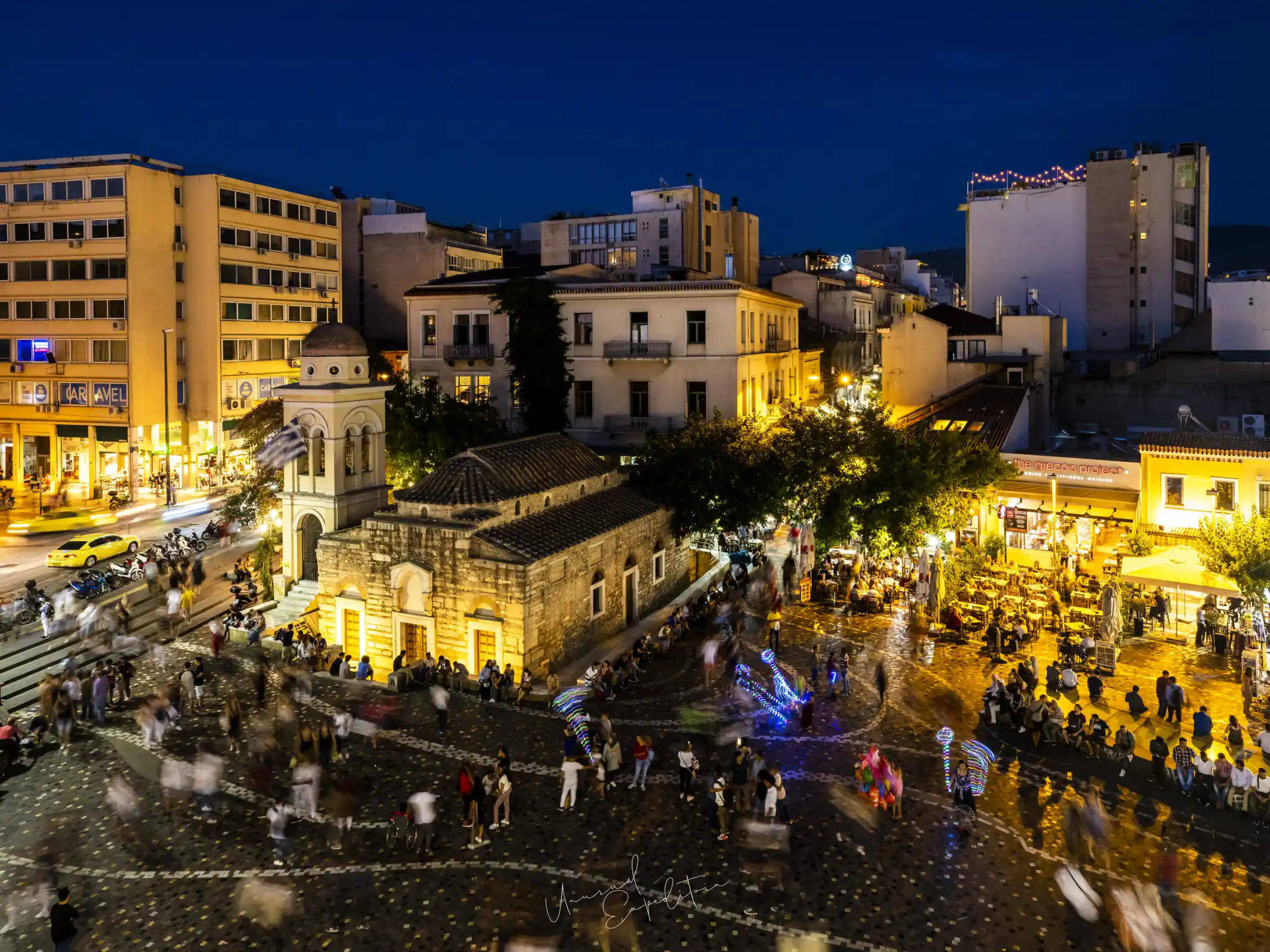
Monastiraki Square, with its small Byzantine church and the Acropolis above, is one of the classic Athens frames, and the Greece photography tour guide shows it from a terrace above the square. Plaka, on the north slope, is quieter: stepped lanes, bougainvillea and the whitewashed houses of Anafiotika just under the rock, best early in the morning before the shops open. To the south-east, the Temple of Olympian Zeus keeps a handful of its giant columns, and at blue hour, with Lycabettus Hill lit up behind, it gives a second night picture that is not the Acropolis. Our best time to photograph Greece article has that frame and the season-by-season picture for the whole country.
Is Athens worth visiting for photography?
Is Athens worth visiting? Many travellers treat Athens as an airport, and they miss a capital where ancient temples and a large modern city sit in the same frame. For a photographer, Athens gives the Acropolis in three kinds of light, evening street life in Plaka and Monastiraki and monuments within walking distance of each other. It is hot and crowded in high summer, and the main sites need booking. Our view is that it is worth at least two evenings and one dawn, and that the trip to Santorini, covered in the Santorini photography tour guide, is better for having Athens at the start or the end.
How many days do you need in Athens for photography?
How many days do you need in Athens? For photography, plan in light rather than in days. You need one dawn on the quiet paths below the rock, one early morning inside the Acropolis, a sunset on Philopappos or Areopagus Hill, and at least two blue hours: one for the Acropolis from a rooftop and one for the Temple of Olympian Zeus. Middays are for the Acropolis Museum, the National Archaeological Museum and rest, especially in summer. Entry, flights and money for Greece are covered once, in our guide to planning a trip to Greece.
Explore Athens in depth
- Best time to visit the Acropolis: light, time slots and summer heat
- Greece photography tour guide
- Best time to photograph Greece
- Santorini photography tour guide
Photograph Athens with us
We have no scheduled Greece departure at the moment, so we run Athens, usually with Santorini, Mykonos or Meteora, as a private trip on request. Private trips suit individuals, couples, families and photographers who want their own pace; we arrange all the logistics to your needs, the cost can be lower than our group tours because no tour leader travels, and a photographer or photography coaching can be added at extra cost. Ask at least two months ahead if you can, though last-minute trips can be arranged. See our private tours and the Greece photography tours page, which lists any current tours.
Athens photography tours
The next Athens departure is announced on the Athens photography tours page, with previous expeditions and all the planning guides.
Explore Athens in depth
Upcoming Photo Tours
- Egypt Photo Tour – EgyptEgypt 12 Dec 2026 To 20 Dec 2026
- Inner Mongolia Winter Owl Photo Tour – ChinaChina 01 Jan 2027 To 04 Jan 2027
- Inner Mongolia Winter Photo Tour – ChinaChina 05 Jan 2027 To 11 Jan 2027
- Mekong And Central Highland Vietnam Photo Tour - VietnamVietnam 16 Jan 2027 To 24 Jan 2027