
Camels in Mongolia: Photographing Bactrian Camels in Winter
Camels in Mongolia: are there camels, where to find Bactrian camels, winter coats, camel portraits and strings on the snow.
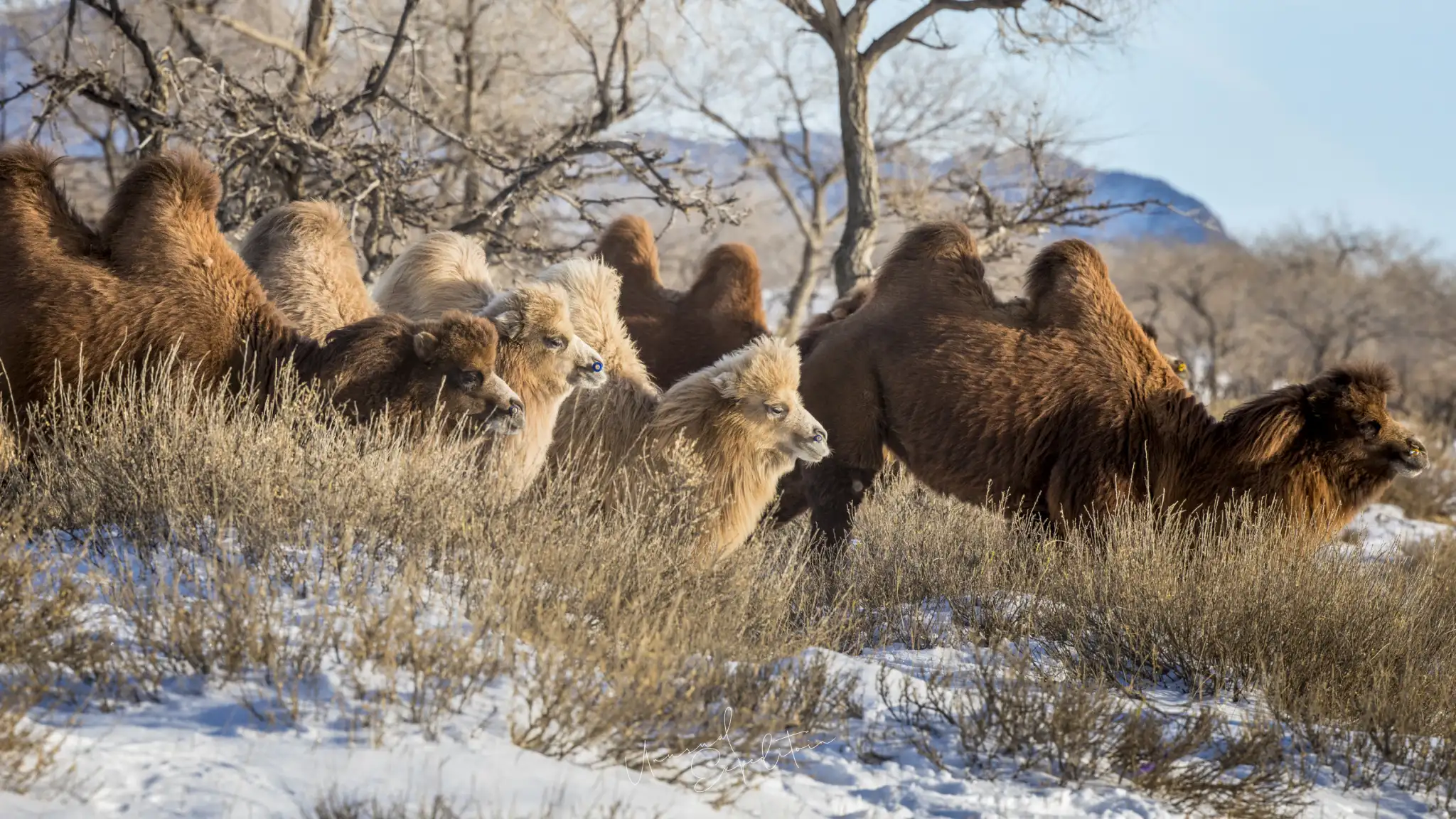
Camels in Mongolia are Bactrian camels, the two-humped camels of Central Asia, kept by herding families as one of the five kinds of livestock. You find them in the Gobi in the south and in the sand dune belts of central Mongolia, where they graze among dunes and trees and carry loads and riders. In winter they grow a thick shaggy coat, and with snow on the sand they make some of the most striking animal portraits in the country.
This article is part of our Central Mongolia photography tour guide. It is about photographing the camels and the herders who keep them.
Are there camels in Mongolia?
Yes, and they are part of everyday herding life. Mongolians count camels among the five snouts, the five kinds of livestock a herding family keeps, with horses, cattle and yaks, sheep and goats. Mongolian camels are Bactrian camels, with two humps, unlike the one-humped dromedaries of Arabia and North Africa. Families use them for wool, milk and meat, and as pack and riding animals; they can carry heavy loads across sand and snow where vehicles struggle. There is also a wild Bactrian camel, a separate species that the IUCN lists as critically endangered, which survives only in remote parts of the Gobi and western China. The camels you photograph are domestic, and they belong to someone.
Camels in Mongolia: where to find them
The Gobi in the south is the classic camel country, but you do not have to go that far. Central Mongolia has belts of sand dunes, such as Elsen Tasarkhai beside the mountain of Khögnö Khan, which visitors call the mini Gobi, where herding families keep camels alongside their other animals. We photographed camels in central Mongolia among sand dunes dotted with trees, with snow lying in the hollows. Your local partner will know which family has camels near your route.
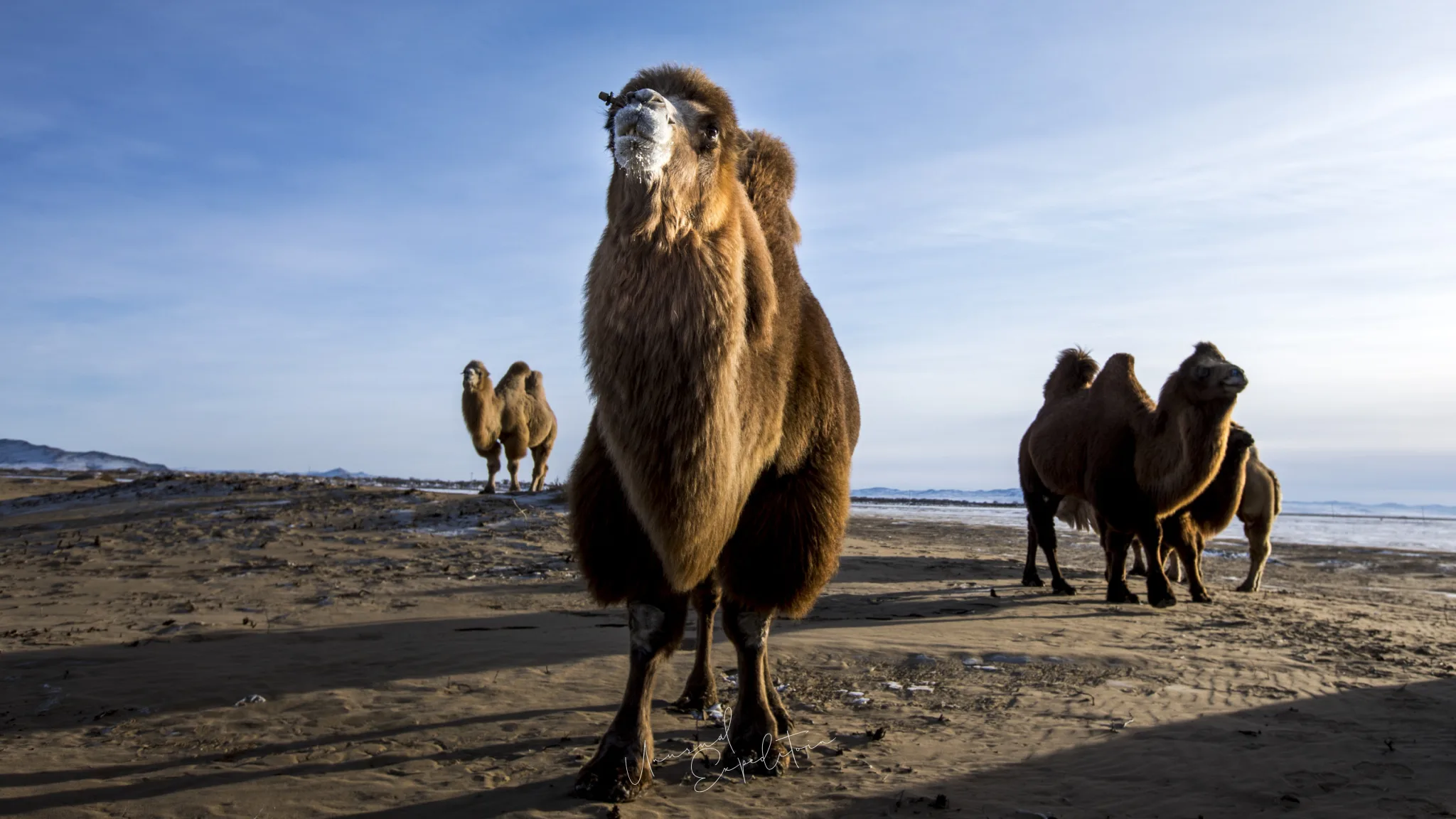
Mongolia camels in winter
Winter is the best season to photograph Mongolia camels. They grow a heavy coat, with long hair on the neck, the humps and the front legs, and when the low sun lights them from the side every strand of hair glows. They lie down among the dunes and the trees to rest, often in groups, and snow gathers on their backs. In this cold they are calm and slow, which makes them easy to approach with the herder's permission. In summer they shed their coats in ragged patches and look very different; that is a picture too, but not the one most people come for.
Mongolia camel portraits
A Mongolia camel portrait works best close and low. Ask the herder to bring one camel forward, then get down to the level of its head with a 16-35mm, and let the face fill the frame with the sky behind. Camels have expressive faces: long eyelashes, split lips, nostrils that close against the wind. A 70-200mm from further back is better for a group resting among the trees, with the dunes and the hills behind. Keep an eye on the camel's mood; a camel that lowers its head and grumbles wants more space.
| Frame | Where | Light | Lens |
|---|---|---|---|
| Single camel portrait | Open sand near the herd | Low side light, blue sky | 16-35mm, close and low |
| Camels resting among trees | Dune edges with trees and grass | Morning or late afternoon | 70-200mm |
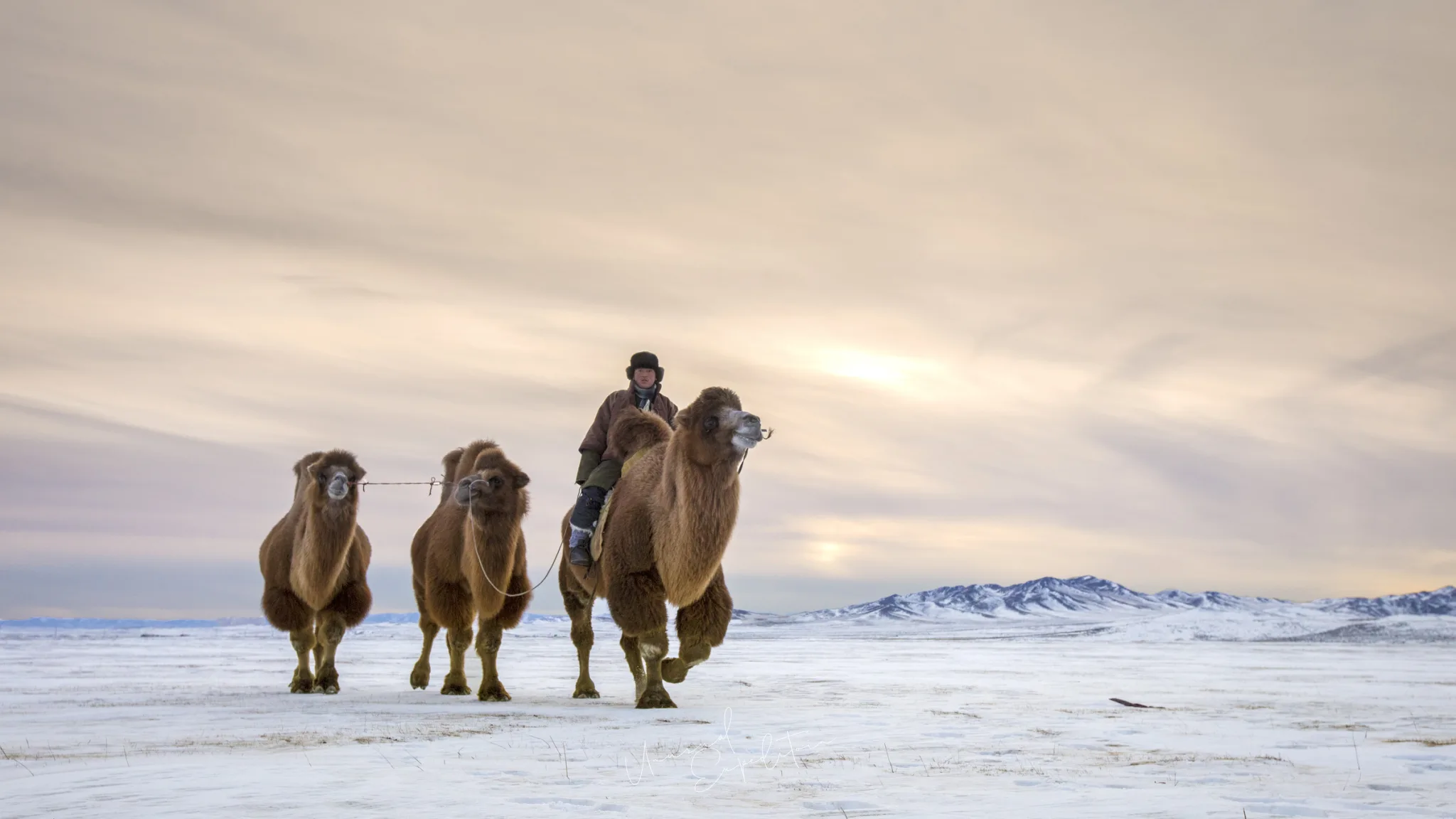
| Rider leading a string of camels | Open snowy plain | Soft light, pale sky | 24-70mm or 70-200mm |
| Caravan in silhouette | A dune ridge | Sunset | 16-35mm or 70-200mm |
| Camels by a fire | Camp on the sand | Blue hour | 16-35mm, high ISO |
The last two belong to the evening; we cover them in is Mongolia mostly desert.
Camels on the move
When a herder rides out with a string of camels tied nose to tail, the frame is about rhythm: the repeated shapes of humps and legs across a plain. On snow under a pale sky, the camels' brown coats are the only colour, and the scene needs almost no composition. Shoot from the side so that every camel is separate, and wait for the moment when the legs are in step. A 70-200mm compresses the string; a 24-70mm with the mountains behind shows where they are going.
"Camels in the snow look like they have wandered into the wrong picture. That is exactly why they work. Soft, pale light suits them, and a patient herder will ride past more than once while you wait for the legs to fall in step."
Joseph Mak, tour leader, Unusual Expedition
Gear and settings for camels
Camels are easy subjects for kit. A 16-35mm for close portraits and a 70-200mm for groups and strings cover almost everything. Sand gets into everything in the dunes, even in winter, so change lenses inside the vehicle and keep a blower in your pocket. Their coats are a mid-brown that meters well, but snow around them does not: add exposure compensation when the frame is mostly white, and check that the highlights on the fur are not clipped in low sun.
Mongolia and Inner Mongolia camels
You can also photograph Bactrian camels across the border in Inner Mongolia, which is a region of China, not part of the country of Mongolia. The animals are the same species, but the trips are different in entry rules, routes and landscapes, and we keep the two apart in our destination guides. This page and the rest of the Central Mongolia guides are about Mongolia the country. For the herding families who keep the camels, see Mongolian nomads.
Respect for the herders and their animals
The camels are a family's livelihood. Ask the herder before you approach, pay for their time through your guide, and do not ride a camel unless the herder offers and you are comfortable. Do not feed them. Stay out of the way of a camel that is loaded or tied, and never stand directly behind one. For the wider picture of the steppe in the cold, read Mongolia winter tour.
Photograph Mongolia's camels with us
We run central Mongolia as a private trip on request and include time with a camel-herding family in the dunes. See private tours and the Mongolia photography tours page.
Ask us about photographing camels in Mongolia
Central Mongolia photography tours
The next Central Mongolia departure is announced on the Central Mongolia photography tours page, with previous expeditions and all the planning guides.
Explore Central Mongolia in depth
- Central Mongolia Photography Tour Guide: Steppe, Herders and Dunes near UlaanbaatarMongolia
- Ulaanbaatar in Winter: Photographing the Coldest CapitalMongolia
- Mongolian Nomads Today: Photographing a Herding FamilyMongolia
- Mongolian Ger: Inside and Outside the Nomad's HomeMongolia
- Mongolia Winter Tour: Herding, Snow and Cold on the SteppeMongolia
- Mongolia Wildlife: Red Deer, Vultures and Yaks on the Winter SteppeMongolia
- Is Mongolia Mostly Desert? Sand Dunes, Snow and FirelightMongolia
Upcoming Photo Tours
- Egypt Photo Tour – EgyptEgypt 12 Dec 2026 To 20 Dec 2026
- Inner Mongolia Winter Owl Photo Tour – ChinaChina 01 Jan 2027 To 04 Jan 2027
- Inner Mongolia Winter Photo Tour – ChinaChina 05 Jan 2027 To 11 Jan 2027
- Mekong And Central Highland Vietnam Photo Tour - VietnamVietnam 16 Jan 2027 To 24 Jan 2027