
Is Mongolia Mostly Desert? Sand Dunes, Snow and Firelight
Is Mongolia mostly desert? The Gobi, the steppe, central Mongolia's sand dunes, and photographing sunset and firelight there.
Is Mongolia mostly desert? No. The Gobi covers the south of the country, but most of Mongolia is steppe grassland, mountains and, in the north, forest, on a high plateau that Britannica puts at about 1,580 metres on average. What surprises many visitors is that sand dunes also appear far north of the Gobi, in belts across central Mongolia, where camels graze, snow lies in the hollows in winter, and sunsets over the sand are as good as any desert.
This article is part of our Central Mongolia photography tour guide. It covers Mongolia's deserts and dunes and how to photograph them at the end of the day.
Is Mongolia mostly desert?
Mongolia is often imagined as one big desert, and the Gobi is one of the most famous deserts in the world, so the picture is understandable. But Britannica describes the country as largely a plateau with a great variety of landscapes: high mountains in the west, the Altai and the Khangai, forest and lakes in the north, and wide steppe grassland across the centre and east. The Gobi takes up the south. Even the Gobi is not all sand; much of it is gravel plain and dry rocky ranges, with dunes in particular places. So no: most of Mongolia is steppe, not sand.
Is Mongolia desert in the centre?
Not mostly, but there is sand. Central Mongolia has belts of sand dunes running across the steppe, the best known being Elsen Tasarkhai beside the mountain of Khögnö Khan, which stretches for about 80 kilometres and is often called the mini Gobi. Dunes like these sit right next to grassland, rocky hills and even woodland, so in one view you can have sand, trees and snowy mountains together. Herding families keep camels and other livestock along the edges. For a photographer this is the easiest way to add desert scenes to a trip based near Ulaanbaatar, without the long trip south.
Mongolia Gobi desert: what it is and what we have not covered
The Mongolia Gobi desert spans the south of the country and continues into China. It is a cold desert, with hot summers and bitter winters, and it is best known for its dinosaur fossil sites, its red cliffs and its large dune fields. We have not photographed the Gobi for these destination guides, so we do not describe it in detail here; we would rather show places we know. If the Gobi is on your list, plan it as its own part of a trip, as it is far from both Ulaanbaatar and the far west.
Sand and snow
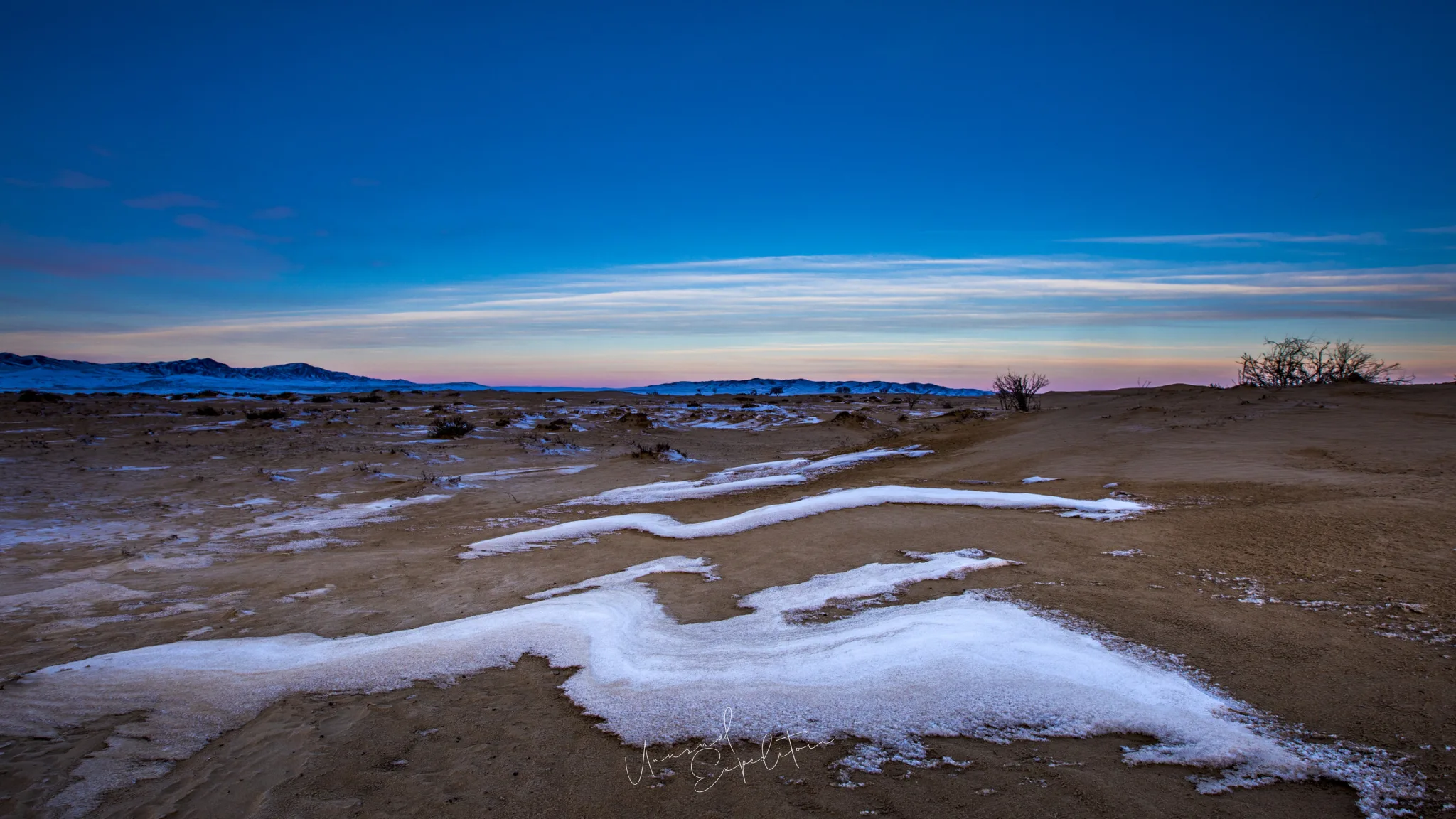
In winter the dunes of central Mongolia take on a look you will not see in hotter deserts: snow lies in the hollows and on the shaded side of every ripple, while the sunlit sand stays bare and gold. At sunrise and sunset the contrast between the white snow and the warm sand is at its strongest, and the patterns make a landscape on their own, without any animal in it. Use a 16-35mm low over the sand, with the snow lines leading back to the hills, and a polariser sparingly, as the sky darkens unevenly at wide angles.
| Scene | When | Lens | Note |
|---|---|---|---|
| Snow lines on the sand | Sunrise and sunset | 16-35mm, low | Use the snow as leading lines |
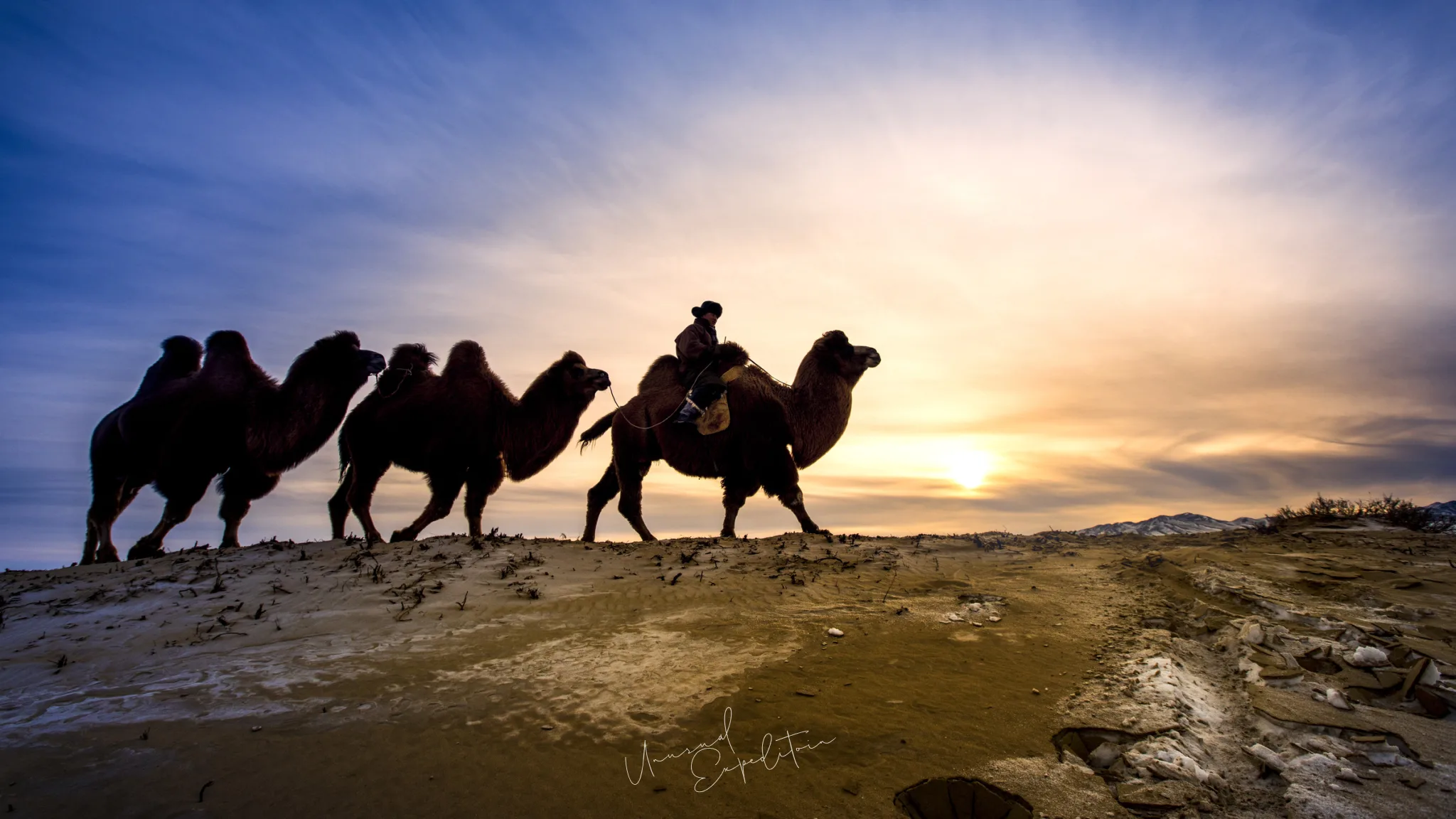
| Camels on a ridge in silhouette | Sunset | 16-35mm or 70-200mm | Expose for the sky, keep the ridge clean |
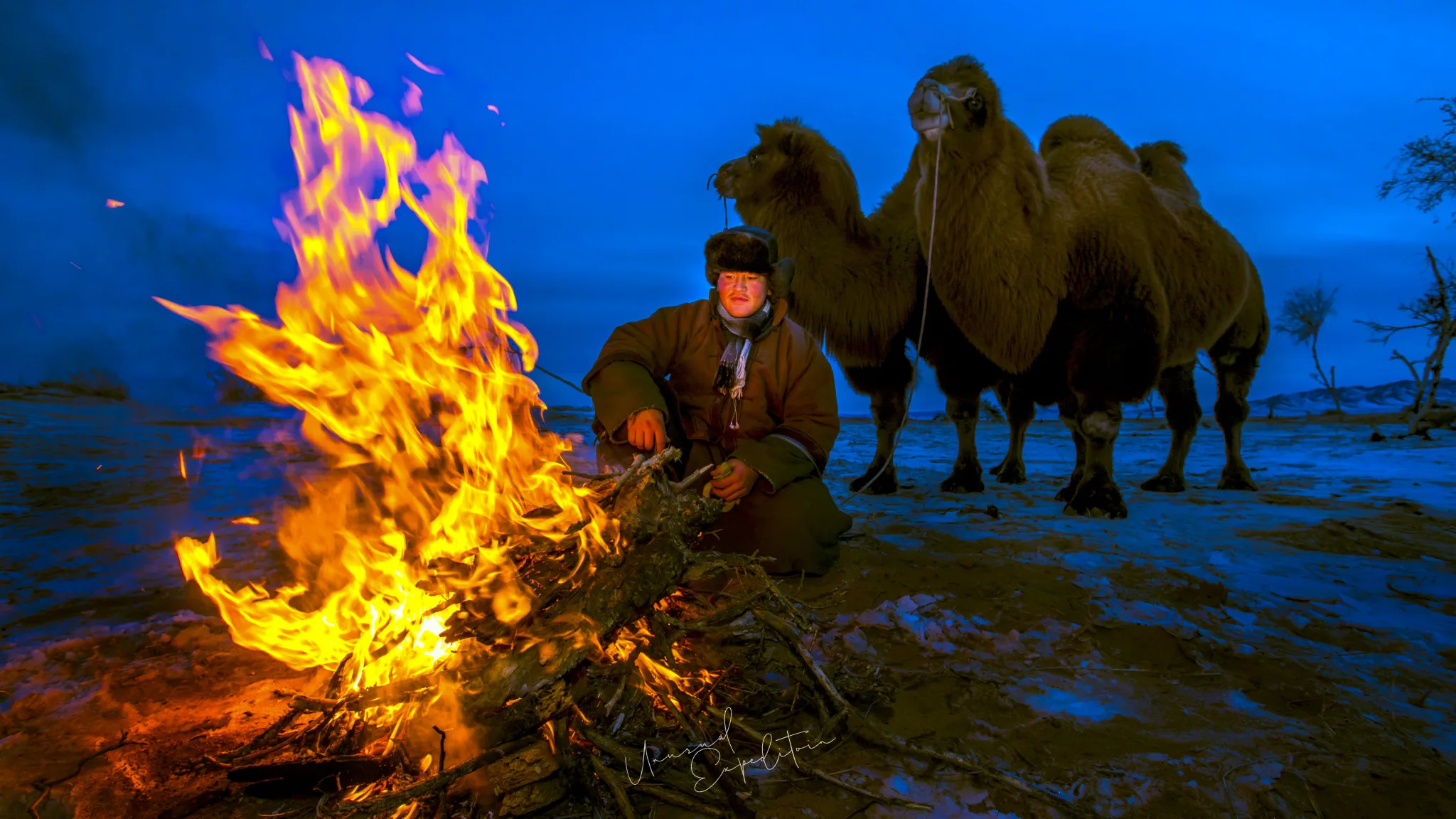
| Fire with camels and herder | Blue hour | 16-35mm, high ISO | Balance the flame against the blue sky |
| Dunes and trees | Late afternoon | 70-200mm | Compress the layers of sand and woodland |
The evening gives you three of these in an hour, so be in place before the sun touches the hills.
Sunset on the dunes
The classic dune frame is a string of camels walking a ridge in silhouette against the setting sun. Find the ridge in the afternoon, decide where the sun will set, and ask the herder to lead the camels along it when the light is low. Keep the ridge line clean, with nothing behind it but sky, and expose for the sky so the camels go black. A rider on the last camel gives scale. A 16-35mm makes the camels part of a huge sky; a 70-200mm from further away makes them large against the sun.
"When the sun had gone we did not pack up. The herder lit a fire of dry branches and the camels stood around it in the blue light, steaming. It was the warmest frame of the trip, in every sense."
Joseph Mak, tour leader, Unusual Expedition
Firelight at blue hour
After sunset the sky over the dunes turns deep blue, and a fire on the sand gives you warm light against it. Firelight changes from moment to moment, so shoot many frames and choose the one where the flames are full but not covering the face. Raise the ISO instead of slowing the shutter too far, or the flames blur into a smear. Expose so that the blue sky keeps its colour; the fire will be bright, and that is fine. Only light a fire with the herder's agreement, use dead wood he provides, and make sure it is out before you leave.
Camels and the people of the dunes
The dunes are home to herding families, and the camels are theirs. Ask before photographing them, pay for their time, and follow the herder's lead on where to stand and when to stop. Our camels in Mongolia article covers the animals in daylight, and Mongolia wildlife the deer and vultures of the hills nearby.
Photograph Mongolia's dunes with us
We run central Mongolia as a private trip on request and plan an evening on the dunes with a camel-herding family. See private tours and the Mongolia photography tours page.
Ask us about the dunes of central Mongolia
Central Mongolia photography tours
The next Central Mongolia departure is announced on the Central Mongolia photography tours page, with previous expeditions and all the planning guides.
Explore Central Mongolia in depth
- Central Mongolia Photography Tour Guide: Steppe, Herders and Dunes near UlaanbaatarMongolia
- Ulaanbaatar in Winter: Photographing the Coldest CapitalMongolia
- Mongolian Nomads Today: Photographing a Herding FamilyMongolia
- Mongolian Ger: Inside and Outside the Nomad's HomeMongolia
- Mongolia Winter Tour: Herding, Snow and Cold on the SteppeMongolia
- Mongolia Wildlife: Red Deer, Vultures and Yaks on the Winter SteppeMongolia
- Camels in Mongolia: Photographing Bactrian Camels in WinterMongolia
Upcoming Photo Tours
- Egypt Photo Tour – EgyptEgypt 12 Dec 2026 To 20 Dec 2026
- Inner Mongolia Winter Owl Photo Tour – ChinaChina 01 Jan 2027 To 04 Jan 2027
- Inner Mongolia Winter Photo Tour – ChinaChina 05 Jan 2027 To 11 Jan 2027
- Mekong And Central Highland Vietnam Photo Tour - VietnamVietnam 16 Jan 2027 To 24 Jan 2027