
Chengdu Teahouse Photos: Old Teahouses and Sichuan Opera
Chengdu teahouse photos: the old teahouses, light and steam, how to shoot politely, and Sichuan opera face changing.
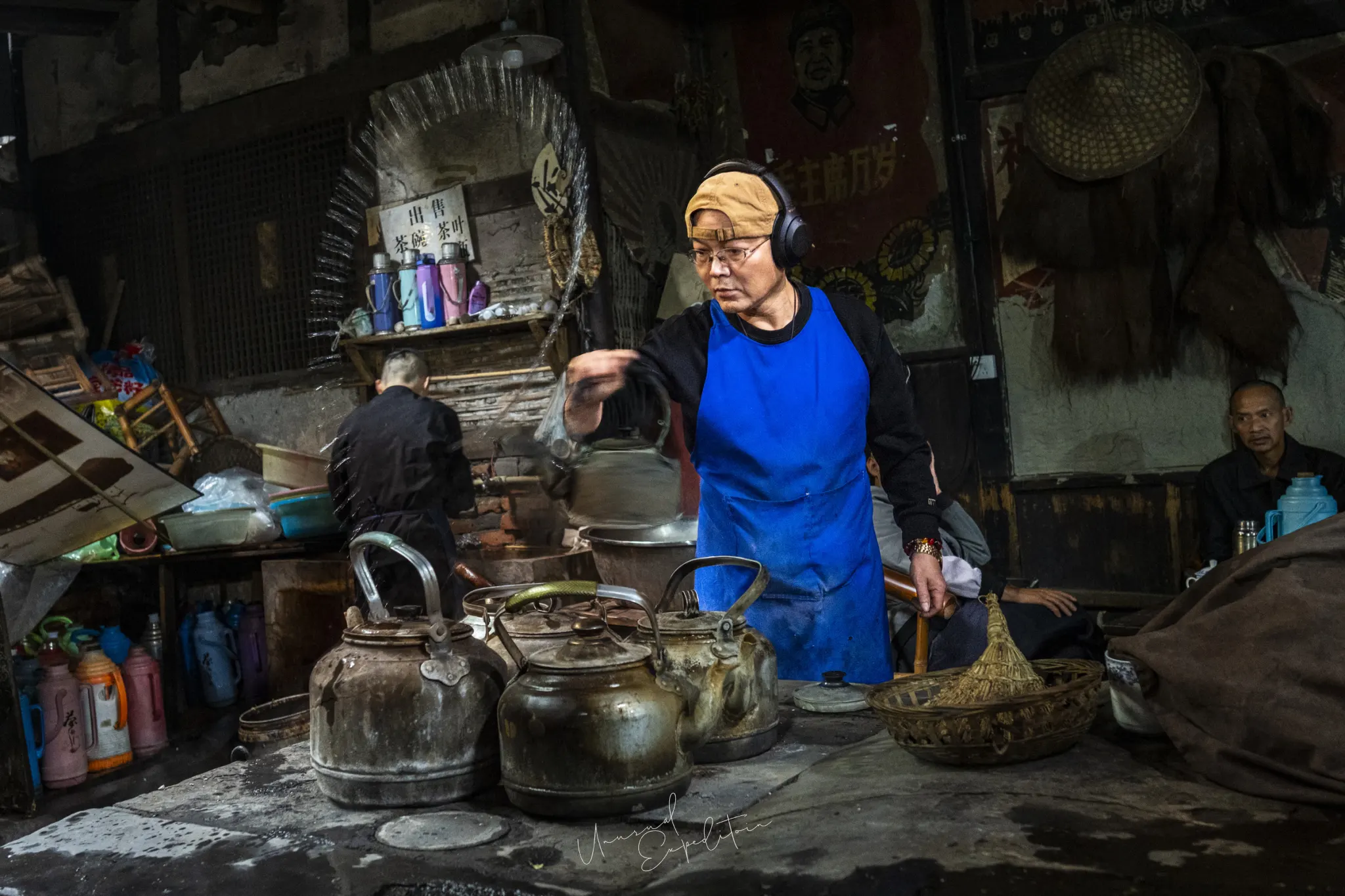
Chengdu teahouse photos come from the old teahouses on the edge of the city, where kettle masters pour from long copper spouts, steam rises through shafts of light, and regulars spend the morning over tea, cards and the newspaper. The best known for photographers is the Guanyin Pavilion teahouse in Pengzhen, Shuangliu district, a century-old building under a tiled roof. We have photographed Chengdu's teahouses on four trips since 2015, and add Sichuan opera in the evening. Here is how to photograph them well and politely.
Chengdu is the start and end of every trip in our western Sichuan photography tour guide, and the teahouses are the best use of a spare morning there.
Chengdu teahouse culture
Tea drinking in Chengdu is social first. A teahouse is where older residents meet friends, play cards or mahjong, get their ears cleaned, read and argue. Tea comes in a covered bowl with a saucer and lid, and the server tops it up with hot water from a long-spouted kettle, sometimes from an arm's length away. In the old suburban teahouses, little has been modernised: bamboo chairs, low tables, a coal or wood stove lined with kettles, and portraits and posters on smoke-darkened walls. That is the setting photographers come for.
Chengdu old teahouse: the light
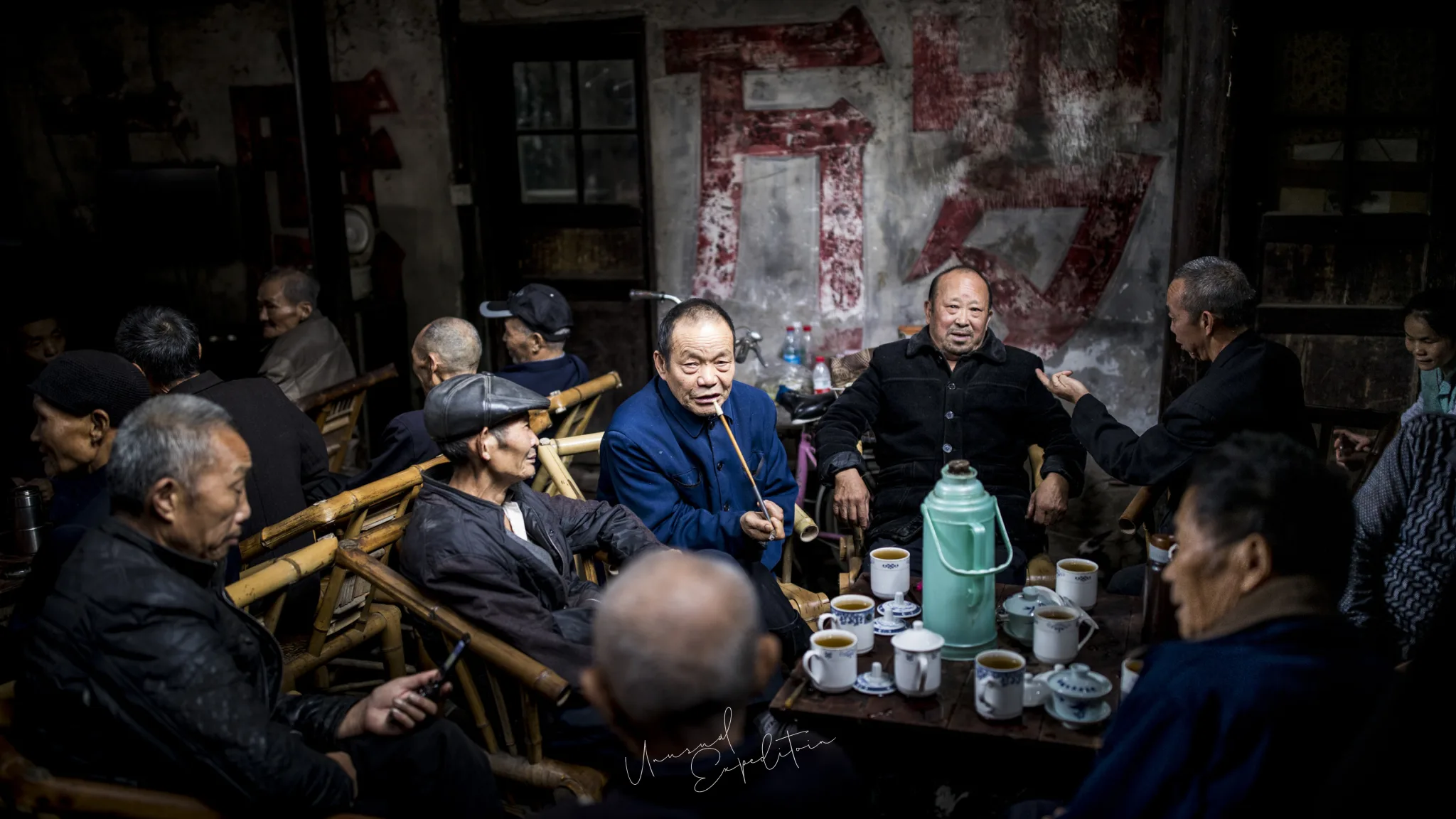
Old teahouses are dark inside, and that is their gift. Light comes through doorways, skylights and gaps in the roof, and on a bright morning it falls in hard beams through the steam from the kettles. Expose for the highlights and let the room go dark; the beam, the steam and a face in the light are the picture. Arrive early, when the regulars have just settled and the stove is busiest, and the sun is still low enough to come in at an angle. By late morning the beams shorten and the room fills with flat light.
How to photograph a Chengdu teahouse without being a nuisance
These are working teahouses for local people, and some have become crowded with photographers. Travel writers have quoted the Pengzhen manager complaining that photographers rarely order tea. So order tea, sit down, and pay for the table. Spend the first part of the visit drinking it with the camera down. Regulars who have seen you settle will mostly ignore you after that, which is what you want. Do not move furniture, block the server's path, or use flash. If someone waves you away, put the camera down and smile.
The best teahouse pictures I have made came after the second cup. By then the old men have decided you are harmless and gone back to their cards, and the kettle master has stopped performing for you and is just working.
Joseph Mak, tour leader, Unusual Expedition
Camera settings in a teahouse
A 24-70mm or 35mm-equivalent prime covers most of it; a 16-35mm helps for the whole room with the stove in front. Use a fast aperture and raise the ISO rather than slowing the shutter, because steam and pouring water need at least 1/250 second to freeze, and slower if you want the pour to streak. Spot-meter on the brightest part of the beam. A small reflector or a phone screen will not help here; work with what the room gives you.
| Scene | Lens | Approach |
|---|---|---|
| Kettle master pouring | 24-70mm | Fast shutter to freeze the stream, or slow to trail it |
| Steam in a light beam | 35mm to 50mm | Expose for the beam, let shadows go black |
| Regulars at cards | 50mm to 85mm | From your own table, after you have settled |
| Whole room | 16-35mm | From a corner, stove in the foreground |
The first two need the morning sun; the last two work any time.
Sichuan opera face changing show in Chengdu
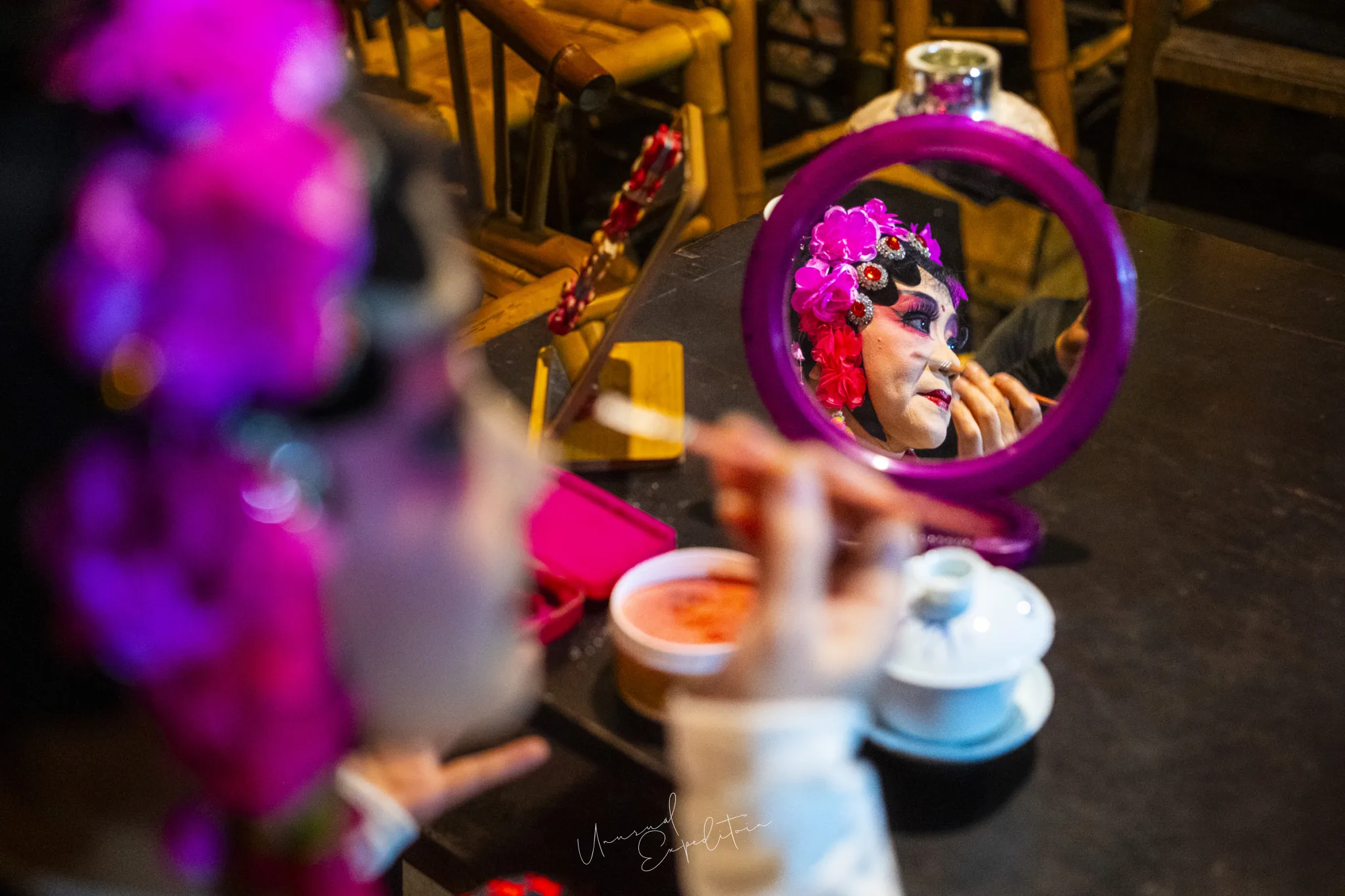
Sichuan opera is the other side of a Chengdu stay. Performances mix singing, comic scenes, puppetry, fire spitting and the famous face changing, in which masks switch faster than you can see. Several theatres and teahouses in the centre stage shows for visitors in the evening. For photographers, the best pictures are often before the show: performers painting their faces in hand mirrors, fixing headdresses and warming up in costume. Ask the venue first; some allow photography backstage for small groups, others do not.
Photographing the opera on stage
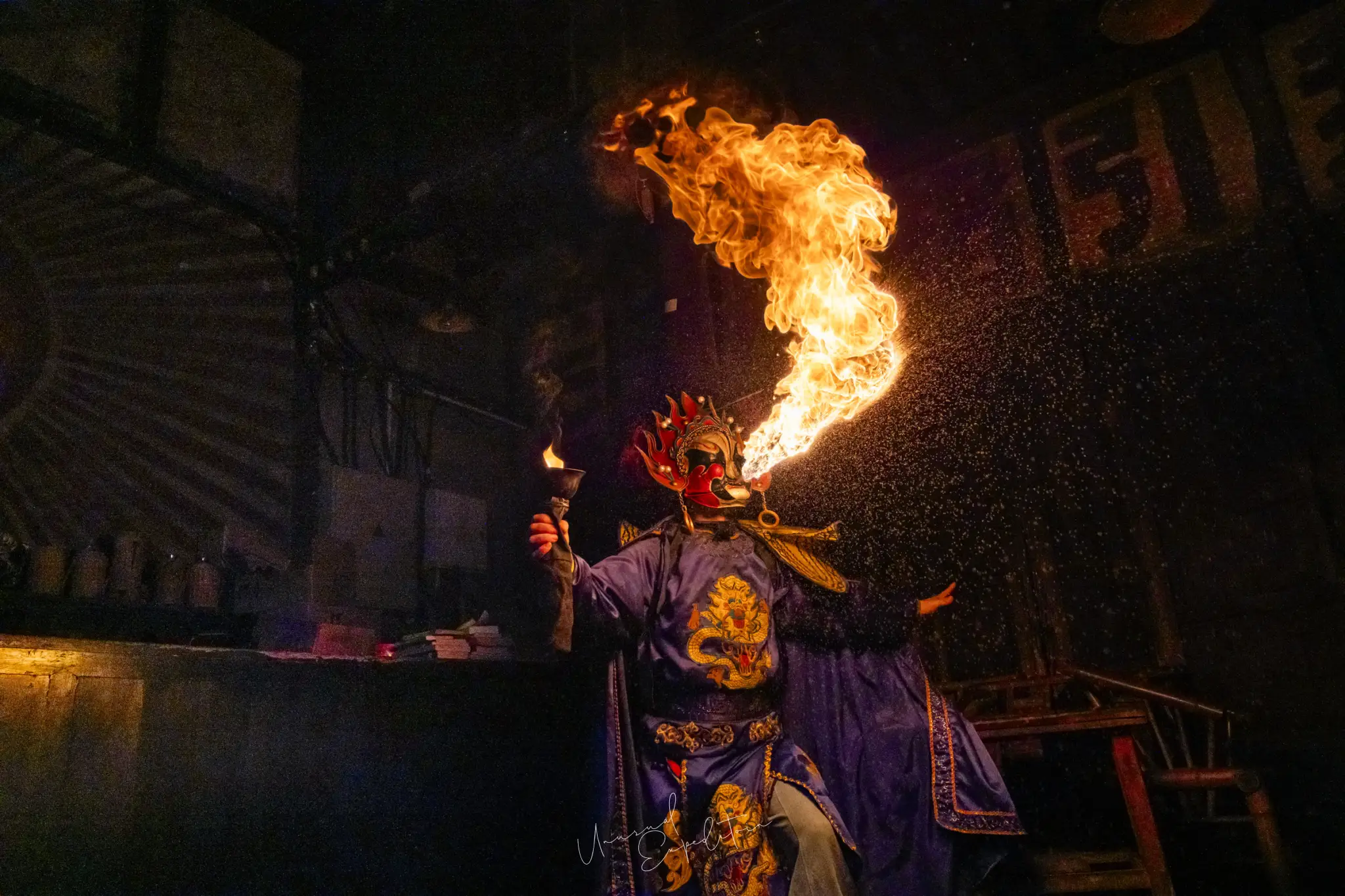
Stage light is uneven and colourful, and face changing happens in a fraction of a second, so shoot in short bursts at a high shutter speed and accept a high ISO. Fire spitting is easier: the flame lights the performer for you, so expose for the fire. Sit to one side of the stage rather than dead centre for more depth in the costumes. Flash is never acceptable during a show.
Other Chengdu photography ideas
Chengdu also has old towns on its outskirts with stone bridges and canals, a former factory district turned arts quarter that looks good at blue hour, and markets full of chillies and Sichuan pepper. On our Fujifilm Chengdu trip we added Yuantong ancient town and the Dongjiao Jiyi arts district to the teahouse mornings. All of these suit the day you land or the day before you fly home, before or after the plateau.
Where to go after Chengdu
Most of our guests come to Chengdu on the way to the mountains. The western Sichuan photo spots article covers Litang, Tagong and the passes, and the best time to visit western Sichuan explains which season suits which subject.
When to photograph Chengdu teahouses
Teahouses are a year-round subject, which makes them useful when the mountains are in cloud. Winter mornings are the best for steam, because the cold air makes every kettle and teacup smoke, and the low sun comes in at a sharper angle. Summer mornings are warm and humid, with less visible steam but softer light. Weekends are busier with both locals and visiting photographers, so a weekday morning gives you more room and a quieter table. Avoid the lunar new year week, when many family-run teahouses keep irregular hours.
Start in Chengdu with us
A teahouse morning is part of every western Sichuan trip we run. See current China departures and all our China guides on the China photography tours page.
Join the Sichuan photography tour
Inner Mongolia Winter Owl Photo Tour – China departs 01 Jan 2027 To 04 Jan 2027, led by Joseph Mak. Small group, photography first. All Sichuan photography tours.
Explore Sichuan in depth
- Western Sichuan Tour: A Photography Guide to Tibetan SichuanChina
- Western Sichuan Photo Spots: Litang, Tagong, the Passes and DanbaChina
- Larung Gar Photos: The Buddhist Academy at Seda, and Whether You Can Go NowChina
- Best Time to Visit Western Sichuan for PhotographyChina
Upcoming Photo Tours
- Egypt Photo Tour – EgyptEgypt 12 Dec 2026 To 20 Dec 2026
- Inner Mongolia Winter Owl Photo Tour – ChinaChina 01 Jan 2027 To 04 Jan 2027
- Inner Mongolia Winter Photo Tour – ChinaChina 05 Jan 2027 To 11 Jan 2027
- Mekong And Central Highland Vietnam Photo Tour - VietnamVietnam 16 Jan 2027 To 24 Jan 2027