
Deadvlei Photography: Dead Trees, White Clay and Orange Dunes
Deadvlei photography: how to shoot the dead camelthorn trees, white clay pan and dune wall, in which light, with what lens.
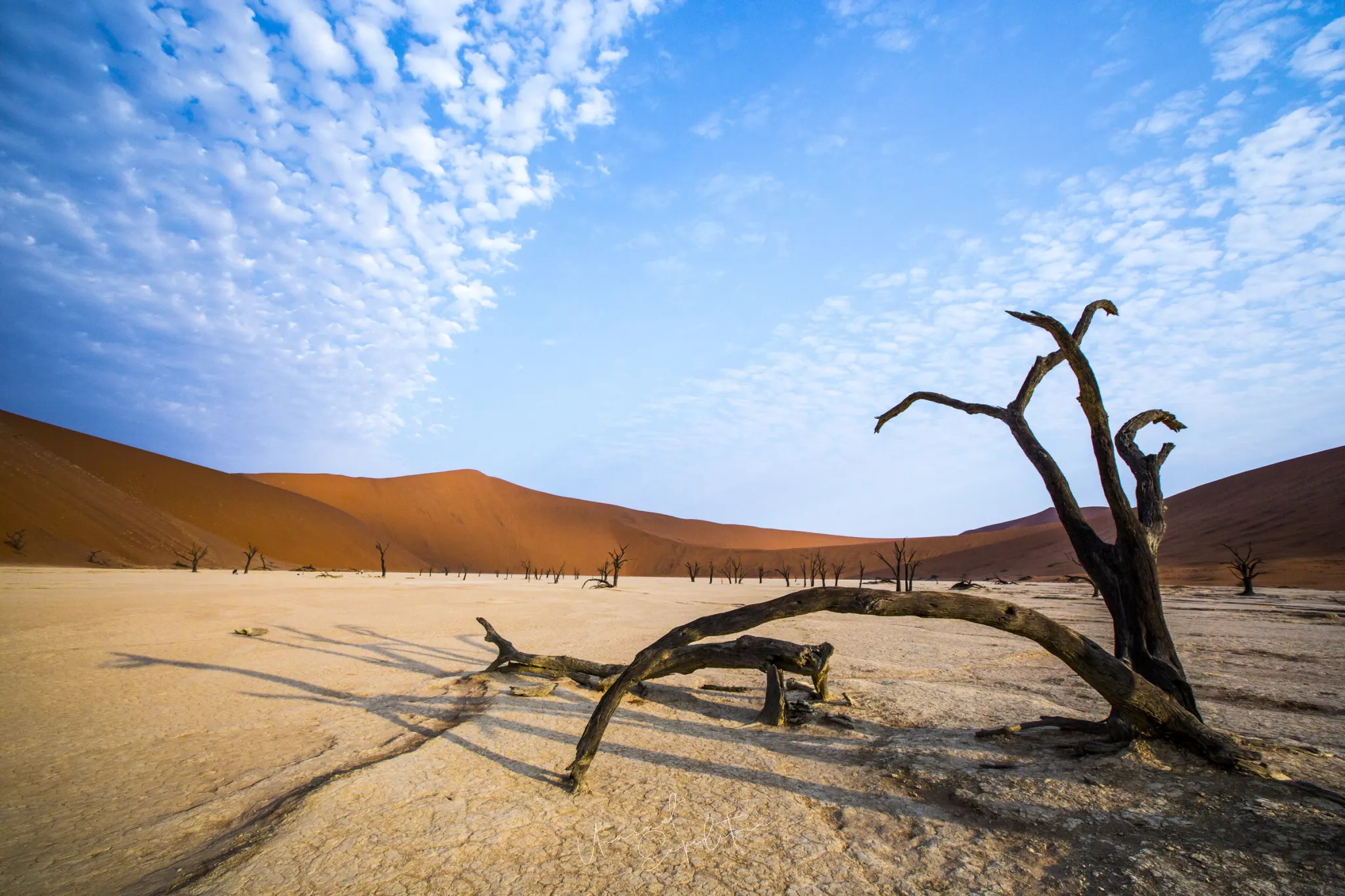
Deadvlei photography is about one scene done well: black, long-dead camelthorn trees standing on a white clay pan under a wall of orange dune. The trees are long dead and still upright, because the dry air barely lets them rot. The place is small, so the picture is made by where you stand, what time you arrive and which lens you pick, not by how far you walk.
Deadvlei sits inside the Sossusvlei dune sea, the area we cover in our Sossusvlei photography tour guide, and the wider country is in the Namibia photography tour guide. This article is the detail on the trees, the light and the frames that work. The photographs here are our own, taken on our trips to the pan; we hold the rights to them, and the notes come from knowing the place first hand.
What are the Deadvlei trees, and why are they still standing?
The trees are camelthorn, the thorny acacia that grows along the dry riverbeds of the Namib. Deadvlei formed when the Tsauchab River flooded the pan and then a dune moved across the channel and cut the water off. The trees that had grown in the wet years died and dried hard in the desert air. Standard geology accounts describe it this way, and a caption can say simply: a pan cut off from its river, and trees left behind. Many of them are black from sun, and against pale clay that black is the whole subject.
Deadvlei photography: which light makes the picture?
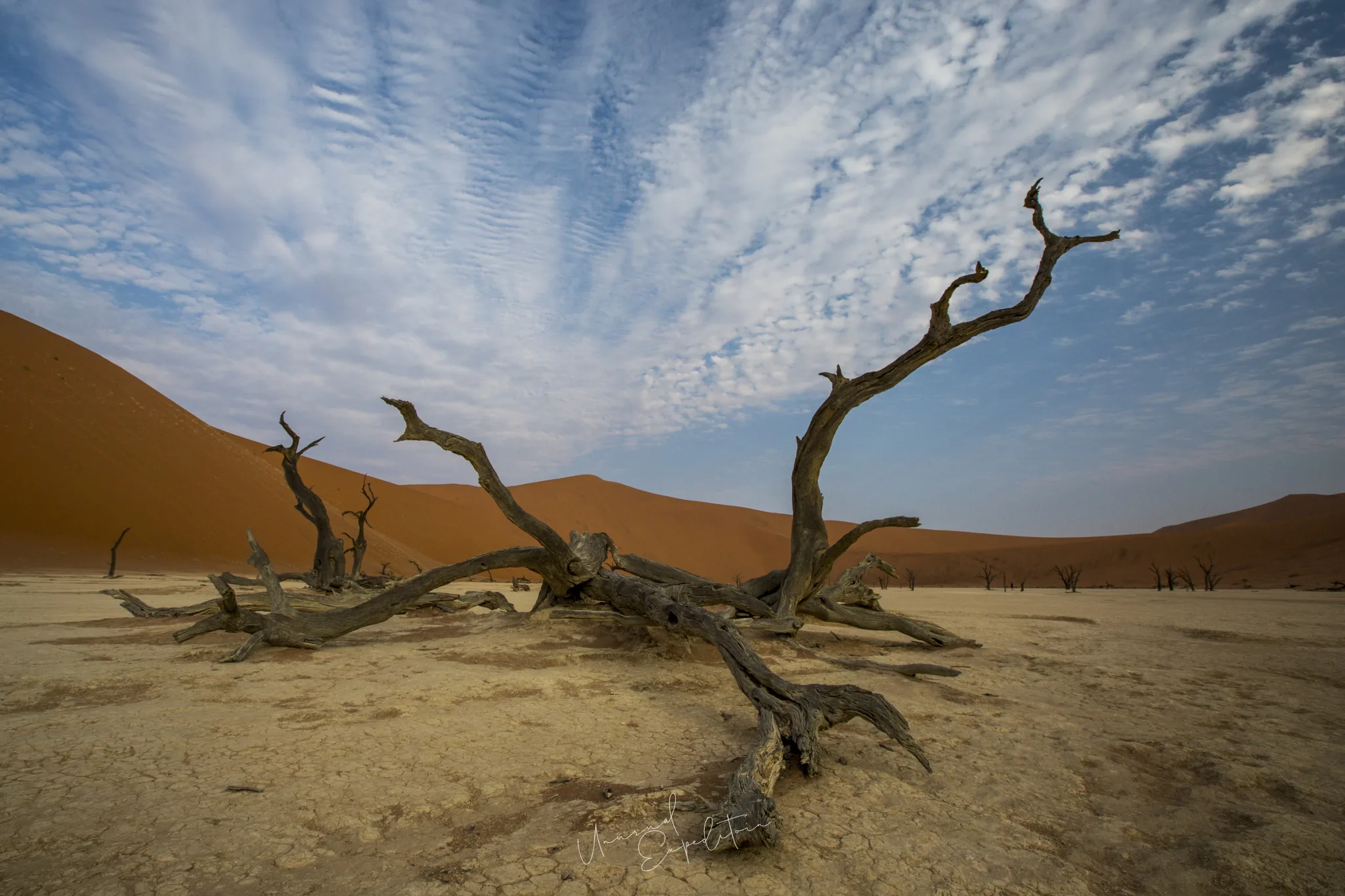
Deadvlei is a bowl, and the dune walls decide the light. In the first hours after sunrise one wall is lit orange while the pan below is still in shade, so the trees sit in soft, even light with a glowing background, which is the classic frame. Later, with the sun higher, the clay turns white and the shadows of the trees get short and hard. Both work. Early light gives colour and separation; high sun gives graphic contrast and clean black and white. Cloud, if you get it, can be better than a clear sky, because it holds the clay evenly bright and keeps the sun out of the frame.
Which lens should you bring to Deadvlei?
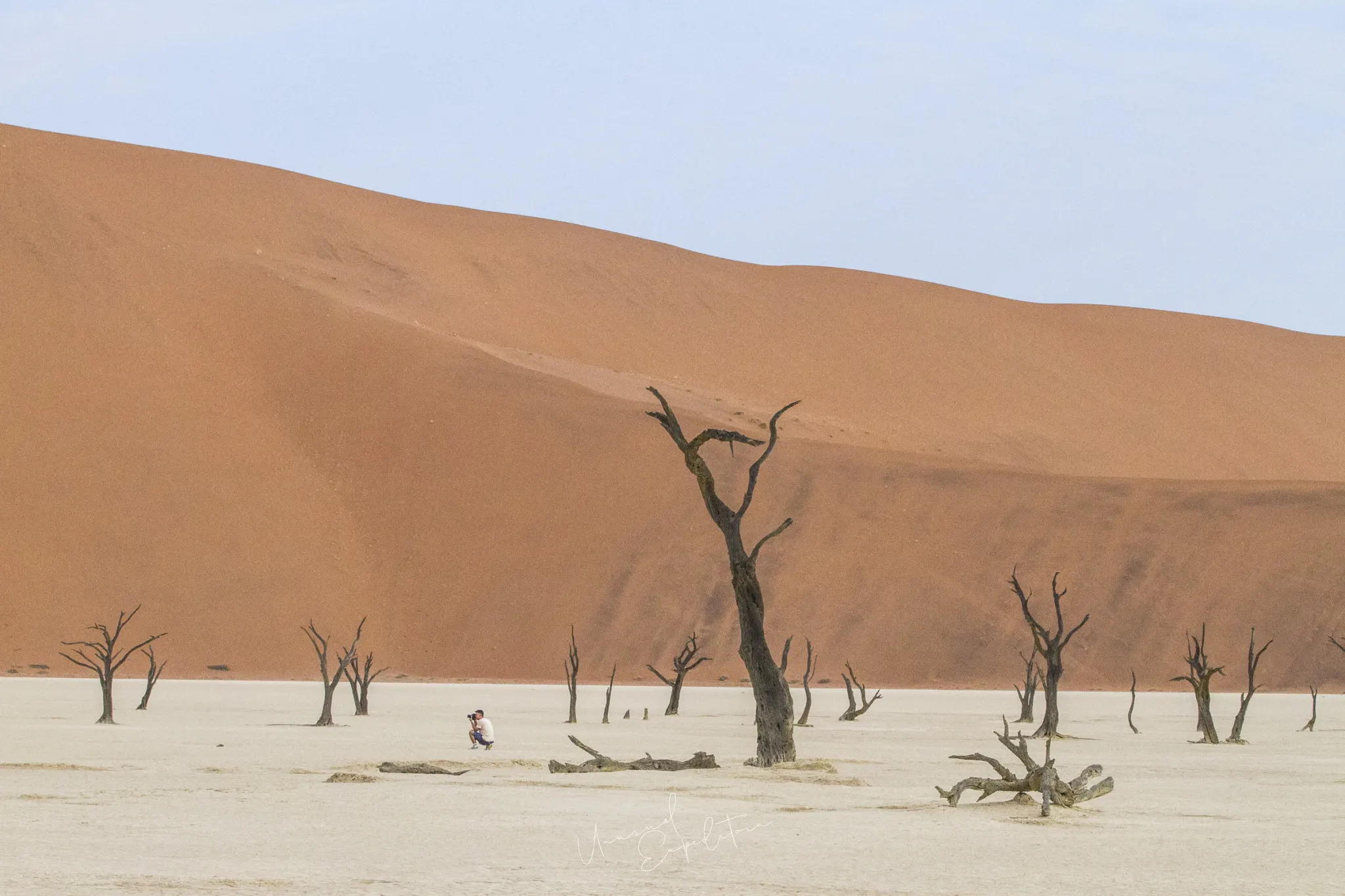
A 24-70mm covers most of what we shoot here: a wide frame of several trees against the dune, and tighter portraits of a single tree. A 16-35mm helps when you want to be low beside a fallen trunk with its branches reaching into the frame. A 70-200mm compresses the dune wall behind the trees so the orange fills the picture, and it lets you pick out two or three trunks without people standing between them. Bring a lens cloth; the fine sand gets everywhere and a gentle blow is better than a wipe.
How do you expose white clay and orange sand?
The clay is very bright and the sand is saturated, and the camera meter will try to turn the clay grey. Expose to the right, check the highlight warning on the white pan and pull back until the clay is just clear of clipping. Shoot raw so you can lift the shadows on the trees. If the sky is blue, a polariser deepens it, but watch the dune: it can darken the orange unevenly across a wide frame. Keep the horizon level; with so few lines in the scene, a tilt shows at once.
Where do you stand for a clean Deadvlei frame?
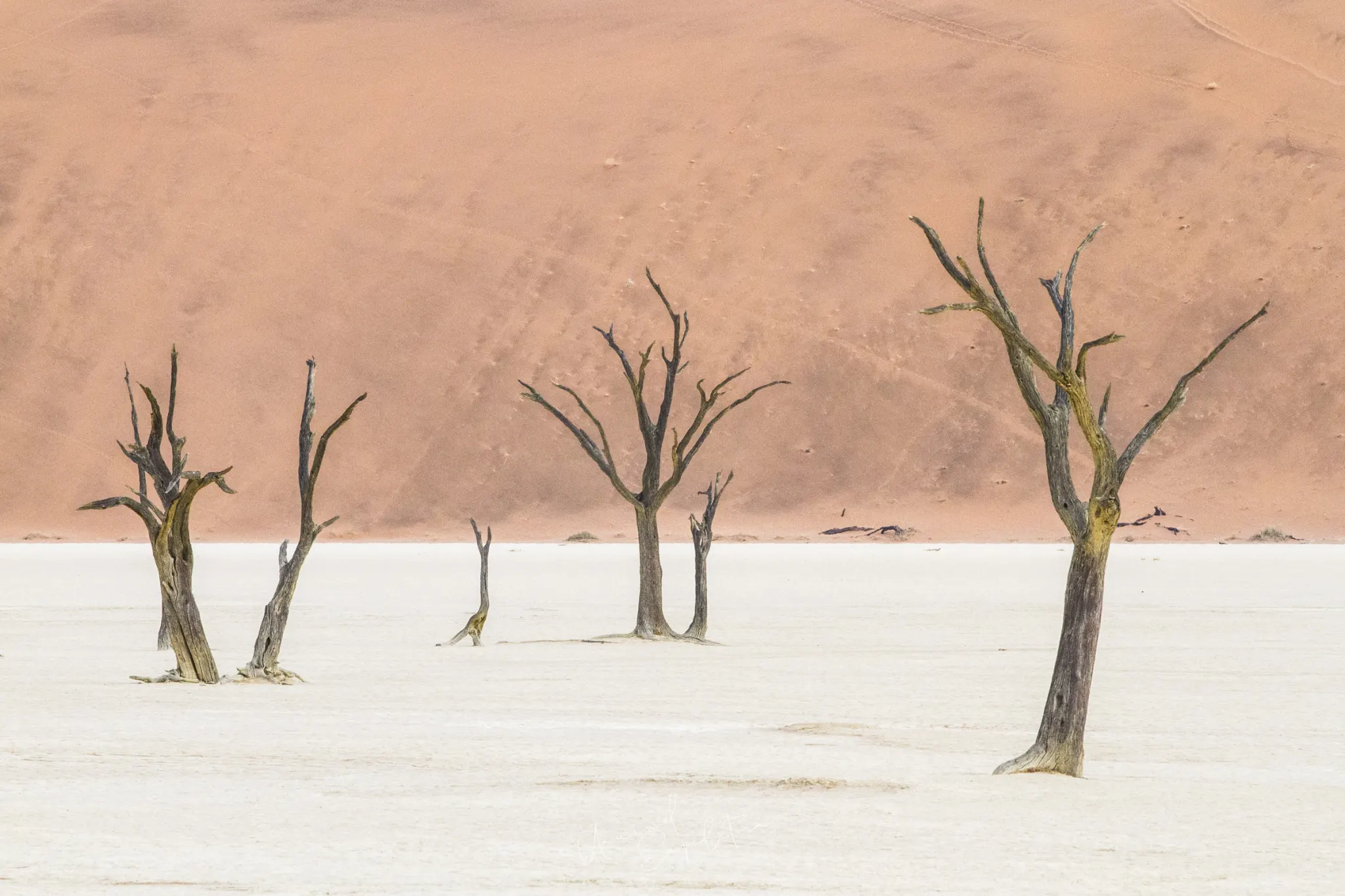
Walk the pan before you set up. The best compositions come from lining up a tree against empty sand rather than against another tree, and from keeping the bright dune ridge as a diagonal behind the trunks. A low position makes the branches sit against the dune; a higher one separates them from it. Footprints are the practical problem. Stay on the paths where you can and step around the area you want to shoot, because tracks across the clay are hard to remove from a frame. Please do not touch or climb on the dead trees.
Is Deadvlei crowded, and how do you work around people?
It is the best known frame in the country, so expect other visitors on the pan, and more of them as the morning goes on. Photographers work around that in three ways. Go early and take the wide frames first, before the pan fills. Use a longer lens and a tight crop so a single tree and the dune are all that is in the frame. Or wait: people drift through, and a frame with nobody in it usually arrives if you stay put on a tripod. Keep your own gear off the clay between shots, and keep out of other people's pictures as you would want them to keep out of yours.
At Deadvlei I stop trying to make something new and look for the tree that has the most space around it. Give it a clean piece of dune behind and wait for the light to reach the wall. That is nearly the whole job.
Joseph Mak, tour leader, Unusual Expedition
How do you get to Deadvlei, and what do you need to check?
Deadvlei is reached from the Sesriem gate of the Namib-Naukluft Park, along a tarred road and then a sand track. The last stretch needs a 4x4 or the shuttle that runs from a car park, and the arrangements have been reported as changing, so check the current rules with Namibia Wildlife Resorts or your lodge before you plan around them. Gate hours follow sunrise and sunset and move through the year. From the sand parking area, the pan is a short walk over soft sand, which is heavier going than it looks with a camera bag.
What else is on the pan besides the trees?
Pied crows work the branches, and the sky above the dune wall can make a picture without any tree in it. The cracked clay itself is a subject, which we cover in the Sossusvlei clay pan photography article, and the dunes behind are the subject of Sossusvlei dunes photography. For when to go, read the best time to visit Sossusvlei.
See Deadvlei with us
We run Namibia as a private trip on request and can build Deadvlei and the Sossusvlei dunes into it. The pace and dates are yours, we arrange the logistics, and a photographer or photography coaching can be added at extra cost. Ask at least two months ahead; last-minute can be arranged. See private tours and the Namibia photography tours page.
Sossusvlei photography tours
The next Sossusvlei departure is announced on the Sossusvlei photography tours page, with previous expeditions and all the planning guides.
Explore Sossusvlei in depth
- Sossusvlei Photography Tour: Dunes, Deadvlei and the PansNamibia
- Sossusvlei Dunes Photography: Dune 45, Big Daddy and Dune LightNamibia
- Sossusvlei Clay Pan Photography: Cracks, Patterns and Cloud ShadowNamibia
- Best Time to Visit Sossusvlei for PhotographyNamibia
Upcoming Photo Tours
- Egypt Photo Tour – EgyptEgypt 12 Dec 2026 To 20 Dec 2026
- Inner Mongolia Winter Owl Photo Tour – ChinaChina 01 Jan 2027 To 04 Jan 2027
- Inner Mongolia Winter Photo Tour – ChinaChina 05 Jan 2027 To 11 Jan 2027
- Mekong And Central Highland Vietnam Photo Tour - VietnamVietnam 16 Jan 2027 To 24 Jan 2027