
Sossusvlei Clay Pan Photography: Cracks, Patterns and Cloud Shadow
Sossusvlei clay pan photography: cracked mud patterns, low sun, cloud shadow and quiet details between the dunes.
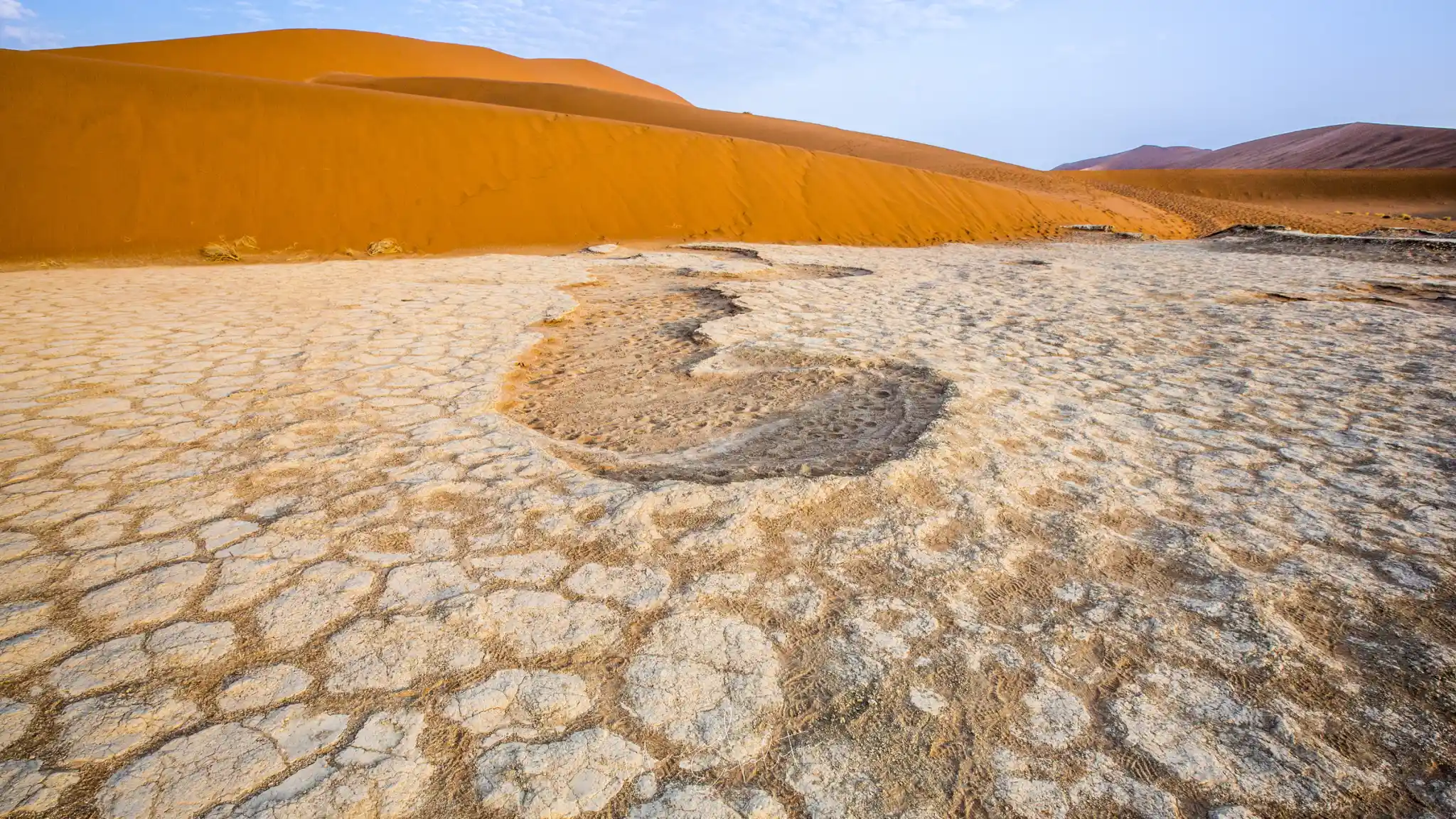
Sossusvlei clay pan photography is the quiet half of a visit to the dunes: cracked mud in polygon patterns, low sun skimming the clay and cloud shadows moving across a pale floor. The pans are flat and bright, and what you photograph is texture, line and tone rather than a grand view. They reward patience and a light step.
The pans belong to the area covered in our Sossusvlei photography tour guide, and the dead trees on the best known pan are in Deadvlei photography. The photographs in this article are our own, taken on our trips to the pans; we hold the rights to them, and the notes come from knowing these places first hand.
What is a vlei, and why do the pans crack?
A vlei is a shallow depression that fills with water after rain or a river flood. Around Sossusvlei, the Tsauchab River occasionally reaches the pans, and the water stands for a while before it soaks away or evaporates. As the clay dries it shrinks and splits into the polygon cracks you see on the surface. The flat shape of the pan is a result of that same slow cycle of flood and drying. The pans are dry for most of the time, which is why the cracked pattern is the usual subject.
Sossusvlei clay pan: when does the texture look best?
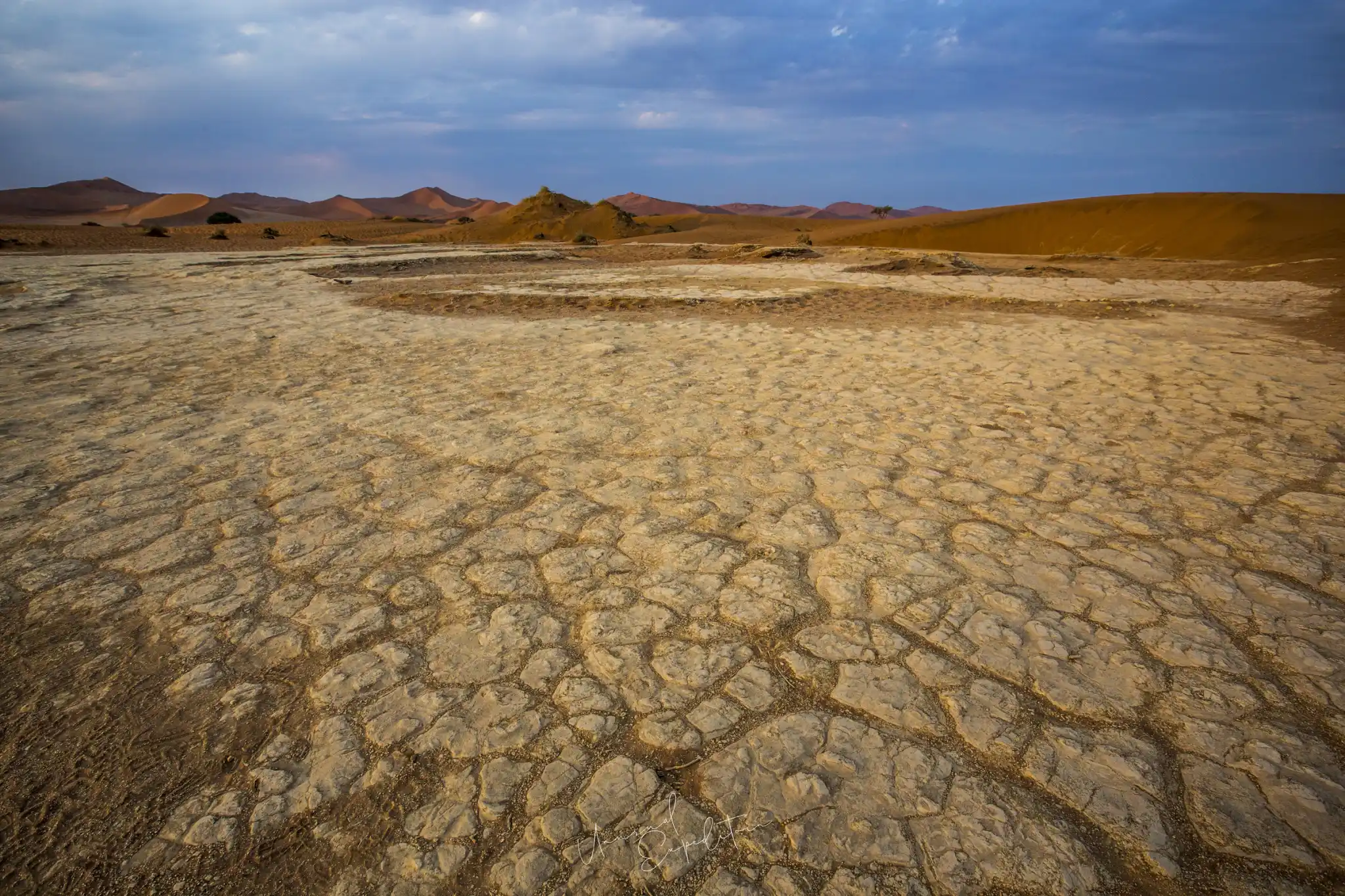
Texture needs raking light. When the sun is low, every crack throws a tiny shadow, and the pattern stands out in relief. At midday the same clay turns flat and white, and the cracks almost vanish. The best time for patterns is therefore early or late, with the sun at a low angle. Keep your own shadow out of the frame, and watch for the footprints of others, which can break the pattern in a wide shot but are easy to avoid in a tight one.
How do you compose cracked mud?
Pick a line and use it. The edge where cracked clay meets the dune is a strong diagonal, and a curve in the cracks can lead the eye to the dune above it, as in the frame at the top of this article. A wide-angle lens, held low, makes the foreground cracks large and the dune distant; a 24-70mm at the long end compresses them into a pattern. A small aperture keeps the near cracks and the far dune sharp. Take care that the horizon is straight.
A pan is easy to walk past. I always stop where the cracks curve, because a curve gives you a line to compose with. After that it is only a matter of where the sun is.
Joseph Mak, tour leader, Unusual Expedition
The low-sun frame: flare and shadow on the pan
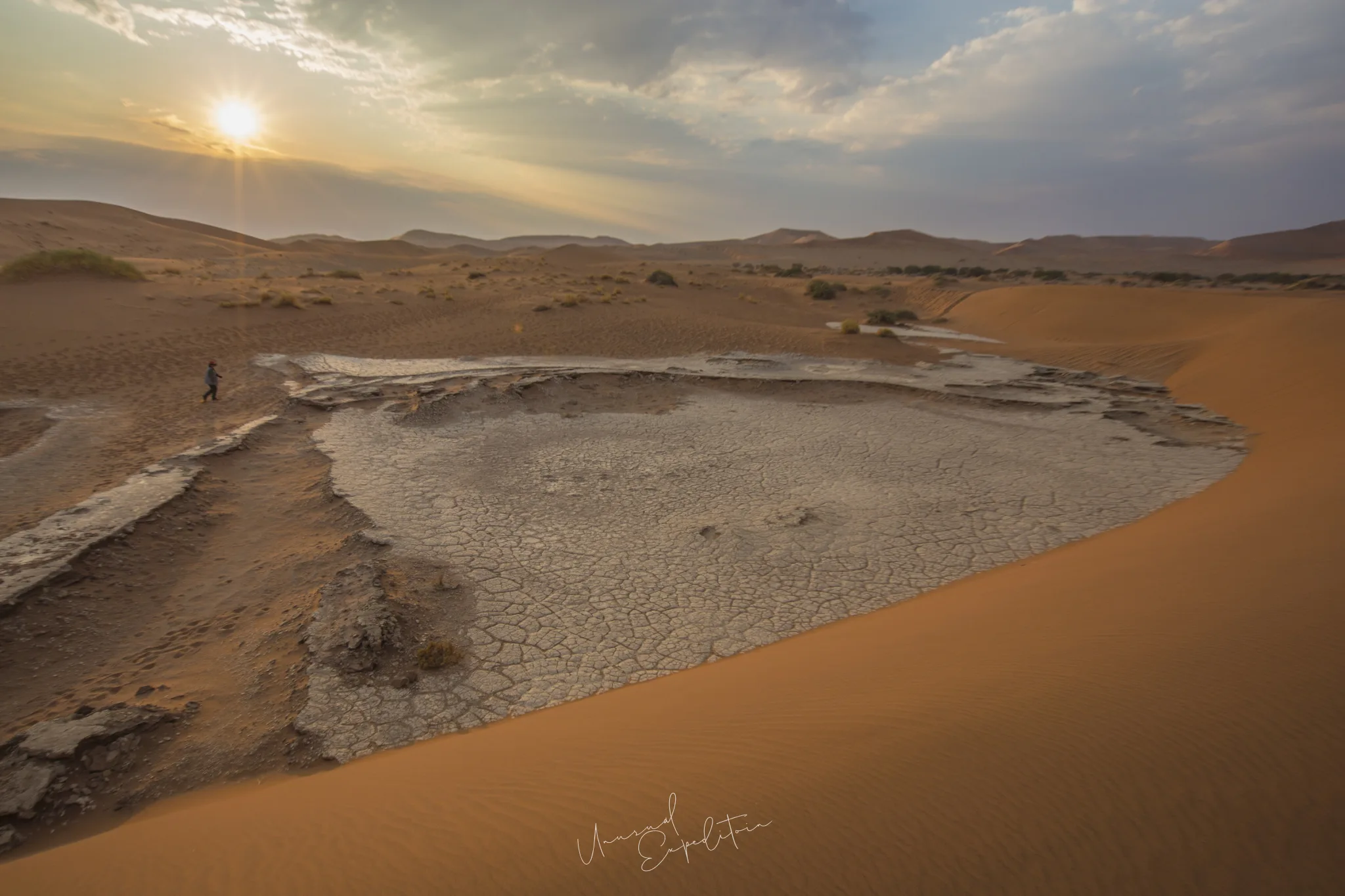
With the sun just above the dune, light rakes across the clay and every crack shows. It also puts the sun in or near the frame, so watch for flare. Shade the lens with your hand or a hood, or let the flare become part of the picture. Expose for the clay, not the sun, and use a bracket of three frames if the dynamic range is large. The low sun on dry clay is one of the few moments where a quiet pan looks as dramatic as the dunes.
Cloud shadows and the open pan
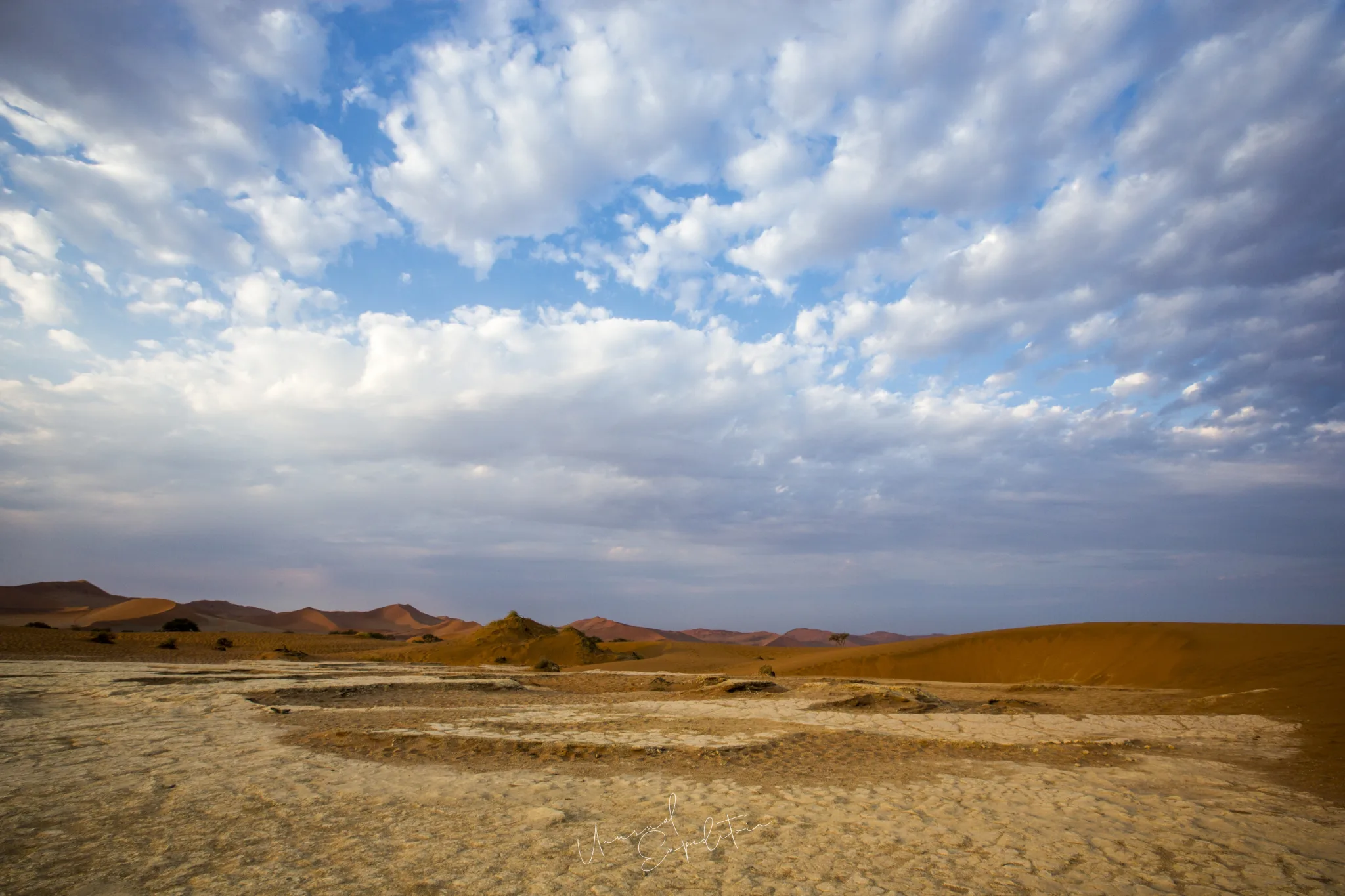
On a day with scattered cloud, shadows travel across the pan and the dunes in the distance. That moving patch of light is a subject in itself: wait for the shadow to cross a line of dunes or a patch of cracks and shoot when it lands in the right place. A telephoto of 70-200mm picks out one pool of light from the shadow; a wide lens shows the whole scale of the pan. A sky with texture matters more here than on a dune, because the flat clay leaves it so much room in the frame.
Mud, wetness and rare water
After rain the pans can hold water, and the whole character changes: the surface turns to a mirror, and the dunes and sky double in it. Such conditions are rare and unpredictable, and it is worth asking your lodge about recent rain. When the clay is wet it is slippery and soft, so take care. A dry pan is the normal case, and its cracked surface is a perfectly good subject for an hour of careful work.
Which lens and settings suit the pans?
A 24-70mm covers most pan frames, from a wide view of cracks leading to a dune to a tight pattern. A 16-35mm helps for a very low foreground, and a 70-200mm is useful for isolating a patch of cracks or a shadow on the dunes. Use a tripod in low light, and shoot at an aperture around f/8 to f/11 for depth. Focus a third of the way into the scene for a wide frame, and check sharpness on the screen. Keep the ISO low; the clay is bright enough that you rarely need to push it.
Practical notes for the pans
Pans are reached from the Sesriem gate of the Namib-Naukluft Park, and gate hours follow sunrise and sunset. The last stretch of the road is soft sand that needs a 4x4 or a park shuttle, and rules have been reported as changing, so check with Namibia Wildlife Resorts or your lodge. Walk gently on the clay, avoid crossing the part you want to shoot and take your litter out. For the seasons, see best time to visit Sossusvlei, and for the dunes Sossusvlei dunes photography.
Photograph the pans with us
We run Namibia as a private trip on request, and the pans fit easily into a day of dune work. The pace and dates are yours, we arrange the logistics, and a photographer or photography coaching can be added at extra cost. Ask at least two months ahead. See private tours and the Namibia photography tours page.
Sossusvlei photography tours
The next Sossusvlei departure is announced on the Sossusvlei photography tours page, with previous expeditions and all the planning guides.
Explore Sossusvlei in depth
- Sossusvlei Photography Tour: Dunes, Deadvlei and the PansNamibia
- Sossusvlei Dunes Photography: Dune 45, Big Daddy and Dune LightNamibia
- Deadvlei Photography: Dead Trees, White Clay and Orange DunesNamibia
- Best Time to Visit Sossusvlei for PhotographyNamibia
Upcoming Photo Tours
- Egypt Photo Tour – EgyptEgypt 12 Dec 2026 To 20 Dec 2026
- Inner Mongolia Winter Owl Photo Tour – ChinaChina 01 Jan 2027 To 04 Jan 2027
- Inner Mongolia Winter Photo Tour – ChinaChina 05 Jan 2027 To 11 Jan 2027
- Mekong And Central Highland Vietnam Photo Tour - VietnamVietnam 16 Jan 2027 To 24 Jan 2027