
Etosha Waterholes: Photographing Zebra, Oryx and Springbok
Etosha waterholes for photographers: zebra, oryx, springbok and ostrich at the water, when to go, light and the rules.
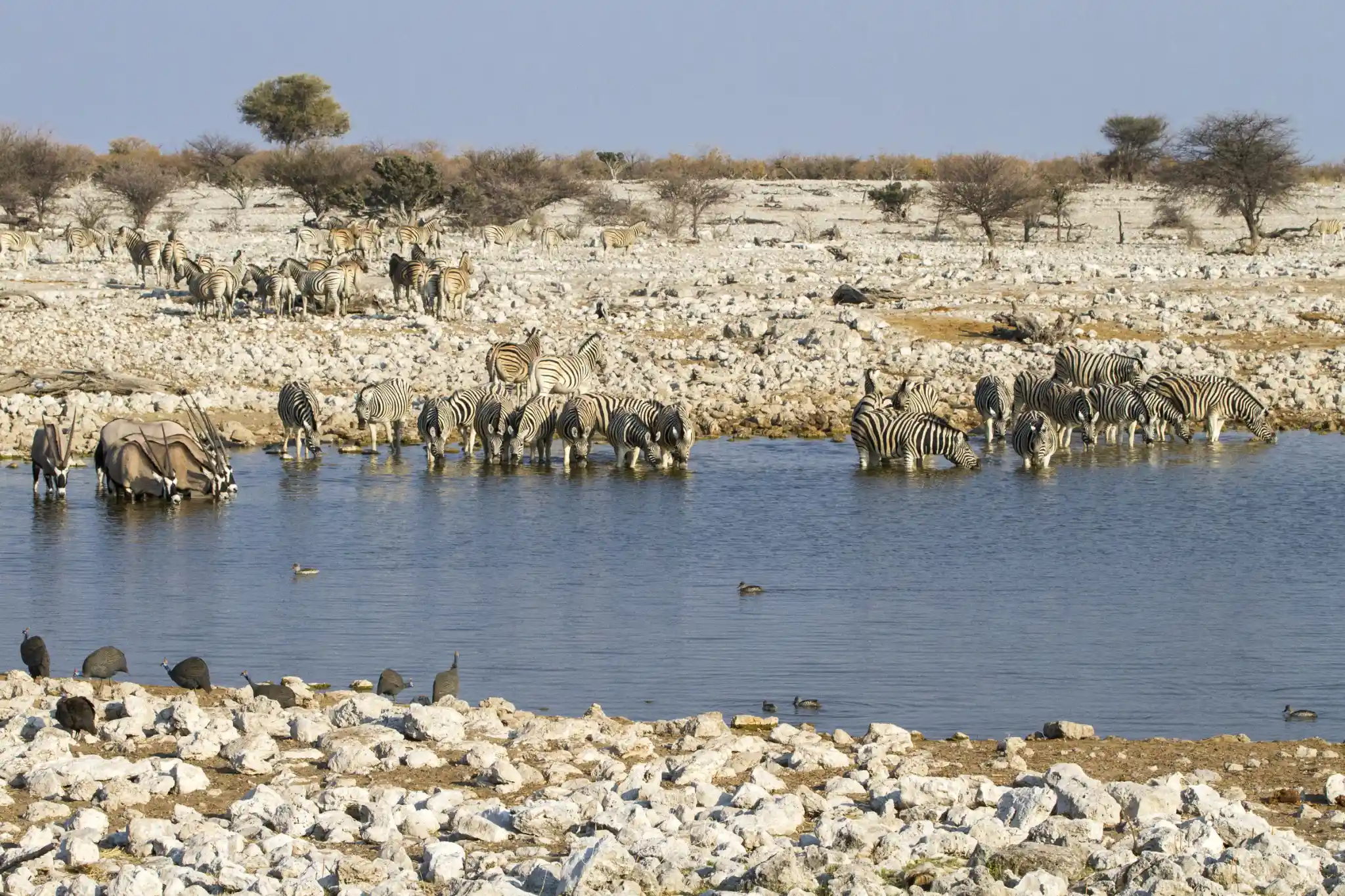
Etosha waterholes are the reason to come: a patch of blue water on pale ground, and zebra, oryx, springbok and ostrich arriving in turn to drink. For a photographer the waterhole is a stage. You choose the position, wait for the cast and take the frame when the light, the animals and the water line up. The best time to visit Etosha for this is the dry season, when water elsewhere has gone.
The waterholes are the core of our Etosha photography tour guide, and the elephants have their own article in Etosha elephants photography. For the whole country, see the Namibia photography tour guide. The photographs here are our own, taken on our trips to Etosha; we hold the rights to them, and the notes come from knowing these places first hand.
Etosha waterholes: how do they work?
Some waterholes are natural springs and some are filled from boreholes, and together they spread water across the park. In the dry season, animals depend on them, and each one has its own character: a stony shore, a reed bed, a long view across the plain. The four rest camps each have a floodlit waterhole, according to Namibia Wildlife Resorts. Searching for a waterhole map is a good first step, but local advice at the camp office about recent activity is better.
Best time to visit Etosha for the waterholes
The late dry season is the classic answer, since the fewer waterholes that hold water, the more animals crowd the ones that do. General travel sources put the dry season at about May to October, and several advise that the later in the dry season you go, the better the viewing. In the rains, animals are spread out and the waterholes quieter, but the grass is green and calves are about. Be ready for dust in the dry months, and protect the camera from it.
Photos of zebras at an Etosha waterhole: how do you frame them?
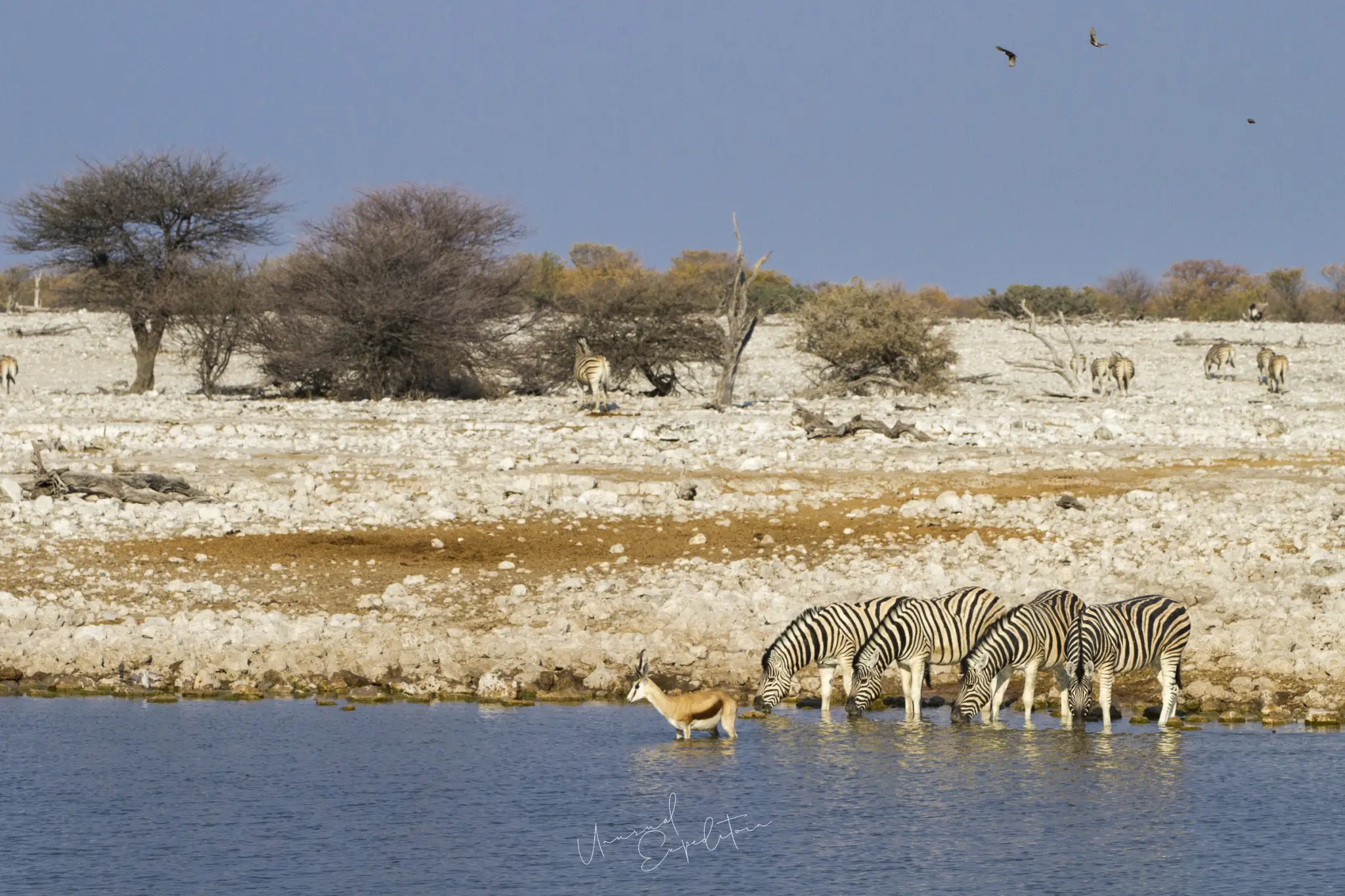
Zebra arrive in groups, drink with nervous glances and leave in a hurry. The classic frame is a line of them at the water, heads down, with reflections beneath them. Use a 70-200mm or 100-400mm, keep the shutter fast to catch a head coming up and watch the stripes in the sun, since they can clip to pure white. In a wide shot, include the waterline and the stony shore, which give the picture its sense of place. Look for gaps in the line, where a head is raised.
Oryx and zebras together
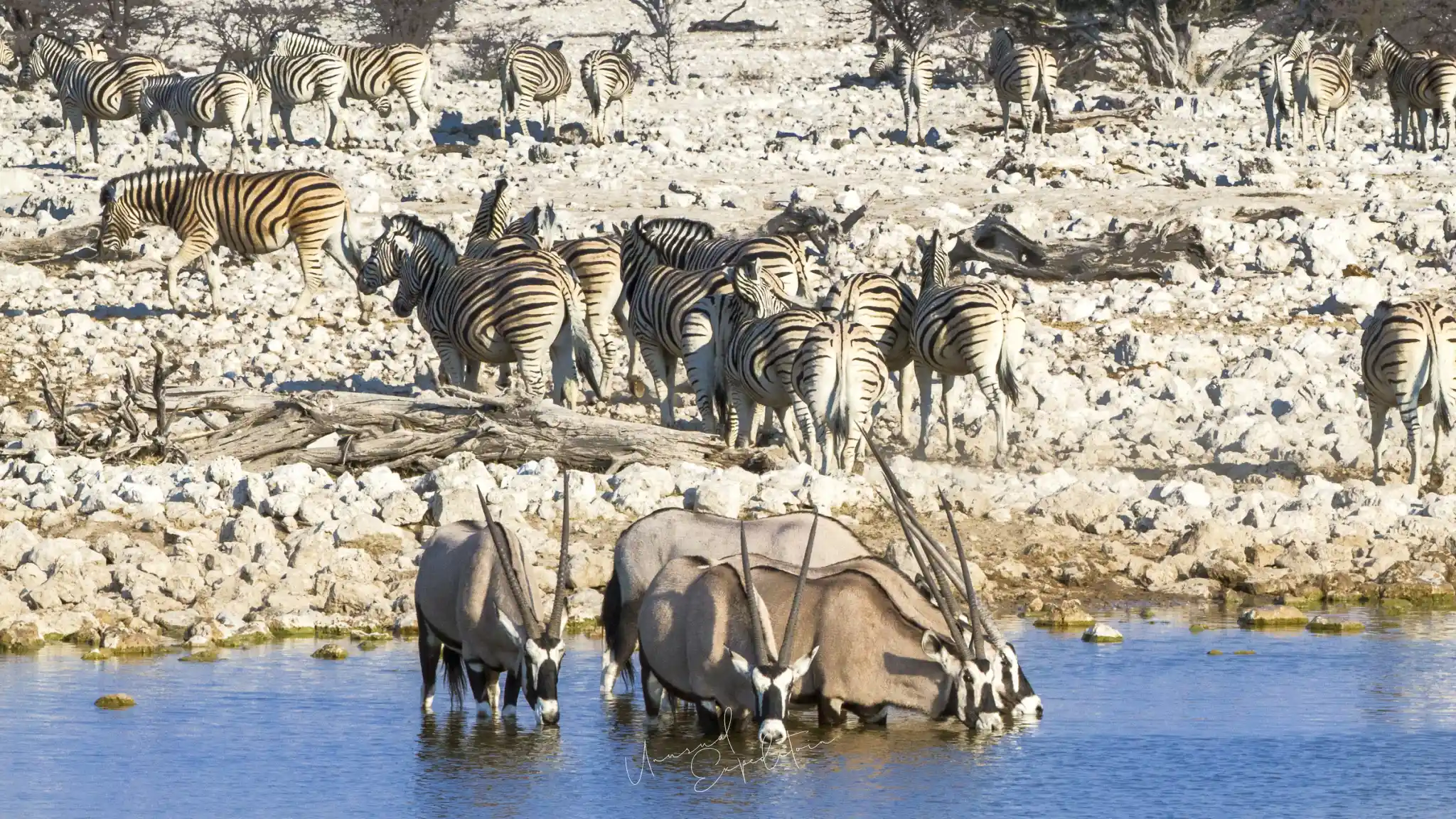
Gemsbok, or oryx, share the waterholes with zebras without much fuss, and the pair makes an appealing frame: stripes beside long straight horns. The oryx stand tall at the water with their faces dark against pale coats. A close frame like the one here comes from a longer lens and a clean background, so look for an angle where the shore and the water fill the space behind them. The oryx tolerate a patient vehicle, but they will back away if you move suddenly.
Springbok, ostrich and the smaller dramas
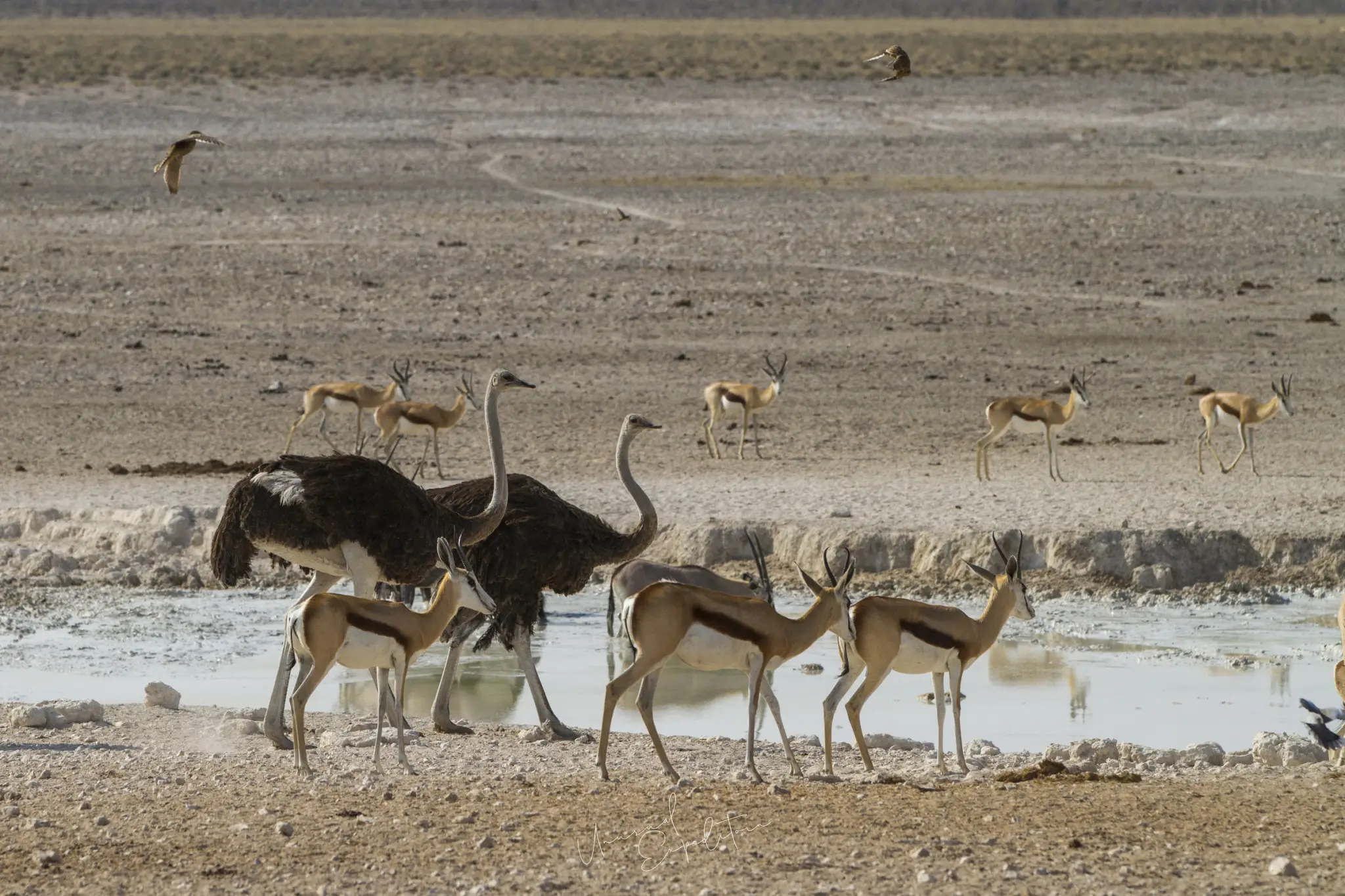
Springbok and ostrich are less showy but make quiet, graphic pictures. A springbok beside zebras gives scale, and ostriches wading at a shallow pool, with their long legs and necks, are a good subject for a shape-based composition. Wait at a pool for the animals to come close enough for a full-frame portrait, since a distant bird is just a dot in a wide plain. These frames reward a steady beanbag, a low window position and an eye for the clean background.
The empty waterhole: how to shoot the stage before the cast
When the animals have not arrived, the waterhole itself is a picture: still water, reeds, a bare acacia and a sky that fills the upper half of the frame. A 24-70mm lets you include the setting and wait. Do this early or late, when the light is soft and warm, and keep the horizon level. It is also the best time to look around the edges, since animals tend to appear from the side where you are not watching. An empty waterhole tells the reader where the story takes place.
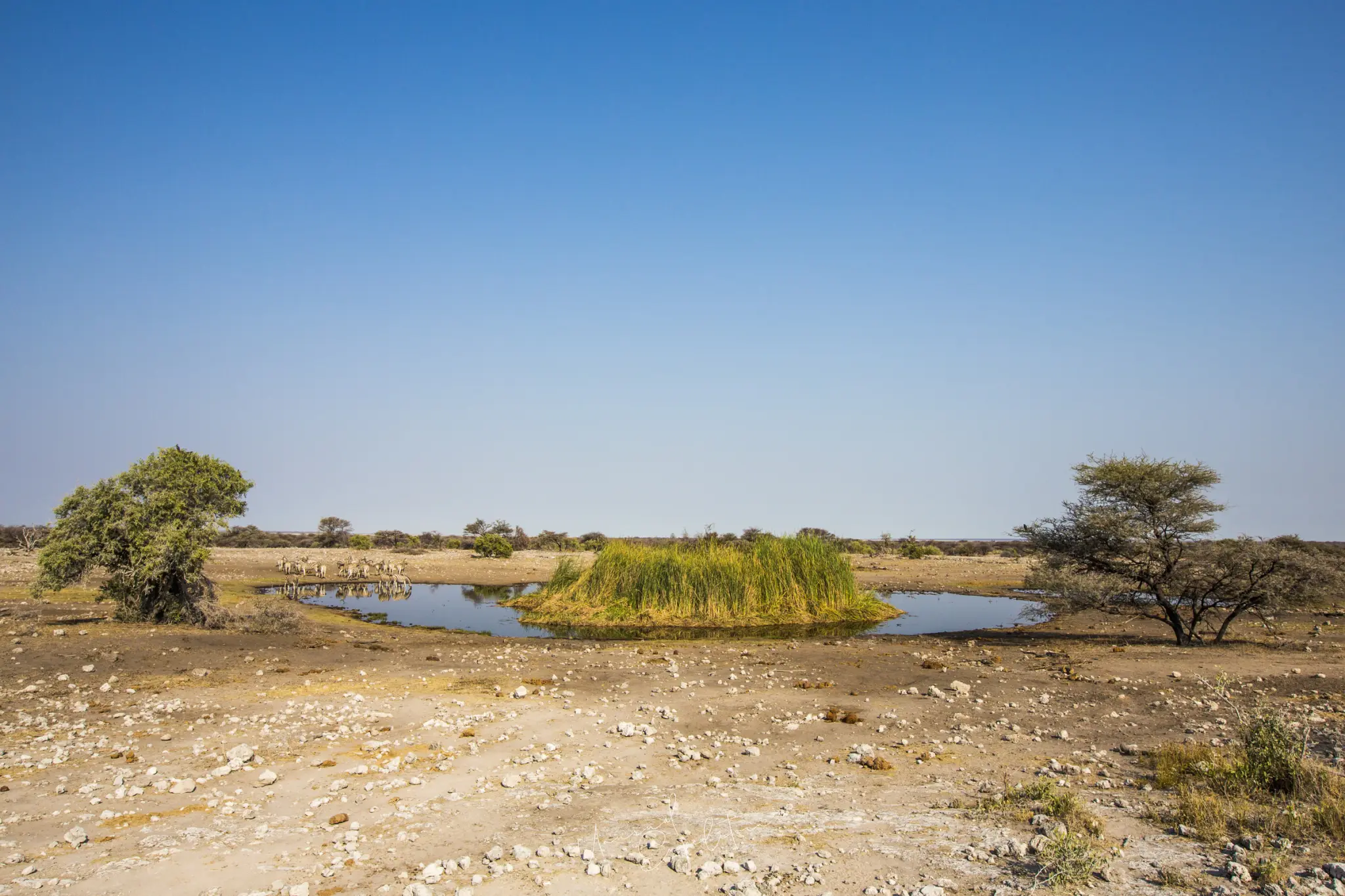
At a waterhole I decide where I want the animals to stand, then wait for them to arrive there. If the position is right, you do not have to chase anything.
Joseph Mak, tour leader, Unusual Expedition
Which lens and which position at a waterhole?
Park the vehicle with the sun behind you or to the side and the water in front, and turn off the engine. Use a beanbag on the window frame, a 100-400mm for animals at the far side and a 70-200mm when they come close. A second body with a 24-70mm records the scene. Keep your elbows in the window, and do not stand up or lean out, which can spook animals and is not permitted. Choose the side of the waterhole where the light falls on the animals, not toward you.
What time of day works best at a waterhole?
Early morning brings soft light and the first animals, who often come to drink as the day warms. Midday is hot and bright, but waterholes are often busiest then in the dry season, and a polariser can cut the glare off the water. Late afternoon gives warm side light and long shadows. Each period has its own mood, so it is worth visiting the same waterhole twice in a day, and watching how the light and the cast change.
Rules and safety at the waterholes
Namibia Wildlife Resorts states that park gates open at sunrise and close at sunset, with times that change weekly and are posted at the gates and the camps. Self-driving at night is not permitted. Stay in your vehicle at the open waterholes, keep your distance, never feed animals and follow the instructions of park staff. The UK Foreign Office advises checking current Etosha access with your provider before you travel. For fees and bookings, check the official source before you travel; we do not quote figures.
See the Etosha waterholes with us
We run Namibia as a private trip on request, with Etosha and its waterholes as a central stop. The pace and dates are yours, we arrange the logistics, and a photographer or photography coaching can be added at extra cost. Ask at least two months ahead. See private tours and the Namibia photography tours page.
Etosha photography tours
The next Etosha departure is announced on the Etosha photography tours page, with previous expeditions and all the planning guides.
Explore Etosha in depth
- Etosha Photography Tour: Waterholes, Elephants and the PanNamibia
- Etosha Elephants Photography: Herds, Water and Close EncountersNamibia
Upcoming Photo Tours
- Egypt Photo Tour – EgyptEgypt 12 Dec 2026 To 20 Dec 2026
- Inner Mongolia Winter Owl Photo Tour – ChinaChina 01 Jan 2027 To 04 Jan 2027
- Inner Mongolia Winter Photo Tour – ChinaChina 05 Jan 2027 To 11 Jan 2027
- Mekong And Central Highland Vietnam Photo Tour - VietnamVietnam 16 Jan 2027 To 24 Jan 2027