
Guizhou Rice Terraces Photography: Cloud, Villages and the Seasons
Guizhou rice terraces photography: where the terraces are, the seasons, cloud and light, villages, drones, gear and how to work on them.
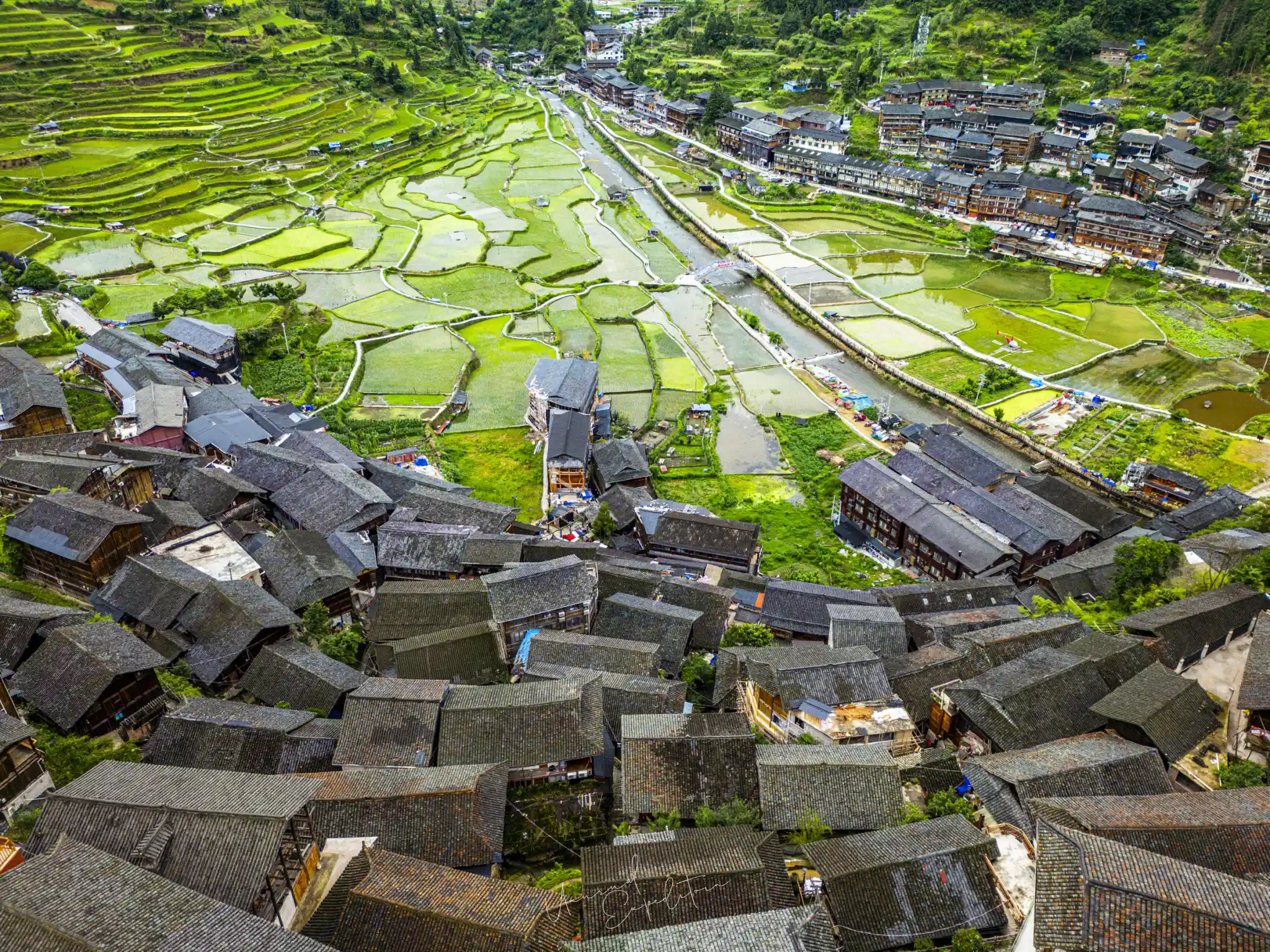
Guizhou rice terraces climb whole mountainsides in the south east of the province, carved by Miao and Dong farmers over centuries and still planted by hand. Seen from above, they become contour lines of water and green, and on wet mornings cloud drifts across them and the villages tucked between. For photographers they are one of the great farm landscapes of China, quieter than the famous terraces of Yunnan and Guangxi. Here is where to look, the seasons, the light and how to work.
The terraces are one strand of our Guizhou photography tour guide, which introduces the province's villages, waterfalls and karst.
Guizhou rice terraces: where they are
Guizhou rice terraces are found across the hills of Qiandongnan, the Miao and Dong prefecture in the south east, and around the Miao heartland near Leigong Mountain. The best known names are Jiabang in Congjiang county, where terraces fill a deep valley, and the slopes around the Dong villages of Zhaoxing and the Miao villages near Xijiang. Smaller terraced valleys appear on almost any road through the region, often with a timber village at their foot, and some of our favourite frames come from valleys without a name on the tourist maps. Because the terraces are working farmland, they change through the year with the rice, and each visit looks different from the last.
Guizhou rice terraces from above
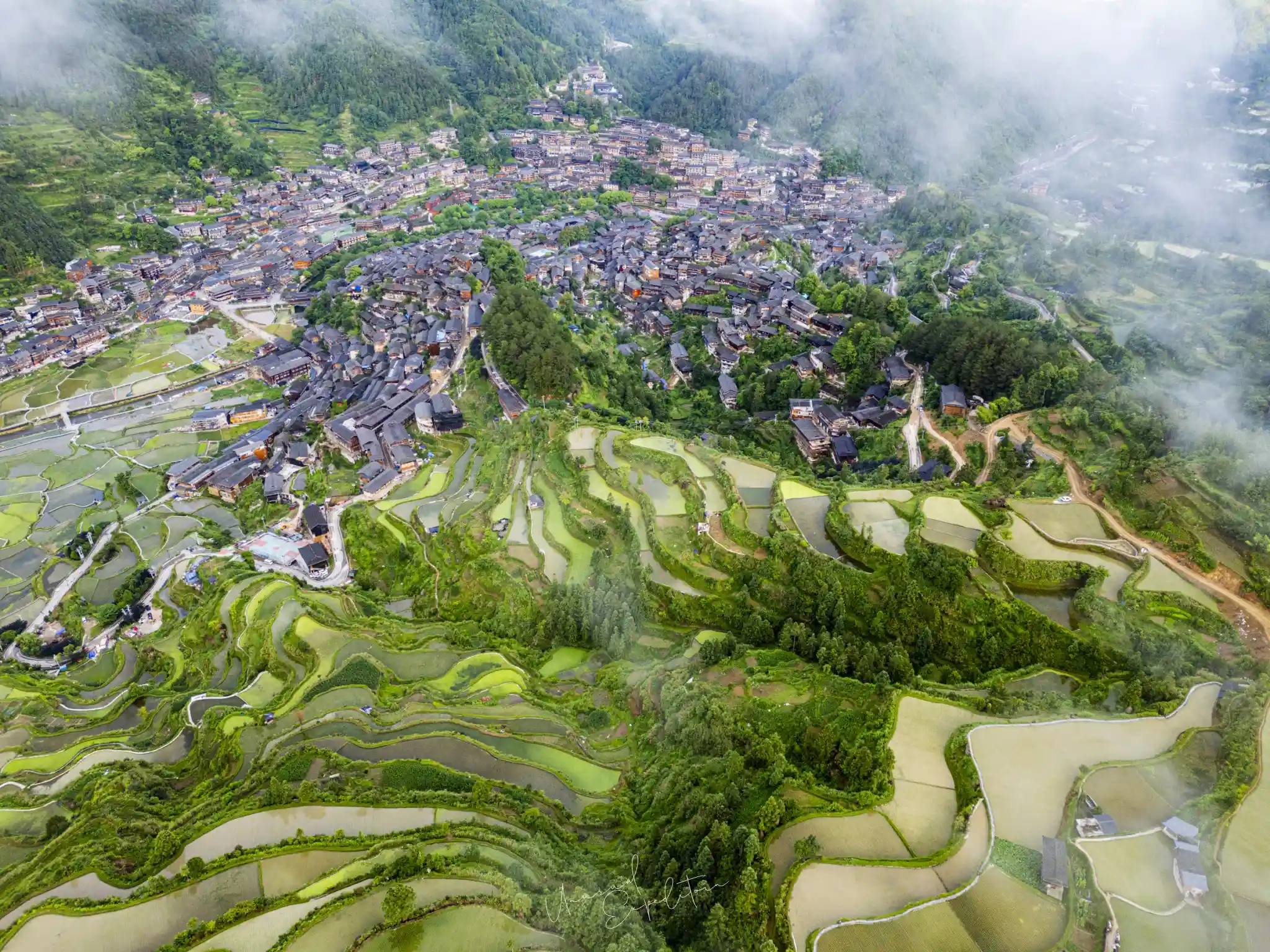
Guizhou rice terraces show their pattern best from height. From a ridge or a viewpoint above a valley, the curving walls read as lines, and the water in them catches the sky. A drone adds the overhead view that turns terraces into abstract shapes, especially when cloud lies across the slopes and breaks to show patches of bright green. Check the rules before flying, stay away from villages and people, and launch only where it is permitted. Without a drone, a 70-200mm from a high road picks out sections of the pattern, and a 24-70mm gives the whole valley with a village for scale.
Seasons on the Guizhou terraces
| Season | What the terraces look like | Photography |
|---|---|---|
| Spring | Flooded before planting, mirrors of the sky | Reflections, lines of water, farmers ploughing |
| Early summer | Newly planted, bright green, frequent cloud | Cloud drifting over green, soft light |
| Late summer | Deep green, full rice | Patterns from above, village life |
| Autumn | Golden at harvest | Colour, harvest scenes |
| Winter | Bare, sometimes flooded again | Quiet, graphic lines, few visitors |
The exact timing depends on altitude and on each year's rain, so ask locally before you commit. Our best time to visit Guizhou article covers the weather in more detail.
Cloud, rain and light
Guizhou is famous in China for its cloudy weather, summed up in an old saying that the sky is never clear for three days running, and on the terraces that is an advantage. Low cloud and drifting mist give the layers and the sense of depth that make terrace pictures special, and they soften the light so the green does not burn out. Mornings after rain are the best of all, when cloud lifts slowly out of the valleys. Bright sun gives strong contrast and hard shadows on the walls, which suits graphic pictures from above but not wide valley views. Keep a lens cloth handy, because the air is often wet.
We drove out of Xijiang into a valley full of cloud and simply waited. Every few minutes the terraces opened and closed again, and each gap gave a different picture.
Joseph Mak, tour leader, Unusual Expedition
Villages among the terraces
Villages give the terraces their meaning. Miao and Dong timber houses with dark tile roofs cluster at the foot of the slopes or along a river, and from above their roofs make a texture of their own against the green. Include a village in a wide view for scale and story, or photograph the roofs alone as a pattern. The largest Miao village in China, Xijiang, described in Xijiang Miao village photos, has terraces on the slopes behind it, and the Guizhou government's own tourism pages put its size at close to 1,300 households.
Composing Guizhou terrace pictures
Guizhou terrace pictures work best with one clear idea. From above, look for a single curve that leads the eye, or a pattern of repeated lines broken by one bright patch where cloud has opened. From a ridge, place a village or a single farmer low in the frame so the terraces rise behind them. Avoid bright sky in a valley view, which pulls the eye away from the fields, and crop tight to the slopes on a white day. Shoot the same view as the cloud moves, because a gap of a few seconds changes the whole picture, and pick the frame later.
Working on the terraces
Terrace walls are farmers' work and easily damaged, so keep to the paths and never walk along the edges of planted fields. Ask before photographing people at work, and keep a respectful distance during planting and harvest, when time matters to them. Footpaths are narrow and slippery after rain, so wear shoes with grip and keep tripods folded until you reach a safe spot. Bring water and something warm, because valleys can be cool when cloud sits in them.
Gear for terrace photography
A 24-70mm and a 70-200mm cover most terrace pictures, the wide lens for valleys with a village and the long lens for patterns and for people on the slopes. A polariser helps control reflections on flooded terraces and deepens the green, but turn it slowly, because it can also remove the sky's reflection you want. A light tripod is useful in low cloud. If you fly a drone, carry spare batteries, because the best moments come in short gaps in the cloud.
Guizhou terraces with the rest of the province
The terraces combine naturally with the Miao and Dong villages: Xijiang, Zhaoxing and Basha all sit within reach. For the gun carrying Miao village near Congjiang, read Basha Miao village photography. Singapore passport holders can currently enter mainland China visa free for short stays under the mutual exemption in force since February 2024, as Singapore's ICA explains; check before you travel.
Photograph the Guizhou terraces with us
Our Guizhou Blossom Photo Tour in spring passes through the terrace country of the south east, indicatively S$3,950 to S$4,500 per person depending on the room. See the China photography tours page for details.
Join the Guizhou photography tour
Inner Mongolia Winter Owl Photo Tour – China departs 01 Jan 2027 To 04 Jan 2027, led by Joseph Mak. Small group, photography first. All Guizhou photography tours.
Explore Guizhou in depth
- Guizhou Photography Tour: The Complete Guide to Miao Villages, Terraces and KarstChina
- Guizhou Tour From Singapore: Flights, Season and What to ExpectChina
- Miao Silver and Embroidery in Guizhou: A Photographer's GuideChina
- Xijiang Miao Village Photos: Photographing the Thousand Household VillageChina
- Xijiang Miao Village Night View: How to Photograph the Lit ValleyChina
- Best Time to Visit Guizhou for Photography: Blossom, Terraces and MistChina
- Basha Miao Village Photography: The Gunmen of GuizhouChina
Upcoming Photo Tours
- Egypt Photo Tour – EgyptEgypt 12 Dec 2026 To 20 Dec 2026
- Inner Mongolia Winter Owl Photo Tour – ChinaChina 01 Jan 2027 To 04 Jan 2027
- Inner Mongolia Winter Photo Tour – ChinaChina 05 Jan 2027 To 11 Jan 2027
- Mekong And Central Highland Vietnam Photo Tour - VietnamVietnam 16 Jan 2027 To 24 Jan 2027