
Hvitserkur, Iceland: Photographing the Troll Sea Stack at Low Tide and Dawn
Hvitserkur sea stack in North Iceland: the troll legend, low tide and dawn, the viewpoint and beach, and road 711 in winter.
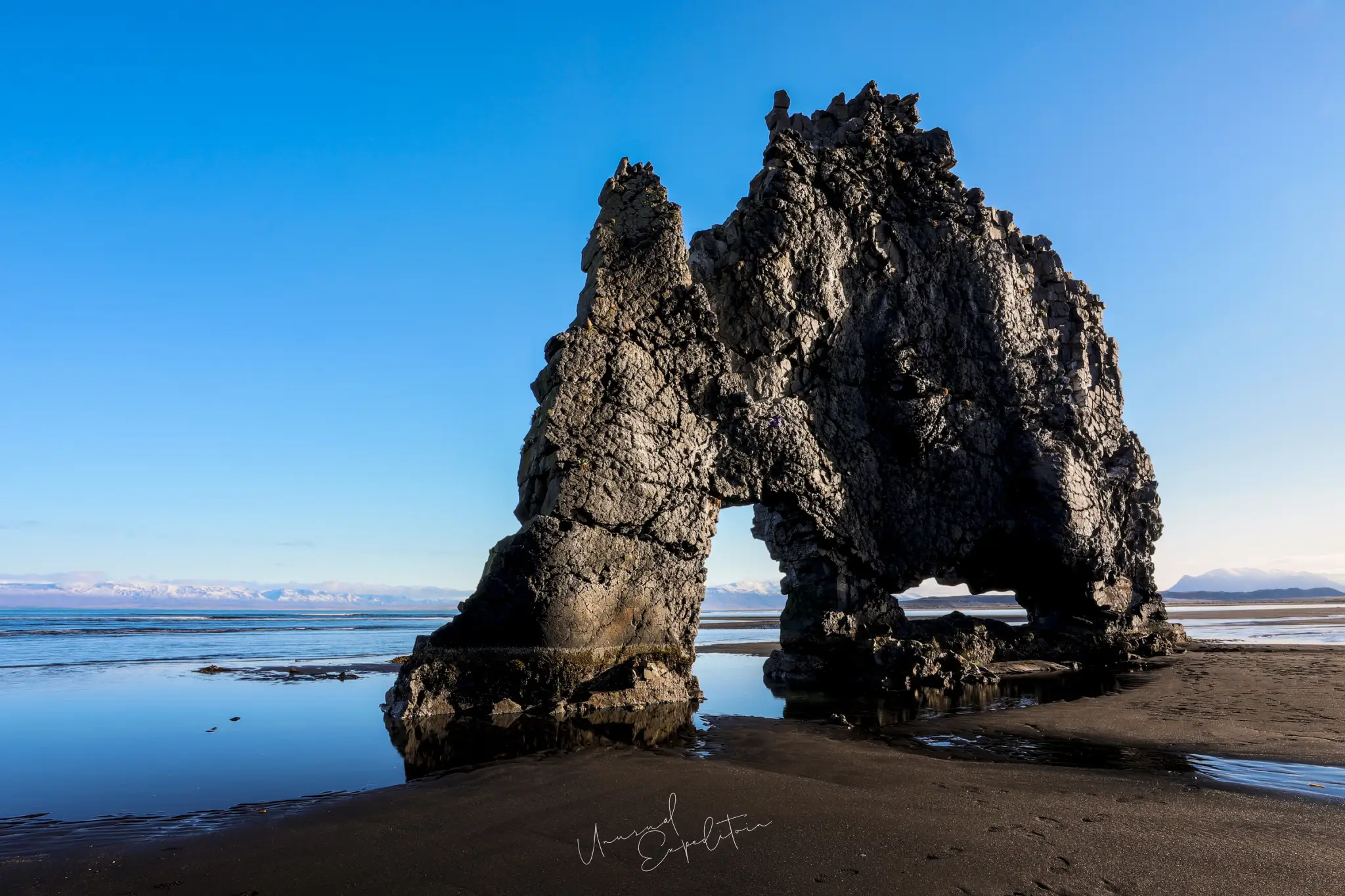
Hvitserkur, Iceland, is a 15-metre basalt sea stack standing in the shallows off the east coast of the Vatnsnes peninsula in the north-west of North Iceland. Its two arches make it look like a beast bending to drink from the sea, and legend calls it a troll turned to stone by the sunrise. For photographers it works from the clifftop viewpoint and, at low tide, from the black beach below, where wet sand and rock pools give you a foreground.
This guide is part of our North Iceland photography tour guide. We have photographed Hvitserkur in autumn, at low tide under a clear sky, and in late winter at dawn, and the notes compare the two.
Hvitserkur sea stack: what you are looking at
Geologically, the Hvitserkur sea stack is what remains of an old volcanic plug: hard basalt that has outlasted the softer rock around it, now standing about 50 metres offshore according to Atlas Obscura's description, at the edge of the bay of Hunafjordur. The sea has worn two holes through its base, which is where the drinking-beast shape comes from. The name means white shirt, after the seabird droppings that whiten its top; shags and cormorants use it as a perch. Visit North Iceland lists it as one of the sights of the Vatnsnes coast, a peninsula also known for its seals.
The troll legend
The story told on Vatnsnes is that a troll from the Westfjords set out at night to tear down the bells of the monastery at Thingeyrar across the bay, because their ringing annoyed him. He misjudged the time, the sun rose before he reached the shore, and he turned to stone where he stood. Guide to Iceland and Gray Line both retell versions of it. Whether or not you photograph at sunrise, it is a good reason to be there early.
Hvitserkur iceland: the viewpoint and the beach
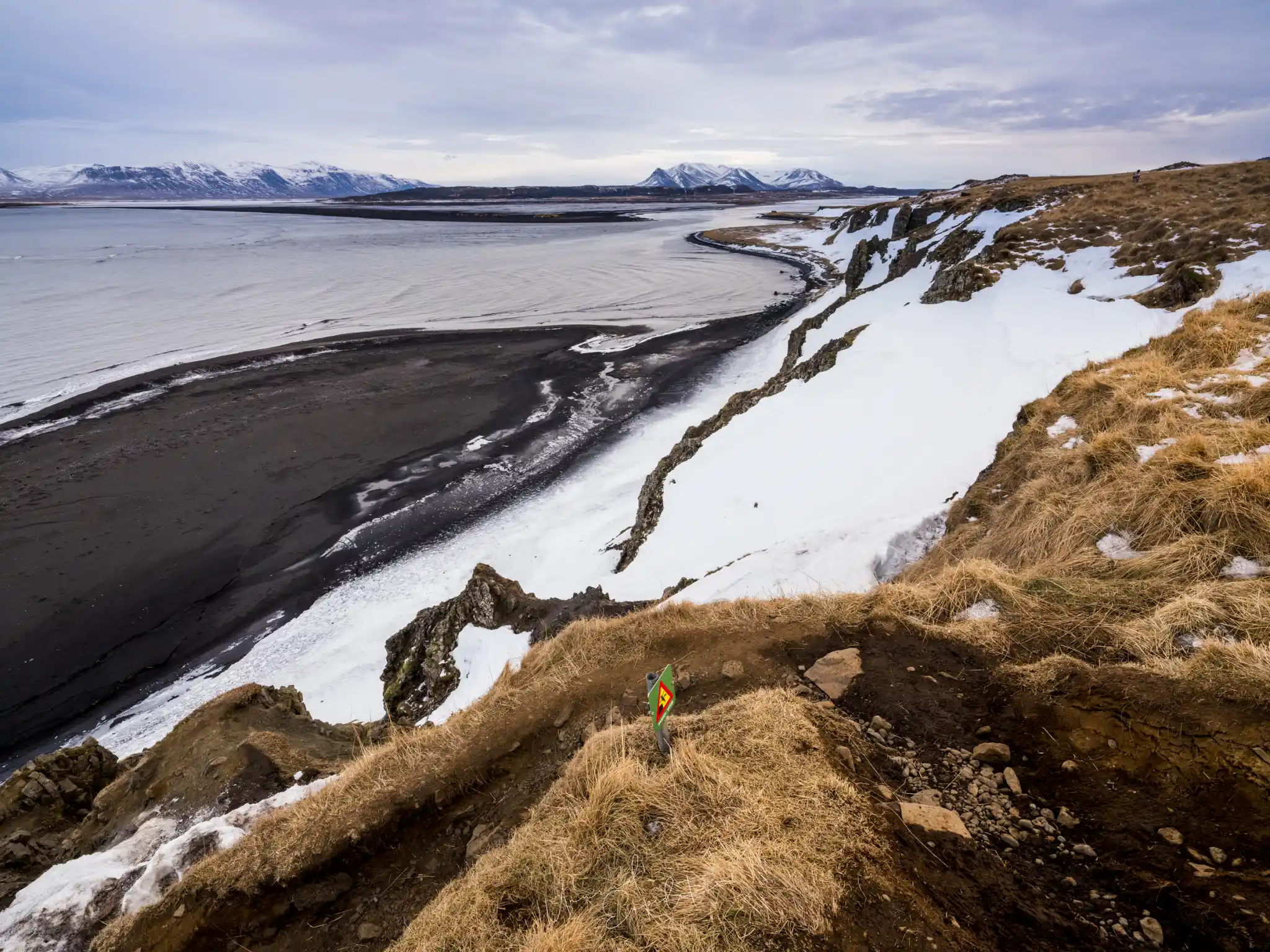
From the parking area a short path leads to a viewpoint on the edge of a grassy cliff, looking down on the stack and along the black beach. That view suits a 70-200mm lens and shows the shape of the coast. A steep path continues down to the beach. At low tide the sand and rock in front of Hvitserkur dry out and you can approach it on foot, which gives the reflections in the wet sand and the close, low views with the sky through the arches. At high tide the stack is surrounded by water and the beach narrows sharply. Check the tide before you go down, keep an eye on the incoming water, and do not climb on the stack.
Low tide in autumn
Our autumn visit came at low tide under a clear blue sky, and the wet sand around the base of Hvitserkur turned into a mirror. Walking right up to the stack let us place it against open sky with its reflection beneath, and the arches stood out sharply. In bright conditions a polarising filter helps with the glare on the sand; a 16-35mm close to the ground exaggerates the arches. The light here comes low across the bay for much of the day in autumn, so you do not have to be there only at the edges of the day.
Dawn and long exposures in winter
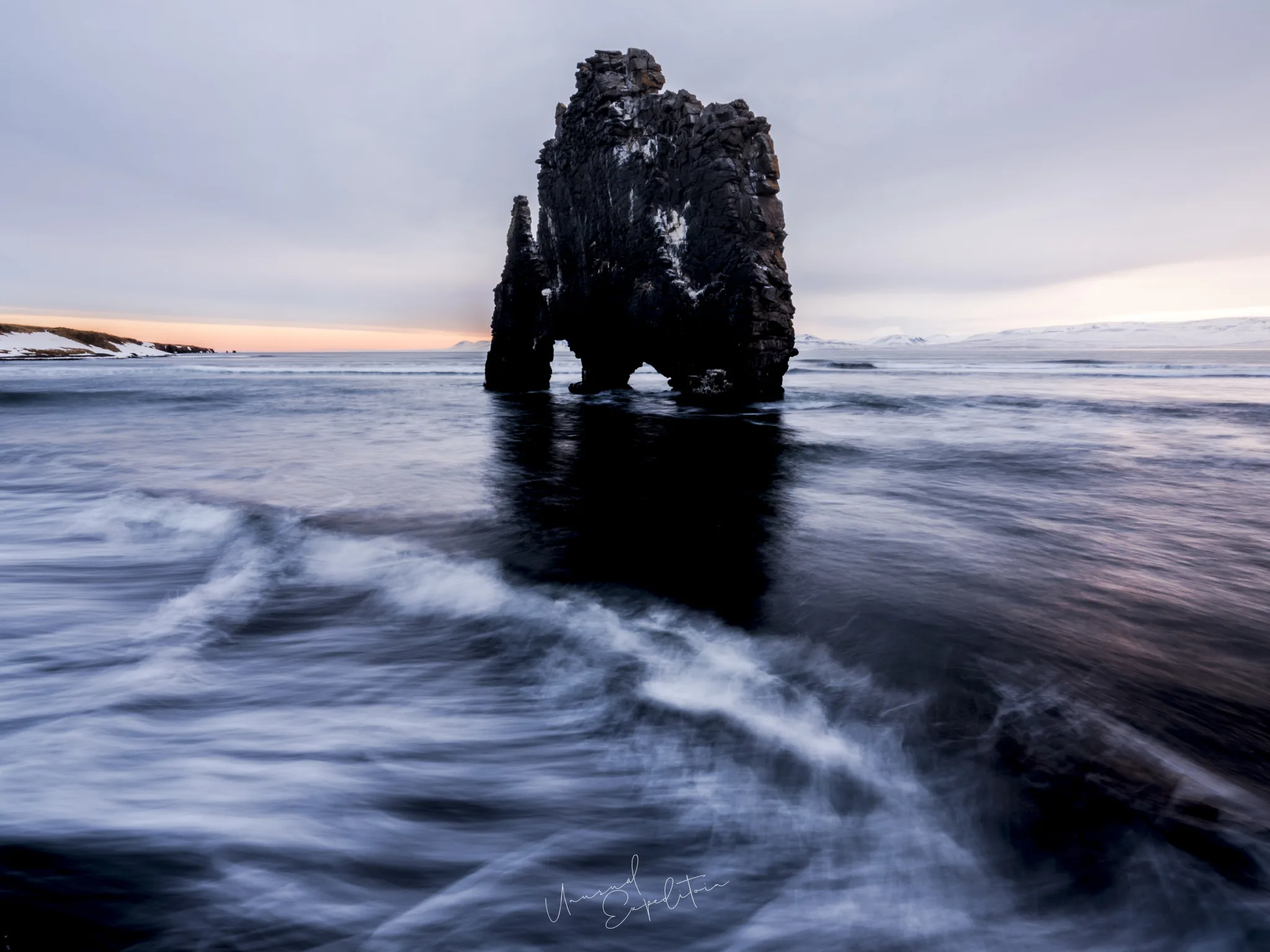
In late winter the mood is very different. On our visit there was snow on the cliffs, the tide was higher and waves were washing over the rocks in front of the stack. We were there at first light, which the troll would not have liked, and a long exposure smoothed the water into a mist around the base and kept the pale dawn sky clean. A neutral density filter is useful even in the low light, because you want the shutter open for several seconds or more. The stack is dark against the sky in these conditions, so expose for the sky and let Hvitserkur become a silhouette.
| Condition | Where to stand | What you get | Lens |
|---|---|---|---|
| Low tide, clear sky | On the sand near the stack | Reflections, arches against the sky | 16-35mm |
| High tide, dawn | On the rocks at the foot of the path | Long exposure water, silhouette | 24-70mm |
| Any tide | Clifftop viewpoint | Stack and coastline | 70-200mm |
| Dark clear night | Beach, if the tide allows | Aurora behind the stack | Fast wide lens |
The tide table decides the plan more than the weather does.
Hvitserkur is one rock, and the tide turns it into two different places. Look at the tide table before you look at the weather.
Joseph Mak, tour leader, Unusual Expedition
The Vatnsnes coast
Hvitserkur sits on the coast road around Vatnsnes, a quiet peninsula of farms, seal colonies and long views across the bay to the mountains. The view from the clifftop near Hvitserkur runs along a black beach backed by grassy slopes, and in winter the snow on the bank makes a strong line down the frame. Visit Iceland's article on a day around the Vatnsnes peninsula describes the seal watching spots along the same road. Seals are wild animals; keep your distance and use a long lens.
Getting to Hvitserkur
Hvitserkur is reached on road 711, the gravel road around the Vatnsnes peninsula, which leaves the Ring Road in the north-west of North Iceland. In good summer conditions an ordinary car manages it; in winter or after heavy rain, a four-wheel-drive is the safer choice, and the road can be icy or closed. Check road.is before you leave the Ring Road. It is a detour, but for a photographer it is worth it. For the other big waterfall subject of the north, see our Godafoss waterfall Iceland guide, and for conditions in the cold months, our guide to North Iceland in winter.
Photograph Hvitserkur with us
We run Hvitserkur and the Vatnsnes coast as part of private tours through the north, timed to the tide. For our scheduled departures across Iceland, see our Iceland photography tours page.
Join the North Iceland photography tour
Iceland Midnight Sun Photo Tour departs 05 Jul 2027 To 18 Jul 2027, led by Joseph Mak. Small group, photography first. All North Iceland photography tours.
Explore North Iceland in depth
- North Iceland Photography Tour Guide: Godafoss, Hvitserkur, Myvatn, Arctic Henge and HorsesIceland
- North Iceland in Winter: Weather, Light, Akureyri and the Northern LightsIceland
- Icelandic Horses Photos: How to Photograph Iceland's Horses, Gaits and ColoursIceland
- Godafoss Waterfall, Iceland: East or West Bank, Winter Light and the LegendIceland
Upcoming Photo Tours
- Egypt Photo Tour – EgyptEgypt 12 Dec 2026 To 20 Dec 2026
- Inner Mongolia Winter Owl Photo Tour – ChinaChina 01 Jan 2027 To 04 Jan 2027
- Inner Mongolia Winter Photo Tour – ChinaChina 05 Jan 2027 To 11 Jan 2027
- Mekong And Central Highland Vietnam Photo Tour - VietnamVietnam 16 Jan 2027 To 24 Jan 2027