
Kirkjufell Northern Lights: When to Go, Where to Stand and Settings
Northern lights at Mount Kirkjufell: the season, reading the cloud forecast, where to stand, settings and Budir on cloudy nights.
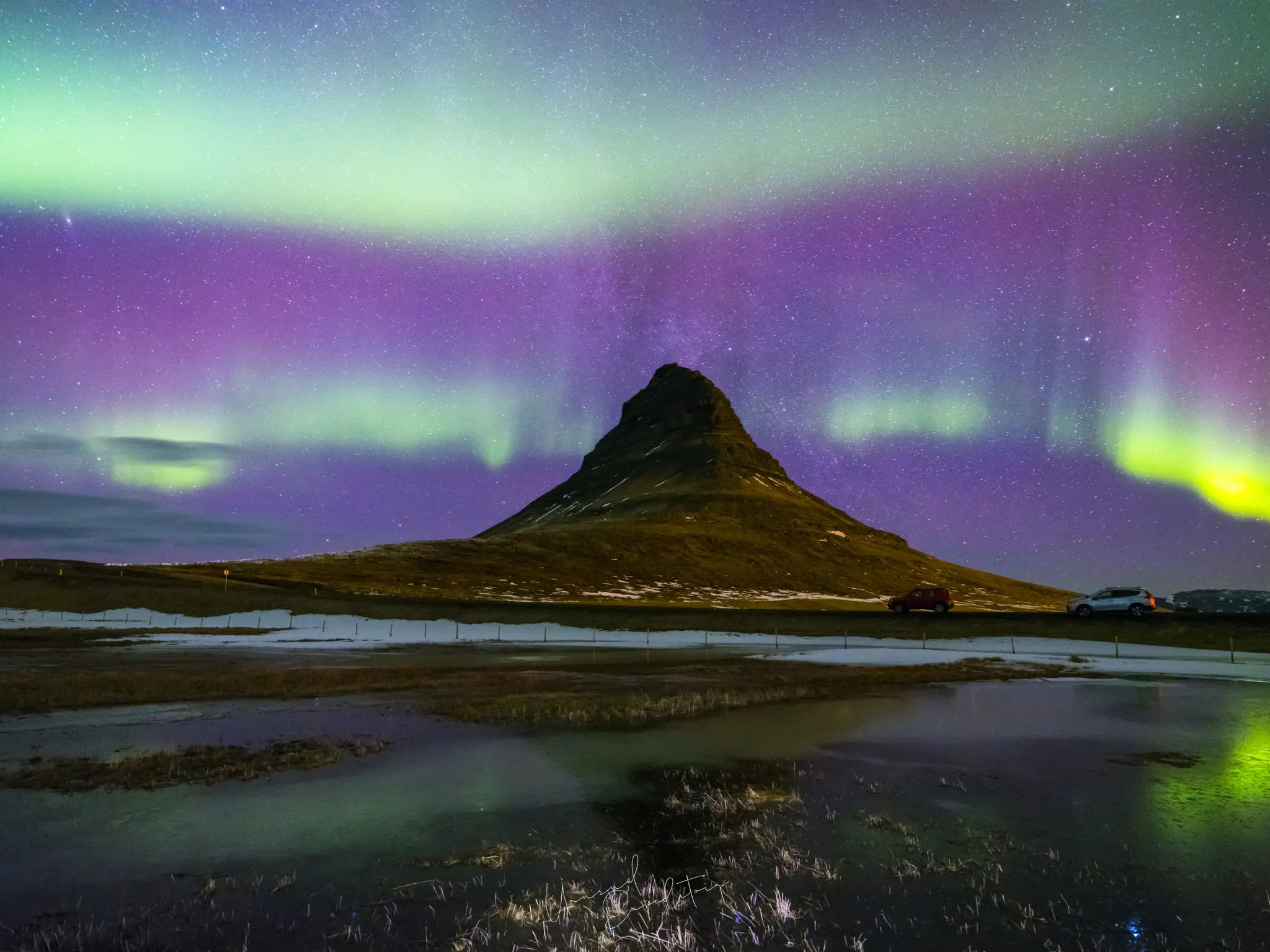
Kirkjufell northern lights photographs are made on clear nights between September and April, from the bank above Kirkjufellsfoss or from the lagoon shore below the mountain, with the aurora rising behind the peak to the north. The mountain stands on the north coast of the Snaefellsnes peninsula, away from big towns, so the sky is dark once you leave Grundarfjordur's lights behind. What decides the night is cloud, and on this coast it can open and close within minutes.
Kirkjufell is one of the two great aurora foregrounds on the peninsula, with Budir black church on the south coast; both are introduced in our Snaefellsnes photography tour guide. Here we cover when to go, how we read the forecast, where to stand and the camera settings that have worked for us.
Northern lights at Mount Kirkjufell: when to go
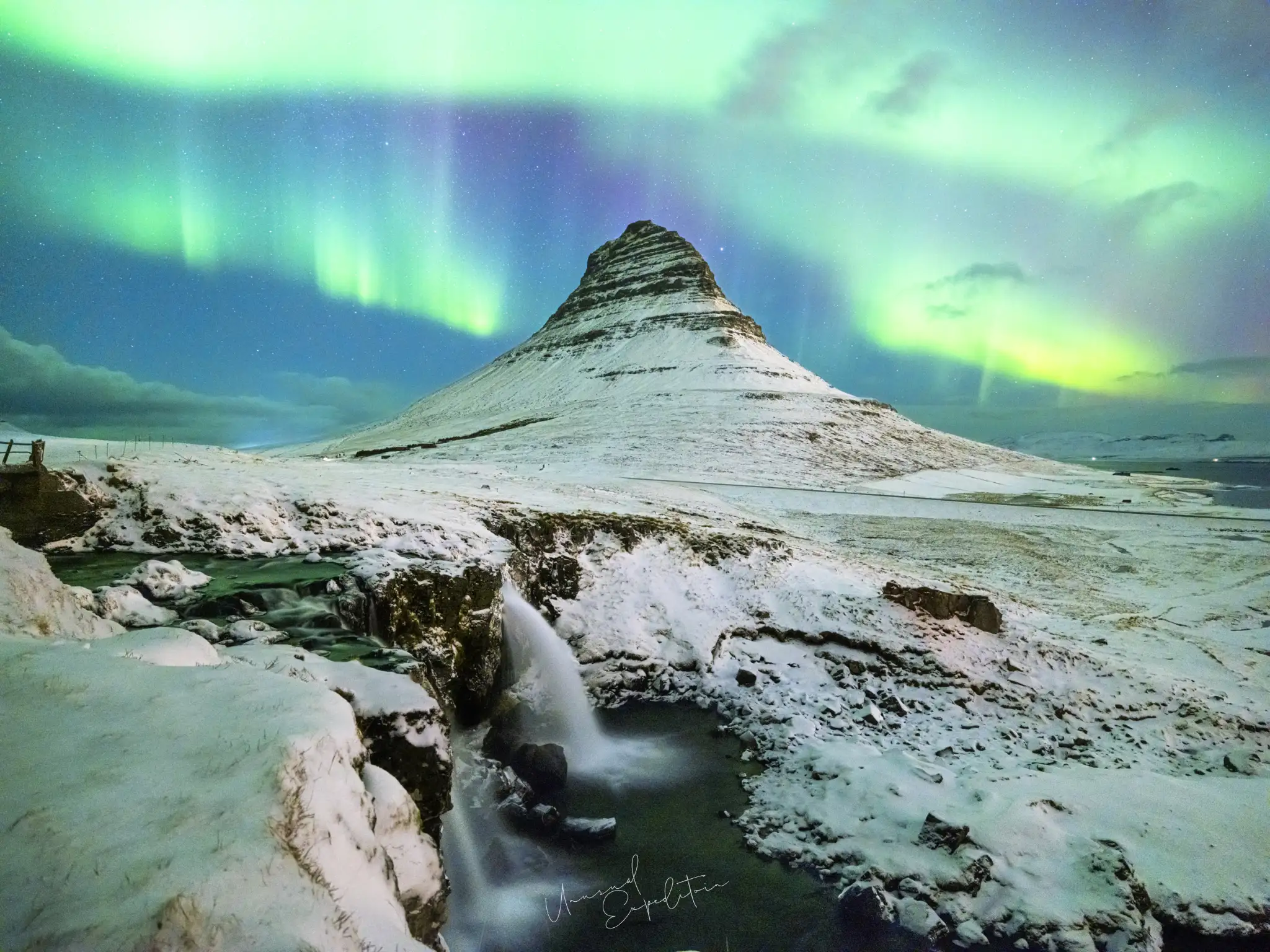
The northern lights at Mount Kirkjufell need darkness, so the season runs from about September to mid-April, when the nights are dark enough for the Icelandic Met Office aurora forecast to matter. Midwinter gives the longest nights; September, October, March and early April give milder weather and a chance of open water at the falls instead of ice. Summer is too bright for any aurora. Within the season, the moon matters: a half moon lights the snow and the mountain nicely, while a full moon washes out faint displays. Our Snaefellsnes peninsula in winter guide compares the months in more detail.
Reading the forecast on Snaefellsnes
The Icelandic Met Office aurora page shows two things side by side: an activity index and a cloud cover map. On Snaefellsnes the cloud map is the one to watch. The peninsula's mountains split the weather, so the north coast at Grundarfjordur can be clear while the south coast at Budir is under cloud, or the other way round. On a promising night we stay flexible, check the map through the evening and drive to whichever side is clearing. Activity forecasts are a guide only; we have seen strong displays on nights forecast as quiet.
| Condition | What it means at Kirkjufell | What we do |
|---|---|---|
| Clear sky, low activity | A green arc low over the mountain | Long lens, wait for it to brighten |
| Clear sky, high activity | Curtains overhead, colour to the south too | Wide lens, shorter exposures |
| Broken cloud | Gaps move fast | Stay set up, shoot in the gaps |
| Full moon | Bright snow, faint aurora fades | Use the moon to light the mountain |
| Strong wind | Shaking tripod, rough water | Lower the tripod, skip reflections |
Cloud and wind decide more nights here than the aurora index does.
Kirkjufell northern lights: where to stand
The classic aurora frame is the same as the daytime one: the bank above Kirkjufellsfoss, with the cascades in the foreground and the peak to the right. Displays often build to the north and overhead, so a lens as wide as 14mm or 16mm helps. On a busy night the bank fills up and headlamps sweep across every frame, which is the moment to walk down to the lagoon shore below the mountain. When the water is still, the aurora and the peak reflect together, and the quiet is worth the change of view. In winter both viewpoints are icy underfoot: wear microspikes and keep away from the edge above the falls.
On a good night at Kirkjufell the aurora moves faster than you can recompose. Set the foreground before it starts, focus on a star, and then just keep shooting while the sky changes.
Joseph Mak, tour leader, Unusual Expedition
Camera settings for the aurora over Kirkjufell
A fast wide lens, an f/2.8 zoom or a brighter prime, is the core of the kit. We start around ISO 1600 to 3200, the widest aperture and exposures of 5 to 15 seconds, then shorten the exposure as the aurora brightens so the curtains keep their shape. Focus manually on a bright star using live view and tape the ring. Shoot raw, set a fixed white balance around 3500K to 4000K so frames match, and carry spare batteries in an inside pocket because cold drains them quickly. For a reflection, wait for a lull in the wind; even small ripples break the doubled image.
Moonlight and snow at Kirkjufell
Many photographers avoid moonlit nights, but at Kirkjufell a quarter or half moon can help. It lights the snow on the mountain and the ice on the falls, so the foreground needs no torch and no blending, and the exposure for the sky and the land comes much closer together. The price is a paler sky in which only brighter displays show well. On dark, moonless nights the mountain becomes a silhouette, which suits a strong aurora overhead. Either way, avoid lighting the falls with a headlamp: it spoils other people's frames and rarely looks natural.
Snaefellsnes northern lights beyond Kirkjufell
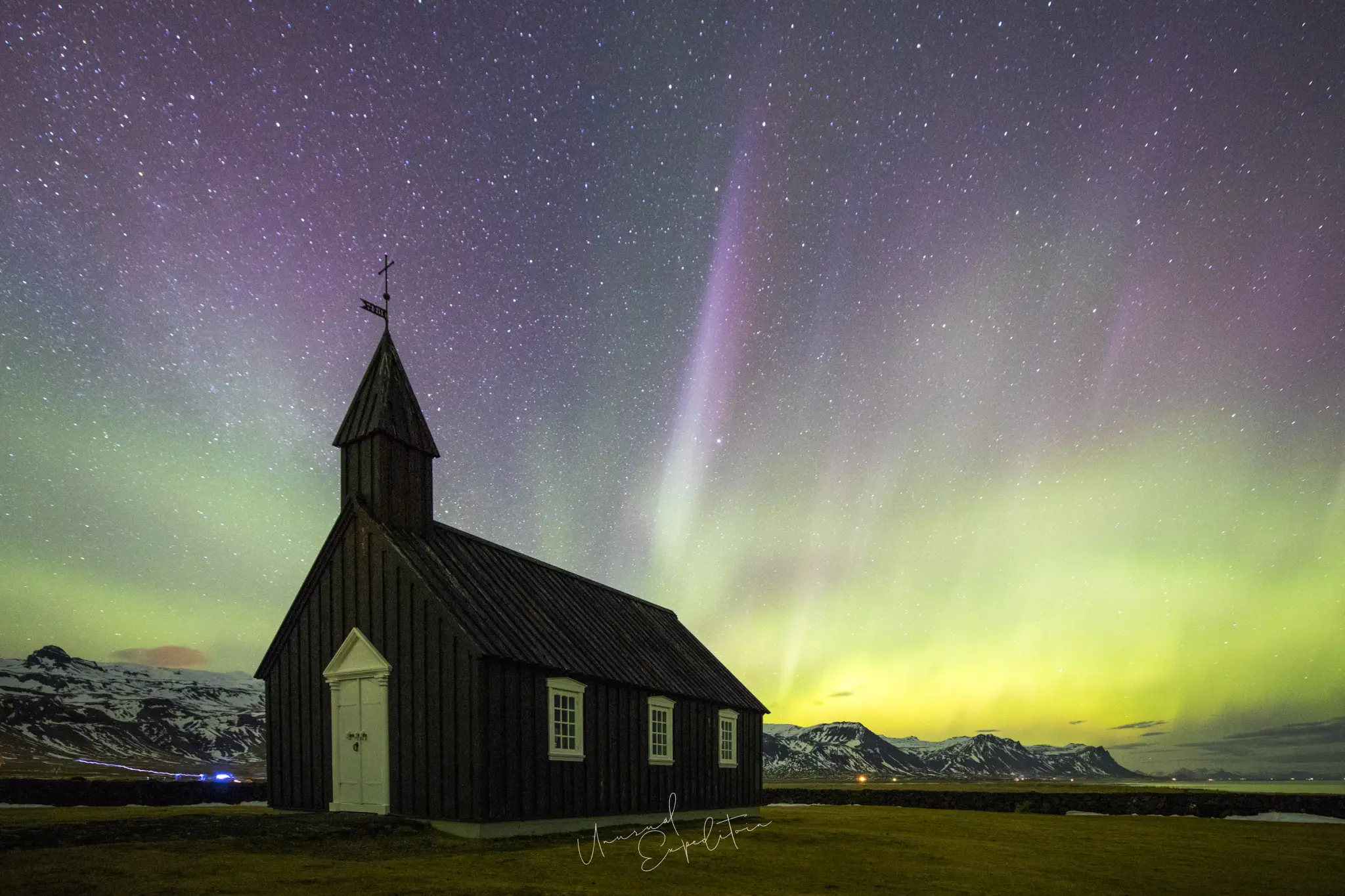
When Kirkjufell is under cloud, the rest of the peninsula is still in play. Budir black church on the south coast is the other classic, with mountains behind it and the lava field around it; our Budir black church guide covers the angles. The fishing harbours of the north coast make good foregrounds too, with boats and drying racks, and the lighthouses at the western tip sit under dark skies. Respect private land and farms, and never stop on the road itself to photograph the sky.
Driving on Snaefellsnes at night
Aurora hunting means driving in the dark, often on ice. Check road.is, run by the Icelandic Road and Coastal Administration, for conditions and closures before you set out, and Safetravel.is for alerts. Park only in proper car parks or wide lay-bys, never on the verge or in the road, and switch off headlights when you arrive so others can keep shooting. Wind on this coast can be strong enough to move a car door, so open it carefully.
Photograph the aurora at Kirkjufell with us
Our scheduled Iceland tour runs in summer under the midnight sun, when there is no aurora; it is listed on our Iceland photography tours page. For the northern lights at Kirkjufell and Budir we arrange private tours from autumn to early spring, with nights on the peninsula planned around the moon and the forecast.
Ask us about the aurora on Snaefellsnes
Join the Snaefellsnes photography tour
Iceland Midnight Sun Photo Tour departs 05 Jul 2027 To 18 Jul 2027, led by Joseph Mak. Small group, photography first. All Snaefellsnes photography tours.
Explore Snaefellsnes in depth
- Snaefellsnes Peninsula Photography Tour Guide: Kirkjufell, Budir, Londrangar and the AuroraIceland
- What to See in Snaefellsnes Peninsula: Photo Spots from Kirkjufell to BudirIceland
- Snaefellsnes Peninsula in Winter: Snow, Aurora and the Best Time to VisitIceland
- Snaefellsnes Day Trip from Reykjavik: Is One Day Enough for Photographers?Iceland
- Londrangar Sea Stacks and Arnarstapi Cliffs: Viewpoints, Gatklettur and the Hellnar PathIceland
- Kirkjufell Photography: Viewpoints, Light, Parking and the WaterfallIceland
- Budir Black Church: History, Angles and the Aurora at BudakirkjaIceland
Upcoming Photo Tours
- Egypt Photo Tour – EgyptEgypt 12 Dec 2026 To 20 Dec 2026
- Inner Mongolia Winter Owl Photo Tour – ChinaChina 01 Jan 2027 To 04 Jan 2027
- Inner Mongolia Winter Photo Tour – ChinaChina 05 Jan 2027 To 11 Jan 2027
- Mekong And Central Highland Vietnam Photo Tour - VietnamVietnam 16 Jan 2027 To 24 Jan 2027