
Lake Tekapo Stargazing: Photographing the Dark Sky Reserve
Lake Tekapo stargazing for photographers: the Dark Sky Reserve, the best time, where to shoot, settings and night rules at the church.
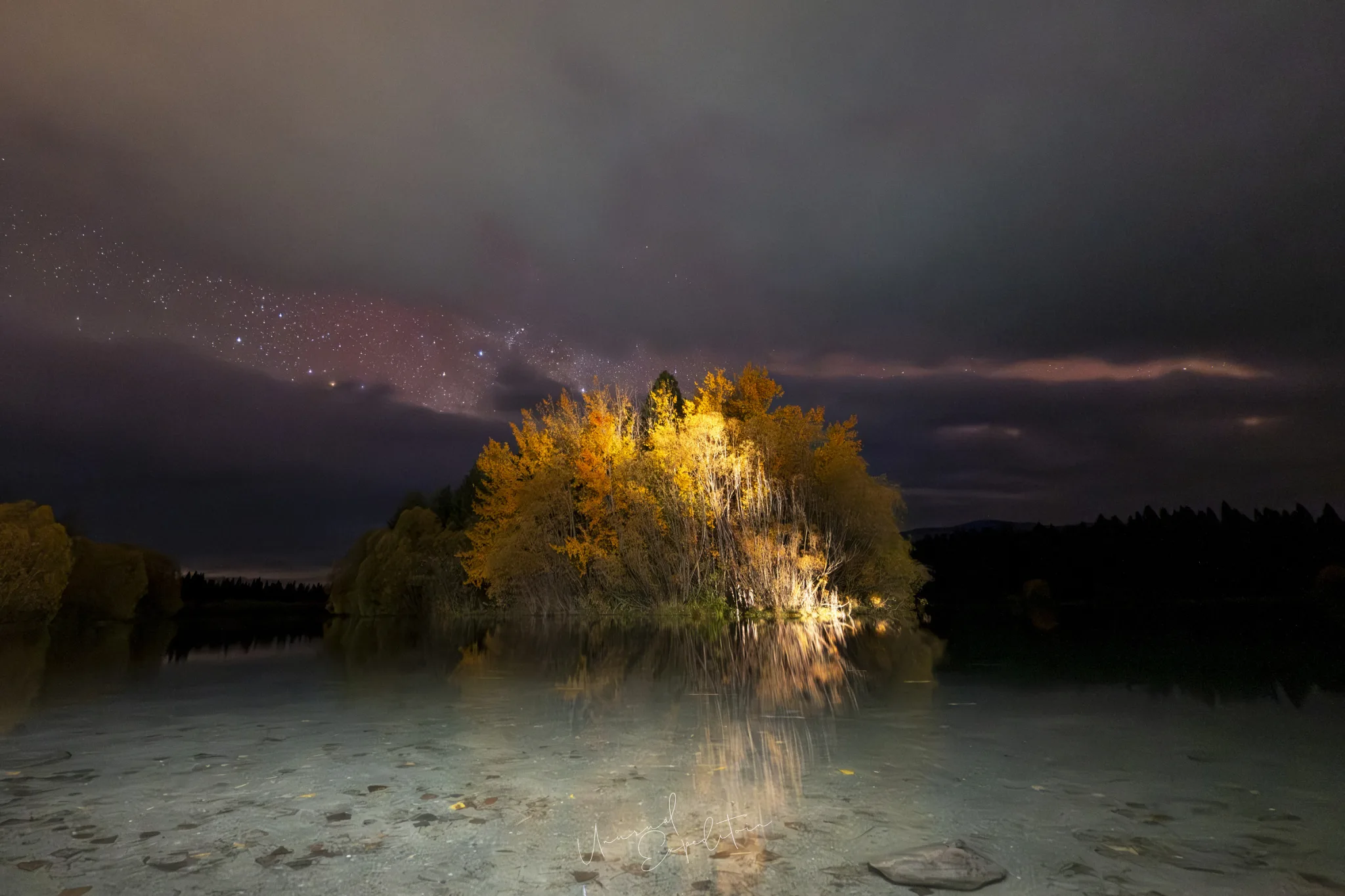
Lake Tekapo stargazing is among the best in the world because the lake sits inside the Aoraki Mackenzie International Dark Sky Reserve, where lighting is controlled, the air is dry and high, and the Milky Way rises clear over the water on moonless nights. For photographers, the best time is a clear night near the new moon between autumn and late winter, when the galactic core stands high, working from the public lakeshore with a fast wide lens and a sturdy tripod.
Night photography is one strand of our Lake Tekapo photography tour guide, and the nights we have spent on this shore were some of the clearest we have known anywhere.
Lake Tekapo Dark Sky Reserve: what it protects
The Aoraki Mackenzie International Dark Sky Reserve was designated by the International Dark-Sky Association, now DarkSky International, in 2012. It takes in Lake Tekapo, Twizel, and Aoraki/Mount Cook village and national park, and its purpose is to protect the sky above the University of Canterbury's Mt John Observatory, on the hill above the lake. In practice that means outdoor lighting in the town is shielded and kept low, so the glow that spoils night pictures in most places is small here. The basin also helps: the Southern Alps catch much of the moisture coming from the west, so the Mackenzie is dry, and at about 710 metres above sea level the air above the lake is thin and steady. On a clear night the sky above the water is dense with stars right down to the hills.
Lake Tekapo stargazing best time
For stars alone, any clear, moonless night works at Lake Tekapo. For pictures of the Milky Way with its bright core, the season matters, because the core of the galaxy is best placed in the southern sky from late summer through autumn and winter, standing high in the evening in the colder months. Winter nights are long, which gives more hours of darkness, but they are cold, sometimes well below freezing on the lakeshore. Spring and summer nights are short, and the core sets earlier. Whatever the month, check the moon first: a few days either side of the new moon gives the darkest sky, while a full moon washes out all but the brightest stars.
| Season | Night sky | For photographers |
|---|---|---|
| Summer (December to February) | Short nights, core low late in the night | Warm, fewer dark hours |
| Autumn (March to May) | Core high in the evening, longer nights | Good balance of dark and comfort |
| Winter (June to August) | Longest nights, core high, crisp air | Best skies, hard frosts |
| Spring (September to November) | Core returns to the evening late in spring | Changeable weather |
Autumn and winter give the most reliable combination of dark hours and a well-placed Milky Way.
Lake Tekapo night sky: where to photograph it
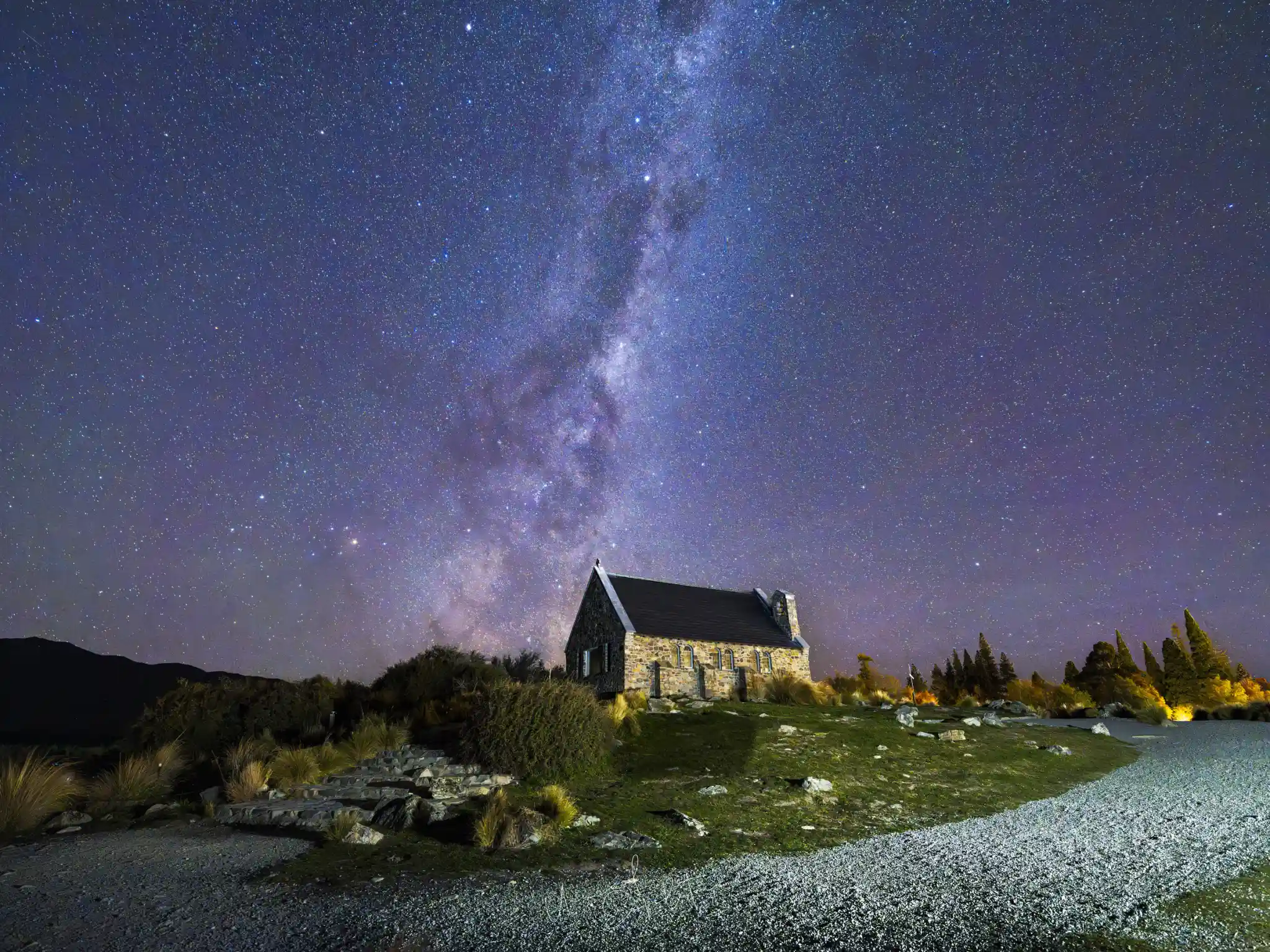
The Lake Tekapo night sky can be photographed from almost anywhere along the public shore, away from the lights of the few buildings near the water. The stony beaches either side of the town give clean foregrounds of willows, rocks and still water, and the reflection of stars on a calm night is a picture in itself. The Church of the Good Shepherd is the subject most people want, but its own notice is clear that night-time access within the fenced perimeter is not permitted, so night pictures of it are made from outside the fence, from the public lakeshore and paths. Mt John, with the observatory on its summit, is visited at night on guided tours; check the current access rules before you plan to drive up after dark, and book a tour if you want to see the sky through the telescopes.
Camera settings for the stars at Tekapo
A fast wide lens is the key piece of equipment for stargazing photography at Lake Tekapo. With a 14mm to 20mm lens at f/2.8 or brighter, an exposure of around 15 to 25 seconds at ISO 3200 to 6400 keeps the stars as points and records the Milky Way, and a 24-70mm at its wide end works if it is all you have, with a slightly shorter exposure. Focus manually: magnify a bright star on the screen and turn the ring until it is a pin point, then tape the ring. Shoot in raw, switch off the screen light where you can, and take a few frames of the foreground at a lower ISO if you want to blend them later. Our pictures of the church under the Milky Way were made with exposures in that range on a wide-angle zoom.
"The first clear night at Tekapo, people go quiet. You can see the Milky Way reflected in the lake, and nobody needs me to tell them what to photograph. My job is mostly reminding everyone to check focus and keep their torches off."
Joseph Mak, tour leader, Unusual Expedition
Cold, light and etiquette after dark
Nights at Lake Tekapo are cold in every season and severe in winter, so dress as for a snow day: warm boots, a down jacket, gloves you can work a camera in and a hat. Batteries drain quickly in the cold; keep spares in an inside pocket. Use a red head torch and point it at the ground, because white light in a long exposure ruins the frames of everyone around you, and car headlights on the lakeshore do the same. Keep voices low near the church and the houses. A thermos of something hot makes the second hour much easier.
Lake Tekapo stargazing tours and the hot pools
For people who want the sky explained, guided stargazing tours run from the town, including visits to the Mt John Observatory, and the hot pools by the lake are reported to run evening stargazing sessions in the water. These are not photography sessions, but they are a good way to learn the southern constellations before you go out with a camera. If you are in Tekapo for several nights, use one for a guided session and the others for your own pictures.
When the sky is cloudy
Cloud is part of every trip to the Mackenzie, and a clear forecast can change within the evening. On cloudy nights, the town and the lake edge still give blue-hour pictures, and the next morning often brings clean, dramatic light after the front has passed. Our Church of the Good Shepherd article covers the church by day and at dusk, and the best time to visit Lake Tekapo compares the seasons for both daylight and night work.
Photograph the Tekapo sky with us
Our New Zealand South Island Winter Photography Tour 2027 holds two nights at Lake Tekapo inside the Dark Sky Reserve, and we keep the clearer of the two for the stars. The tour then continues to Lake Pukaki, Aoraki/Mount Cook, Wanaka and Queenstown. The current rate is on the New Zealand photography tours page.
Ask us about stargazing at Lake Tekapo
Join the Lake Tekapo photography tour
New Zealand South Island Winter Photography Tour 2027 departs 07 Aug 2027 To 16 Aug 2027, led by Joseph Mak. Small group, photography first. All Lake Tekapo photography tours.
Explore Lake Tekapo in depth
- Lake Tekapo Photography Tour Guide: Lake Tekapo, New Zealand, Through the LensNew Zealand
- Mackenzie Basin, New Zealand: Photographing the High CountryNew Zealand
- Lake Tekapo Things to Do for PhotographersNew Zealand
- Lake Tekapo Photos: What the Lake Really Looks LikeNew Zealand
- Lake Tekapo in April: Autumn Colour in the Mackenzie BasinNew Zealand
- Church of the Good Shepherd, Lake Tekapo: Where to Stand, the Light and the RulesNew Zealand
- Best Time to Visit Lake Tekapo: Autumn Colour, Winter Snow and LupinsNew Zealand
Upcoming Photo Tours
- Egypt Photo Tour – EgyptEgypt 12 Dec 2026 To 20 Dec 2026
- Inner Mongolia Winter Owl Photo Tour – ChinaChina 01 Jan 2027 To 04 Jan 2027
- Inner Mongolia Winter Photo Tour – ChinaChina 05 Jan 2027 To 11 Jan 2027
- Mekong And Central Highland Vietnam Photo Tour - VietnamVietnam 16 Jan 2027 To 24 Jan 2027