
Sambadrome Parade: How to Photograph Rio Carnival's Samba Schools
Sambadrome parade guide: what the Sambadrome is, how a samba school parade works, floats, tickets, seats and lenses.
The Sambadrome parade is the competitive heart of Rio carnival: samba schools take turns to cross a long, floodlit avenue lined with grandstands, each with its own theme, floats, costumed wings, flag-bearing couple and a drum section of hundreds. For a photographer it means long nights, long lenses and subjects that never stop moving. Sit low and close to the avenue, bring a 70-200mm and a 24-70mm, and stay late: the parades run deep into the night.
This guide is part of our Rio de Janeiro photography tour guide. It explains what you are looking at, how to photograph it and what we learned in the stands.
What is the Sambadrome?
The Sambadrome, officially the Passarela Professor Darcy Ribeiro, is a permanent parade avenue on Rua Marquês de Sapucaí in central Rio de Janeiro. It was designed by Oscar Niemeyer and opened in 1984, according to National Geographic Brasil, and it exists for one purpose: to give the samba schools a stage and the public a place to watch. Grandstands and boxes run along both sides of the avenue, and the schools enter at one end and leave at the other, judged as they go. Outside carnival the avenue is quiet, so the Sambadrome is a carnival-only subject for photographers.
The Sambadrome parade, piece by piece
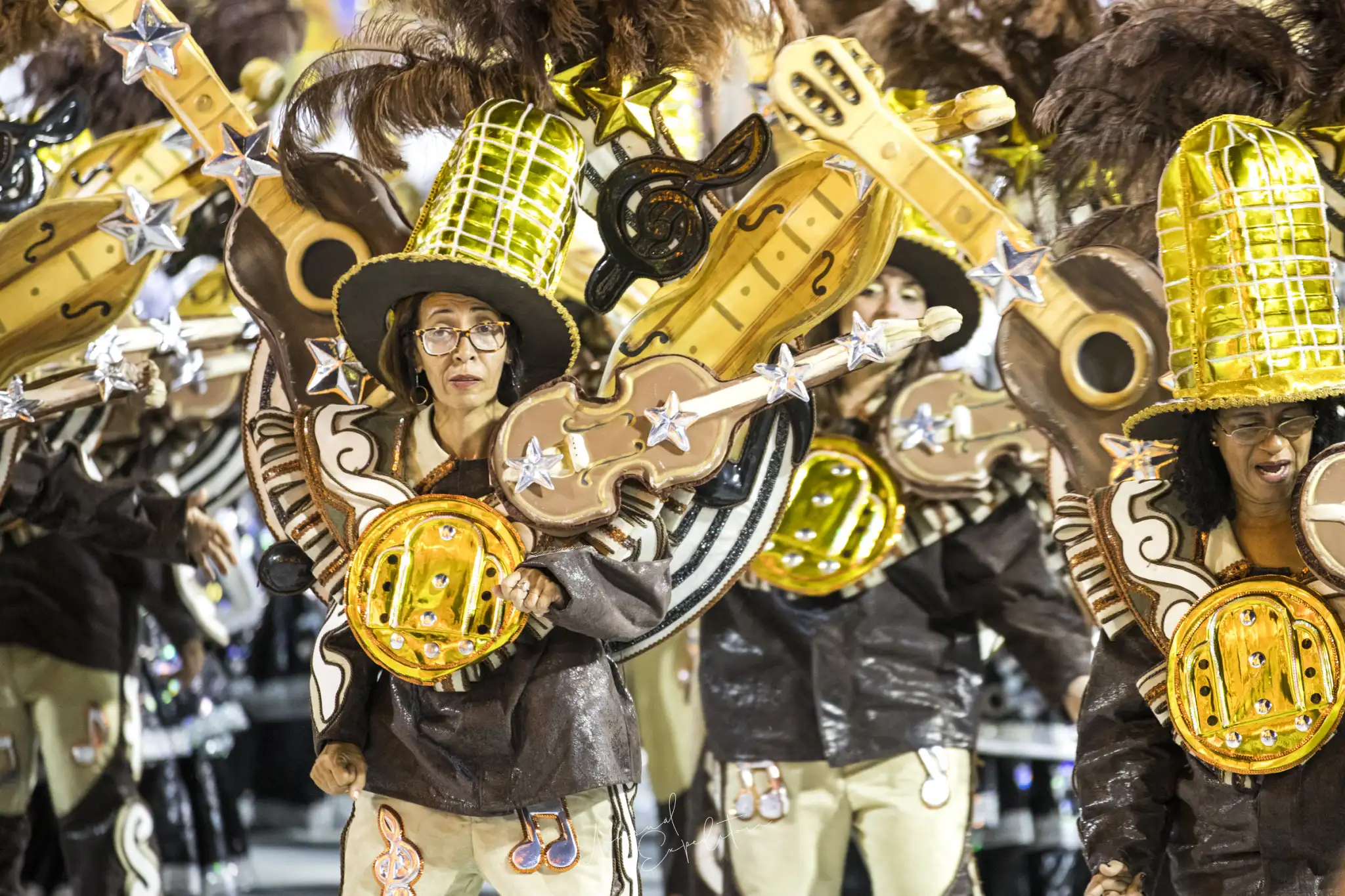
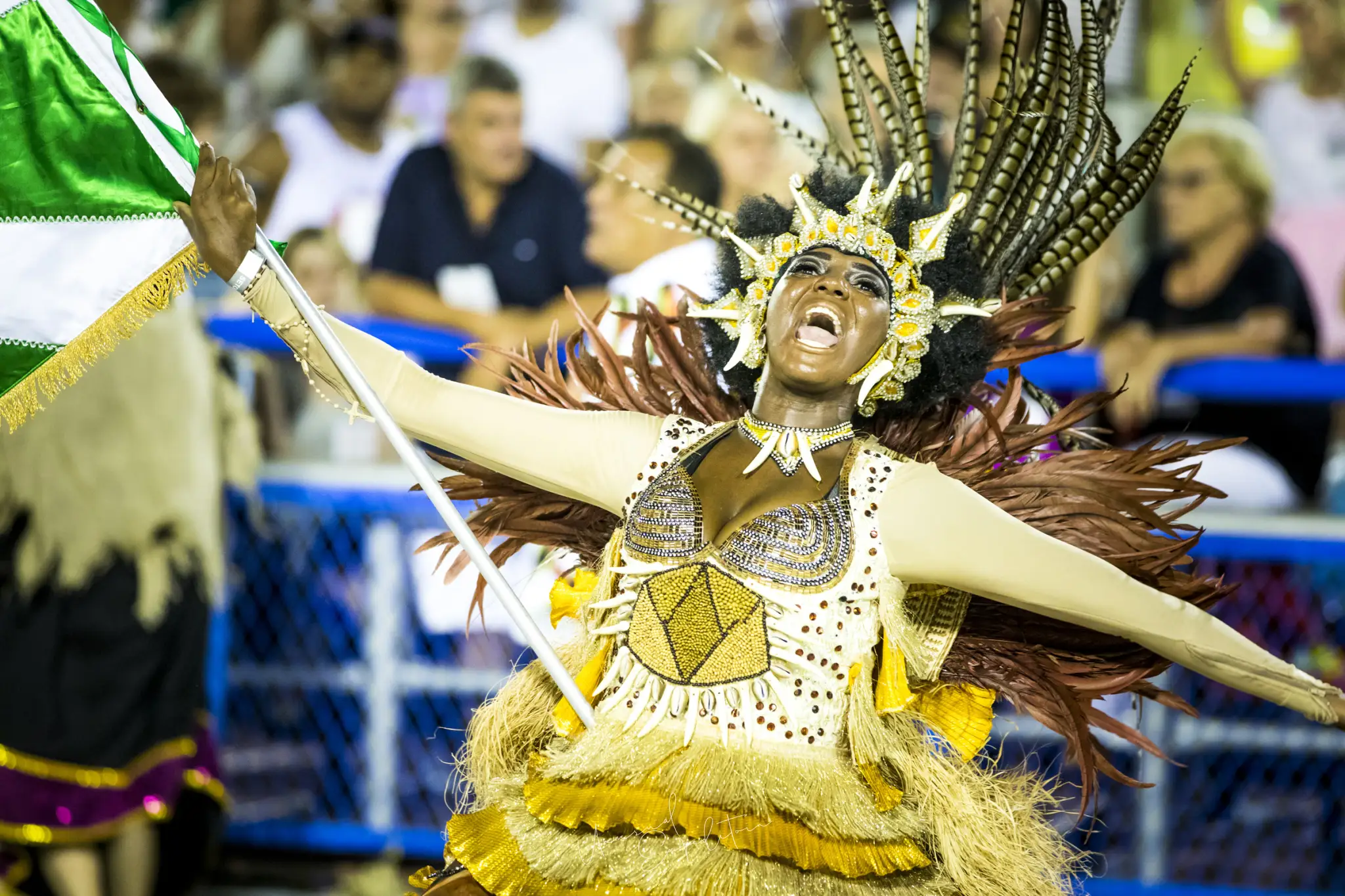
A samba school's parade follows a pattern, and knowing it helps you be ready. First comes the opening wing, a choreographed group that introduces the theme. Then the wings of costumed members, the alas, each dressed as one idea from the story, with floats rolling between them. Somewhere in the middle are the porta-bandeira and mestre-sala, the couple who carry and guard the school's flag, and the passistas who dance samba in feathers. The bateria, the drum section, sets the beat for everyone. We photographed one wing dressed as musical instruments, guitars and violins worn like armour, and the whole block of costumes repeating across the frame made the picture.
Rio carnival floats
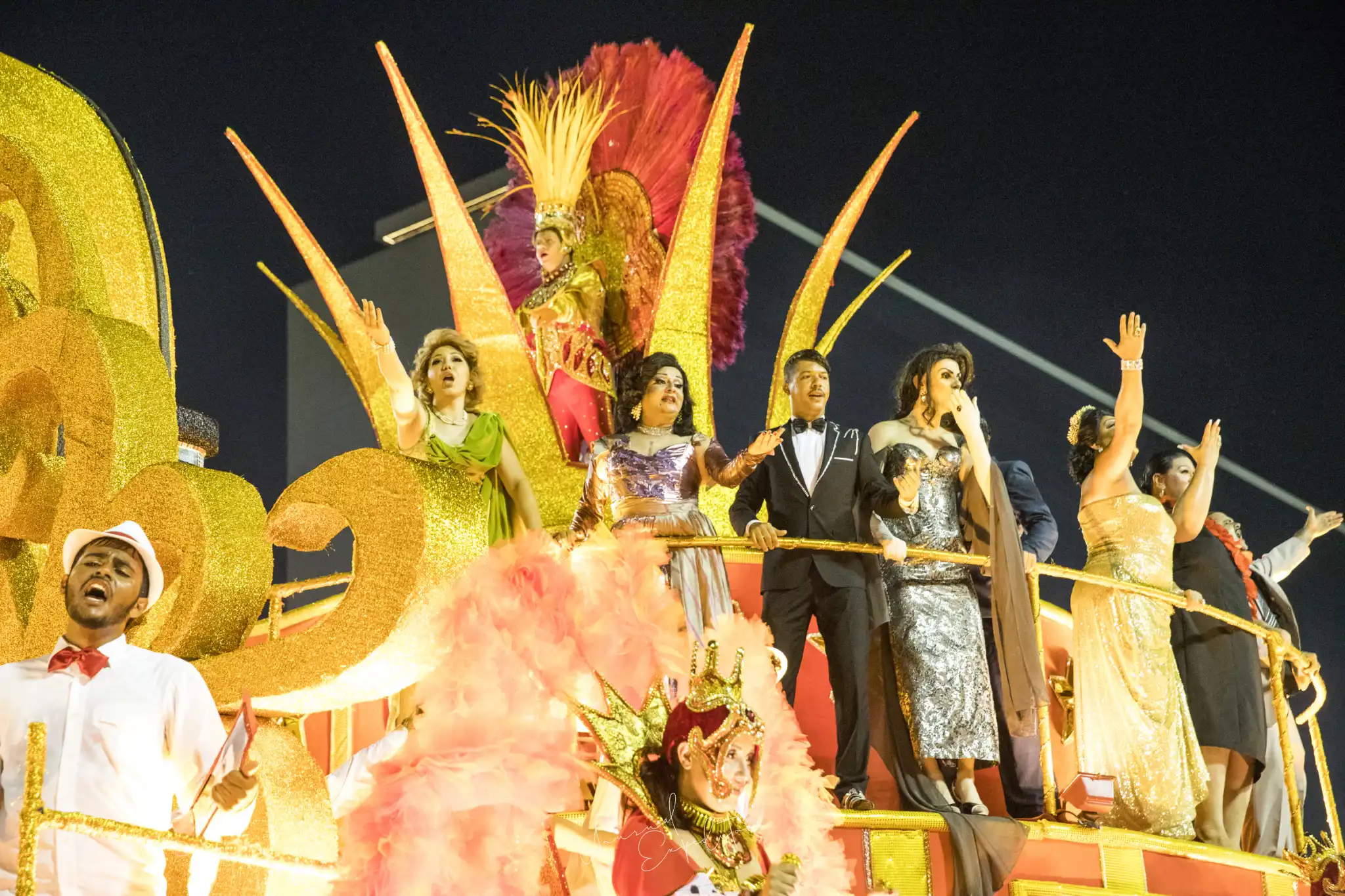
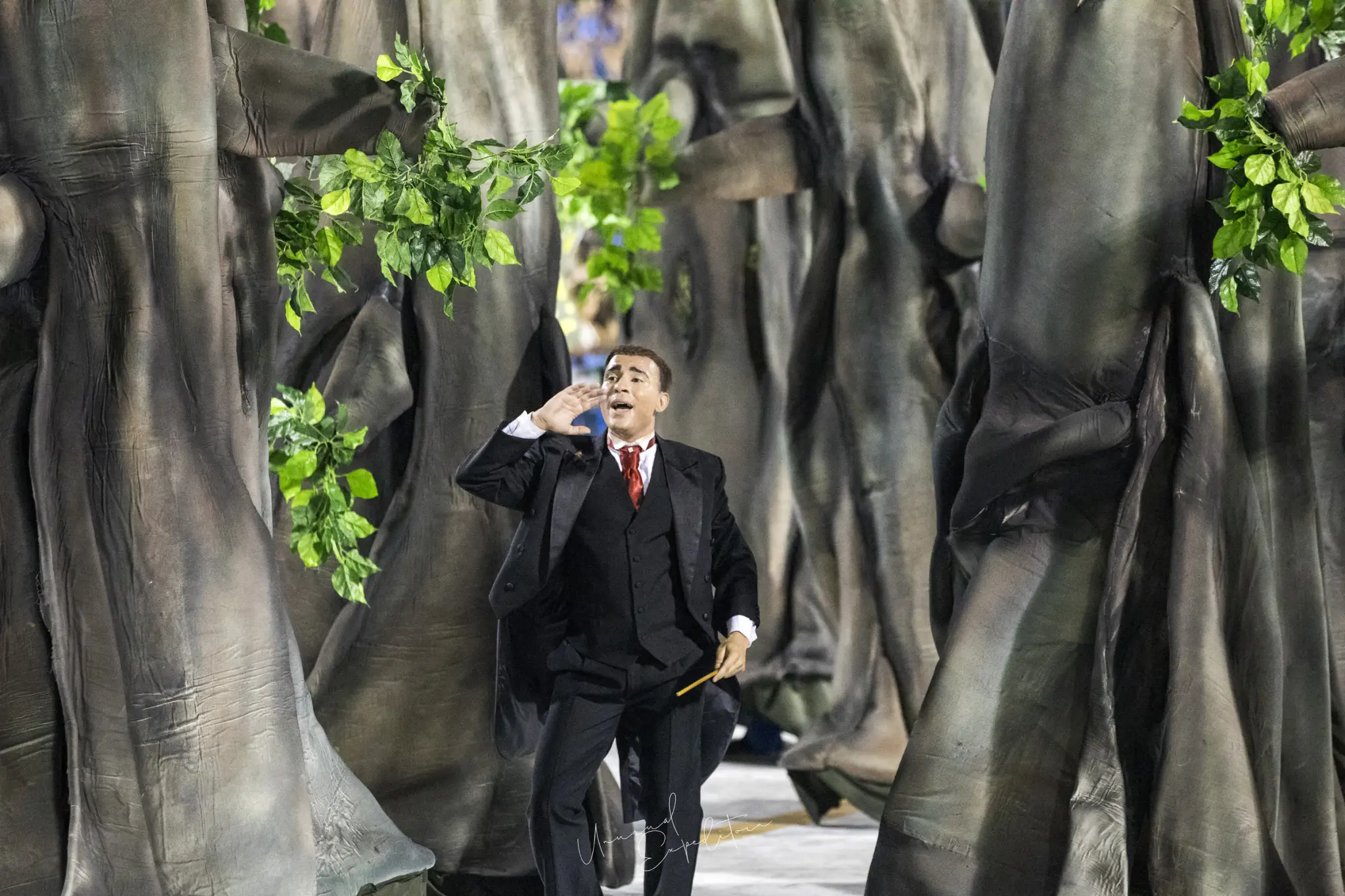
The floats are the biggest subjects in the Sambadrome and the hardest to fit in a frame. Our feature photograph shows a float of gold spikes and pink feathers carrying performers in evening dress, waving to the stands. Rio carnival floats are tall, so from low seats you are looking up at them against a black sky; from higher seats you see the whole structure. Shoot the full float as it enters your section, then switch to the long lens for the performers on the upper decks, who often hold a pose for some time. Theatrical sets travel through the parade too: we photographed a performer in a black suit walking between giant grey tree trunks, a scene from one school's story played out on the avenue.
Sambadrome Rio: how to photograph the wings
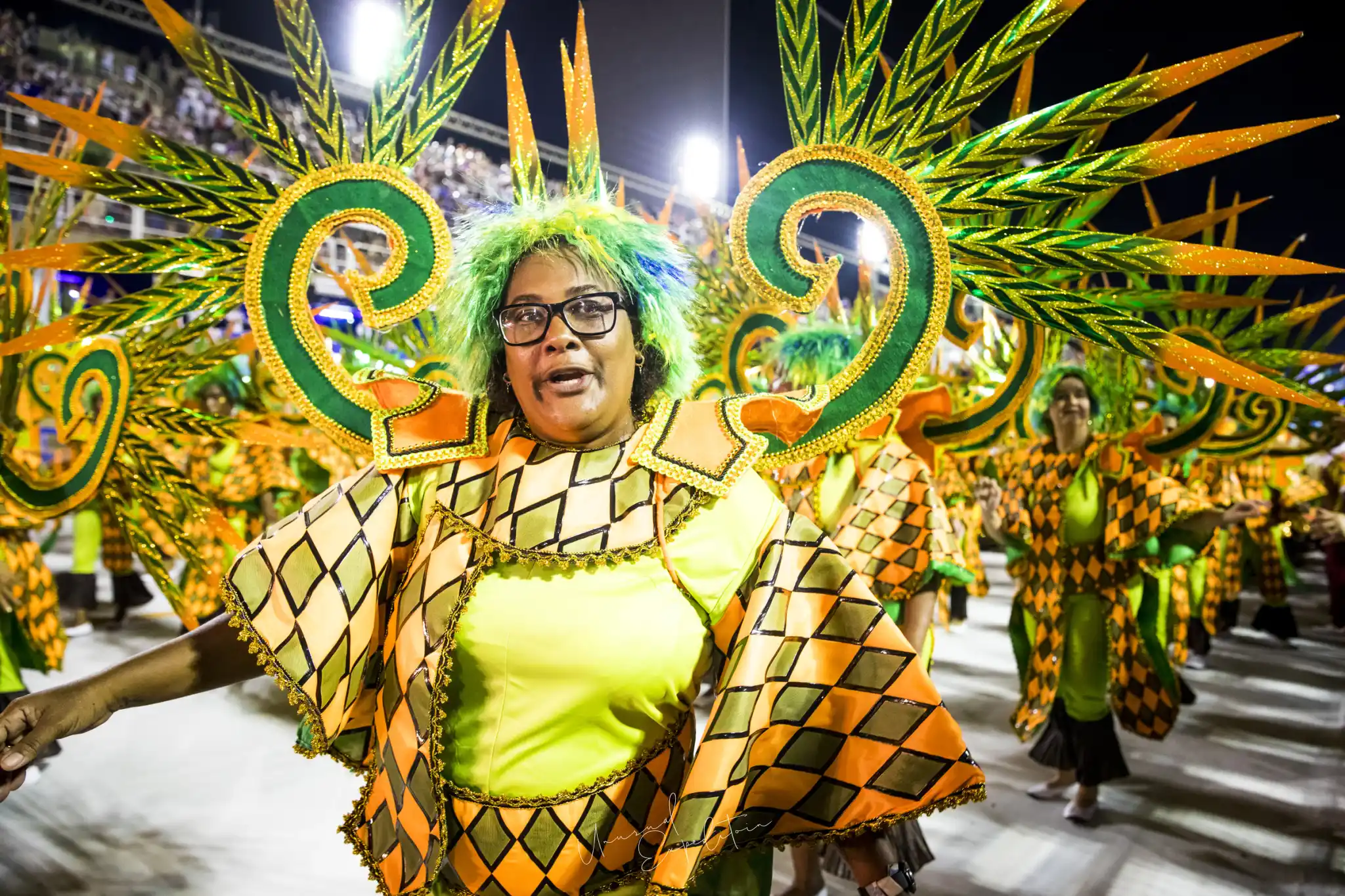
The wings are where you find faces. Each ala has dozens of people in the same costume, so you can watch one go past, see the pattern, and pick the next person who looks up. We photographed a woman with green hair and glasses in a costume of orange diamonds and a huge green headdress, mid-step and singing, with the rest of her wing behind her. Use a shutter speed fast enough for dancing, around 1/250 second or faster, keep the aperture wide, and let the ISO climb. The floodlights in the Sambadrome are even, so a modern camera handles them well at high ISO.
The first school always catches you unprepared. By the third you know where the floats slow down, where the dancers turn to the stands, and you start getting the pictures you came for.
Joseph Mak, tour leader, Unusual Expedition
Rio carnival Sambadrome tickets and where to sit
There are three broad kinds of seat. The grandstands, arquibancadas, are open seating on concrete steps and the cheapest way in. The frisas are boxes at the edge of the avenue, the closest you can get to the dancers and the best choice for photography. The camarotes are hospitality boxes, comfortable but usually further from the dancers. Tickets for the top division are sold by Liesa, the league of the leading samba schools, and through authorised resellers; buy only from official channels and check prices on the official site before you travel. For photography, a seat low on the avenue in the middle sections gives you the dancers at eye level and the floats as they turn towards the stands.
| Seat type | View for photography | Lens |
|---|---|---|
| Grandstand, high rows | Whole floats and wings, looking down | 24-70mm |
| Grandstand, low rows | Faces at a distance, floats against the sky | 70-200mm |
| Frisa (front box) | Dancers at eye level, close | 24-70mm and 70-200mm |
| Camarote (hospitality box) | Comfortable, usually further from the dancers | 70-200mm |
If photography is the reason you are there, the frisas are worth the extra cost.
Which night to choose
The top division, the Special Group, has in recent years paraded over three nights from carnival Sunday, with the second division, the Série Ouro, on the Friday and Saturday before, and a Champions' Parade on the Saturday after carnival. Our own night in the stands was a Friday, a second-division night, and every school still came with full floats, wings and drummers. Those nights are worth considering if seats for the top division are sold out. Our best time to visit Rio de Janeiro guide gives the carnival calendar, and our Rio carnival photos show more of what a night here gives you.
What to bring into the Sambadrome
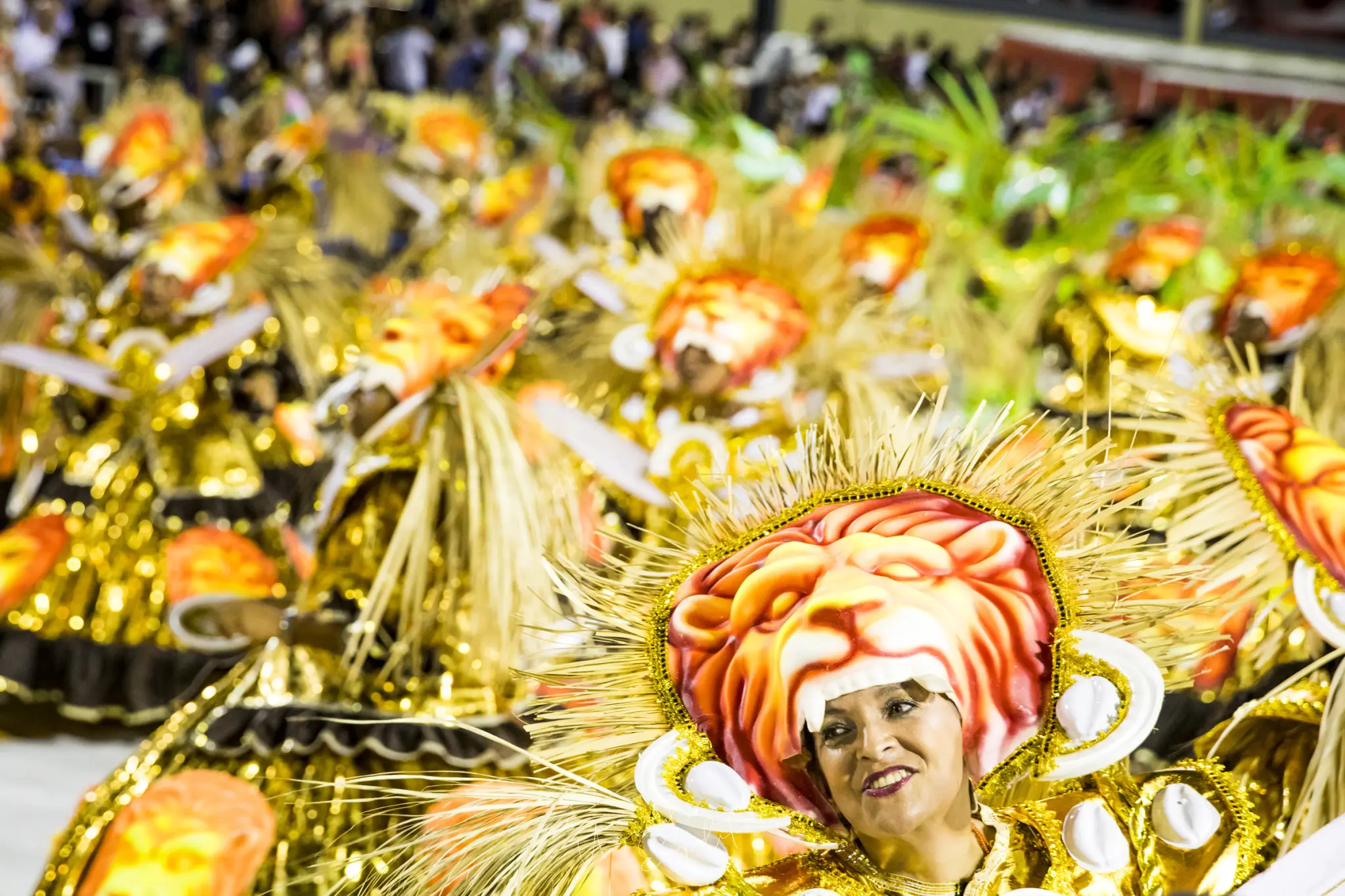
A night in the Sambadrome is long, hot and loud. Bring one body with a 70-200mm and a 24-70mm, spare batteries and cards, earplugs, water and a light rain jacket, since summer storms in Rio de Janeiro arrive quickly. Check the venue's rules on bags and camera size before you go. Keep your kit with you at all times, in the stands and in the crowd outside. When the parade ends the crowd leaves at once, so plan how you will get back before the last school starts. We also photographed one wing in lion headdresses among gold feathers, a reminder that the last schools of the night can be the best.
Photograph the Sambadrome with us
We arrange Rio carnival as a private trip on request, with Sambadrome seats chosen for photography, the nights you want and the blocos in between. A photographer or coaching can be added at extra cost. Start with our private tours page, read the Rio carnival blocos guide for the daytime side, and see all our Brazil destination guides on the Brazil photography tours page.
Rio de Janeiro photography tours
The next Rio de Janeiro departure is announced on the Rio de Janeiro photography tours page, with previous expeditions and all the planning guides.
Explore Rio de Janeiro in depth
- Rio de Janeiro Photography Tour Guide: Carnival, Blocos and BeachesBrazil
- Santa Teresa, Rio de Janeiro: Street Art, Tram Tracks and BlocosBrazil
- Rio de Janeiro Beach Photos: Copacabana, Ipanema and the SurfBrazil
- Carnival in Rio Travel Guide: Flights, Visa, Tickets and SafetyBrazil
- Rio Carnival Photos: Pictures from the Sambadrome and the StreetsBrazil
- Rio Carnival Blocos: Photographing Rio's Street PartiesBrazil
- Best Time to Visit Rio de Janeiro: Carnival, Seasons and LightBrazil
Upcoming Photo Tours
- Egypt Photo Tour – EgyptEgypt 12 Dec 2026 To 20 Dec 2026
- Inner Mongolia Winter Owl Photo Tour – ChinaChina 01 Jan 2027 To 04 Jan 2027
- Inner Mongolia Winter Photo Tour – ChinaChina 05 Jan 2027 To 11 Jan 2027
- Mekong And Central Highland Vietnam Photo Tour - VietnamVietnam 16 Jan 2027 To 24 Jan 2027