
Sunrise and Sunset in South Iceland: Vik, Seljalandsfoss, the Plane Wreck and Haukadalur
Sunrise and sunset in Iceland by month, and the best light at Vik, Seljalandsfoss, the plane wreck and Haukadalur in South Iceland.
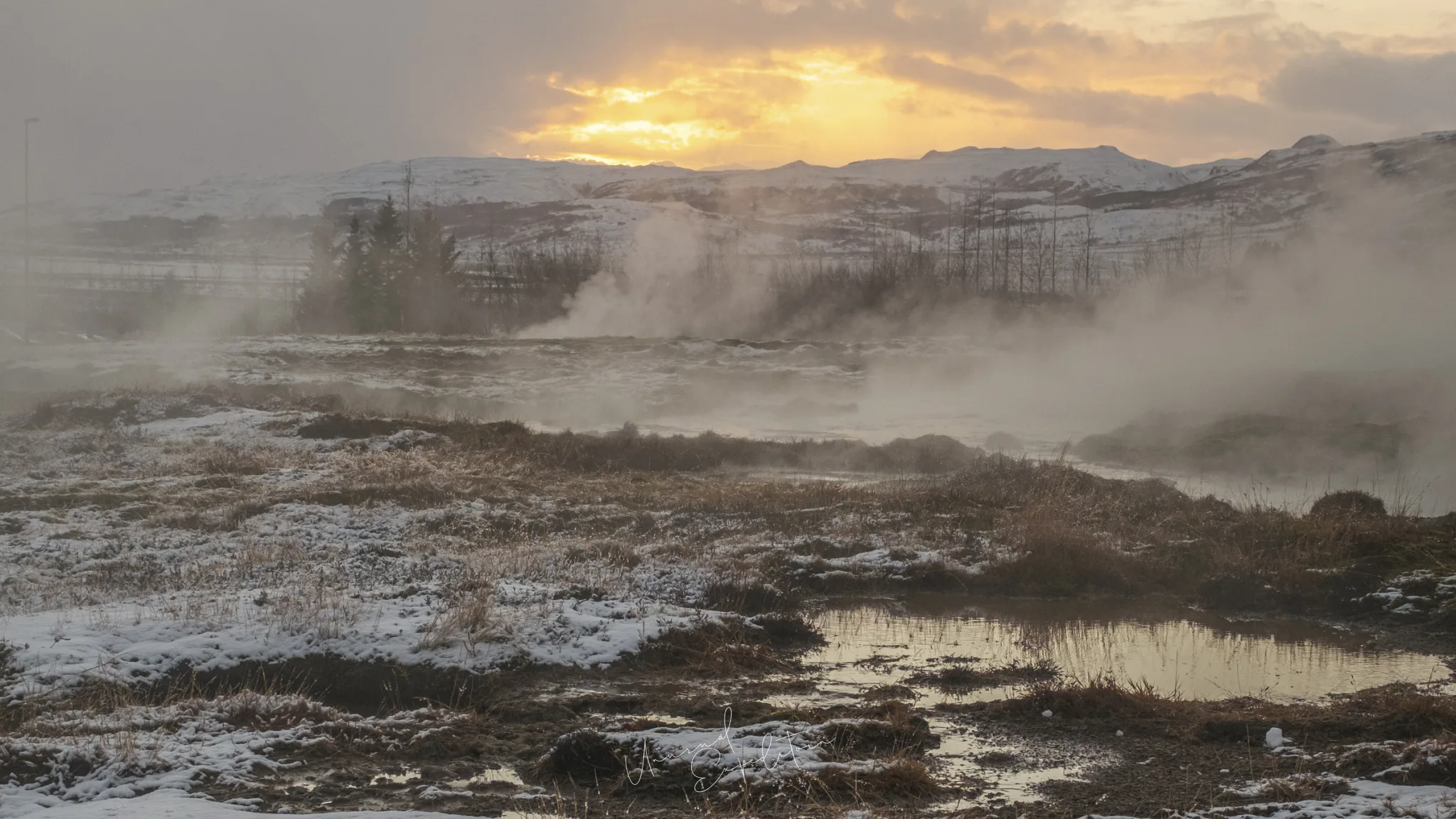
Sunrise and sunset in Iceland swing further through the year than anywhere most of us live, and on the south coast that swing decides your pictures. In midwinter the sun rises late, slides low along the southern horizon and sets early, so sunrise light lasts for much of the morning. In midsummer it barely sets at all, and the gold of a sunset runs straight into the gold of a sunrise. Each of the South Iceland icons has its own best moment.
This guide belongs to our South Iceland photography tour guide. It is about light, not clocks: for the exact sunrise and sunset time on your dates, use the Icelandic Met Office or any almanac app, and plan around the direction of the sun as much as its timing.
Iceland sunrise sunset by month
| Months | What the sun does in South Iceland | What it means for photography |
|---|---|---|
| December and January | Rises late in the south-east, stays very low, sets early in the south-west | Long sunrise and sunset light, soft all day, short working day |
| February and March | Days lengthen quickly, sun still low | Low sun on snow, dark nights for aurora |
| April and May | Long evenings, short nights | Late golden light, the last dark skies early in the season |
| June and July | Midnight sun, the sun dips only briefly below the horizon | Hours of low light through the night, empty car parks late |
| August and September | Nights return, sunsets move earlier | Golden evenings and the first aurora |
| October and November | Days shorten fast | Low sun again, autumn colour, darker nights |
The table explains why we photograph the south coast late in the evening in summer and through the middle of the day in winter.
Sunset in Vik, Iceland
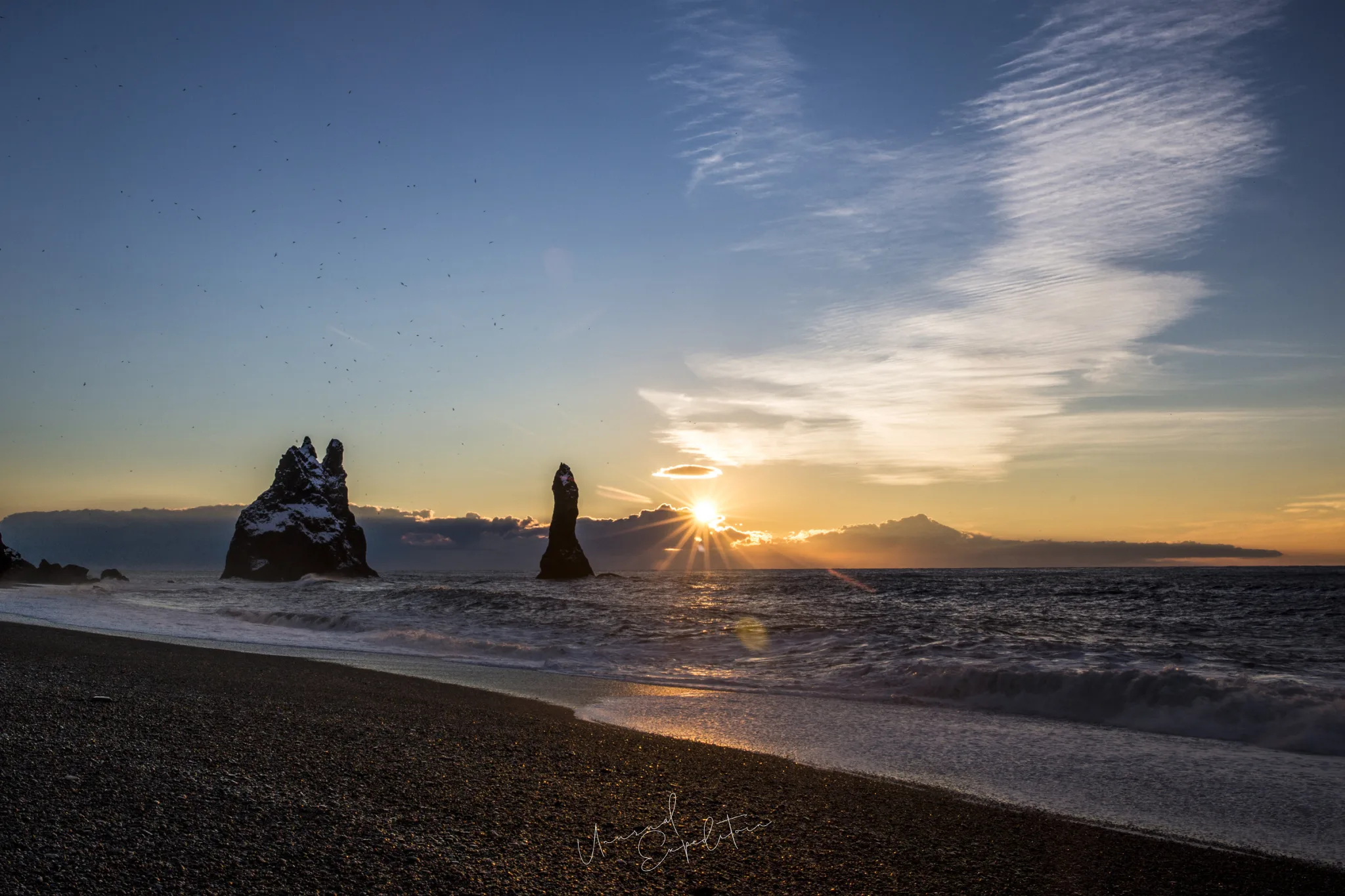
Sunset in Vik works best on the beaches either side of the headland of Reynisfjall. From Vik beach, below the village on the east side of the headland, the Reynisdrangar stacks sit off the end of the cliff, and after the sun has gone the blue hour turns the wet sand into a mirror for the sky. On Reynisfjara, west of the headland, the low winter sun rises and sets close to the stacks themselves and backlights the spray of the breaking waves. Keep well back from the surf in failing light, when sneaker waves are even harder to see. Our Reynisfjara black sand beach guide covers the safety rules.
Seljalandsfoss at sunset and twilight
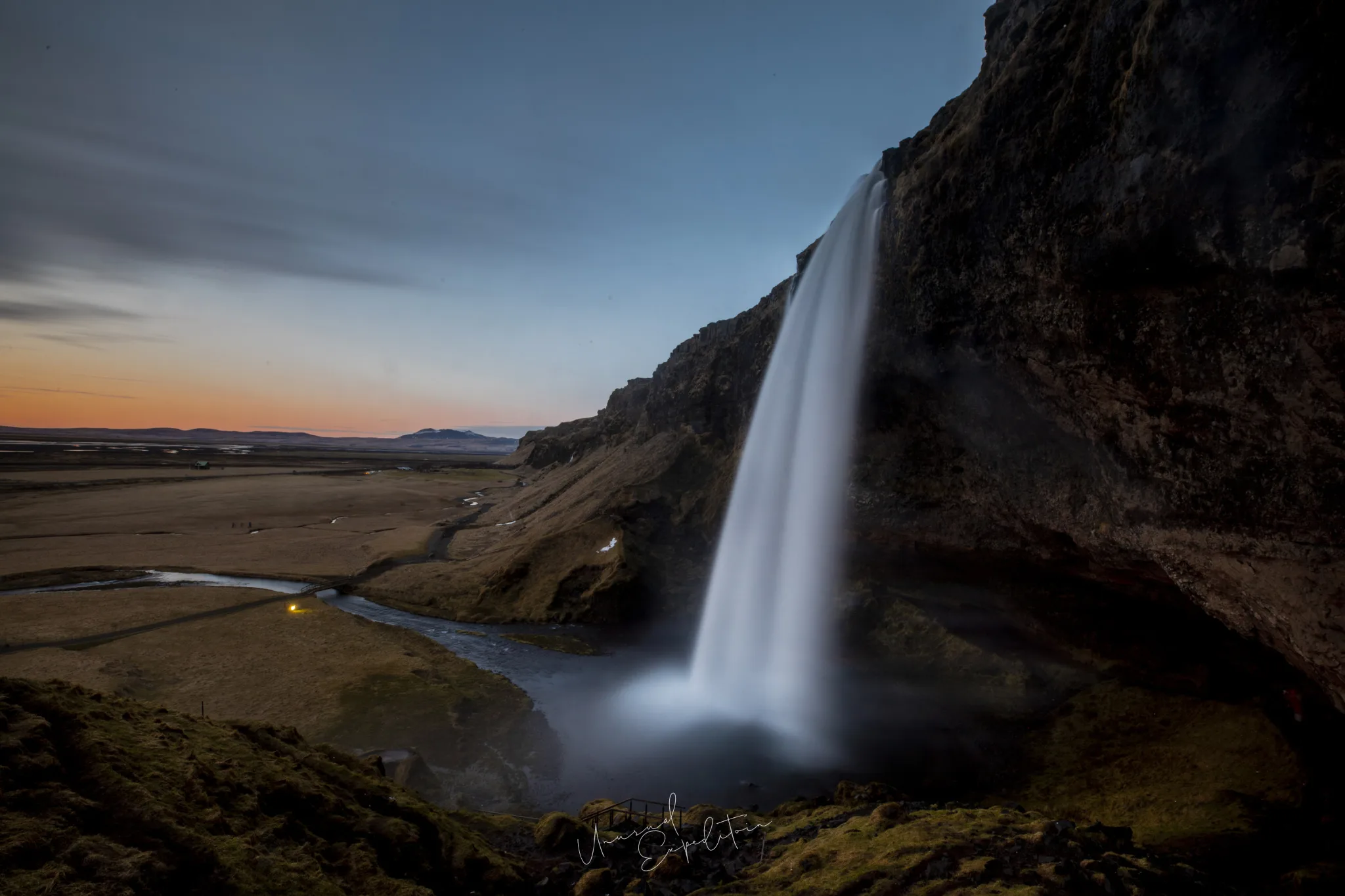
Seljalandsfoss stands clear of its cliff with open farmland in front, so the sky around it is part of every frame. In summer the low evening sun can shine through the falling water when you stand behind it, which is why our scheduled tour photographs it late in the evening. In winter the drama comes in twilight: the fall glows pale against the dark cliff while the horizon still holds a band of orange. A tripod and a few seconds of exposure smooth the water and the sky together. The Seljalandsfoss waterfall guide has more on the view from behind.
The plane wreck at sunset
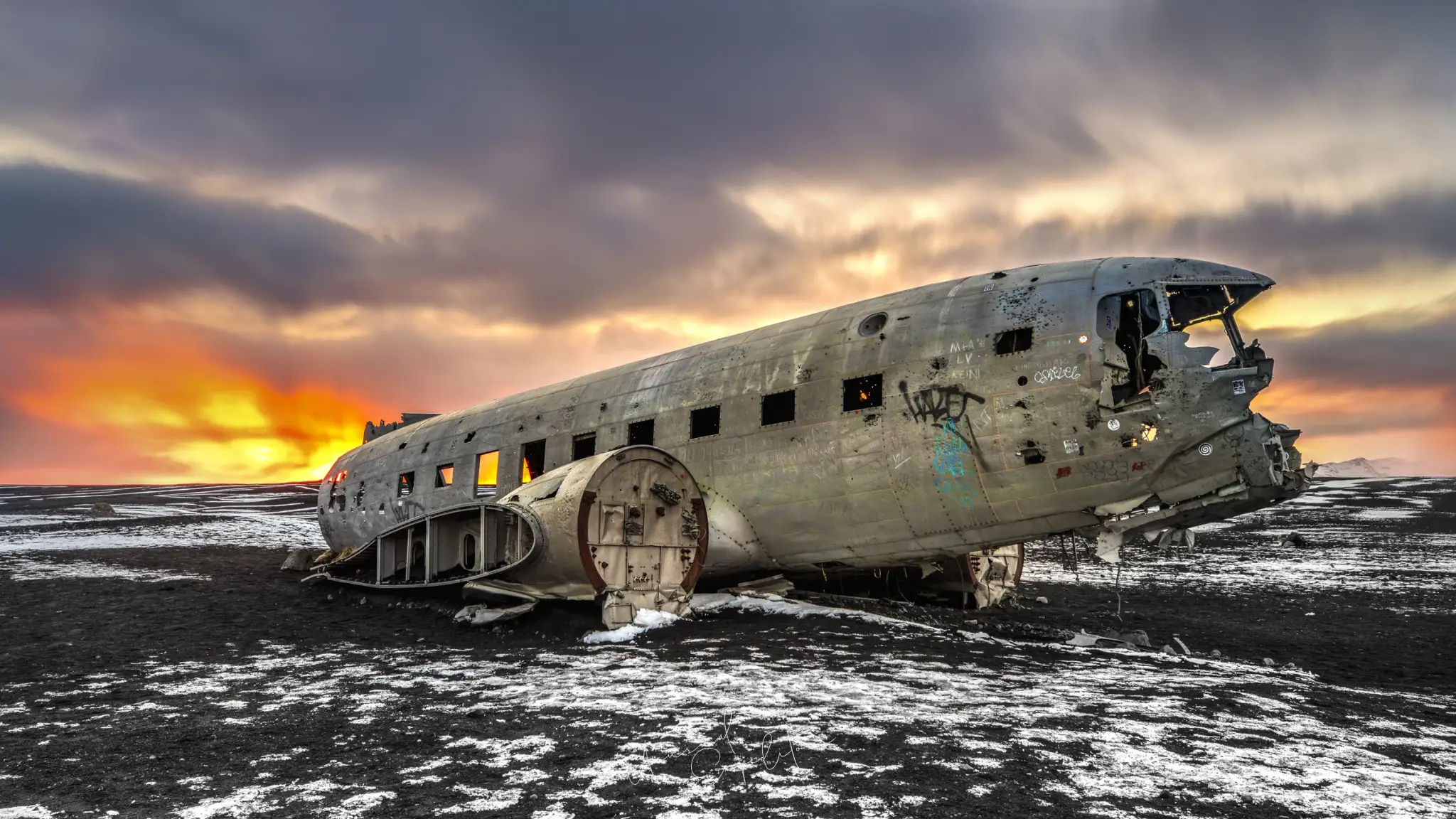
The DC-3 wreck on Solheimasandur faces an open horizon in every direction, so whichever way the sun goes down there is a sky behind it. With colour in the clouds, shoot the fuselage against it and let the metal pick up the warm light from the side, or wait until the sun is gone and the wreck becomes a dark shape on a coloured sky. Remember the walk back is about 4 kilometres across open sand: carry a headlamp and leave while you can still see the marker posts. The Solheimasandur plane wreck guide covers the approach.
Sunrise at Haukadalur on the Golden Circle
On cold, still mornings the Haukadalur geothermal valley fills with steam, and when the low sun breaks through it the whole slope glows. This is the best moment of the Golden Circle for us, better than any eruption of Strokkur at noon, and in winter the sun is low enough for it to last well into the morning. Shoot into the light with a 24-70mm, protect the lens from drifting spray, and keep to the marked paths around the hot pools. The Golden Circle Iceland guide covers the rest of the loop.
In winter people ask me what time sunrise is. The better question is how long it lasts. On the south coast the sun can stay low enough for sunrise colour from first light until midday.
Joseph Mak, tour leader, Unusual Expedition
Sunrise and sunset under the midnight sun
From late May to late July the sun dips only briefly below the northern horizon in South Iceland, and the sky never goes fully dark. Sunset and sunrise merge into one long stretch of low, warm light, which is the reason our summer tour works through the evening and into the night, when the day visitors have gone. The catch is that the sun now sets in the north-west and rises in the north-east, so places that face south, like Skogafoss and the Reynisdrangar stacks seen from Vik, are lit from behind or from the side.
Planning around the light
Three habits help on any season's trip. Check the sun's direction for each place with a planning app before you go, not only the time. Watch the cloud forecast on vedur.is, because a clear gap on the horizon matters more than a clear sky overhead. And stay close: the best light on this coast comes to people already standing in the right place, not to people driving towards it. Our weather in South Iceland by season guide covers what each season adds.
Catch the light with us
Our Iceland Midnight Sun Photo Tour is built around the long summer light, photographing the south coast late in the evening. The fare is indicatively S$15,500 to S$19,250 per person depending on the room; dates and the current rate are on our Iceland photography tours page. For the low winter sun, we plan a private tour around your dates.
Ask us about light on the south coast
Join the South Iceland photography tour
Iceland Midnight Sun Photo Tour departs 05 Jul 2027 To 18 Jul 2027, led by Joseph Mak. Small group, photography first. All South Iceland photography tours.
Explore South Iceland in depth
- South Iceland Photography Tour Guide: South Coast Waterfalls, Black Sand Beaches and the Golden CircleIceland
- Weather in South Iceland by Season: Winter Snow, Summer Light and Autumn in SkaftafellIceland
- Golden Circle Iceland: Photographing Gullfoss, Strokkur and ThingvellirIceland
- Solheimasandur Plane Wreck: The Walk, the Angles and the LightIceland
- Reynisfjara Black Sand Beach: Basalt Columns, Sea Stacks and Sneaker WavesIceland
- Seljalandsfoss Waterfall: Behind the Fall, in Winter and at SunsetIceland
- Iceland South Coast Highlights: Photo Spots from Seljalandsfoss to VikIceland
Upcoming Photo Tours
- Egypt Photo Tour – EgyptEgypt 12 Dec 2026 To 20 Dec 2026
- Inner Mongolia Winter Owl Photo Tour – ChinaChina 01 Jan 2027 To 04 Jan 2027
- Inner Mongolia Winter Photo Tour – ChinaChina 05 Jan 2027 To 11 Jan 2027
- Mekong And Central Highland Vietnam Photo Tour - VietnamVietnam 16 Jan 2027 To 24 Jan 2027