
Torres del Paine Sunrise and Sunset: Where to Be for the Light
Torres del Paine sunrise and sunset: where the light falls, the best spots, daylight hours, blue hour and the towers at dawn.
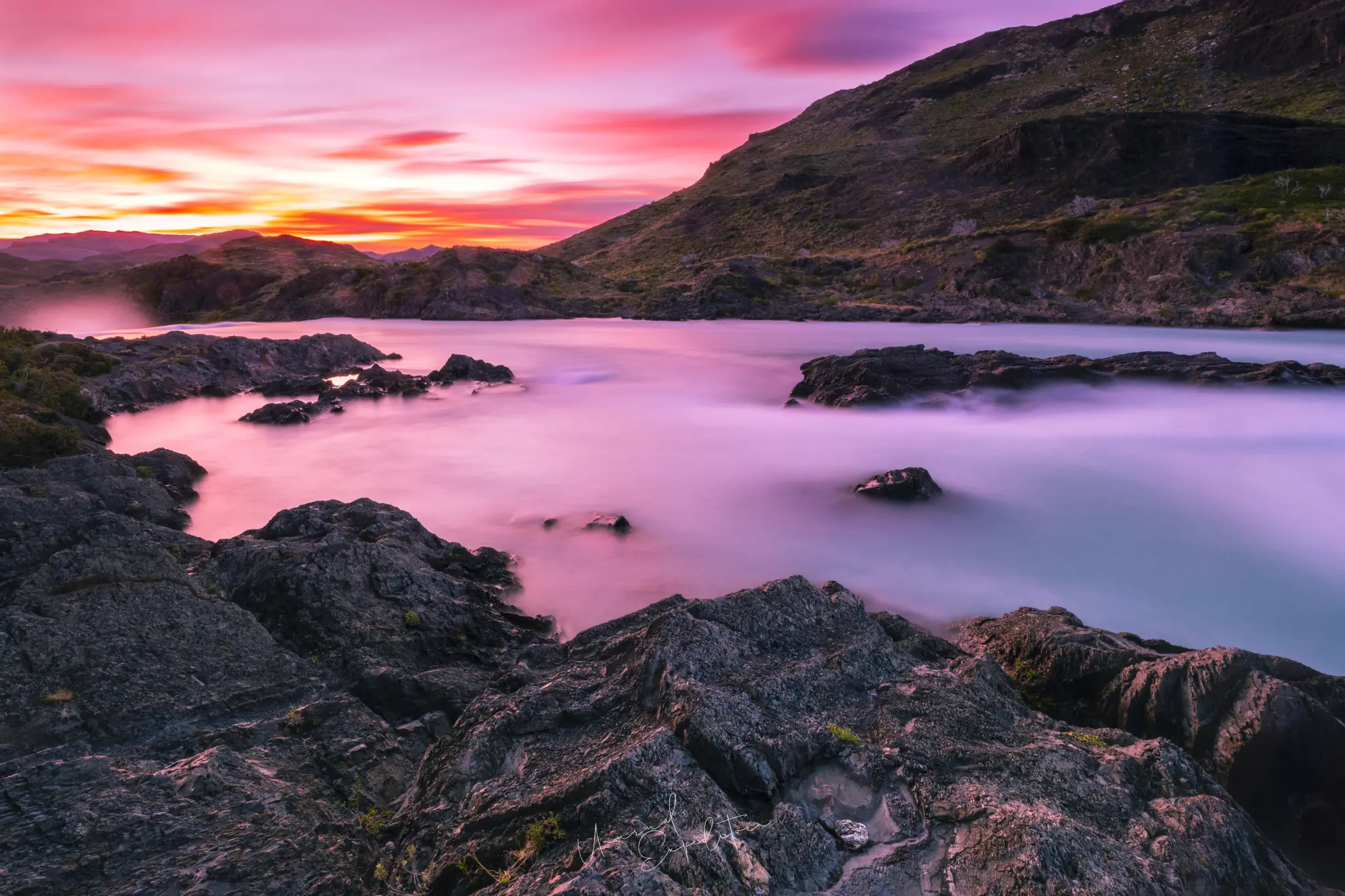
Torres del Paine sunrise is the moment the granite turns red: for a few minutes the first sun lights the Cuernos and the towers from the southeast while the lakes below are still in shadow. The best places to catch it are the Lago Pehoé shore, Laguna Amarga for the towers and the lakeshore rocks for long exposures. Sunset and blue hour work at the Río Serrano viewpoint and around Pehoé, and summer twilight lasts long enough to shoot both ends of the day.
For the park as a whole, see our Patagonia photography tour guide. Here the subject is light: where the sun comes from, which faces it catches, and how to stay in place when the wind is trying to move you.
Where the sun rises and sets in Torres del Paine
Torres del Paine lies at about 51 degrees south. In the southern summer the sun rises well south of east, crosses the northern sky and sets well south of west. That geometry matters. At sunrise the light comes from the southeast and strikes the south and east faces of the Paine massif, which are exactly the faces you see from Lago Pehoé, the Río Serrano valley and Laguna Amarga. In the evening the sun swings round to the southwest and lights the range from the other side, often more softly through cloud. Because the summer sun climbs at a shallow angle, the colour lasts longer than in the tropics, and twilight before sunrise and after sunset is long and blue.
Torres del Paine sunrise spots
| Spot | Sunrise or sunset | What the light does |
|---|---|---|
| Lago Pehoé shore | Sunrise and blue hour | Red light on the Cuernos, island hostería windows lit |
| Laguna Amarga | Sunrise | The three towers glow across the water |
| Lakeshore rocks | Sunrise | Pink sky reflected in smoothed water |
| Río Serrano viewpoint | Sunrise and sunset | The whole massif lit above the river curves |
| Puerto Natales old pier | Sunset | Pier posts in silhouette against the channel |
The Pehoé shore is the safest bet if you only get one clear dawn.
Sunrise at Lago Pehoé
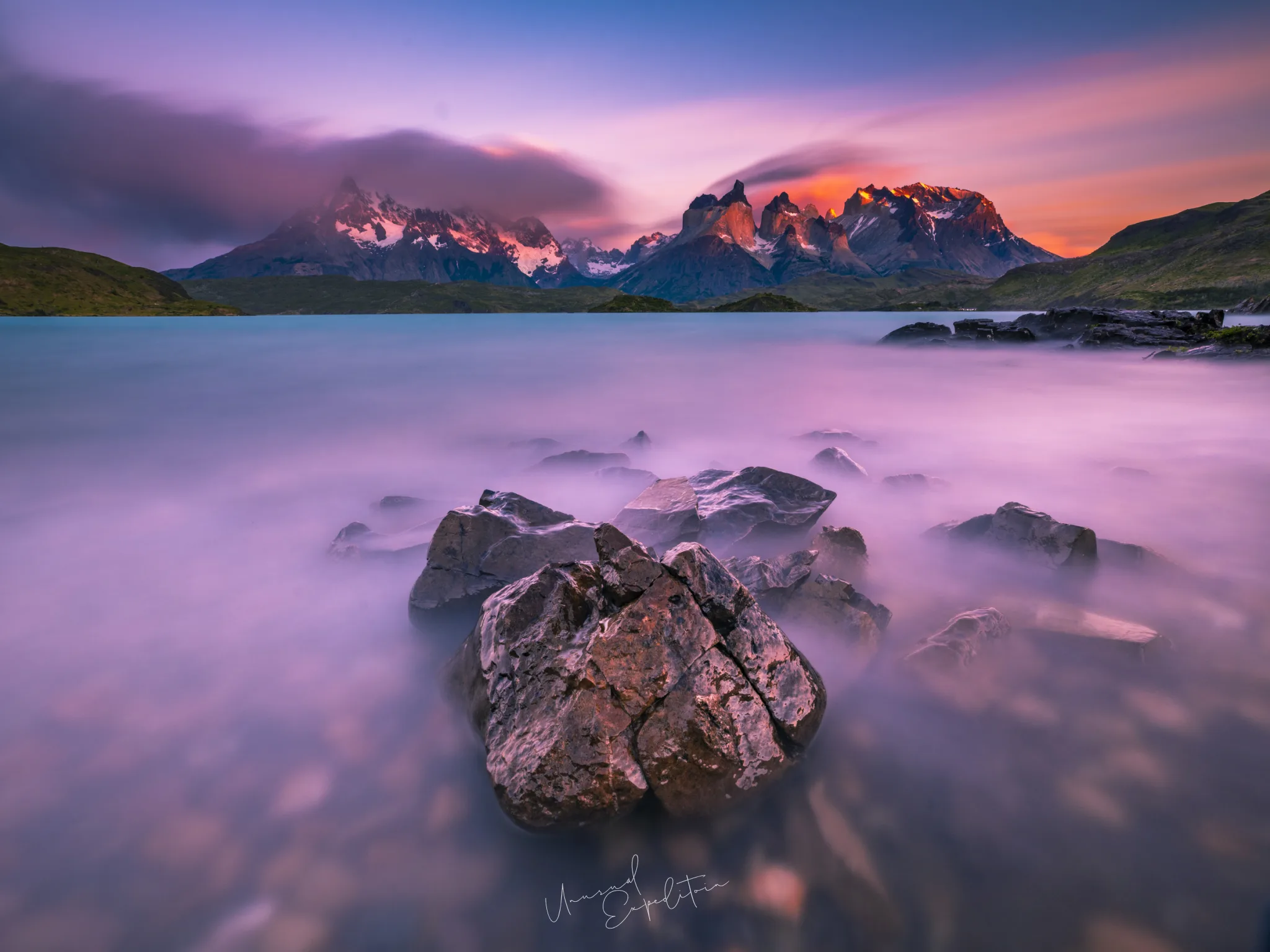
Lago Pehoé faces the Cuernos del Paine from the southwest, so at sunrise you look straight at the lit faces. Arrive in the dark, set up on the rocks or the slope above the water, and watch the sky first: pink cloud often appears before the peaks catch the sun. The red on the granite is brief; once the sun clears the horizon the colour turns to orange and then plain daylight in a few minutes. A rock in the foreground, a neutral density filter and an exposure of a minute or more smooth the waves into mist, as in the frame below, made on a lakeshore in the park. If the wind is too strong to keep the tripod still, raise the ISO and shoot faster; a sharp frame beats a smooth blurred one.
Torres del Paine sunrise hike to the towers
The famous image of the three towers of Torres del Paine glowing orange above a glacial lake is taken at the base of the towers, after a long and steep climb in the dark. Many trekkers make the effort; check CONAF's current rules on access to that trail before you plan it. Laguna Amarga, near the eastern entrance, gives a less strenuous sunrise view of the same towers, smaller and further away, so bring a 70-200mm. The towers face east and catch the first sun directly, so the light is strong and fast. For a photographer who does not want the hike, Laguna Amarga is a fair trade.
Torres del Paine sunset and blue hour
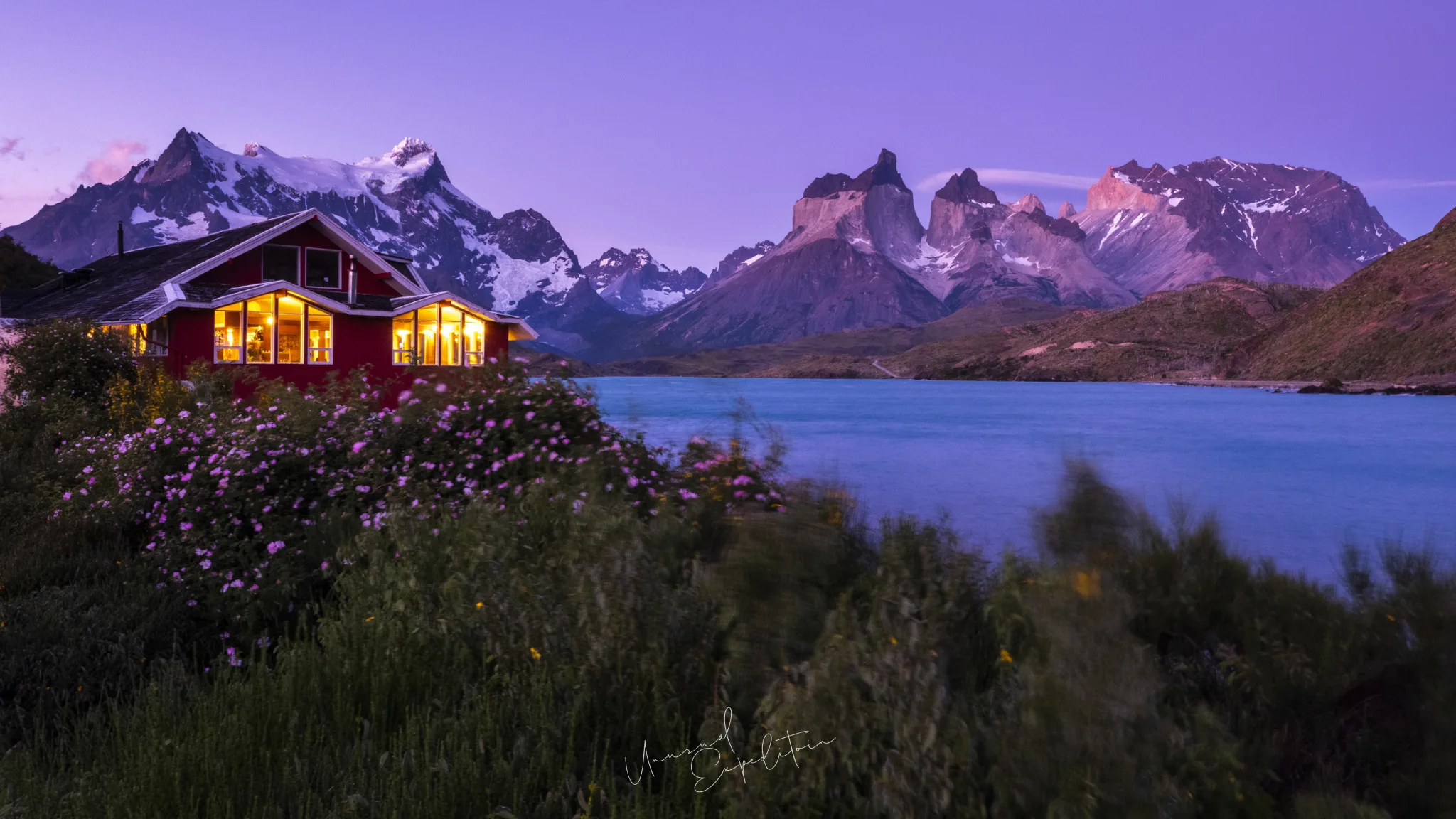
Sunset in Torres del Paine is less predictable than sunrise, because cloud tends to build over the massif during the day. When it breaks, the evening light from the southwest gives warm, raking colour across the Cuernos and Paine Grande, and the Río Serrano viewpoint shows the whole range at once. Blue hour after sunset is often the best part: the sky goes violet, the snow goes blue, and any lit window becomes a point of warmth. A lakeshore house below the Cuernos, with its windows glowing, made one of our favourite frames. Keep shooting well after the sun has gone.
Torres del Paine daylight hours
In summer the days in Torres del Paine are very long. The Las Torres help centre points out that December to February give the most daylight, and around the December solstice it is light from very early until very late. That stretches the golden hours but makes for short nights and early alarms. In spring and autumn sunrise comes at a gentler hour, which is one reason we like the shoulder months; the best time to visit Torres del Paine article goes through the year. For exact sunrise and sunset times on a given date, use a sun calculator such as timeanddate.com for Puerto Natales.
Night sky over Patagonia
Away from Puerto Natales the sky over Torres del Paine is dark, and on clear nights the southern Milky Way and the two Magellanic Clouds stand above the peaks. Summer nights are short, so night photography is easier in spring and autumn. Wind is again the enemy of sharpness: shelter behind a rock or a vehicle and keep exposures short.
The best dawn we had in Torres del Paine lasted only a few minutes. The sky went pink over the lake, the peaks caught fire, and then the cloud closed in for the rest of the day. That is why we are always standing in the cold before the light, not walking toward it.
Joseph Mak, tour leader, Unusual Expedition
Practical tips for Torres del Paine sunrise
Scout every sunrise spot in daylight the day before, so you know where to stand in the dark. Carry a head torch, gloves and a windproof layer, because dawn in Torres del Paine is cold even in summer. A sturdy tripod, a remote release and neutral density filters are the core kit; a lens hood and cloths deal with spray and drizzle. For the full list of viewpoints see Torres del Paine photo spots, and for the old pier at Puerto Natales at sunset, how to get to Torres del Paine.
Be there for first light with us
We arrange Patagonia as a private trip on request, at your own pace, with every dawn and dusk planned around the weather. Coaching on location can be added at extra cost. Private tours explains the rest; the Chile photography tours page gathers every Chile destination guide.
Patagonia photography tours
The next Patagonia departure is announced on the Patagonia photography tours page, with previous expeditions and all the planning guides.
Explore Patagonia in depth
- Patagonia Photography Tour Guide: Torres del Paine, Penguins and GauchosChile
- Torres del Paine Photography FAQ: Tickets, Drones, Wind and WildlifeChile
- How to Get to Torres del Paine: From Santiago, Punta Arenas and OverseasChile
- Patagonia Gauchos: Photographing the Horsemen of Chile's EstanciasChile
- King Penguins in Chile: The King Penguin Park in Tierra del FuegoChile
- Best Time to Visit Torres del Paine for Photography, Month by MonthChile
- Torres del Paine Photo Spots: Where to Stand for Every Classic ViewChile
Upcoming Photo Tours
- Egypt Photo Tour – EgyptEgypt 12 Dec 2026 To 20 Dec 2026
- Inner Mongolia Winter Owl Photo Tour – ChinaChina 01 Jan 2027 To 04 Jan 2027
- Inner Mongolia Winter Photo Tour – ChinaChina 05 Jan 2027 To 11 Jan 2027
- Mekong And Central Highland Vietnam Photo Tour - VietnamVietnam 16 Jan 2027 To 24 Jan 2027