
Xiapu Photography Tour: The Complete Guide
Our Xiapu photography tour guide: mudflats, laver farms, sunrise spots, fishing villages, She people and staged scenes in Fujian.
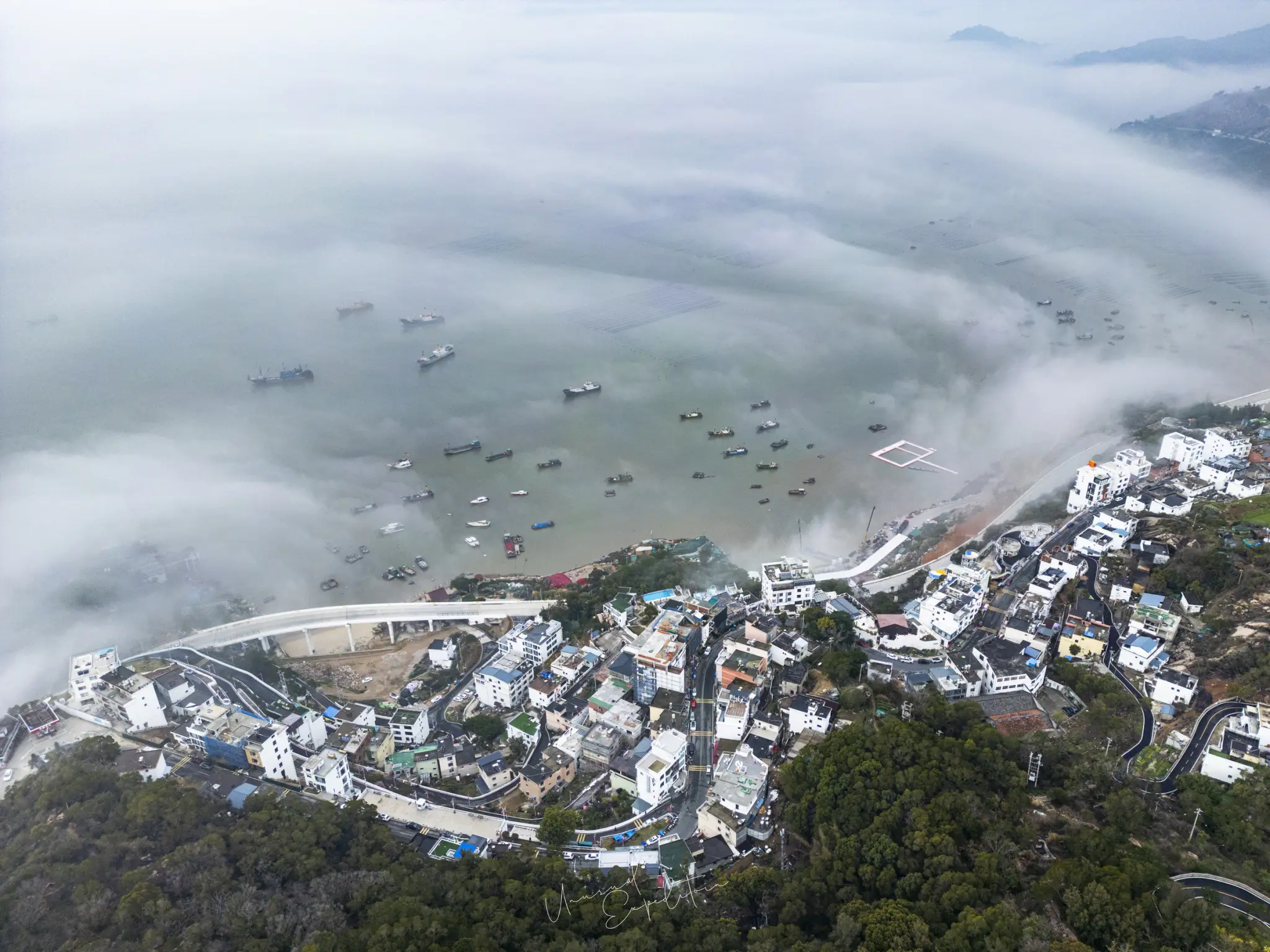
A Xiapu photography tour is a trip to the coast of Xiapu county in north-east Fujian, China, to photograph the mudflats, the bamboo poles and rafts of the seaweed farms, the fishing villages and the people who work them, mostly at sunrise and sunset. Xiapu is less a sightseeing destination than a working coast that happens to make extraordinary pictures. Below is what you photograph there, when to come, how a trip fits together and what to expect from the famous staged scenes.
We have photographed Xiapu over many years, most recently with two groups in spring and again on a wider Fujian trip. This page links every Xiapu article we have written, and the wider China photography tour guide covers entry, money and the other regions we photograph.
Where is Xiapu county, Fujian province?
Xiapu is a county of Ningde city on the north-east coast of Fujian province, between Fuzhou and the border with Zhejiang. The coastline is long and broken into bays, headlands and small islands, and the bays are shallow. At low tide the sea pulls back across kilometres of grey mud, leaving channels, pools and the lines of the farms exposed. That combination of shallow water, a big tidal range and intensive farming is what makes the Xiapu mudflats unique. Fodor's describes the area as a photographer's haven for its mudflats, fishing villages and sunrises, which is a fair summary.
What you photograph on a Xiapu photo tour
Most of the photography falls into five subjects, and each has its own article.
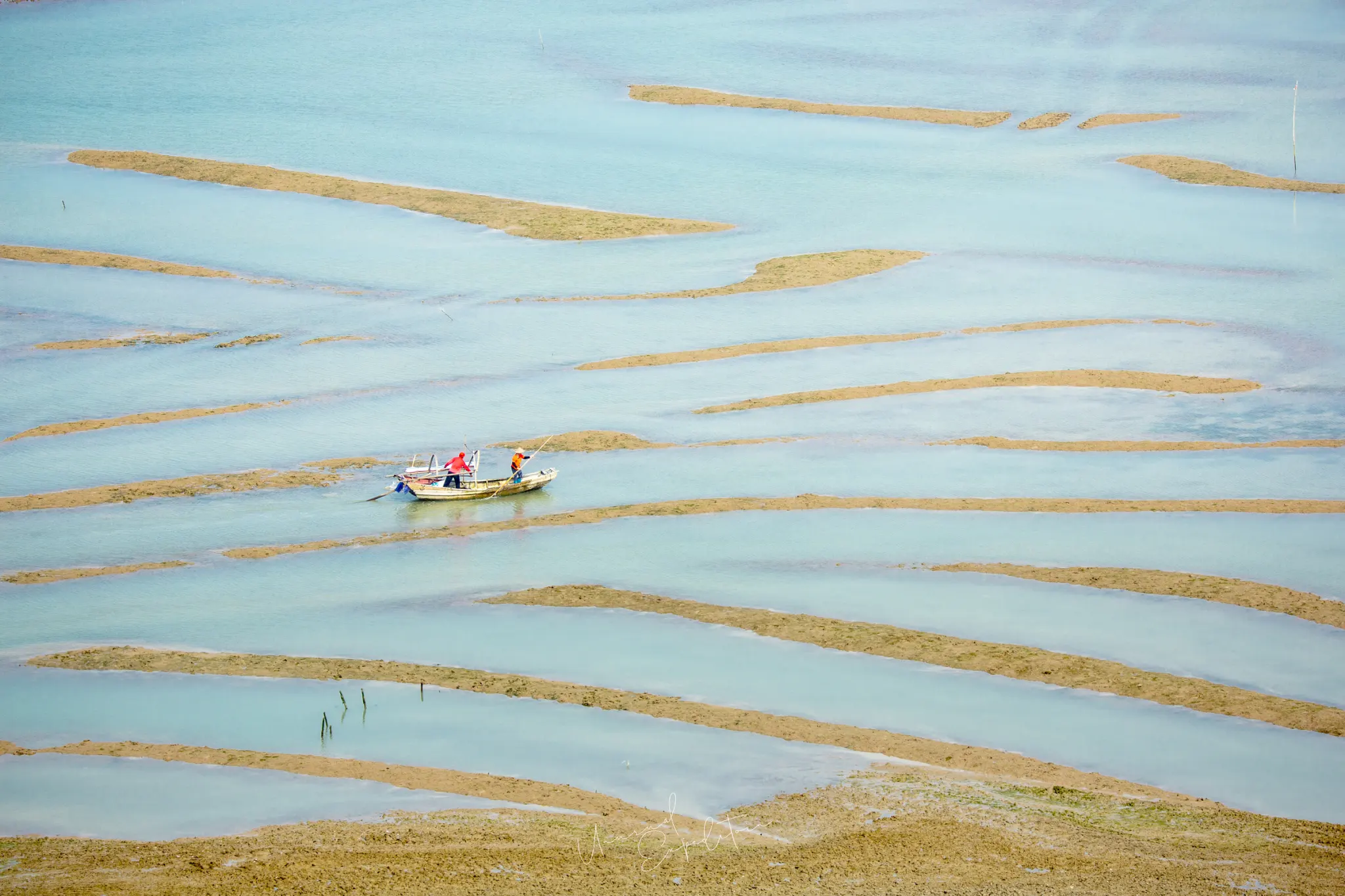
- The mudflats and farms from a viewpoint. Bamboo poles in rows and curves, laver rafts, a single sampan crossing a silver bay. Our Xiapu mudflats photo spots article goes through the viewpoints.
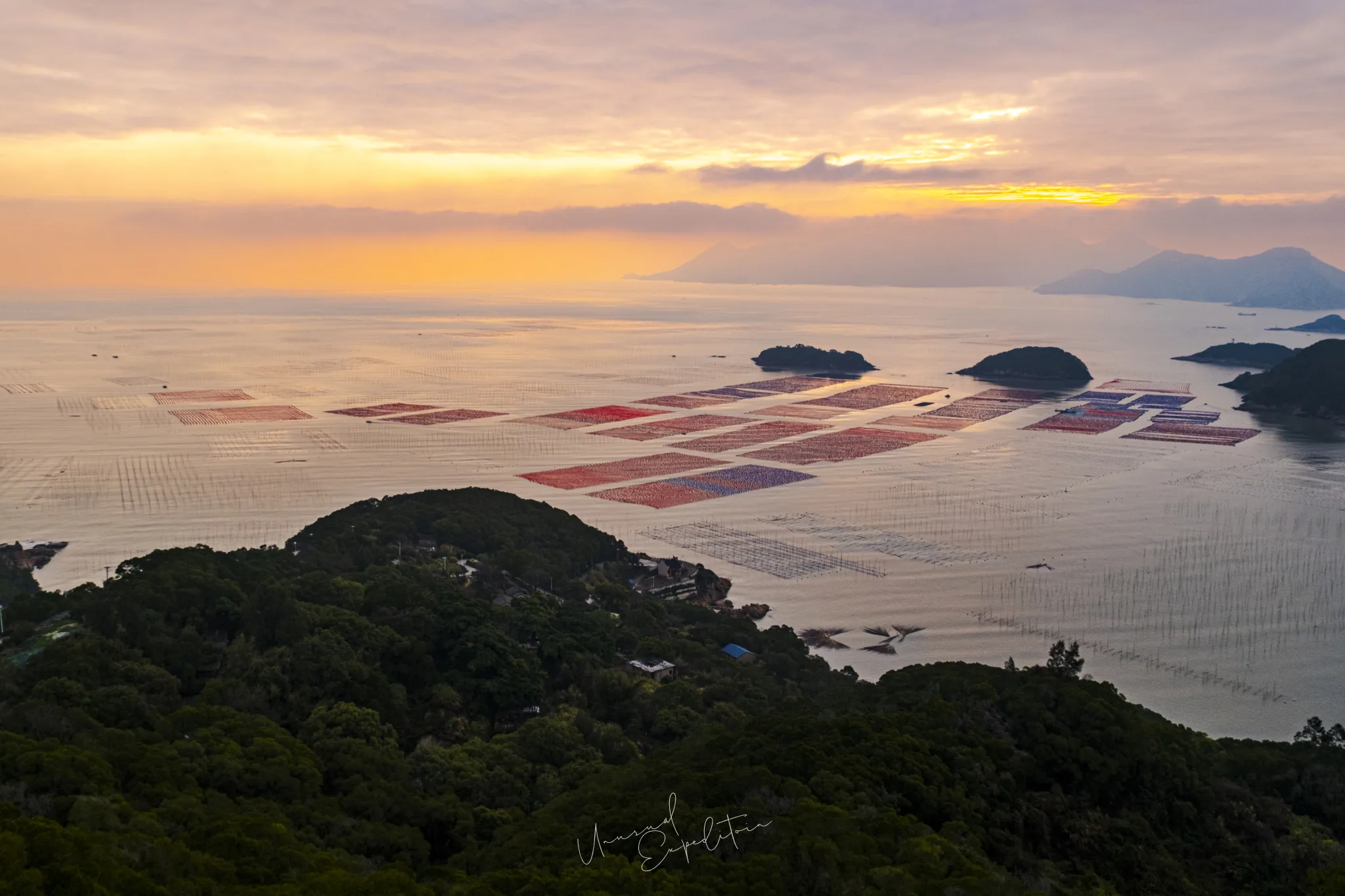
- Sunrise and sunset over the water. Beiqi for sunrise, Xiaohao and Dongbi for the evening, with the tide deciding what you see.
- The farms from the air. Drone pictures of channels, nets and boat wakes have become the new Xiapu signature.
- People at work. Shrimp fishers with hand nets, oyster shuckers, families on the rafts, and the She minority villages in the hills, covered in Xiapu fishermen and She village photography.
- The seasons. Laver in autumn and winter, kelp in late spring, sea mist in March and April, explained in the best time for Xiapu photography.
Xiapu mudflats, Fujian: why they look the way they do
The patterns are man-made. Farmers push bamboo poles into the mud and string nets between them to grow laver, the seaweed sold as nori, and they anchor rafts and lines further out for kelp and oysters. When the tide is half out, the poles stand in shallow water that reflects the sky; when it is fully out, the mud shows the channels the water has cut around them. Seen from a hill, the farms read as calligraphy on a grey page. The same bay can look completely different an hour apart, which is why tide tables matter more here than anywhere else we photograph.
The fishing villages and raft homes
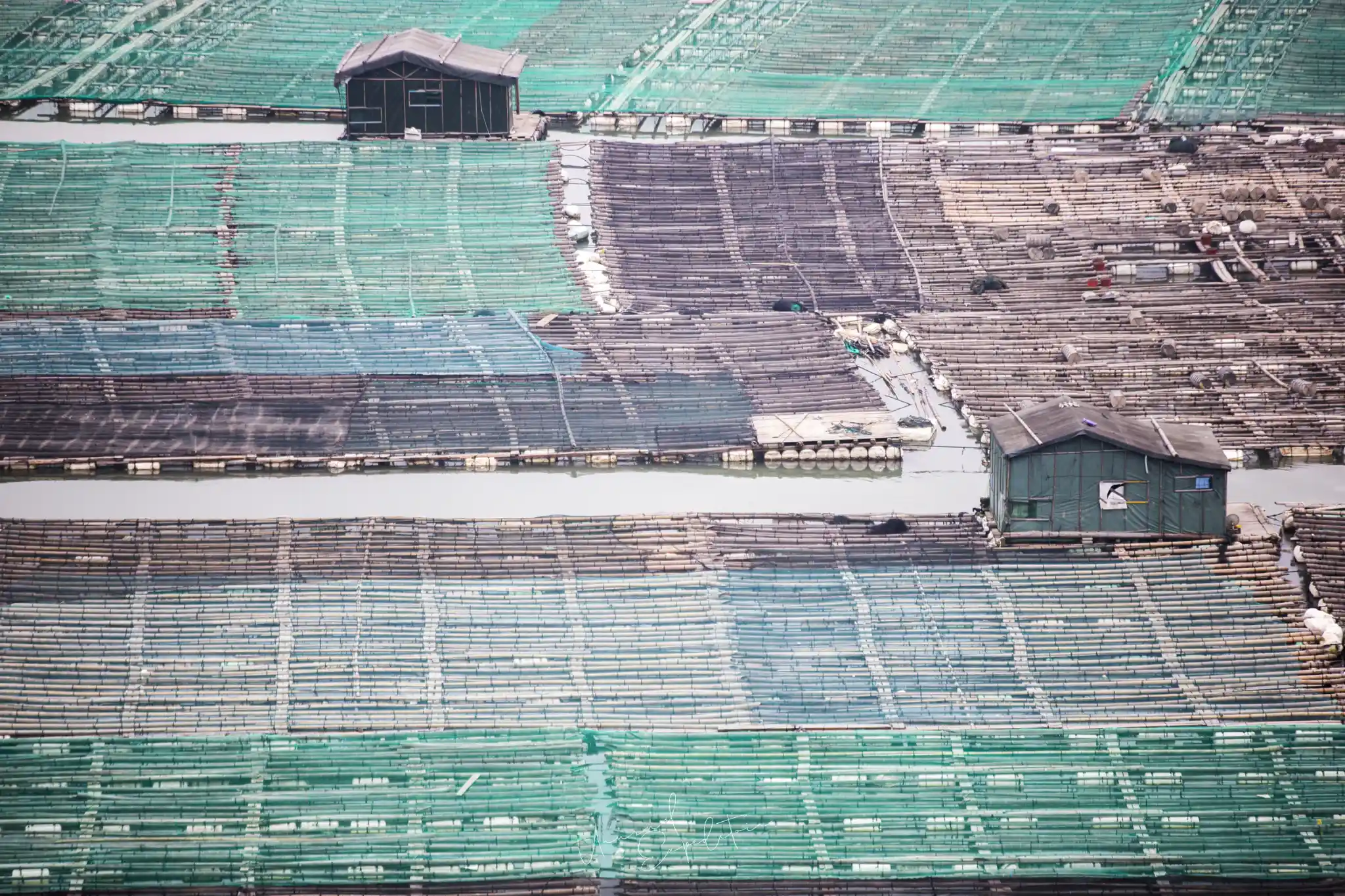
Beyond the mudflats, the deeper bays hold whole floating villages: wooden platforms for fish and abalone farming, with small houses, walkways and green nets, home to families who live on the water for much of the year. From the hills above, they make dense, graphic frames; from a boat, they give you portraits of people mending nets and feeding fish. In the hills behind the coast, villages of grey stone houses belong to the She people, one of Fujian's ethnic minorities.
Are the Xiapu photos staged?
Some are, and it is better to know before you go. Xiapu became famous with Chinese photography clubs, and the villages responded. The farmer leading an ox through sunbeams in the Yangjiaxi banyan grove, the fishermen walking through the shallows with hand nets on poles, the nets hung to dry in the wind, a boat sitting between two dead trees: many of these scenes are arranged, with local people paid to pose and smoke added for the light. The landscape, the farms and the daily work on the rafts are real. We tell you which is which, we pay the people who pose, and we spend most of our time on the real coast.
"Xiapu rewards patience more than any coast I know. You can stand at the same viewpoint two mornings running and get two different pictures, because the tide, the mist and the boats are never in the same place twice."
Joseph Mak, tour leader, Unusual Expedition
Is a Xiapu photography tour worth it?
For a landscape photographer who likes graphic, minimal pictures, yes. Few places give you so many compositions of line, reflection and pattern within a short distance of each other. It suits a 70-200mm or 100-400mm lens more than a wide angle, because the best frames isolate a few poles and a boat in a big empty bay. It is less suited to someone looking for famous monuments, nightlife or comfortable hotels with a view: Xiapu is a working county town and the shooting means early starts and muddy boots.
| Subject | Light | Lens |
|---|---|---|
| Bays of bamboo poles and boats | Grey mornings, mist, soft overcast | 100-400mm |
| Sunrise over the laver rafts | Dawn, clear eastern horizon | 70-200mm |
| Low tide channels from the air | Mid morning, sun on the water | Drone |
| Fishermen and shuckers | Any light, overcast is easiest | 24-70mm |
| She village portraits | Soft window and doorway light | 35mm or 56mm prime |
The coast gives you something in almost every kind of weather, which is unusual for a landscape destination.
How to get to Xiapu
There is no airport in Xiapu. From Singapore the easiest gateway is Xiamen, with nonstop flights on Xiamen Airlines and Singapore Airlines, or Fuzhou with a connection. Xiapu has a station on the coastal high-speed railway through Fuzhou, and from the station the viewpoints are reached by road. Singapore passport holders currently enter China visa-free for up to 30 days per visit, under the mutual arrangement announced by Singapore's ICA. The practical details are in our Xiapu photography trip FAQ, and if you want a city and the tulou as well, see our Xiamen photography tour guide.
Explore Xiapu in depth
- Xiapu mudflats photo spots: where to stand for sunrise, sunset and the poles
- Best time for Xiapu photography: laver, kelp, mist and tides
- Xiapu fishermen and She village photography
- Xiapu photography trip FAQ
- Xiamen photography tour guide
Photograph Xiapu with us
We run Xiapu as a private photography trip on request, built around the tide tables and the season you want, and often combined with Xiamen and the tulou. Scheduled China departures are listed on our China photography tours page; write to us there and we will plan Xiapu around your dates.
Join the Xiapu photography tour
Inner Mongolia Winter Owl Photo Tour – China departs 01 Jan 2027 To 04 Jan 2027, led by Joseph Mak. Small group, photography first. All Xiapu photography tours.
Explore Xiapu in depth
- Xiapu Photography Trip FAQ: Getting There, Visas, Drones, TidesChina
- Xiapu Mudflats Photo Spots: Sunrise, Sunset and the Pole BaysChina
- Xiapu Fishermen and She Village PhotographyChina
- Best Time for Xiapu Photography: Laver, Kelp, Mist and TidesChina
Upcoming Photo Tours
- Egypt Photo Tour – EgyptEgypt 12 Dec 2026 To 20 Dec 2026
- Inner Mongolia Winter Owl Photo Tour – ChinaChina 01 Jan 2027 To 04 Jan 2027
- Inner Mongolia Winter Photo Tour – ChinaChina 05 Jan 2027 To 11 Jan 2027
- Mekong And Central Highland Vietnam Photo Tour - VietnamVietnam 16 Jan 2027 To 24 Jan 2027