
Asaro Mudmen Photos: the Mud Masks of the Eastern Highlands
Asaro mudmen photos: the legend and history, how the mud masks are made, the slow dance, and how we photograph the mudmen.
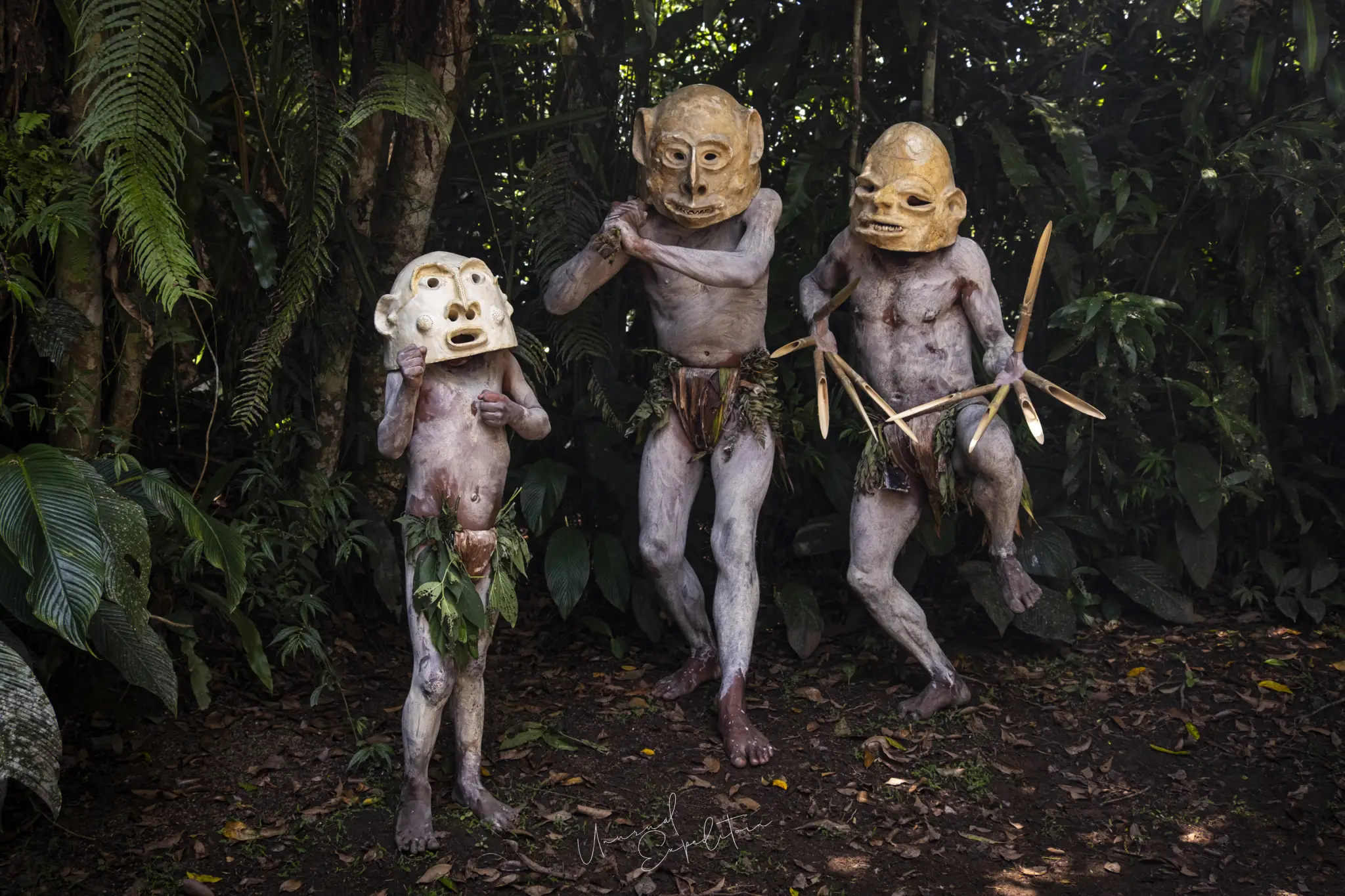
The Asaro mudmen are men from the Asaro Valley near Goroka in the Eastern Highlands of Papua New Guinea who cover their bodies in grey clay and wear heavy, grotesque mud masks, often with long bamboo fingers, to re-enact the legend of warriors taken for ghosts. Asaro mudmen photos are some of the strangest and most striking portraits in the Pacific. Below are our own frames, the history of the masks and how we photograph the mudmen, as part of our Papua New Guinea Highlands guide.
Asaro mudmen of Papua New Guinea: who they are
The Asaro Valley lies just west of Goroka, the capital of Eastern Highlands Province. The mudmen tradition is associated with the village of Komunive and neighbouring communities in the valley, and the men who perform it today are farmers who keep the masks and the story alive for sing-sings, the Goroka Show and visitors. Wikipedia's article on the mudmen and academic studies of the tradition both note how widely it has spread: the mudmen are now an emblem of the Eastern Highlands and of Papua New Guinea tourism.
Asaro mudmen history: the legend
There are as many versions of the Asaro mudmen story as there are tellers. In the most common one, Asaro warriors were defeated by a neighbouring clan and fled into the Asaro River. When they climbed out at dusk, covered in grey mud, their enemies took them for the spirits of the dead and ran. Since then, the story goes, the Asaro have used mud and masks to frighten their enemies. In another version, the men met a spirit at the river who gave them power. Whatever the origin, the modern performance took its form in the 1950s, when the mudmen appeared at the early Eastern Highlands agricultural shows in Goroka and became famous through the visitors who photographed them there.
Asaro mudmen mask: how it is made
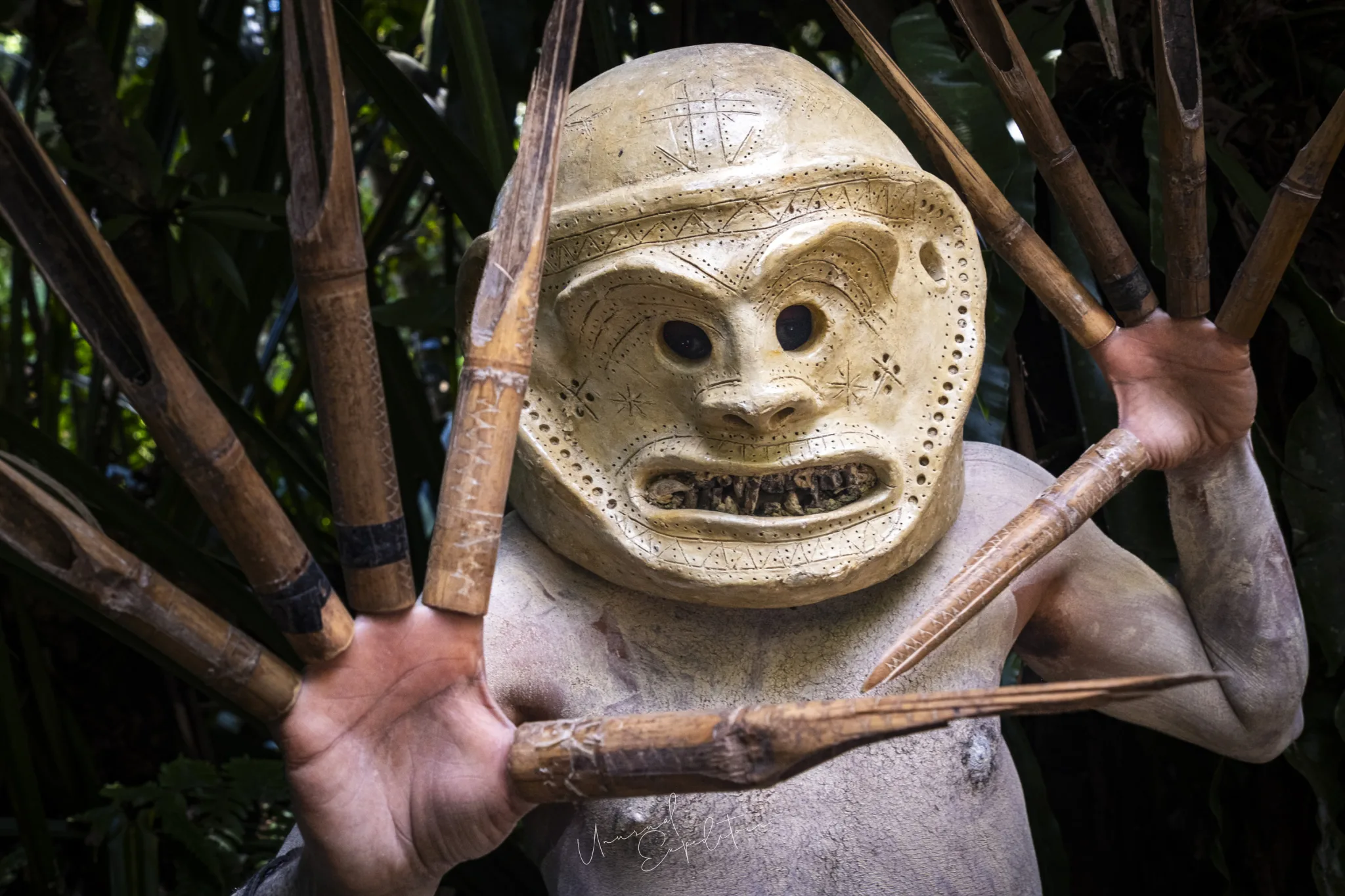
The Asaro mudmen mask is made from clay, or sometimes river mud mixed with water and shaped over a frame, then dried and smoothed. The Australian Museum, which collected masks directly from makers in the valley, describes them as heavy and fragile, with long ears, deep mouths and exaggerated brows, each with its own expression. The body is coated in grey clay that dries pale. Long fingers made of bamboo, slipped over the real fingers, complete the figure and give the mudmen their slow, menacing gestures.
The masks are works of art in their own right and are worth photographing close, against shade, with the texture of the clay lit from one side.
Asaro mudmen dance
The mudmen do not dance in the lively way of other Highlands groups. They move slowly and silently in a line, crouching, pointing their bamboo fingers, freezing and then moving again, like ghosts emerging from the forest. That stillness makes them easy to photograph, but it also means the picture depends on setting and light rather than action. A group of three or four coming out of the dark trees toward you is the classic frame.
"With the mudmen the forest is half the picture. Put them in open grass and they look like men in masks. Bring them out of the dark trees, slowly, and they become what the legend says they are."
Joseph Mak, tour leader, Unusual Expedition
Asaro mudmen photos: how we photograph them
For our Asaro mudmen photos we work with a group in their own forest rather than on a showground. The best results came from a few simple choices:
- Dark backgrounds. The pale clay stands out against the shadows under the trees, so we set up at the forest edge with the light coming from the open side.
- Low angles. Shooting from below with a 16-35mm makes the masks loom and the bamboo fingers reach into the frame.
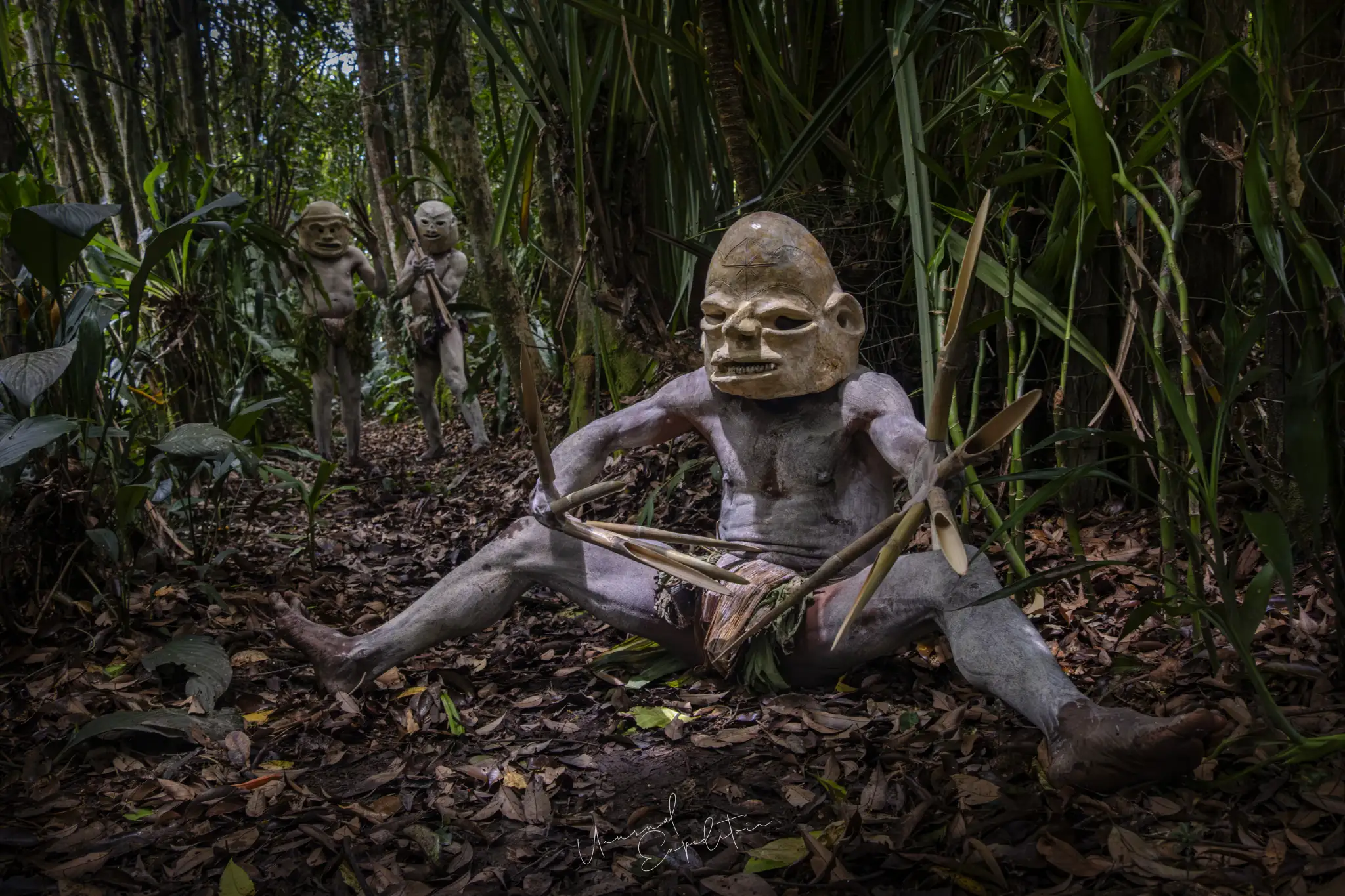
- Single figures and groups. A lone mudman sitting in the leaf litter is as strong as a line of four, and both tell the story differently.
- Close details. The cracked clay, the eye holes and the bamboo fingers make strong frames with a 70-200mm.
Asaro mudmen: are they friendly?
Yes. The masks are designed to frighten, but the men inside them are welcoming, curious and often funny once the masks come off. The mudmen performance is a source of income and pride for the community, and the men are used to photographers. As everywhere in the Highlands, the session should be arranged with the village through a guide, with the fee agreed in advance. Ask before photographing men without their masks or children watching from the side.
Mudmen Papua New Guinea: other mud and mask traditions
The Asaro are the best known mudmen in Papua New Guinea, but other Highlands groups use clay and masks in their own ways, and at the Goroka Show you may see several mudmen groups side by side. On our trips we combine the Asaro with the Huli of Hela and the Chimbu skeleton dancers: see Huli wigmen photos and skeleton tribe Papua New Guinea.
| Group | Look | Best setting |
|---|---|---|
| Asaro mudmen | Grey clay, mud masks, bamboo fingers | Dark forest edge, low angle |
| Huli wigmen | Feathered wigs, yellow and red face paint | Banana groves, forest streams |
| Chimbu skeleton dancers | Black body paint with white bones | Bamboo groves, bare ground |
The three look nothing alike, which is why we try to photograph all three on the same trip.
Exposure for grey clay
Grey clay against a dark forest fools a camera meter into overexposing, which turns the masks chalky and flat. Dial in about a stop of negative compensation, check the histogram, and keep some detail in the clay texture. In open shade the clay looks cool and pale; with a little side light it turns warm and shows every crack.
When to see the Asaro mudmen
The mudmen perform year round for arranged visits, and they appear at the Goroka Show each September. The drier months from about May to October are the easiest time in the Highlands; see best time to visit Papua New Guinea.
Photograph the Asaro mudmen with us
A mudmen session is part of our private Papua New Guinea photography trips. See planned departures on the Papua New Guinea photography tours page.
Papua New Guinea Highlands photography tours
The next Papua New Guinea Highlands departure is announced on the Papua New Guinea Highlands photography tours page, with previous expeditions and all the planning guides.
Explore Papua New Guinea Highlands in depth
- Papua New Guinea Highlands Photography Guide: Tribes, Markets and BirdsPapua New Guinea
- Birds of Paradise Papua New Guinea: A Photographer's GuidePapua New Guinea
- Skeleton Tribe Papua New Guinea: Photographing the Chimbu Skeleton DancersPapua New Guinea
- Huli Wigmen Photos: Photographing the Huli of Papua New GuineaPapua New Guinea
Upcoming Photo Tours
- Egypt Photo Tour – EgyptEgypt 12 Dec 2026 To 20 Dec 2026
- Inner Mongolia Winter Owl Photo Tour – ChinaChina 01 Jan 2027 To 04 Jan 2027
- Inner Mongolia Winter Photo Tour – ChinaChina 05 Jan 2027 To 11 Jan 2027
- Mekong And Central Highland Vietnam Photo Tour - VietnamVietnam 16 Jan 2027 To 24 Jan 2027