
Skeleton Tribe Papua New Guinea: Photographing the Chimbu Skeleton Dancers
Skeleton tribe Papua New Guinea: who the Chimbu skeleton dancers are, the paint and the dance, and how we photograph them.
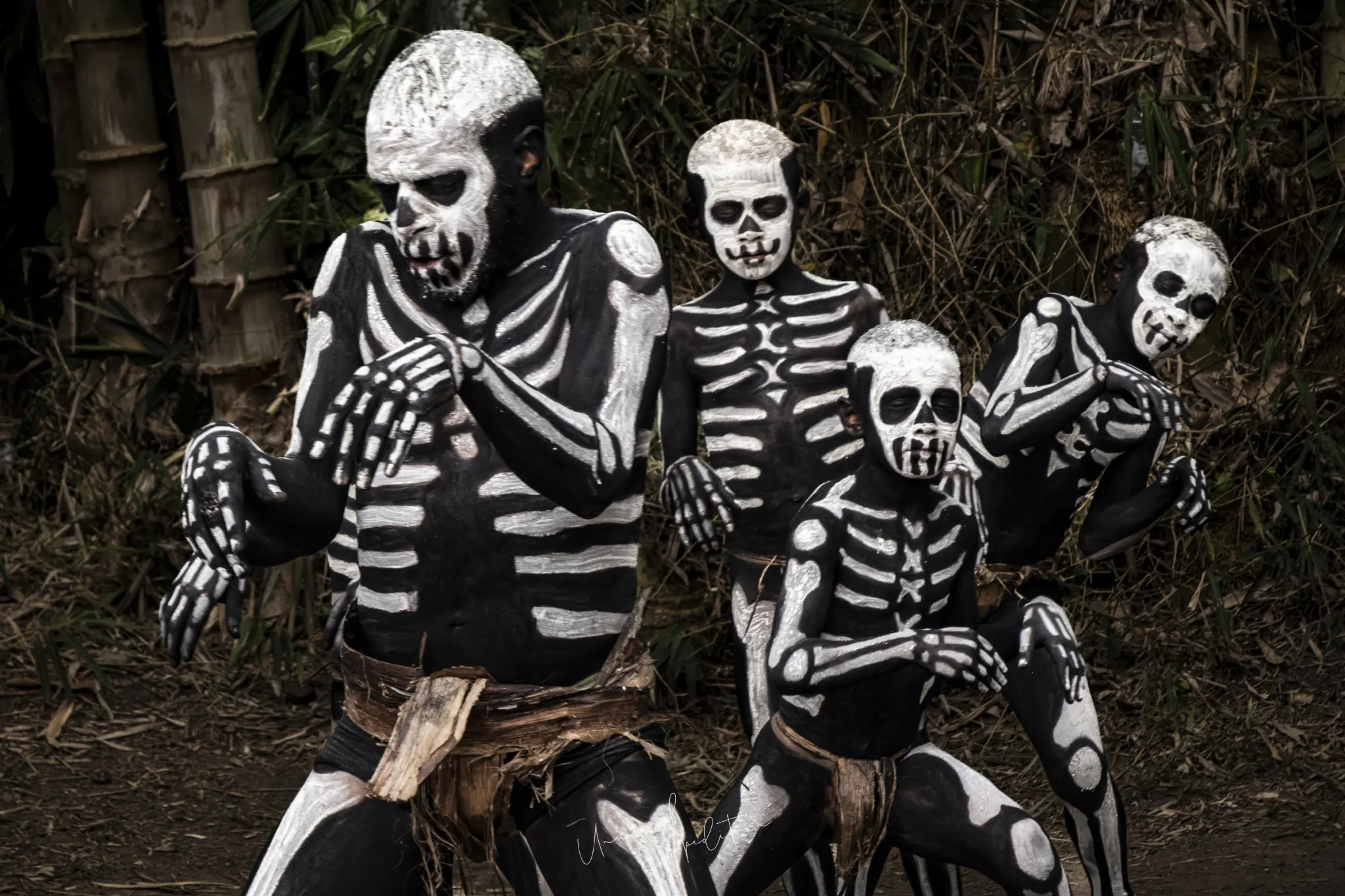
The skeleton tribe of Papua New Guinea is the name visitors give to the Chimbu skeleton dancers, young men from Simbu Province in the central Highlands who paint their bodies black and draw white bones over them, then dance in a crouching, stalking style meant to look like the dead come back to life. They are among the most graphic subjects a photographer can find. Here are our frames, what is known about the dance and how we photograph it, as part of our Papua New Guinea Highlands guide.
Skeleton tribe Papua New Guinea: who are the Chimbu?
Chimbu, or Simbu, is both a people and a province in the central Highlands, between the Western and Eastern Highlands, with Kundiawa as its capital and Mount Wilhelm, the country's highest mountain, on its northern edge. It is one of the most densely populated parts of rural Papua New Guinea, a land of steep valleys and terraced gardens. The skeleton dance is one of several ceremonial traditions of the Chimbu, and like the Asaro mudmen it became widely known through the Highlands shows.
Written history of the dance is thin, and accounts differ. Most say the black and white paint is meant to show the spirits of the dead, and that the dance was used to frighten enemies. We would rather say less than invent, so we photograph it as what it is today: a performance with deep roots in the community that keeps it.
Chimbu skeleton dancers: the paint
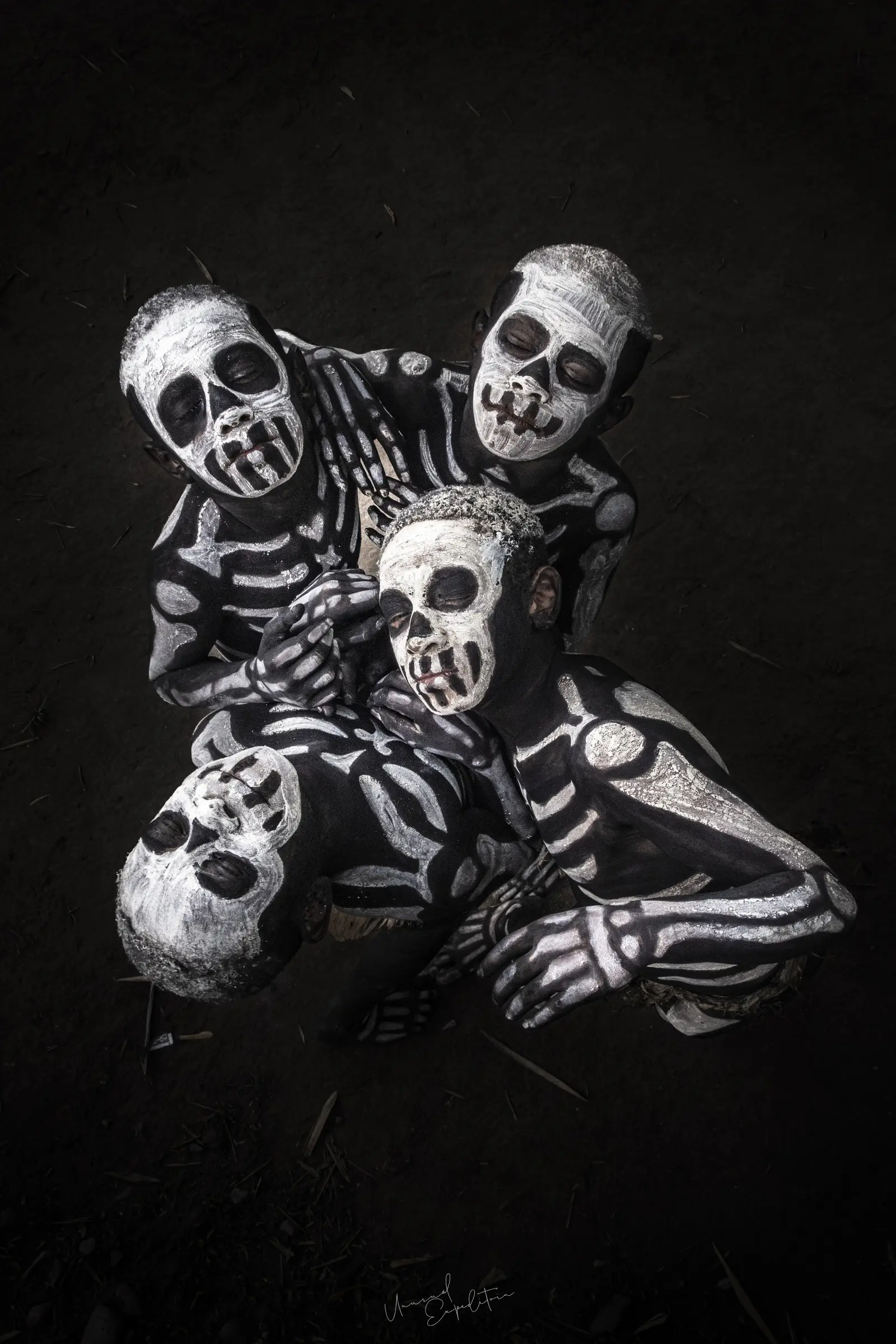
The paint is applied all over the body, face included: a base of black, then the bones drawn in white with fingers and sticks, from the skull and jaw down through ribs, spine, arms, legs and the fine bones of the hands and feet. Done well, it reads as a skeleton from across a field. Close up, every dancer's version is slightly different, and the hand-drawn lines are worth photographing in detail.
Chimbu skeleton dance: what it looks like
The Chimbu skeleton dance is low and angular. The dancers crouch, spread their fingers and creep forward together, jerk their heads, freeze, then lunge. A group of four or five moving in step looks less like dancers than like a single creature. It is fast enough to need a quick shutter, but the pauses between movements are where the best frames come.
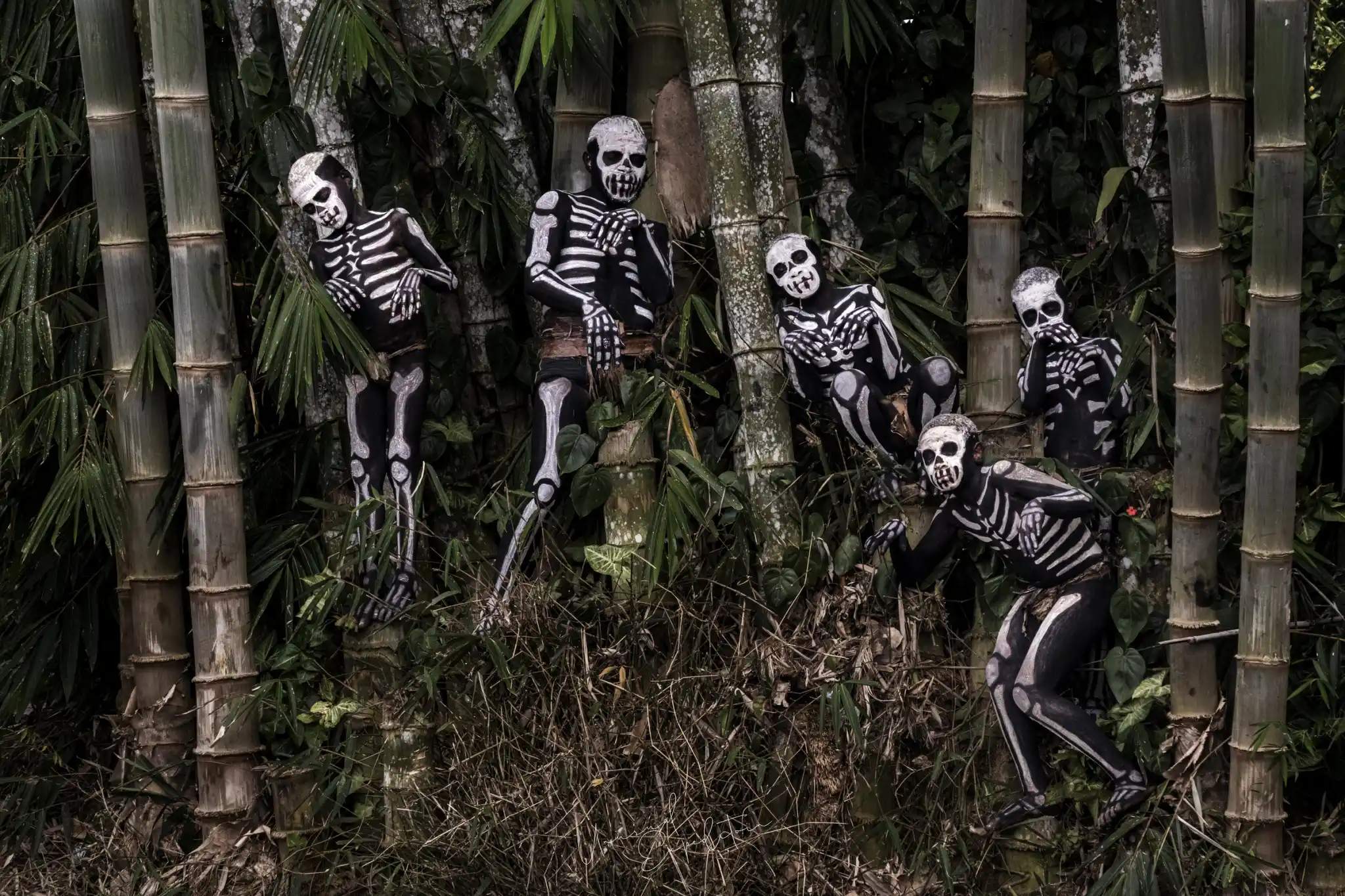
"The skeletons were the session I worried about most, because black paint in a dark forest is a hard exposure. Then they came out of the bamboo in a line, the white bones caught the light, and the picture was simply there."
Joseph Mak, tour leader, Unusual Expedition
Skeleton people Papua New Guinea: how we photograph them
For our skeleton people Papua New Guinea frames we worked with a group in a bamboo grove and on the bare earth of a village ground. What worked:
- Bamboo and darkness. Tall bamboo stems give vertical lines that echo the painted bones, and the dark grove makes the white stand out.
- Bare ground for action. On open earth the dancers can lunge toward the camera; shoot low with a 16-35mm for drama.
- Black and white. The subject is already monochrome; many of our favourite frames are converted to black and white.
- Exposure for the white. Meter for the painted bones, not the black skin, or the white lines blow out and lose their shape.
Chimbu skeleton men and the Highlands shows
Skeleton dancers are a regular sight at the Goroka Show each September and the Mount Hagen Show in August, both listed by the PNG Tourism Promotion Authority. At the shows they perform among dozens of other groups and hundreds of spectators. For photography we prefer an arranged village session, where the group performs for a small number of photographers in a setting they choose, without a crowd in the background.
Chimbu skeleton tribe: respect and fees
Skeleton dancers are performers who prepare for hours, and a session is arranged with the community through a local guide, with the fee agreed beforehand. Ask before photographing the painting process, and before photographing anyone who is not part of the performance, especially children who gather to watch. Thank the dancers properly at the end; many enjoy seeing their pictures on the back of the camera.
Camera settings for skeleton dancers
| Situation | Lens | Settings note |
|---|---|---|
| Group in bamboo grove | 24-70mm | Spot meter on the white paint, raise ISO rather than slow the shutter |
| Lunging toward camera | 16-35mm | Fast shutter, continuous focus, shoot low |
| Single dancer portrait | 70-200mm | Dark background, focus on the painted eyes |
| Detail of the paint | 70-200mm | Raking side light shows the texture |
The paint is easiest to read in soft light, so an overcast morning is better than sun.
Simbu Province: what else to photograph
Simbu is one of the most dramatic landscapes in the Highlands, with steep valleys and gardens laid out on slopes that look impossible to farm. Mornings often begin with cloud sitting in the valleys below the road, and the light on the terraced gardens and scattered homesteads is worth an early start. Markets in the small towns along the Highlands Highway are busy and friendly, with vendors selling vegetables, coffee and betel nut, and they make a good stop between sessions with the dancers.
Mount Wilhelm, the highest peak in Papua New Guinea, rises on the northern edge of the province and is climbed by trekkers, but it is a separate expedition from a photography trip and not something we combine with the dancers.
Combine with other Highlands groups
The Chimbu skeleton dancers work beautifully alongside the Asaro mudmen, whose grey clay is their mirror image, and the colourful Huli wigmen. When to go is covered in best time to visit Papua New Guinea.
Photograph the skeleton dancers with us
A skeleton dance session is part of our private Papua New Guinea photography trips. Planned departures are on the Papua New Guinea photography tours page; write to us to plan your own.
Papua New Guinea Highlands photography tours
The next Papua New Guinea Highlands departure is announced on the Papua New Guinea Highlands photography tours page, with previous expeditions and all the planning guides.
Explore Papua New Guinea Highlands in depth
- Papua New Guinea Highlands Photography Guide: Tribes, Markets and BirdsPapua New Guinea
- Birds of Paradise Papua New Guinea: A Photographer's GuidePapua New Guinea
- Asaro Mudmen Photos: the Mud Masks of the Eastern HighlandsPapua New Guinea
- Huli Wigmen Photos: Photographing the Huli of Papua New GuineaPapua New Guinea
Upcoming Photo Tours
- Egypt Photo Tour – EgyptEgypt 12 Dec 2026 To 20 Dec 2026
- Inner Mongolia Winter Owl Photo Tour – ChinaChina 01 Jan 2027 To 04 Jan 2027
- Inner Mongolia Winter Photo Tour – ChinaChina 05 Jan 2027 To 11 Jan 2027
- Mekong And Central Highland Vietnam Photo Tour - VietnamVietnam 16 Jan 2027 To 24 Jan 2027