
Banke Bihari Temple, Vrindavan: History, Holi and Photography Rules
Banke Bihari temple Vrindavan for photographers: the temple's history, Holi in the courtyard, the photography rules and where to stand.
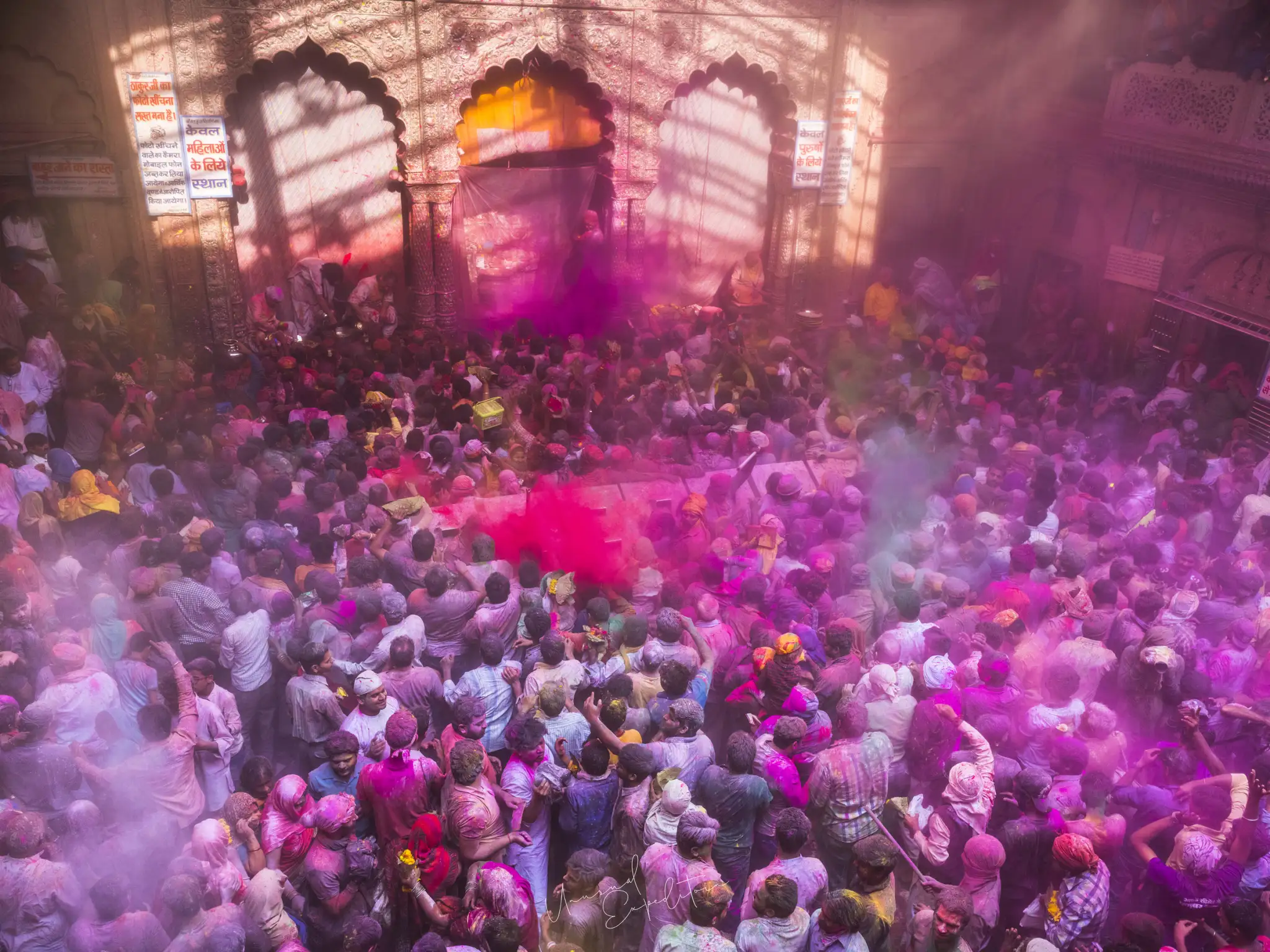
The Banke Bihari temple, Vrindavan, is the most loved Krishna temple in Braj and the heart of the town's Holi. Its courtyard faces three scalloped, silver-faced arches; behind the curtain stands the image of Krishna as Banke Bihari. For photographers it is the place where Holi looks most like the pictures: a packed courtyard, powder thrown into slanting light, thousands of raised hands. Photography of the deity is forbidden, so you photograph the crowd, the arches and the colour, with respect.
The temple is one stop in our Mathura Vrindavan tour guide, which places it among the other temples, ghats and lanes of the two towns.
Banke Bihari temple history
The temple trust's own history tells the story this way. The image of Banke Bihari was granted to Swami Haridas, a musician and saint who lived in Vrindavan when it was still forest, at the grove now called Nidhivan. It was first worshipped in a small temple there, and a new temple befitting the deity was built in 1862, with the Goswamis raising the resources themselves. The worship is still performed by descendants of the Goswami family, in three parts through the day: shringar, the bathing and dressing of the deity, rajbhog, the main offering, and shayan, the evening rest. The building follows the Rajasthani style of its time, with carved stone and the famous arched facade to the courtyard. Older sources sometimes give a slightly later year for the building; we follow the trust.
Banke Bihari temple Holi
Banke Bihari temple Holi is the reason many photographers come to Vrindavan at all. According to the temple trust, full-scale Holi starts in the evening of Aanwla Ekadashi, the eleventh day of the bright half of the month of Phalguna, and is celebrated for more than five days. The trust describes dry, natural colours in silver, gold, red, green, yellow and purple, colour boiled from the orange flowers of the tesu tree, and red gulal as part of the deity's adornment. In the courtyard this becomes a storm of colour: priests and helpers throw powder and coloured water from the steps, the crowd sings with arms raised, and every shaft of sun through the roof turns pink or yellow. The Holi in Mathura and Vrindavan guide places these days in the wider Braj calendar.
The photography rules at Banke Bihari
Read the signs on the wall before you lift a camera. Beside the arches, a sign in Hindi says that photographing Thakur ji, the deity, is strictly forbidden, and warns that cameras and phones used for it can be taken and a fine charged. Other signs mark places for women only and places for men only in front of the sanctum. We follow both without exception: no lens is pointed at the sanctum when the curtain opens, and our women and men stand in their own marked spaces. What you can photograph, and what makes the pictures, is the courtyard, the light, the colour in the air and the faces of the crowd. If a temple volunteer asks you to lower the camera, lower it. Rules can change, so check the signs and the trust's own notices on the day.
Where to stand in the Banke Bihari courtyard
The Banke Bihari courtyard has two working positions. From the floor, among the crowd, you get faces, garlands, raised hands and colour falling on people around you; you will be pushed, painted and soaked, and a wide lens close to people works best. From the upper galleries around the courtyard, where space allows and the temple permits, you look down on the whole scene with the arches behind, and you see how the light falls in diagonal shafts through the haze. Both need patience. The crowd is densest in the hours around the main Holi rites, and in those hours it can become dangerous; Singapore's Ministry of Foreign Affairs asks Singaporeans in India to avoid large gatherings, and this is one of the largest in the country. We go in with a plan, stay together, and leave before the press peaks.
| Position | What you get | Lens | Watch out for |
|---|---|---|---|
| Courtyard floor | Faces, garlands, hands, colour falling close | 16-35mm or 24-70mm | Crowd pressure, water, pickpockets |
| Upper gallery | The whole courtyard, arches and shafts of light | 24-70mm | Limited space, temple permission |
| Lanes outside | Pilgrims arriving, flower and sweet sellers | 24-70mm | Motorbikes in narrow lanes |
Most of the best courtyard frames come from a fixed spot and a long wait.
"At Banke Bihari I stopped trying to move. I found a step, braced my back against a pillar and watched the light. The crowd moves, the colour moves, the shafts of sun move across the arches, and every few minutes they line up. That is the frame."
Joseph Mak, tour leader, Unusual Expedition
The devotees: photograph them with respect
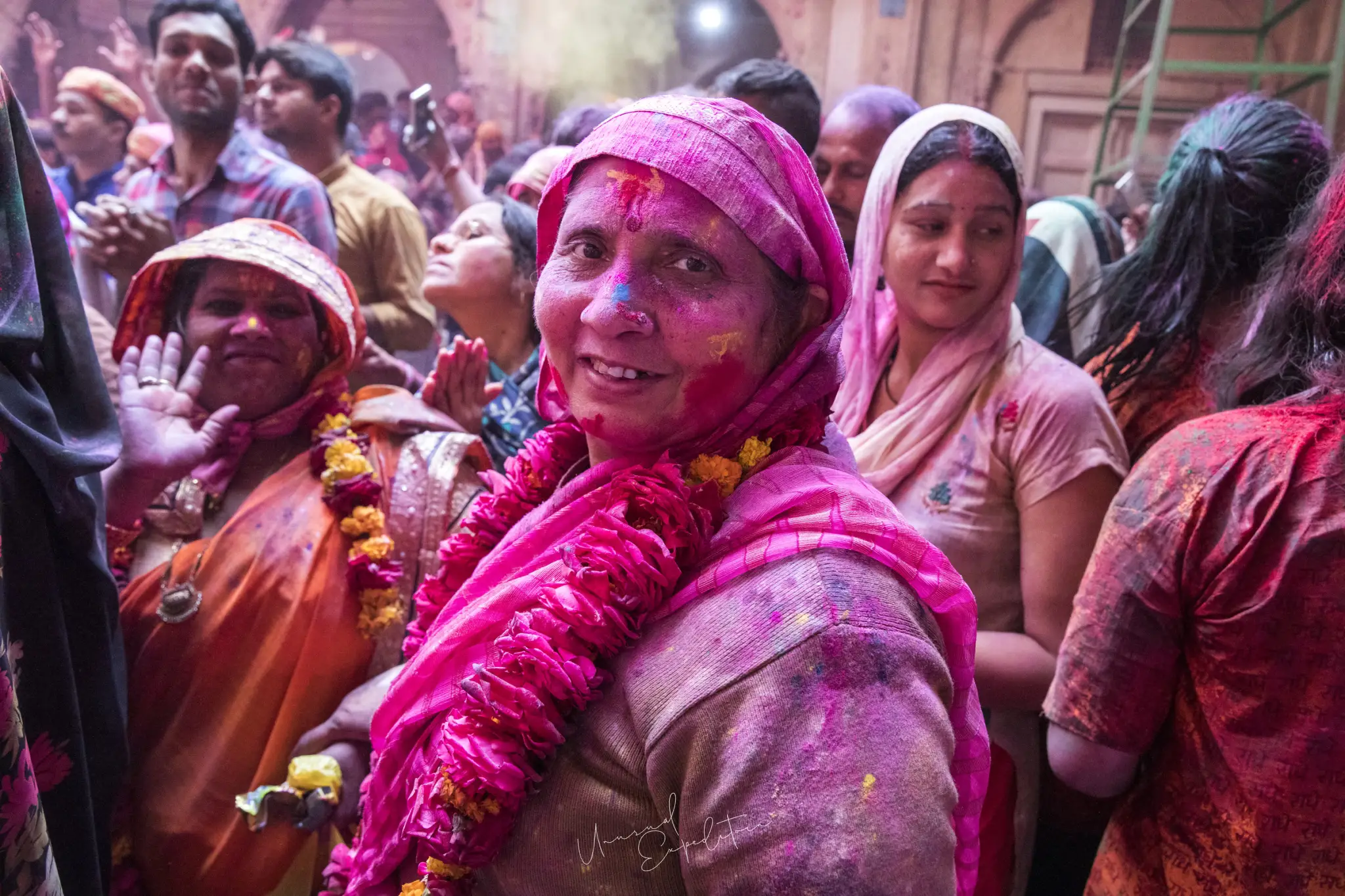
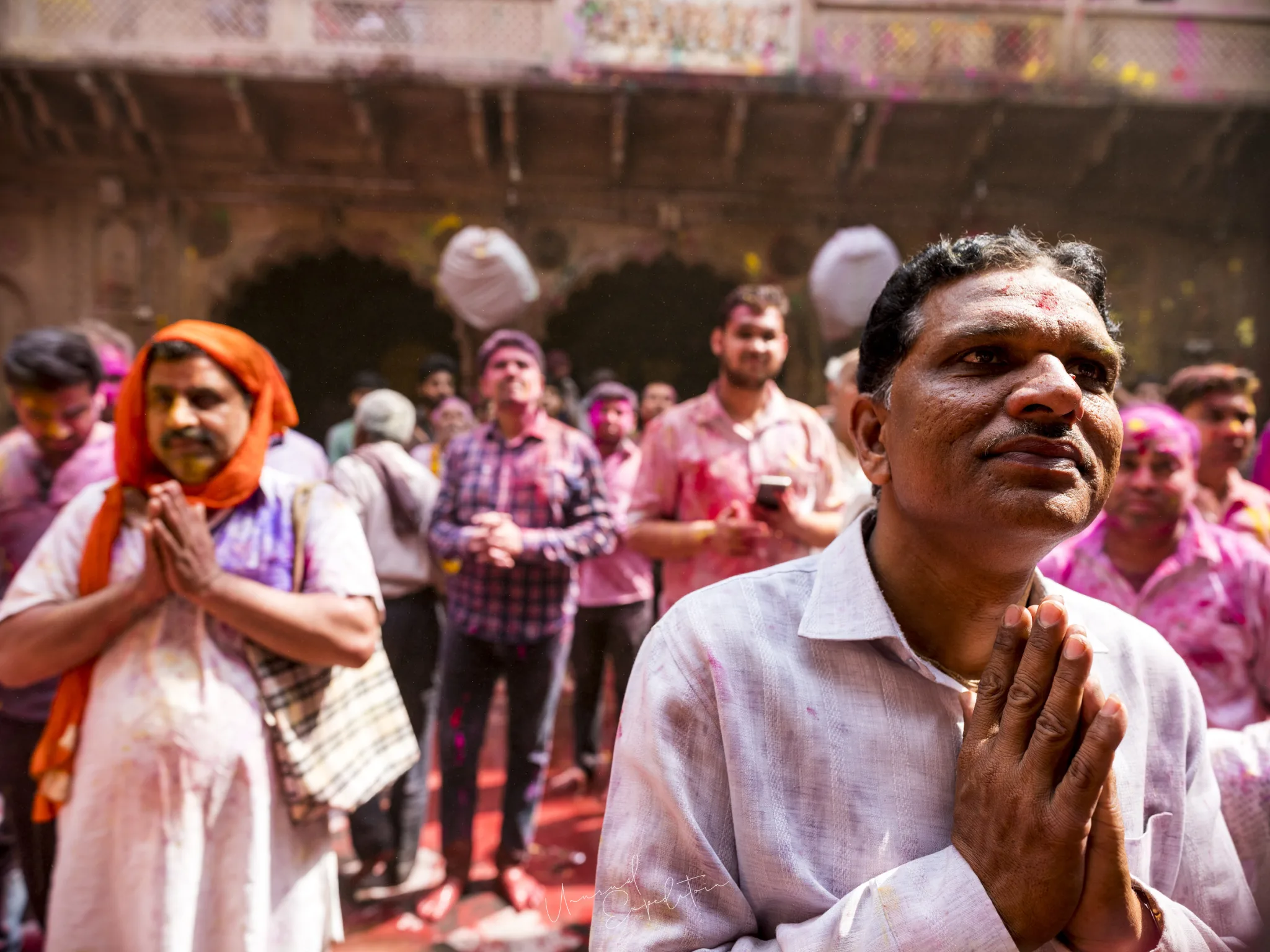
Most people in the Banke Bihari crowd are local families and pilgrims from all over India, many on the most important visit of their year. They are usually happy to be photographed in the festive chaos, and some will pose and laugh; others are in prayer and should be left alone. Never photograph anyone in distress, anyone being pushed in the crowd, or children, and never make a picture that turns a devotee into a joke. Outside the courtyard, in the lanes, people stop to fold their hands as they pass the temple, and those quiet moments make some of the most telling frames.
Banke Bihari temple, Vrindavan, outside Holi
Outside the festival the Banke Bihari temple is calmer but rarely empty. Darshan, the viewing of the deity, takes place in sessions that change with the season, and the trust publishes them; check its current timings, since old lists go out of date. The lanes around the temple are full of flower garland sellers, sweet shops and devotional stalls, good subjects in soft light. For quieter months and the weather through the year, see best time to visit Mathura Vrindavan, and for the other great Holi temple of Braj, the Dwarkadhish temple in Mathura.
Visit Banke Bihari with us
We include Banke Bihari in Holi trips to Braj that we run as private trips on request. We plan the vantage points, the timing and the logistics around you, whether you travel alone, as a couple, as a family or as a group of photographers, and we can add a photographer or photography coaching at extra cost. Ask at least two months ahead for Holi. Scheduled departures, when we announce them, are on our India photography tours page.
Ask us about Banke Bihari at Holi
Mathura and Vrindavan photography tours
The next Mathura and Vrindavan departure is announced on the Mathura and Vrindavan photography tours page, with previous expeditions and all the planning guides.
Explore Mathura and Vrindavan in depth
- Mathura and Vrindavan Photography Tour Guide: Holi, Temples and GhatsIndia
- Mathura Vrindavan Photos: Temples, Lanes, Ghats and HoliIndia
- Holika Dahan: The Bonfire Night Before Holi in Mathura and VrindavanIndia
- Holi Photography Tips: Protect Your Camera and Work the Crowd in BrajIndia
- Holi in Mathura and Vrindavan: The Braj Holi Calendar and Where to BeIndia
- Dwarkadhish Temple, Mathura: Holi Songs, Colour and Where to StandIndia
- Best Time to Visit Mathura Vrindavan: Weather, Holi and Festivals by MonthIndia
Upcoming Photo Tours
- Egypt Photo Tour – EgyptEgypt 12 Dec 2026 To 20 Dec 2026
- Inner Mongolia Winter Owl Photo Tour – ChinaChina 01 Jan 2027 To 04 Jan 2027
- Inner Mongolia Winter Photo Tour – ChinaChina 05 Jan 2027 To 11 Jan 2027
- Mekong And Central Highland Vietnam Photo Tour - VietnamVietnam 16 Jan 2027 To 24 Jan 2027