
Dwarkadhish Temple, Mathura: Holi Songs, Colour and Where to Stand
Dwarkadhish temple Mathura for photographers: history, Holi songs and colour in the painted courtyard, where to stand and timings.
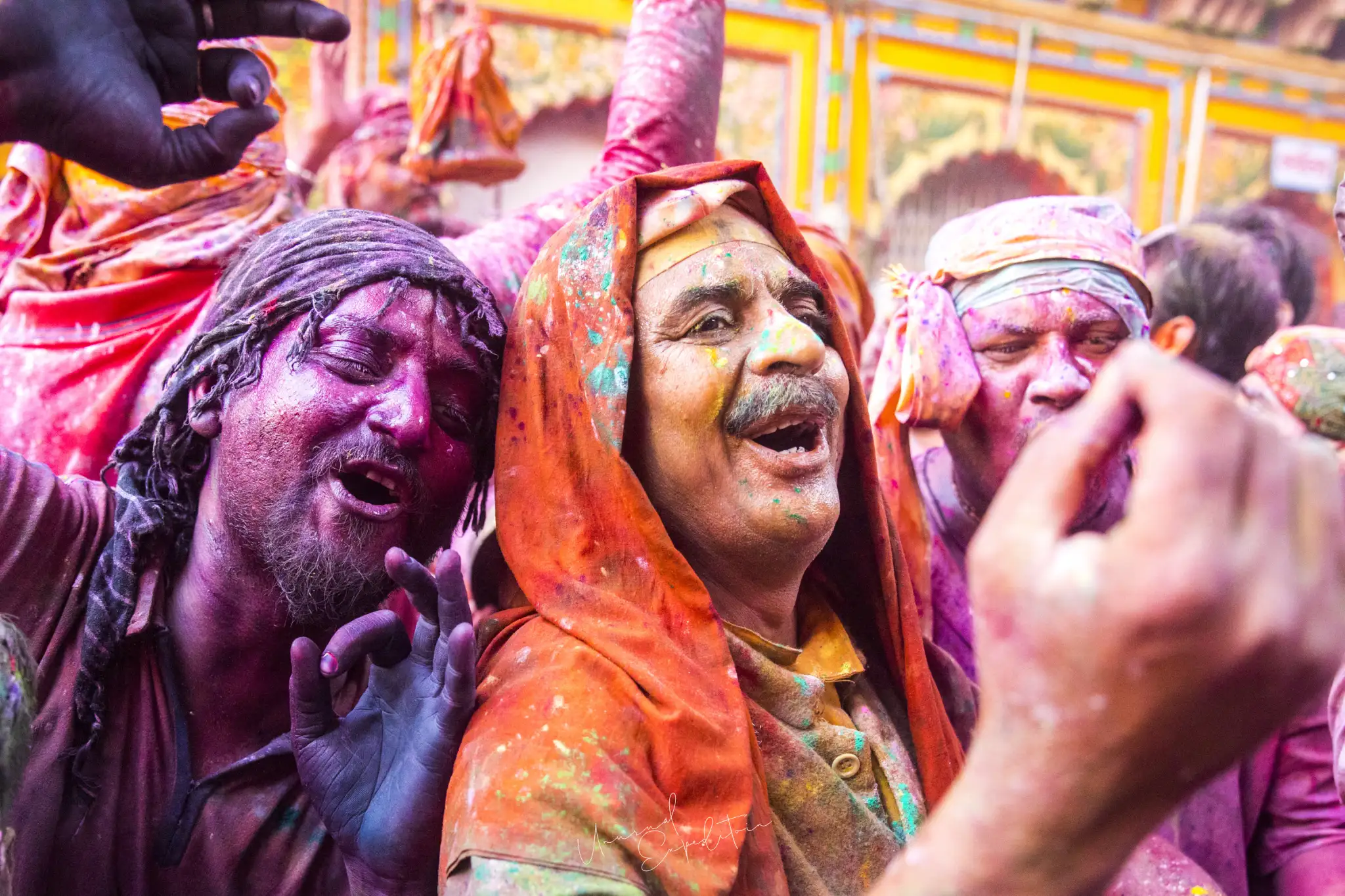
The Dwarkadhish temple, Mathura's great Krishna temple, is at Holi the loudest and most colourful courtyard in the city. It stands near Vishram Ghat on the Yamuna, a painted courtyard ringed by galleries, where singers lead Holi songs, drummers keep time and powder is thrown down from above into the crowd. For photographers it offers what Banke Bihari in Vrindavan cannot: room to see faces, dancing and musicians, and galleries from which to look down on the whole scene.
Our Mathura Vrindavan tour guide introduces the temple alongside the ghats, the lanes and Vrindavan's temples. This page is about the Dwarkadhish courtyard alone.
Dwarkadhish temple Mathura: history and setting
The Dwarkadhish temple in Mathura was built in the early nineteenth century by Seth Gokul Das Parikh, a treasurer of the princely state of Gwalior; India's Ministry of Tourism, on its Incredible India site, gives the date as 1815, and other sources a year earlier. Its name means the lord of Dwarka, the kingdom Krishna is said to have ruled after leaving Braj, and it belongs to the Pushtimarg tradition of devotion founded by Vallabhacharya. You recognise it from inside by the inscription over the sanctum, Shri Dwarkesho Jayati, victory to the lord of Dwarka, and by the painted pillars and arcades in yellow, red and green. The temple stands among the bazaars a short walk above the Yamuna, close to Vishram Ghat, which Incredible India names the most significant of Mathura's twenty-five ghats.
Holi in the Dwarkadhish courtyard
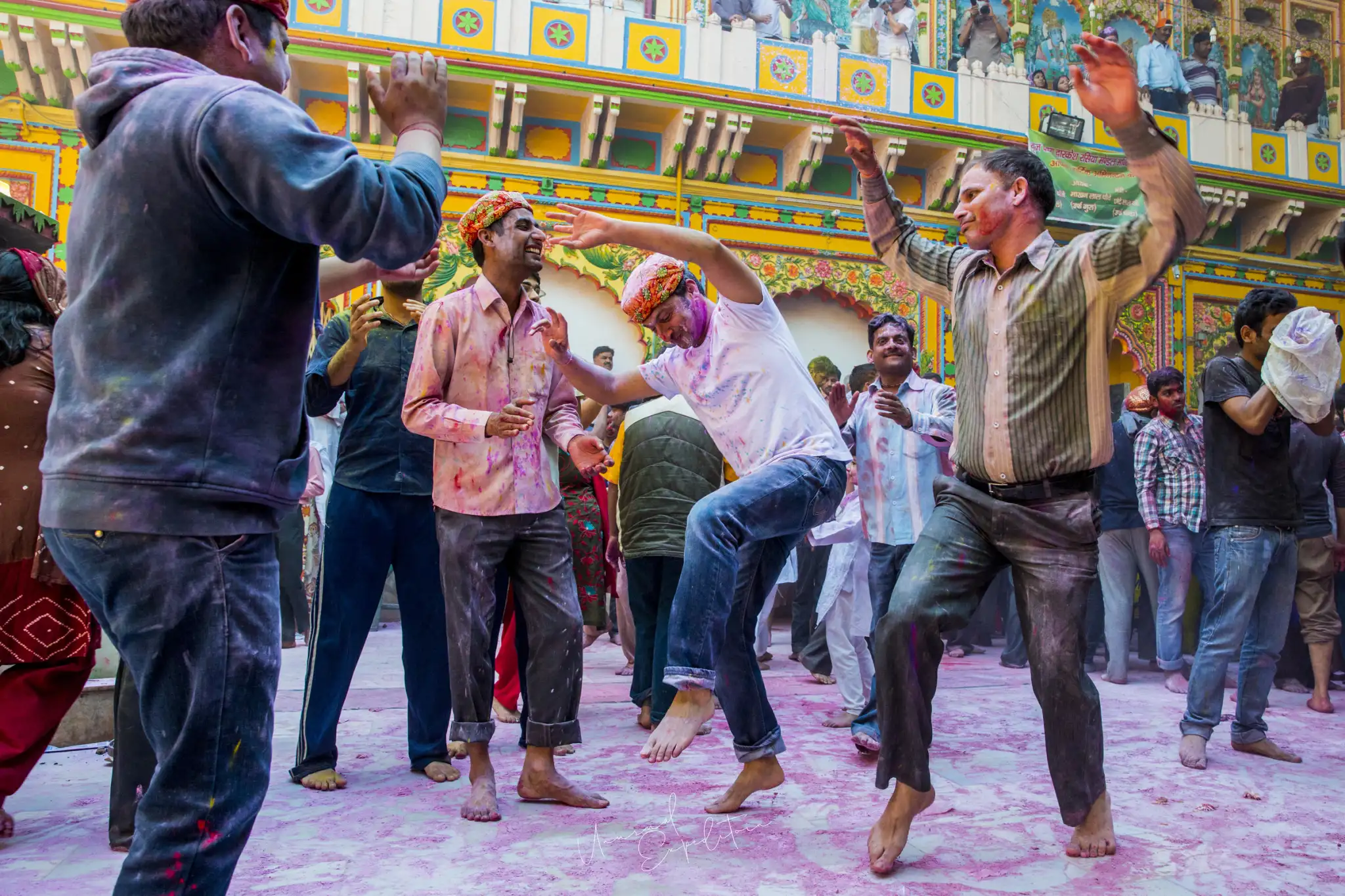
Holi in the Dwarkadhish courtyard is music first. In the days before the full moon, singers in garlands and turbans stand at the front with cymbals and drums and lead the traditional Holi songs of Braj, and the crowd sings back. Men dance in the open floor of the courtyard, women gather in their own groups and dance with each other, and colour drifts over all of them, thrown in handfuls from the floor and in great clouds from the galleries. On the busiest days the courtyard is packed wall to wall; on others there is space to move and work. The Holi in Mathura and Vrindavan guide explains how these temple days fit the lunar calendar.
Dwarkadhish temple Mathura photos: where to stand
Good Dwarkadhish temple Mathura photos come from three places, and each needs a different lens.
| Position | Subject | Lens | Notes |
|---|---|---|---|
| Upper gallery | The whole courtyard, colour clouds, the crowd from above | 16-35mm or 24-70mm | Arrive early, space is limited and shared |
| Front of the courtyard | Singers, drummers, garlands, faces | 24-70mm | Stay to the side, never block the view of the sanctum |
| Open floor | Dancers, women's groups, colour thrown close | 16-35mm | You will be painted; keep the camera covered |
The gallery gives you the big picture once; the floor gives you a dozen pictures an hour.
"In the Dwarkadhish courtyard I like to stand close to the singers. They sing with their eyes closed and their hands in the air, half lost in it, and the colour lands on them without anyone noticing. That is the Holi of Braj for me, devotion first and the colour second."
Joseph Mak, tour leader, Unusual Expedition
The singers and the crowd
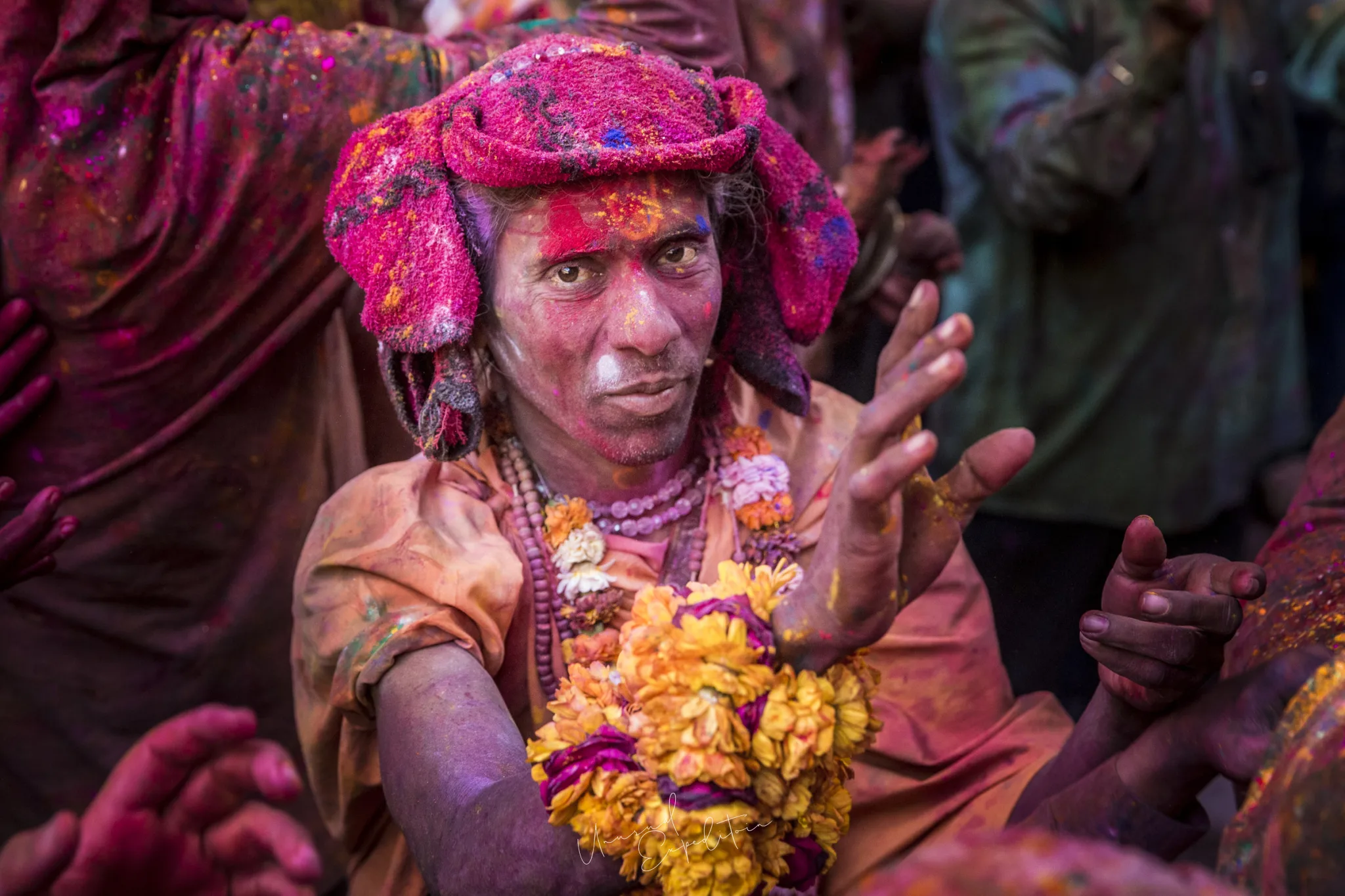
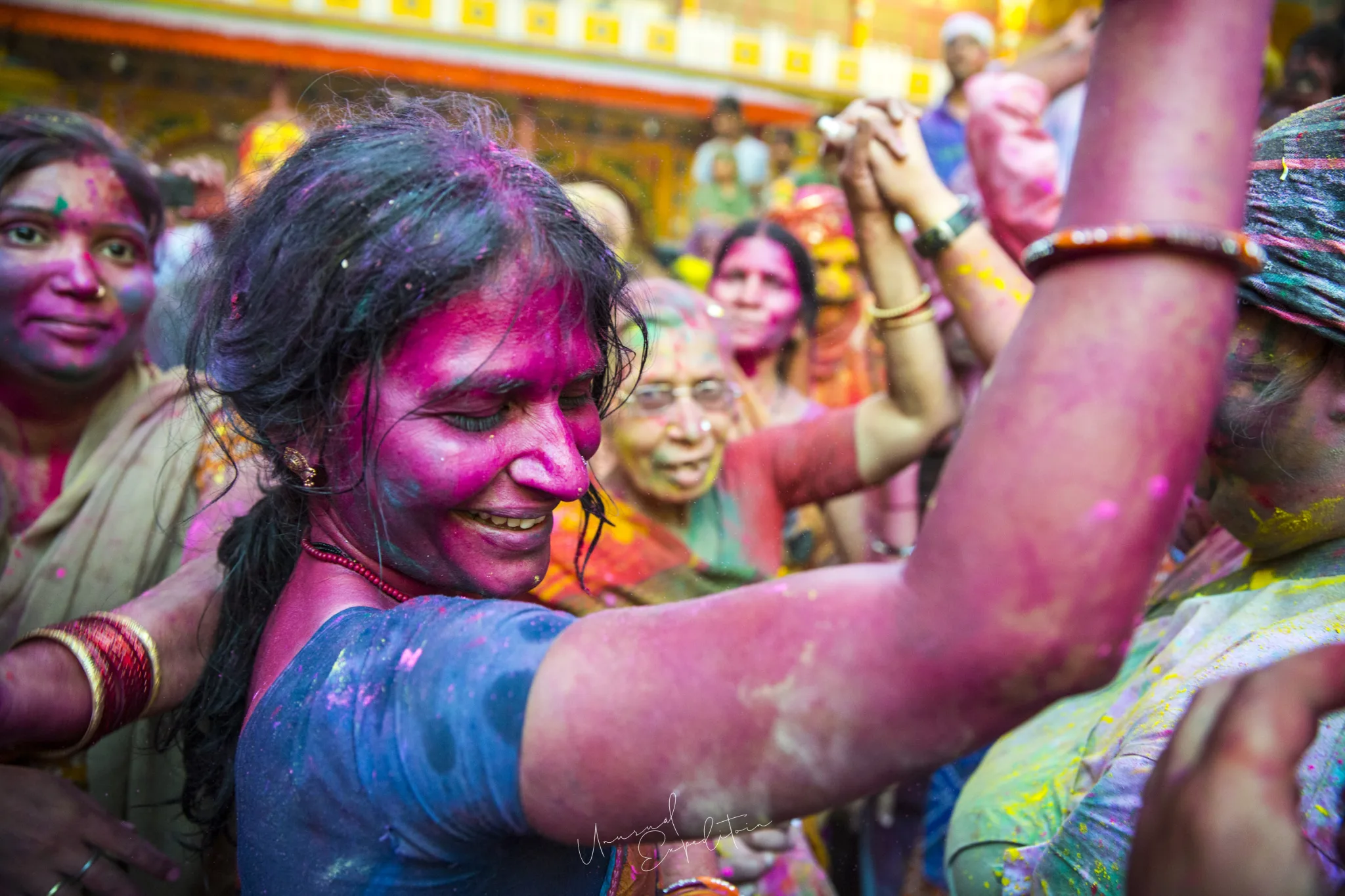
The people of the Dwarkadhish courtyard are the subject. The singers at the front are often older men, garlanded and turbaned, deep in the songs. Around them, local men dance in loose circles, devotees in headcloths and marigold garlands clap with their faces turned up to the colour, and women dance together in their own corner, laughing and painted pink and blue. Ask before you move in close, keep your distance from anyone at prayer before the sanctum, and photograph women's groups only when they are clearly happy to be photographed. Children are part of every Holi crowd; leave them out of your frames.
Dwarkadhish mathura temple timings
People often search for Dwarkadhish Mathura temple timings, and the answer is that they change. Like other temples of the Pushtimarg tradition, Dwarkadhish traditionally opens for darshan in several short sessions through the day, with the deity dressed and offered food between them, and the schedule shifts with the seasons and on festival days. During Holi the temple keeps its own programme of songs and colour play. Check the current sessions at the temple or with a local contact on arrival, and plan to arrive well before a session starts if you want a place in the gallery. Shoes are left outside.
Working from the Dwarkadhish galleries
The galleries around the Dwarkadhish courtyard are where the big Holi pictures are made, and they reward preparation. Space along the railings is shared with local families, other photographers and the people who throw colour, so arrive early, take a small place and keep it. From above you see the pattern of the festival: the crowd packed towards the sanctum, the singers' circle, the moments when someone lifts a sack and the whole floor turns yellow or violet. Shoot wide when the cloud rises and longer when it settles on faces. Ceiling fans and strings of lights hang across the space, and they belong in the picture; trying to frame around them only loses the cloud. Colour thrown from the gallery drifts back on you, so keep the rain cover on and the lens hood fitted.
Around the Dwarkadhish temple
Step out of the Dwarkadhish temple and you are in Mathura's old bazaar, a tangle of lanes selling sweets, brassware, devotional prints and Holi powder in open sacks. Downhill is the Yamuna and Vishram Ghat, where pilgrims bathe in the early morning and boats wait at the steps. A morning on the ghats, the temple when it opens, and the lanes in between make a full Mathura day for a photographer. For how the lanes look outside the festival, see Mathura Vrindavan photos, and for Vrindavan's great temple, Banke Bihari temple, Vrindavan.
Photograph the Dwarkadhish temple with us
We include the Dwarkadhish temple in the Holi trips to Mathura and Vrindavan that we run as private trips on request, for individuals, couples, families and photographers who want their own pace. We arrange all the logistics around your plans, and a photographer or photography coaching can be added at extra cost. Ask at least two months ahead for the Holi season. Any scheduled departure appears on our India photography tours page.
Ask us about the Dwarkadhish temple at Holi
Mathura and Vrindavan photography tours
The next Mathura and Vrindavan departure is announced on the Mathura and Vrindavan photography tours page, with previous expeditions and all the planning guides.
Explore Mathura and Vrindavan in depth
- Mathura and Vrindavan Photography Tour Guide: Holi, Temples and GhatsIndia
- Mathura Vrindavan Photos: Temples, Lanes, Ghats and HoliIndia
- Holika Dahan: The Bonfire Night Before Holi in Mathura and VrindavanIndia
- Holi Photography Tips: Protect Your Camera and Work the Crowd in BrajIndia
- Holi in Mathura and Vrindavan: The Braj Holi Calendar and Where to BeIndia
- Best Time to Visit Mathura Vrindavan: Weather, Holi and Festivals by MonthIndia
- Banke Bihari Temple, Vrindavan: History, Holi and Photography RulesIndia
Upcoming Photo Tours
- Egypt Photo Tour – EgyptEgypt 12 Dec 2026 To 20 Dec 2026
- Inner Mongolia Winter Owl Photo Tour – ChinaChina 01 Jan 2027 To 04 Jan 2027
- Inner Mongolia Winter Photo Tour – ChinaChina 05 Jan 2027 To 11 Jan 2027
- Mekong And Central Highland Vietnam Photo Tour - VietnamVietnam 16 Jan 2027 To 24 Jan 2027