
Borobudur Photo Spots: Punthuk Setumbu, the Terraces, Prambanan and Plaosan
Borobudur photo spots: Punthuk Setumbu sunrise, the stupa terraces, the temple at night, Prambanan, Plaosan and Ratu Boko, with light.
The Borobudur photo spots worth planning around are the Punthuk Setumbu hill for sunrise over the misty Kedu valley, the stupa terraces at the top of the monument, the floodlit temple from its base after dark, and, across the plain near Yogyakarta, the towers of Prambanan, the Buddhist complex of Plaosan and the hilltop gateway of Ratu Boko. Sunrise belongs to the hills, the terraces to soft early light, Prambanan and Ratu Boko to late afternoon.
This guide is part of our Borobudur and Yogyakarta photography tour guide. The photographs are our own, from our trips to central Java, several of them during the Waisak festival, and the notes on where to stand come from working these places with a camera. Our Borobudur temple photos article shows the monument itself in more detail.
Borobudur photo spots at a glance
| Spot | What you photograph | Best light | Lens |
|---|---|---|---|
| Punthuk Setumbu | Borobudur in the morning mist, volcanoes behind | Before and at sunrise | 70-200mm, 24-70mm |
| Upper terraces of Borobudur | Openwork stupas, Buddha statues, the hills | Early morning, soft evening light | 16-35mm, 24-70mm |
| Borobudur from the base | The stepped monument, floodlit on event nights | Blue hour, night | 24-70mm, tripod |
| Prambanan | Pointed Hindu towers above fallen stones | Late afternoon, sunset | 24-70mm, 70-200mm |
| Plaosan | Twin Buddhist temples among ruins | Late afternoon | 24-70mm |
| Ratu Boko | The hilltop stone gateway | Evening | 24-70mm |
Borobudur is a morning place and Prambanan an evening one, which is why they rarely share a day.
Punthuk Setumbu sunrise
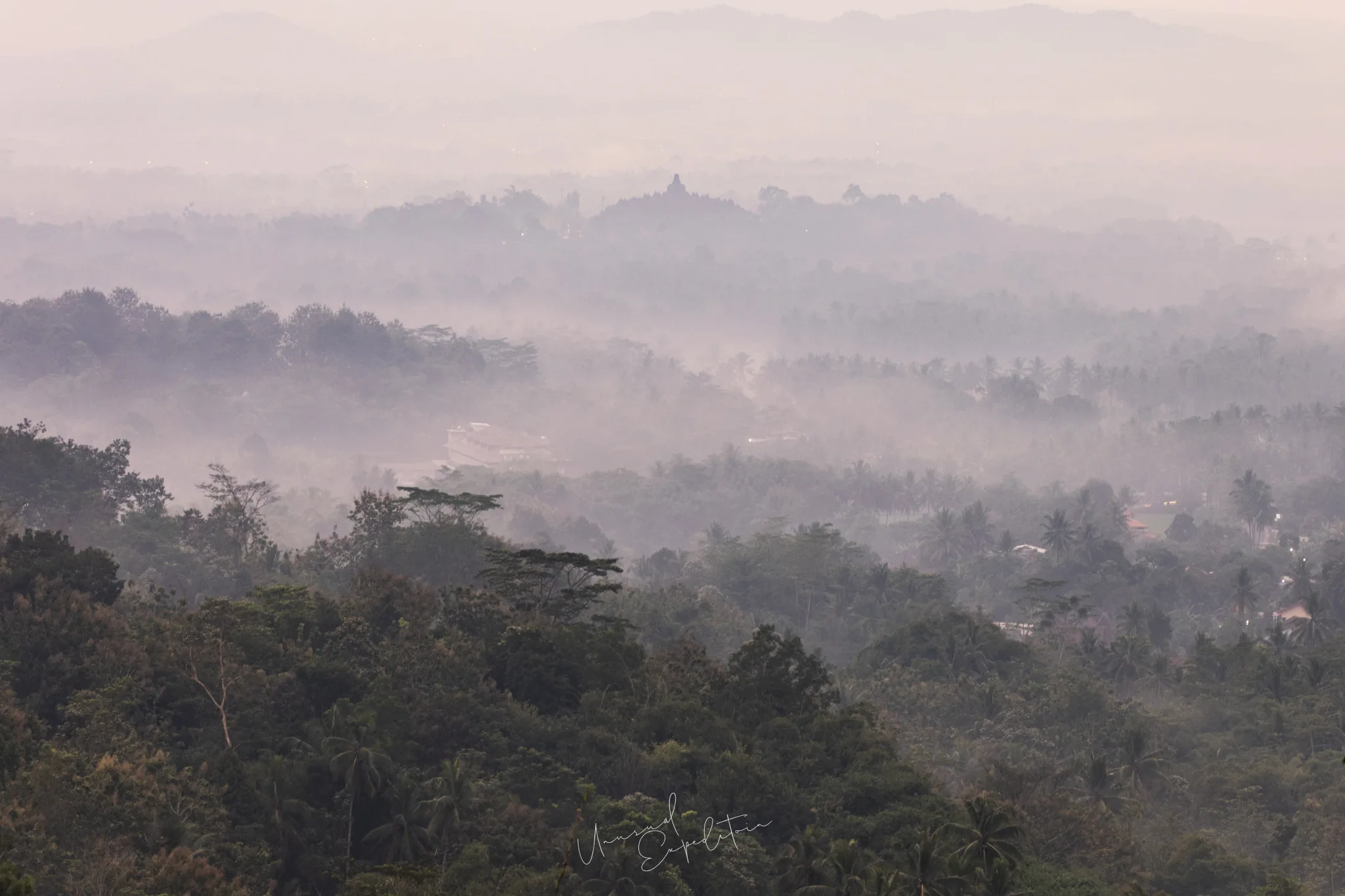
Punthuk Setumbu is a hill in the Menoreh range west of the temple, and the official Central Java tourism site describes its sunrise view: Borobudur rising out of the mist in the Kedu valley, with Merapi and Merbabu on the skyline behind. The temple is small in the frame from here, so a 70-200mm pulls it forward through the layers of mist; a 24-70mm gives the whole valley and the volcanoes. The mist is thickest on still mornings, and the colour comes before the sun clears the volcanoes. Arrive in the dark, because the platform fills well before sunrise. Our Borobudur sunrise guide compares the hill with a sunrise on the monument itself.
The upper terraces: stupas and Buddhas
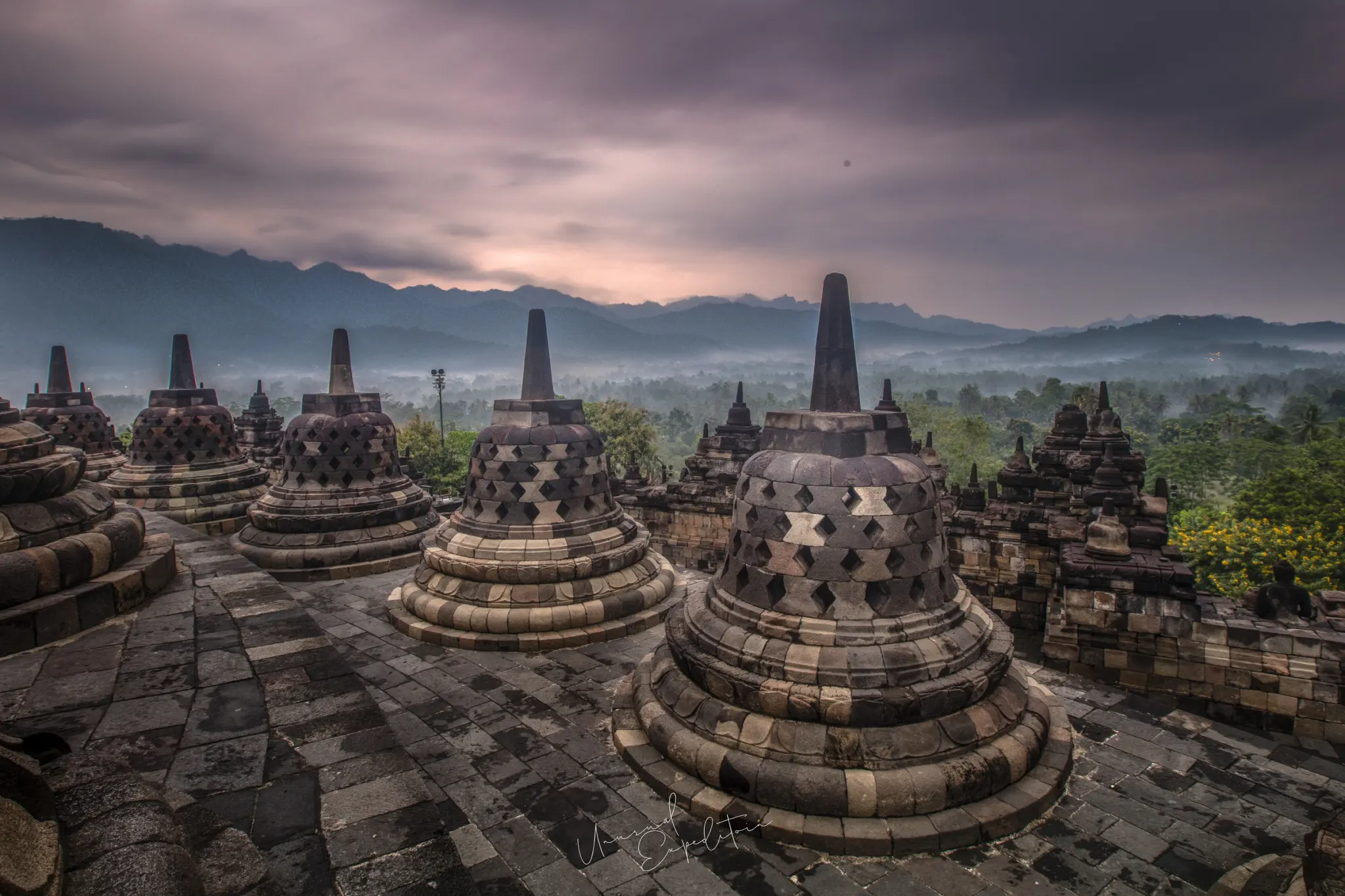
Borobudur, a UNESCO World Heritage site, is a stupa built in three tiers around a hill: five square terraces, three circular platforms and a great stupa at the top, with 72 openwork stupas around the platforms, each holding a statue of the Buddha, according to UNESCO. The upper platforms are the classic Borobudur photo: rows of latticed stupas leading the eye to the volcanoes and the green plain. Use a wide lens low among the stupas, or frame a Buddha through the opening of a stupa. Climbing the structure needs a separate climbing ticket, a guide and the woven sandals the operator issues, booked online through the official site, and a small dawn programme on the upper terrace has been reported in trial; check the official ticket site for what is open.
Borobudur from the base at night
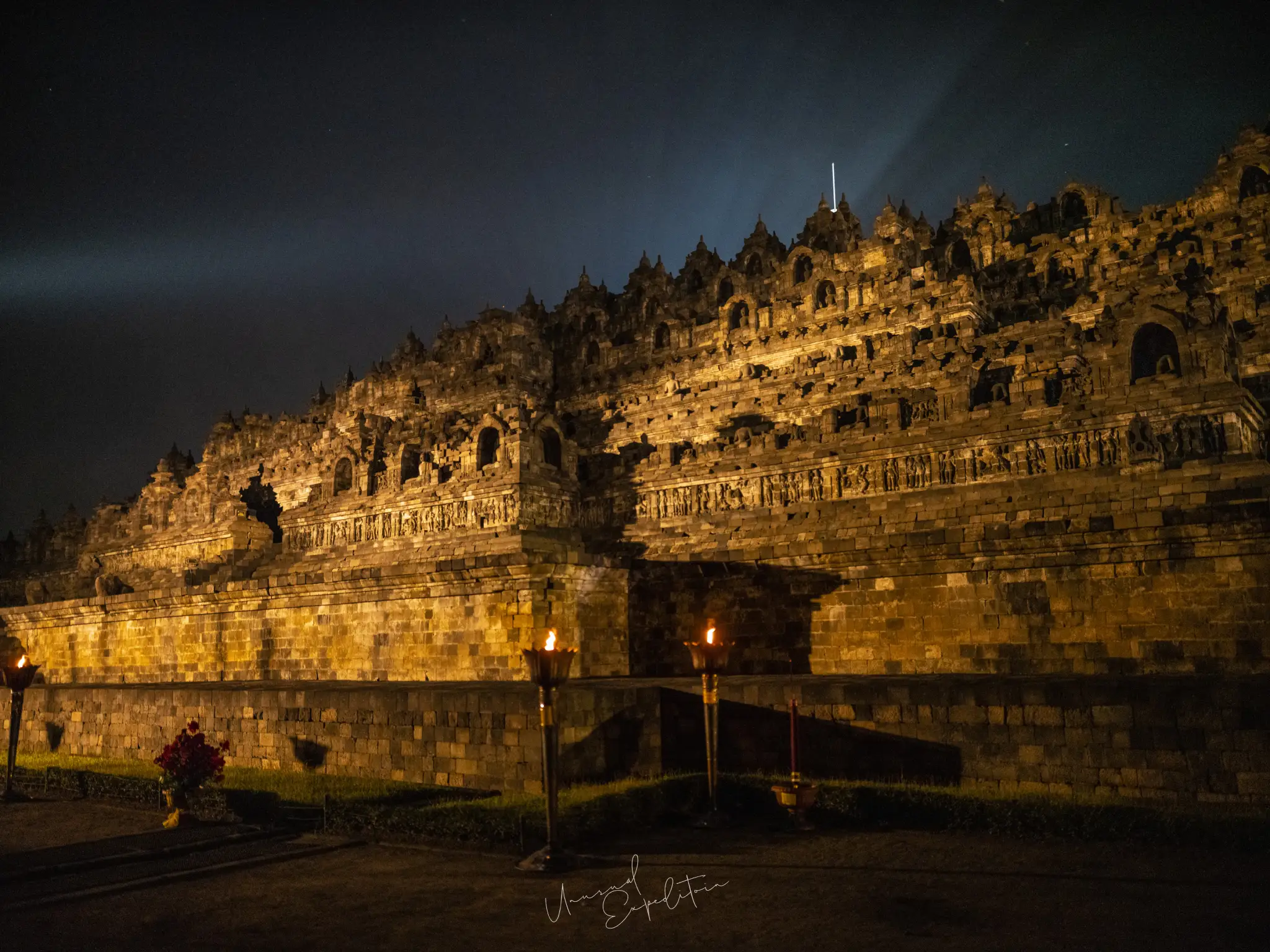
From the paved courtyard at the base, the monument rises in its stepped layers, and on event nights, Waisak above all, it is floodlit and lined with lamps and torches. That is the picture of the whole structure, which you cannot make from the top. A tripod and a 24-70mm handle it; at blue hour the sky still holds some colour behind the stone. On Waisak the area is crowded and the rules are strict: no photographing too close to monks who are praying, no drones, white or modest dress. Our Waisak festival at Borobudur guide explains the ceremony.
Prambanan: towers in the evening
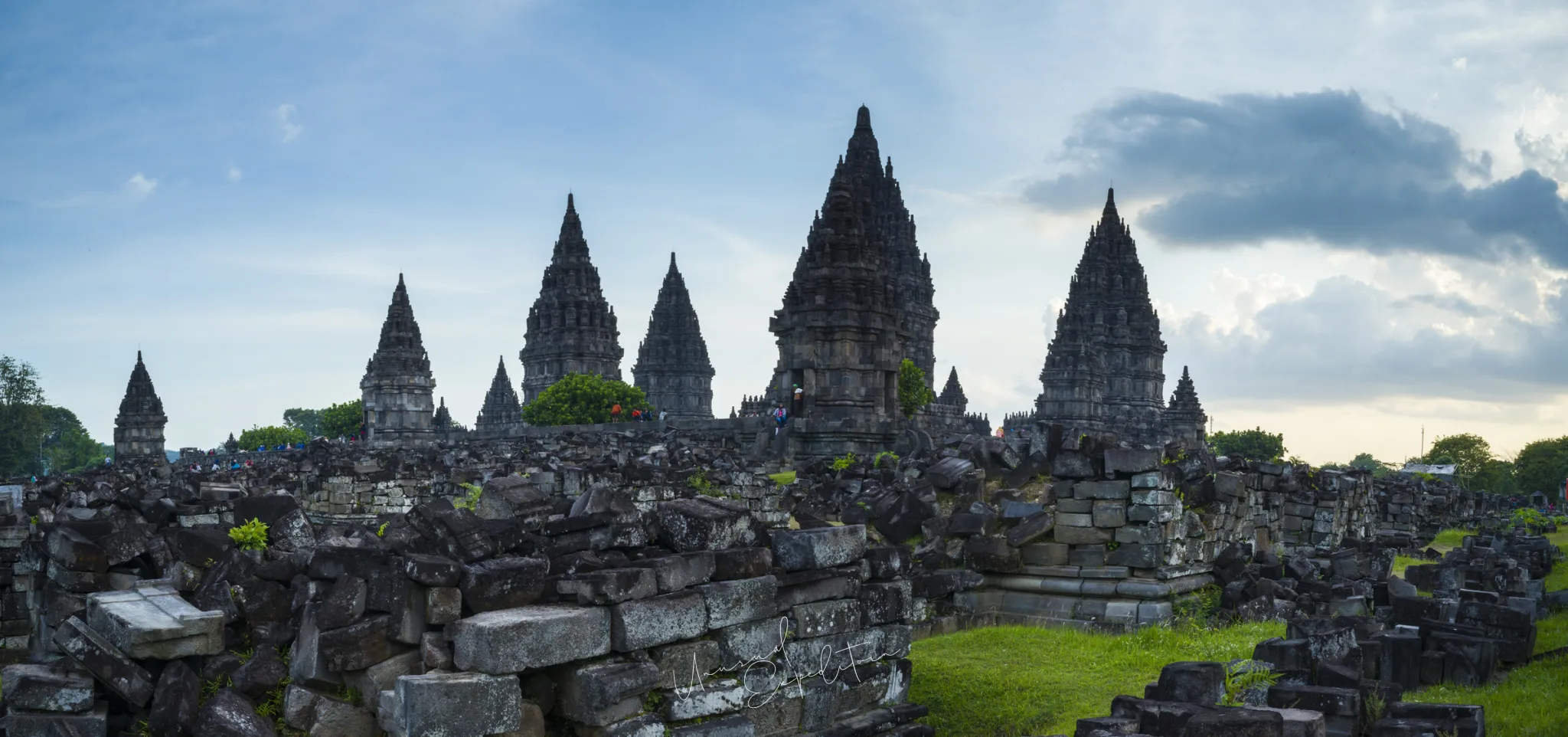
Prambanan, the 9th-century Hindu temple compound dedicated to Siva on the border of Yogyakarta and Central Java, is the other UNESCO site of the plain. Its pointed towers rise above a field of fallen stones left by earthquakes, and the late afternoon is the time, when the sun falls on the west faces and then sets behind the towers. Stand back across the ruins with a 24-70mm, or compress the towers with a 70-200mm. The compound also contains Sewu, Indonesia's largest Buddhist complex. Our Prambanan temple photography guide covers sunset and the floodlit towers.
Plaosan: the quiet twin temples
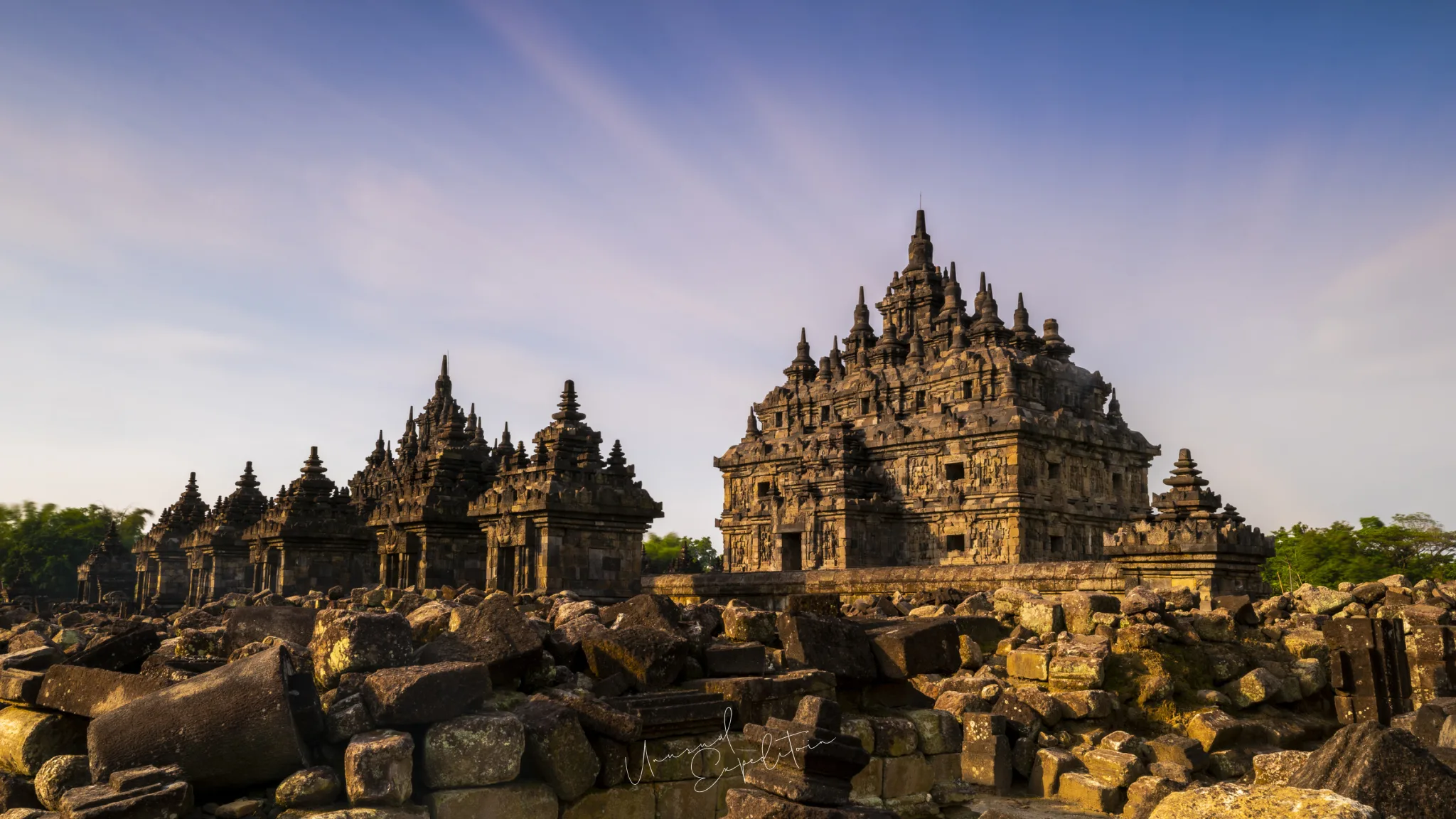
Plaosan, a short way from Prambanan, is a 9th-century Buddhist complex of two main temples, traditionally linked to a royal couple of two faiths. It is far quieter than Prambanan, which makes it the place for unhurried compositions: the main temple above its fallen stones, carved guardian figures on the walls, and, in the late afternoon, warm light on the stone. Monks sometimes visit; ask before you photograph them.
Ratu Boko and Jomblang
Ratu Boko is a hilltop archaeological site south of Prambanan, managed with Borobudur and Prambanan by the same state tourism company, and its stone gateway is an evening subject, with the light low over the plain behind. Further south, in Gunungkidul, Jomblang Cave is a vertical sinkhole entered by rope with the operator's staff and gear; on sunny days around midday, a beam of light falls through the opening into the chamber below, which the official Yogyakarta tourism site calls the light of heaven. No beam forms under cloud.
"At Borobudur I spend the first light on the hill and the last on the stones of Prambanan. The middle of the day is for the workshops in the villages, not the temples."
Joseph Mak, tour leader, Unusual Expedition
Seasons, access and Merapi
Java's wet season runs roughly from November to March and the drier months from May to October; Waisak falls at the turn into the dry season, at the full moon of the month of Waisak. Mount Merapi, behind Borobudur in the sunrise picture, has been at alert level III since 2020, and tourism in the danger zone near the summit is not allowed; check the current alert level before you go. Drones need permission at all of these sites. The Borobudur and Yogyakarta photography FAQ covers tickets and practical questions.
Photograph Borobudur with us
We run Borobudur and Yogyakarta as a private trip on request, timed to Waisak or the dry season and planned around these hours of light; see our private tours page. Any scheduled departure appears on our Indonesia photography tours page.
Ask us about a Borobudur photography trip
Borobudur and Yogyakarta photography tours
The next Borobudur and Yogyakarta departure is announced on the Borobudur and Yogyakarta photography tours page, with previous expeditions and all the planning guides.
Explore Borobudur and Yogyakarta in depth
- Borobudur and Yogyakarta Photography Tour Guide: Temples, Waisak and WorkshopsIndonesia
- 5 Best Restaurants in Yogyakarta, Indonesia: Bakmi Jawa, Grilled Chicken and a Village BuffetIndonesia
- Yogyakarta Photography: Gong Forge, Tofu Workshop, Puppet Maker and Jomblang CaveIndonesia
- Waisak Festival at Borobudur: Calendar, Procession and Night CeremonyIndonesia
- Prambanan Sunset: Photographing Prambanan, Plaosan and Ratu BokoIndonesia
- Borobudur Temple Photos: Stupas, Reliefs and the Monument at NightIndonesia
- Borobudur Sunrise: Punthuk Setumbu or the Temple TerracesIndonesia
- Borobudur Lantern Festival: How the Waisak Lantern Release Works NowIndonesia
- Borobudur and Yogyakarta Photography FAQ: Tickets, Monks, Drones and MerapiIndonesia
Upcoming Photo Tours
- Egypt Photo Tour – EgyptEgypt 12 Dec 2026 To 20 Dec 2026
- Inner Mongolia Winter Owl Photo Tour – ChinaChina 01 Jan 2027 To 04 Jan 2027
- Inner Mongolia Winter Photo Tour – ChinaChina 05 Jan 2027 To 11 Jan 2027
- Mekong And Central Highland Vietnam Photo Tour - VietnamVietnam 16 Jan 2027 To 24 Jan 2027