
Dead Sea Salt Formations: How They Form and How to Photograph Them
Dead Sea salt formations on the Jordanian shore: how the crystals form, where to find them and how to photograph them at sunset.
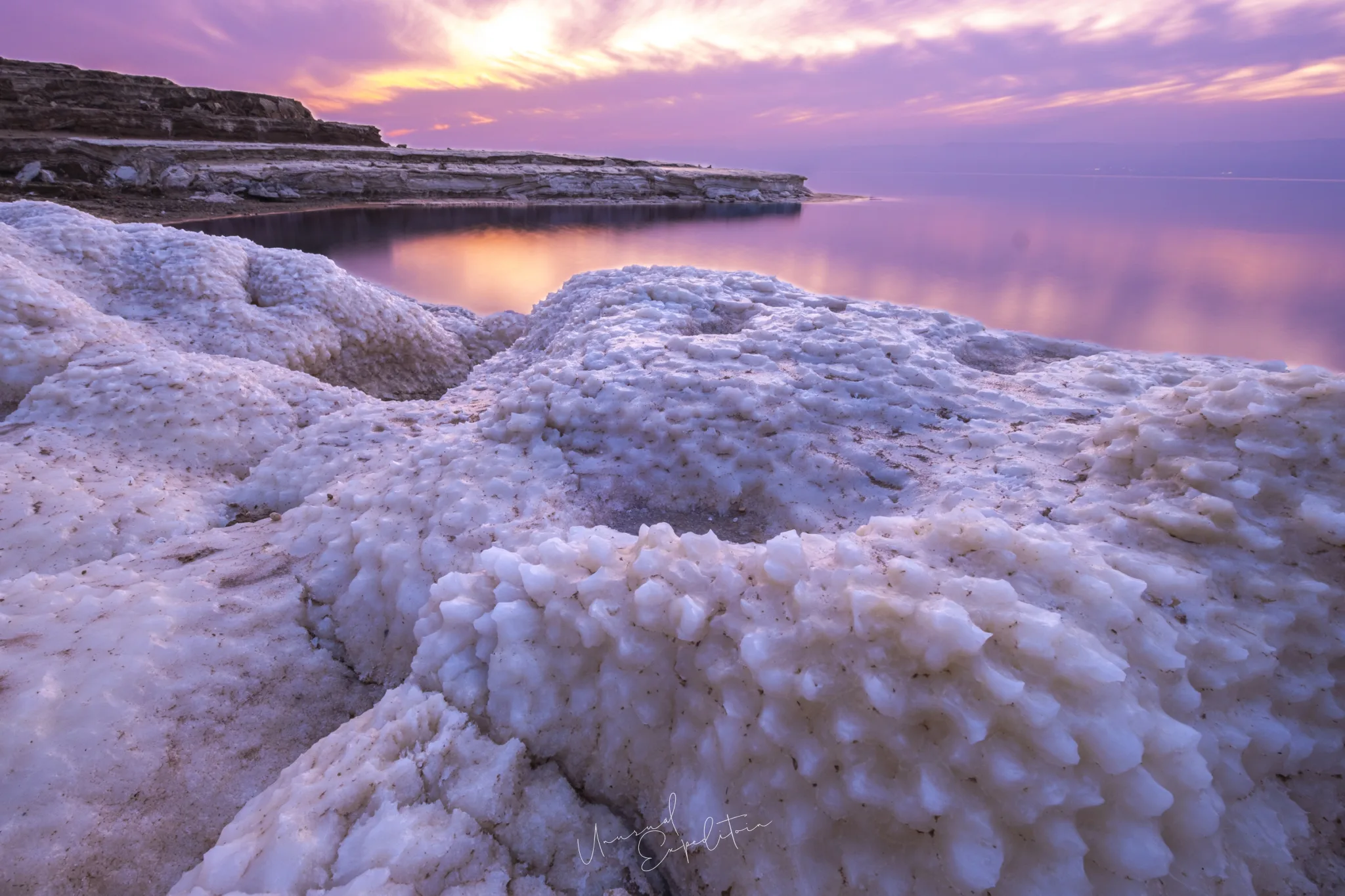
Dead Sea salt formations are the crusts, mounds, ridges and crystal "mushrooms" that build up wherever the lake's very salty water touches the shore. On the Jordanian side they line long stretches of rocky beach in white and cream, shaped like cauliflower, coral or frozen waves, and they change from season to season as the water evaporates and the level falls. For photographers they are the main subject of the Dead Sea, best in low evening sun and at dusk, when the crystals glow against a pastel sky.
This article is part of our Dead Sea photography tour guide, which covers the area as a whole.
Dead Sea salt formations: how they form
Dead Sea salt formations grow because the lake holds far more dissolved salt than the ocean, and the hot, dry air evaporates water constantly. Where waves splash onto rocks, or where shallow pools are cut off from the main lake, the water becomes saturated and halite, rock salt, crystallises out. Layer after layer builds up into crusts and rounded mounds. Amusing Planet's article on the formations describes the most striking of them, salt "mushrooms" standing on thin stems in shallow pools near the shore, which form after periods of strong evaporation. Because the level keeps dropping, formations that grew at the water's edge are left stranded on dry land, where rain slowly dissolves them into new shapes.
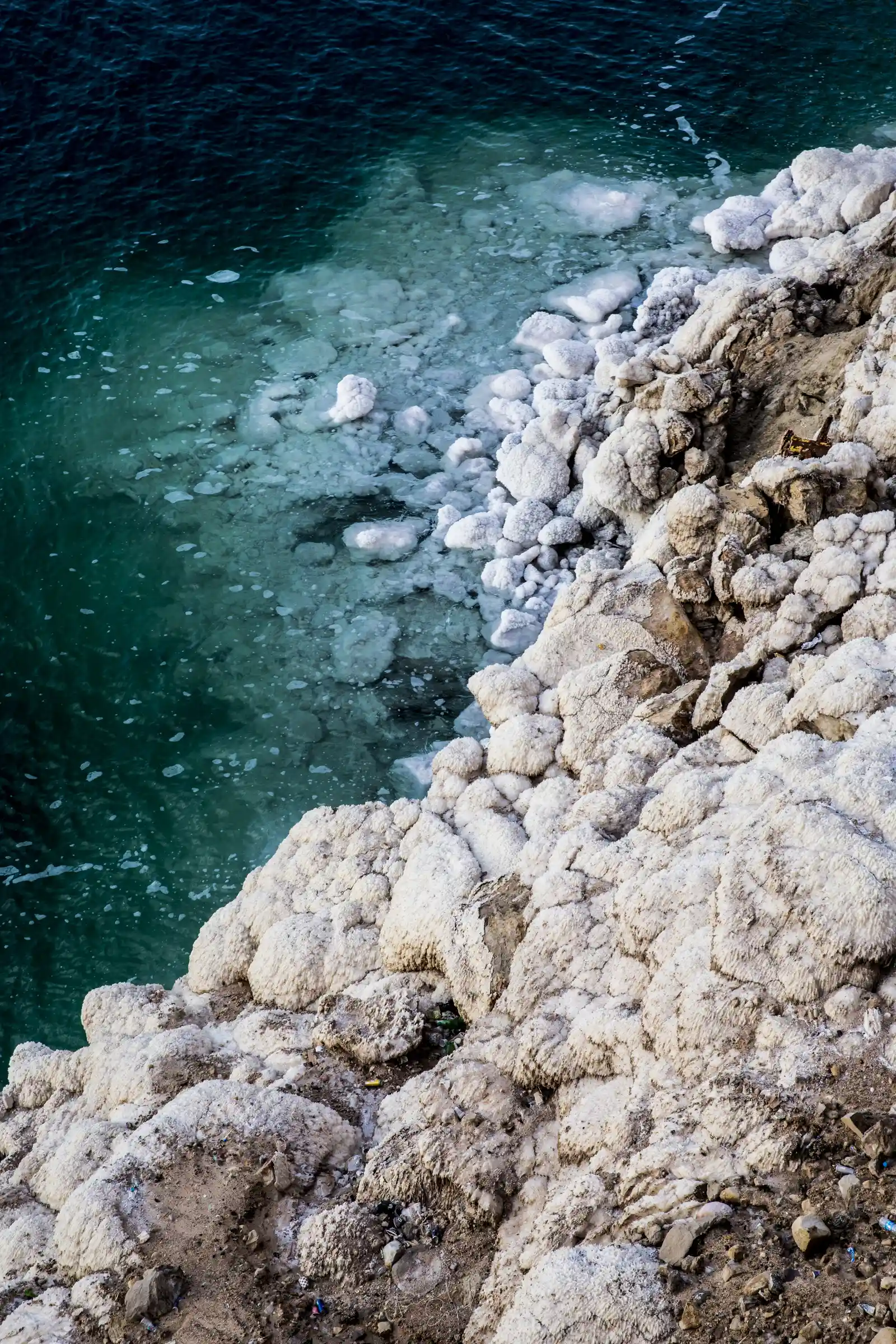
Dead sea salt crystal close up
Up close, a Dead Sea salt crystal crust is a landscape of its own. The mounds are made of thousands of small cubes and knobs, white where they are dry and grey or translucent where they are wet, and in low sun each knob throws a tiny shadow. Get low with a 16-35mm, almost touching the salt, and let a single mound fill the bottom half of the frame with the water and sky behind. Focus stacking or a small aperture keeps the crystals sharp from front to back. On a bright day, a polariser cuts the glare from the white surface; in the evening, it is not needed.
Salt beach Dead Sea: where to find them
The best salt beach Dead Sea stretches on the Jordanian side are away from the resorts and the public beaches, where the shore is rocky and nobody rakes it. Driving south along the shore road, look for places where white salt lines the water's edge below the road, then find a safe way down. Wikivoyage's Dead Sea (Jordan) guide notes the many salt deposits and crystals along the shoreline. Always keep to firm ground: the mud between the salt can be deep, the salt is sharp, and sinkholes have opened along parts of the shore as the level falls. We work these stretches with a local driver who knows the safe access points.
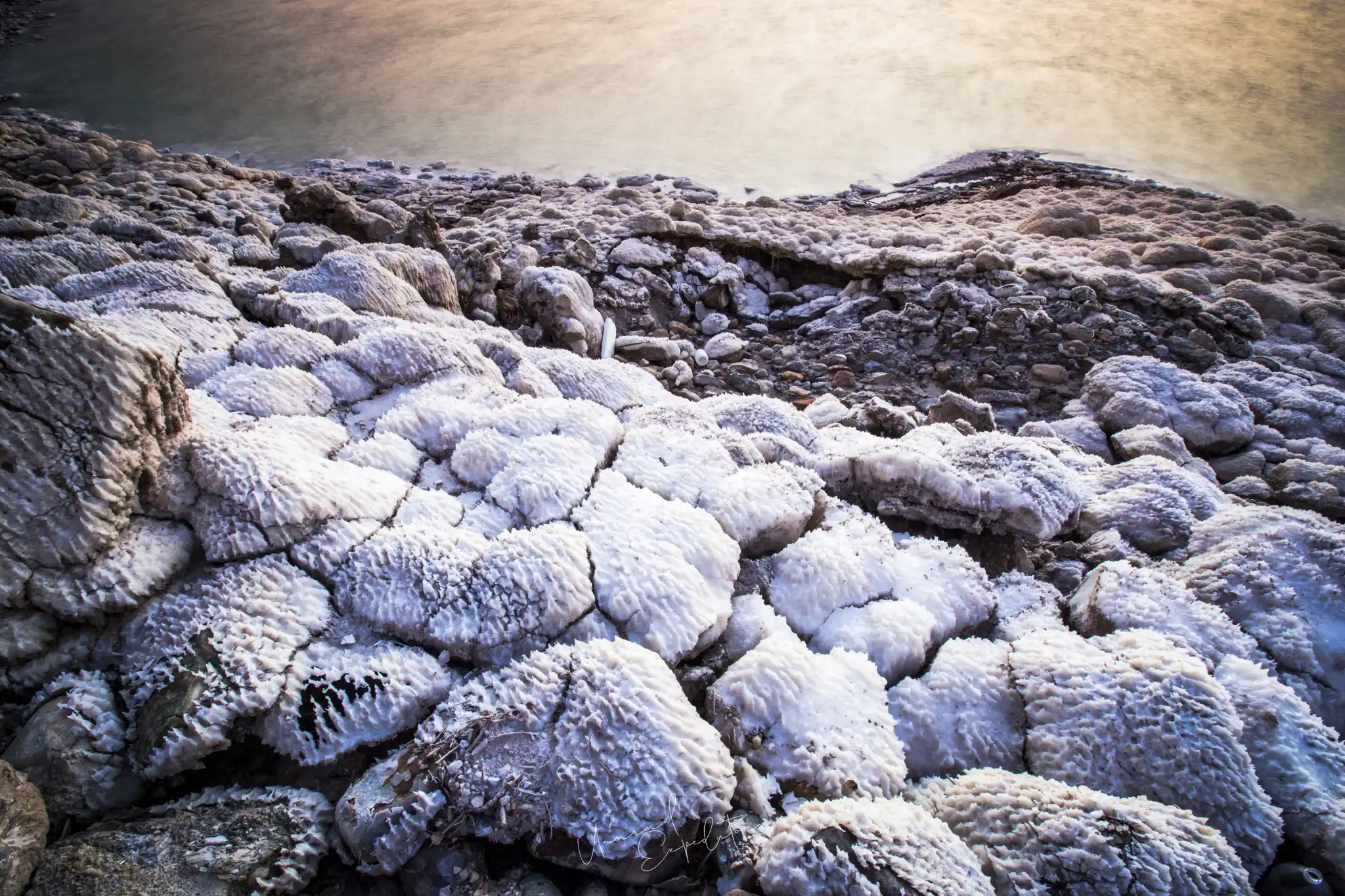
Dead sea salt deposits at sunset
Dead sea salt deposits come alive at sunset. As the sun drops towards the hills of the far shore, its light skims across the water and turns the salt warm cream and pink; after it sets, the sky reflects in the wet crystals, and the whole shore takes on a violet tint. The cover picture of this article was taken in that afterglow, with a salt mound in the foreground and the headland and sky reflected in the still water. Arrive well before sunset to find your mound and compose, then stay for at least half an hour after it: the colour often peaks late.
"I tell people to find one good piece of salt and stay with it. The light changes every minute at sunset, and the same mound gives you five different pictures if you are patient."
Joseph Mak, tour leader, Unusual Expedition
Shapes to look for
| Formation | What it looks like | How to photograph it |
|---|---|---|
| Mounds | Rounded cauliflower shapes at the water's edge | Low wide angle, sky behind, sunset |
| Crusts and shelves | Flat white plates over rock and mud | Leading lines into the water, dusk |
| Ridges in the water | Lines of salt running out into the shallows | Long exposure to smooth the water |
| Terraces | Stepped old shorelines | From higher ground, late afternoon |
| Crystals close up | Cubes and knobs of halite | Very close, small aperture |
The same stretch of shore can hold all five within a short walk.
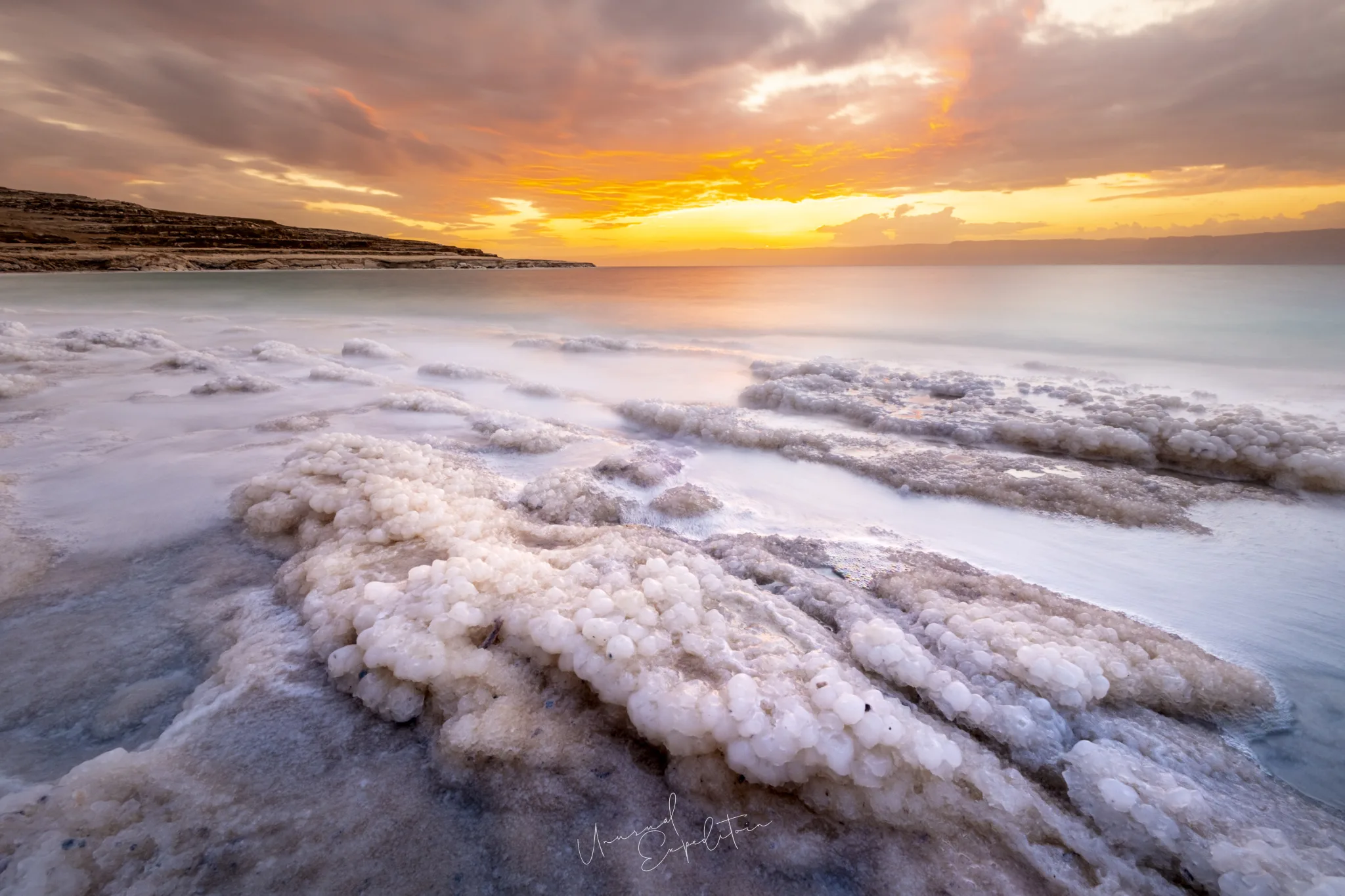
Long exposures over the salt
Long exposures turn the Dead Sea into silk. On a tripod, with a neutral density filter or simply in the dimming light after sunset, exposures of several seconds smooth the small waves around the salt ridges, so the salt stands sharp in soft, glowing water. Keep the tripod on firm salt, not mud, and check it is not slowly sinking during the exposure. Rinse it in fresh water afterwards: salt water corrodes metal quickly.
Are the formations changing?
Yes. The formations are temporary. Rain dissolves the exposed mounds, waves build new ones, and as the level drops the whole band of salt moves down the shore. The places we photographed on our trips will not look the same on yours, which is part of the appeal. For why the level is falling, see is the Dead Sea drying up, and for the seasons, best time to visit the Dead Sea.
Camera settings on the salt
Salt is bright, and cameras read it wrongly. In daylight, add between half a stop and one stop of exposure compensation, or the white crystals will come out grey; check the histogram and keep the highlights just short of clipping. At sunset the problem reverses: the sky is far brighter than the salt in shadow, so a soft graduated filter or two bracketed exposures help to hold both. Low ISO and a tripod are the rule from sunset on. Focus about a third of the way into the scene, or focus stack if a mound is very close to the lens. White balance set to daylight keeps the warm tones of sunset and the violet of the afterglow, which an automatic setting tends to neutralise.
Photograph the salt with us
We run the Dead Sea as part of a private trip in Jordan on request, with a driver who knows the shore. See private tours and the Jordan photography tours page.
Ask us about the Dead Sea salt
Dead Sea photography tours
The next Dead Sea departure is announced on the Dead Sea photography tours page, with previous expeditions and all the planning guides.
Explore Dead Sea in depth
- Dead Sea Photography Tour Guide: Salt, Sunsets and the Lowest Shore on EarthJordan
- Is the Dead Sea Worth Visiting? Floating, Safety and the SunsetJordan
- Is the Dead Sea Drying Up? What the Jordanian Shore ShowsJordan
- How to Get to the Dead Sea from Amman, via Madaba and Mount NeboJordan
- Best Time to Visit the Dead Sea: Seasons, Weather and LightJordan
Upcoming Photo Tours
- Egypt Photo Tour – EgyptEgypt 12 Dec 2026 To 20 Dec 2026
- Inner Mongolia Winter Owl Photo Tour – ChinaChina 01 Jan 2027 To 04 Jan 2027
- Inner Mongolia Winter Photo Tour – ChinaChina 05 Jan 2027 To 11 Jan 2027
- Mekong And Central Highland Vietnam Photo Tour - VietnamVietnam 16 Jan 2027 To 24 Jan 2027