
Dead Sea Photography Tour Guide: Salt, Sunsets and the Lowest Shore on Earth
The Dead Sea in Jordan for photographers: salt formations, sunsets over the water, the falling shore, access and when to go.
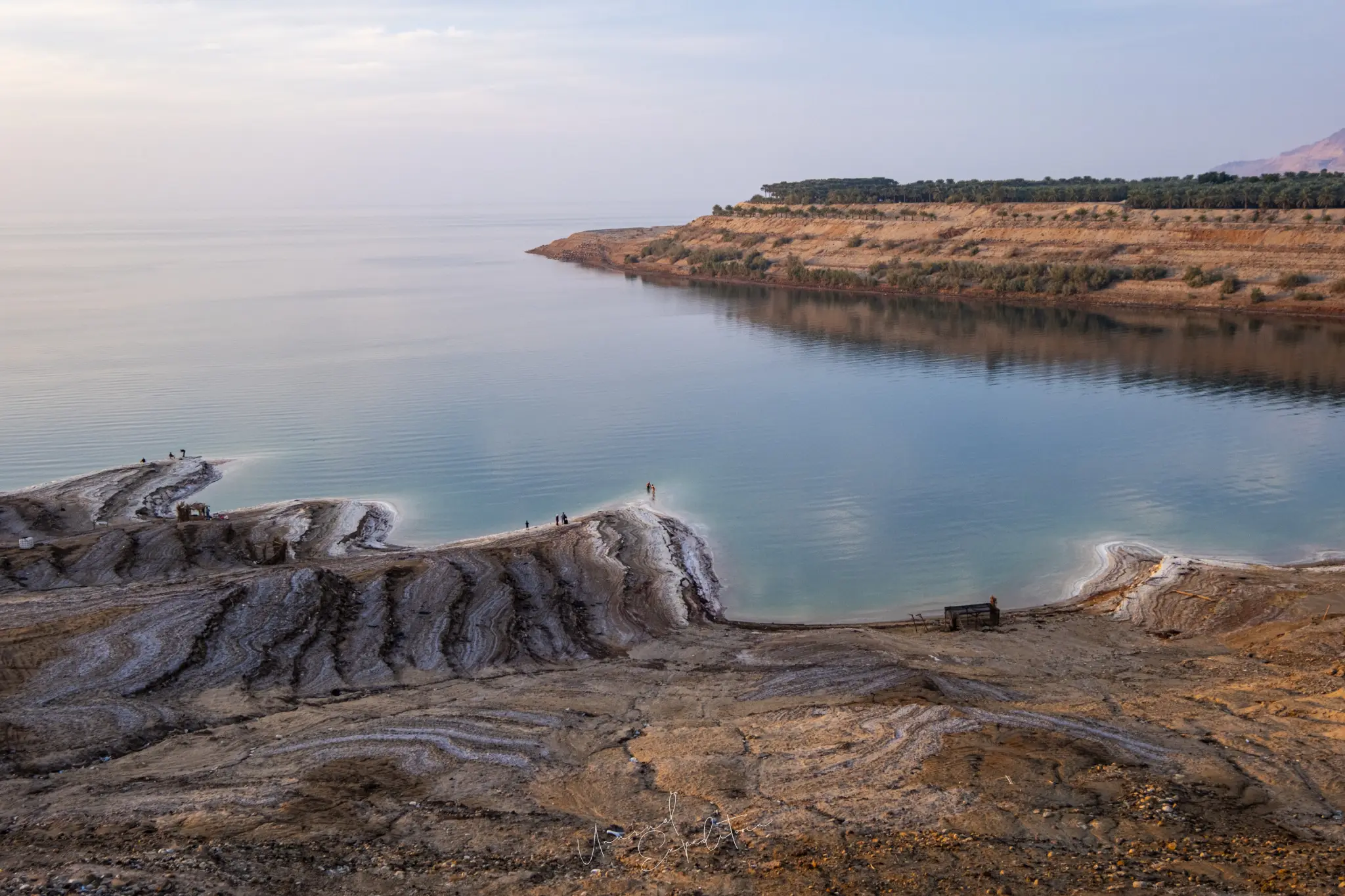
The Dead Sea in Jordan is the lowest shore on earth, a salt lake lying about 440 metres below sea level, and for photographers it is one of the strangest landscapes in the Middle East: white salt crusts, mounds and shelves along the water's edge, terraces left behind as the level falls, and a calm surface that mirrors the sky. From the Jordanian shore the sun sets over the water and the hills beyond, so the best pictures come in the last hour of the day and at dusk.
This is the area guide for the Dead Sea within our Jordan photography tour guide, which covers entry, money, flights from Singapore and the current travel advice for the whole country. The photographs in this guide are our own, taken on our trips to the Dead Sea; we hold the rights to them, and the notes come from knowing this shore first hand.
Dead Sea Jordan: what the shore looks like
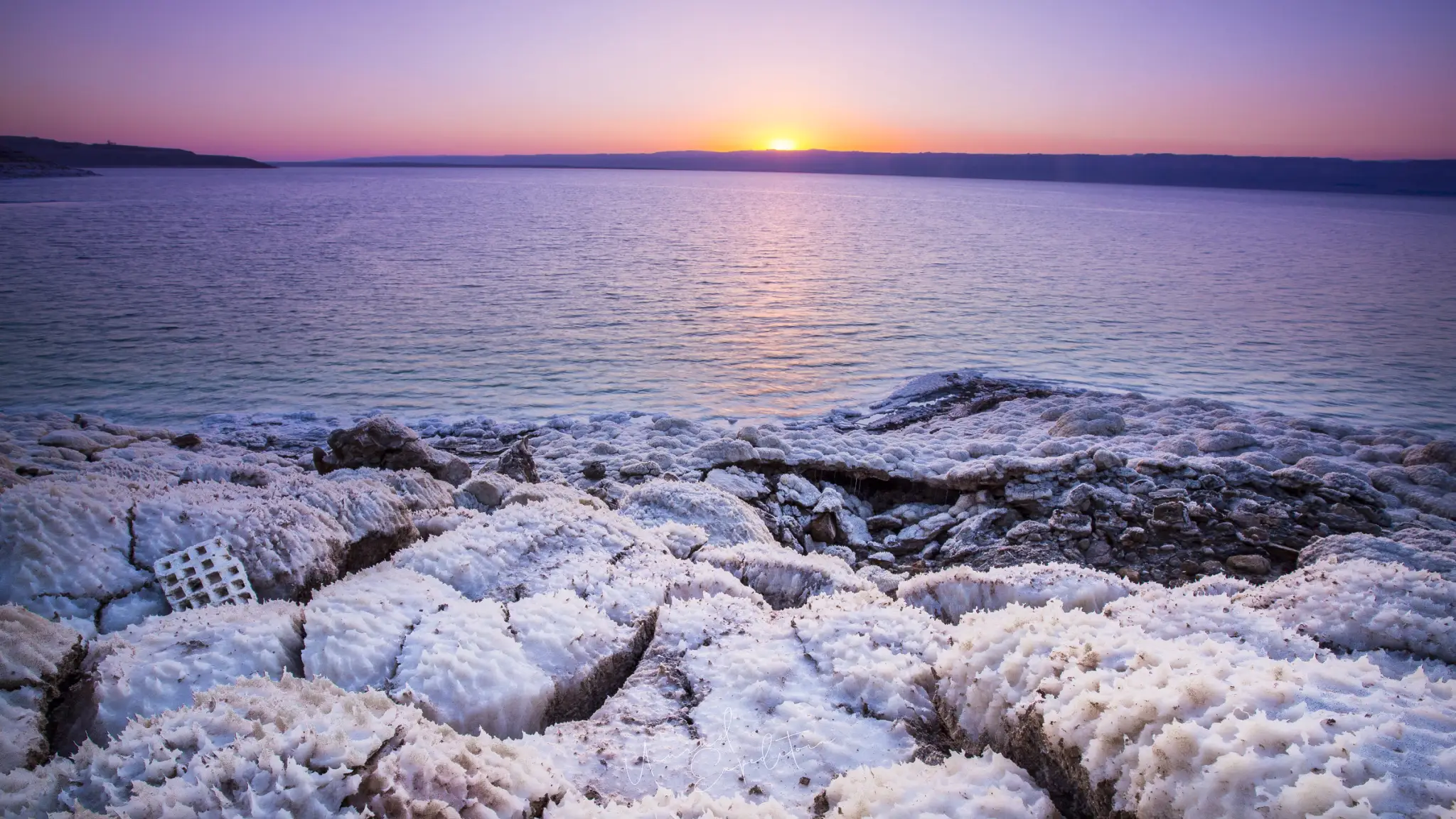
The Dead Sea Jordan shore is a long strip of land between steep, bare hills and the water. Hotels and public beaches cluster at the northern end; further south the road runs along the cliffs with few buildings, and the shoreline becomes rocky and white with salt. Because the lake is so salty, salt crystallises wherever the water touches stone, building crusts, cauliflower-like mounds, flat shelves and ridges that change shape with each season. As the level falls, old shorelines are left above the water as stepped terraces of salt and mud. On calm evenings the surface is glassy and pastel, and the far shore fades into haze. Our Dead Sea salt formations article shows the shapes in detail.
Visit the Dead Sea in Jordan for photography
To visit the Dead Sea in Jordan for photography, plan your time around the evening. In the middle of the day the light is hard and hazy, the salt glares white and the far shore disappears. From the late afternoon the low sun rakes across the salt and picks out every crystal; the sun then drops towards the hills on the far side, often through a band of haze that softens it to orange. After sunset the sky and water turn pink and violet, a colour that lasts surprisingly long. A tripod is essential for dusk, and long exposures smooth the water into silk. Mornings are calm and pale, with the sun rising behind you over the Jordanian hills: good for floating, less so for pictures.
| Subject | What it looks like | Best light |
|---|---|---|
| Salt mounds and crusts | White crystal shapes at the water's edge | Low sun and dusk |
| Salt terraces | Stepped old shorelines above the water | Late afternoon, from higher ground |
| The water | Glassy, mirror-like, pastel | Sunset and blue hour |
| Beaches | Umbrellas, floaters, mud bathers | Late afternoon |
The salt is the reason to come with a camera; the beaches are the reason to come at all.
Is the Dead Sea worth visiting?
The Dead Sea is worth visiting for most travellers to Jordan, if only for the experience of floating, and for photographers it is worth an evening at least. Our is the Dead Sea worth visiting article answers this properly, including safety in the water and what to do besides floating. Put simply, the shore is unlike anywhere else, it is close to Amman and Madaba, and it is warm in winter when the hills are cold.
A sea that is shrinking
The Dead Sea has been falling by more than a metre a year, and according to a Xinhua report in mid 2026 its surface was about 440 metres below sea level; Britannica gives about 430 metres in the mid 2010s. The causes are the diversion of Jordan River water and mineral extraction at the southern end. On the shore you see the result: terraces of old beaches, piers and steps that no longer reach the water, and in places sinkholes, which are a real hazard. Our is the Dead Sea drying up article explains what is happening and how it shapes the pictures.
"The Dead Sea surprised me more than anywhere in Jordan. I came for the floating and stayed on the salt until it was dark, because every few metres the crystals made a new shape."
Joseph Mak, tour leader, Unusual Expedition
Getting to the Dead Sea
The Dead Sea lies south west of Amman, down a long road that drops from the plateau to below sea level, and most visitors come as a day trip from the capital or stay at one of the resorts. On the way, Madaba and Mount Nebo sit on the high ground above the valley. Public buses run to the public beach, but for photography a car with a driver is far better, because the best salt is away from the beaches and the light comes late. Our how to get to the Dead Sea from Amman article covers the options.
When to go
The best months are spring and autumn, when the shore is warm but not hot; winter is mild here, which makes the Dead Sea a good escape from a cold Amman; summer is extremely hot, around 40 degrees in August according to Rough Guides. The best time to visit the Dead Sea article has a season by season table.
Camera gear and care on the salt
Salt is hard on equipment. Keep lenses capped between shots, never put a bag down on wet salt, and wipe the tripod legs with fresh water afterwards: salt water corrodes metal quickly. A 16-35mm is the main lens for the crystals in the foreground and the sky behind; a 24-70mm for the terraces; a polariser helps with the glare in daytime. Wear old shoes with good soles, because the salt is sharp and slippery. Keep to established paths near the water: the shore has sinkholes and soft mud in places.
Travel advice
Read the official advice before you plan: as at November 2026, Singapore's Ministry of Foreign Affairs still shows its March 2026 advisory to defer travel to the Middle East region. Our Jordan photography tour guide keeps the current position, and the Amman and Jerash photography tour guide covers the capital most trips start from.
Explore the Dead Sea in depth
- Dead Sea salt formations
- Is the Dead Sea drying up?
- Is the Dead Sea worth visiting?
- How to get to the Dead Sea from Amman
- Best time to visit the Dead Sea
Photograph the Dead Sea with us
With no scheduled Jordan departure at present, we run the Dead Sea as part of a private trip on request, for individuals, couples, families and photographers at their own pace. We arrange the logistics, the cost can be lower than a group tour because no tour leader travels, and photography coaching can be added at extra cost. Ask at least two months ahead where you can. See private tours and the Jordan photography tours page.
Dead Sea photography tours
The next Dead Sea departure is announced on the Dead Sea photography tours page, with previous expeditions and all the planning guides.
Explore Dead Sea in depth
- Is the Dead Sea Worth Visiting? Floating, Safety and the SunsetJordan
- Is the Dead Sea Drying Up? What the Jordanian Shore ShowsJordan
- How to Get to the Dead Sea from Amman, via Madaba and Mount NeboJordan
- Dead Sea Salt Formations: How They Form and How to Photograph ThemJordan
- Best Time to Visit the Dead Sea: Seasons, Weather and LightJordan
Upcoming Photo Tours
- Egypt Photo Tour – EgyptEgypt 12 Dec 2026 To 20 Dec 2026
- Inner Mongolia Winter Owl Photo Tour – ChinaChina 01 Jan 2027 To 04 Jan 2027
- Inner Mongolia Winter Photo Tour – ChinaChina 05 Jan 2027 To 11 Jan 2027
- Mekong And Central Highland Vietnam Photo Tour - VietnamVietnam 16 Jan 2027 To 24 Jan 2027