
Jokulsarlon Northern Lights: Aurora Over the Glacier Lagoon and Diamond Beach
Jokulsarlon northern lights: the aurora season, the Met Office forecast, Diamond Beach at night, moonlight and camera settings.
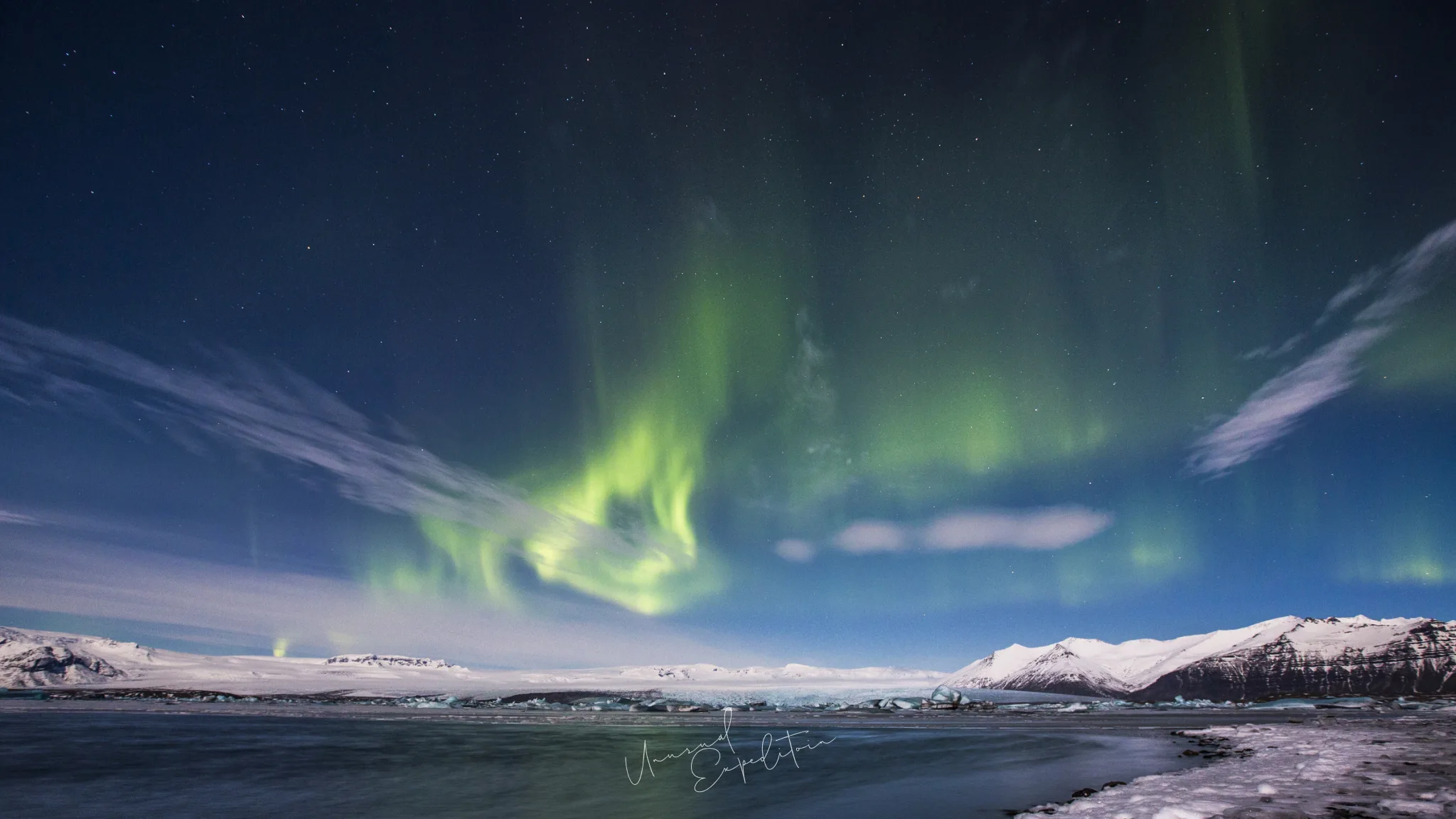
Jokulsarlon northern lights season runs from about September to April, when the nights are dark enough, and the glacier lagoon is one of the best aurora foregrounds in Iceland: almost no artificial light, icebergs for shapes, and on calm nights a lagoon that reflects the sky. You need a clear gap in the cloud and some aurora activity, so watch the Icelandic Met Office forecast, stay close to the lagoon for several nights, and be ready to go out at short notice.
This night guide belongs to our Jokulsarlon photography tour guide. We have stood on this shore under the aurora in autumn and in winter, and the pictures here are from those nights.
Northern lights over Jokulsarlon glacier lagoon: why it works
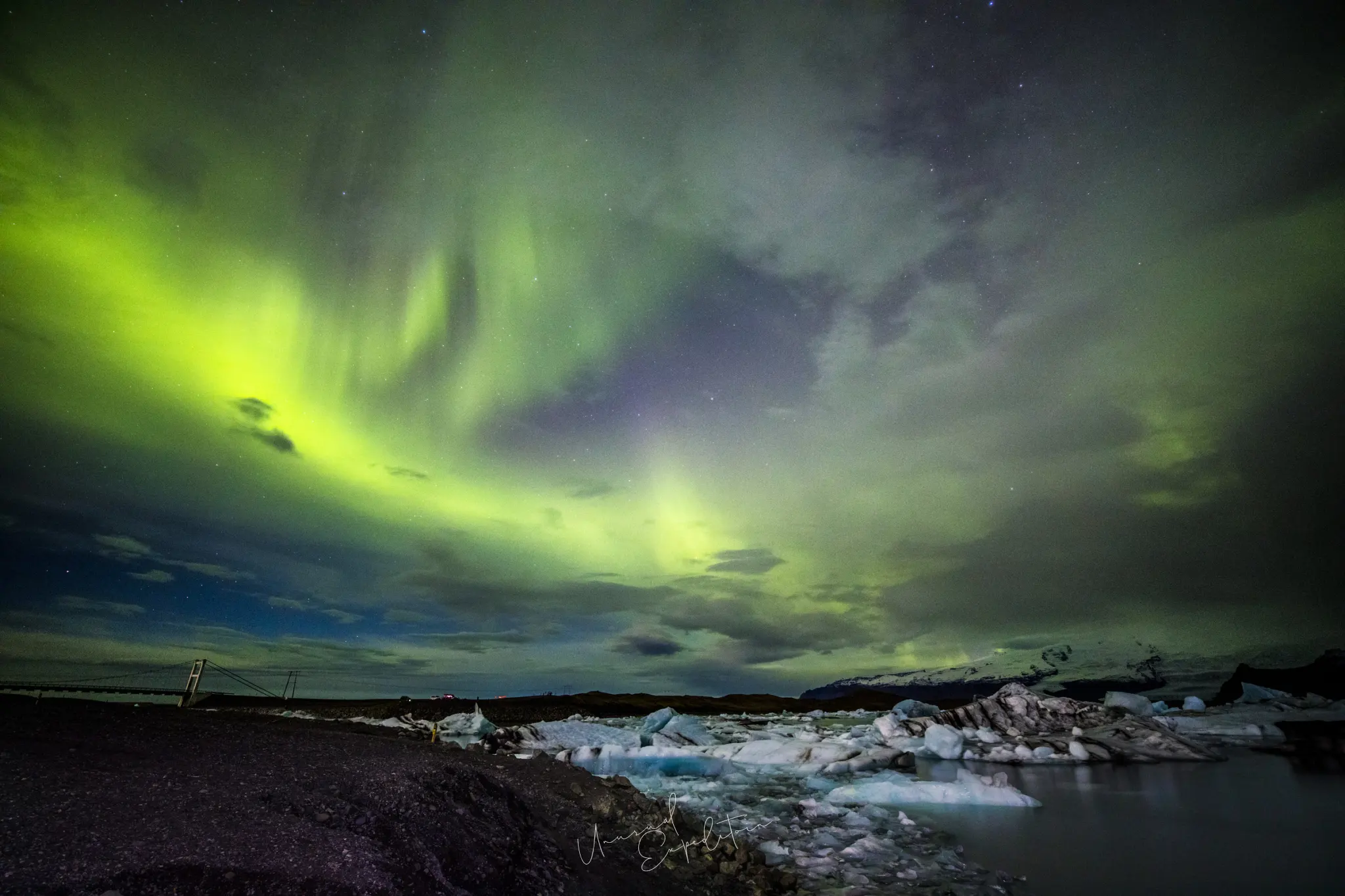
The northern lights over Jokulsarlon glacier lagoon make one of the classic Iceland pictures for good reasons. The lagoon is on the thinly populated south-east coast, far from any town, so the sky is dark. The glacier and the mountains of Vatnajokull give a horizon to the north, which is usually where the aurora starts, and the bergs in the foreground catch any light, from the moon or from the aurora itself. On a still night the water doubles everything. The lagoon also faces north from its south shore, so you can stand with your back to the road and the sea and have the whole show in front of you.
Jokulsarlon aurora forecast: what we check
For a Jokulsarlon aurora forecast we use the Icelandic Met Office (vedur.is), which combines aurora activity with a cloud cover map and the sun and moon. Cloud matters more than activity: a modest aurora under a clear sky beats a strong one behind cloud. The south-east often clears when the north is cloudy and the other way round, so we check the cloud map through the afternoon and decide where to be once it is dark. The forecast is a guide, not a promise, and the aurora can appear and fade within minutes. Keep the camera set up near the door, and check the sky yourself every half hour on a promising night.
| Condition | What it means at the lagoon | What we do |
|---|---|---|
| Clear sky, low activity | Faint arc low over the glacier | Long exposure, wait for a pulse |
| Clear sky, high activity | Bands overhead, colour in the water | Wide lens, short exposures |
| Broken cloud | Aurora between the clouds | Stay out, the gaps move |
| Full moon | Ice and mountains lit, fainter aurora | Use the moonlight on the bergs |
| Thick cloud | No aurora visible | Rest, try again tomorrow |
A trip of several nights near the lagoon is the best insurance against cloud.
Diamond Beach Iceland northern lights
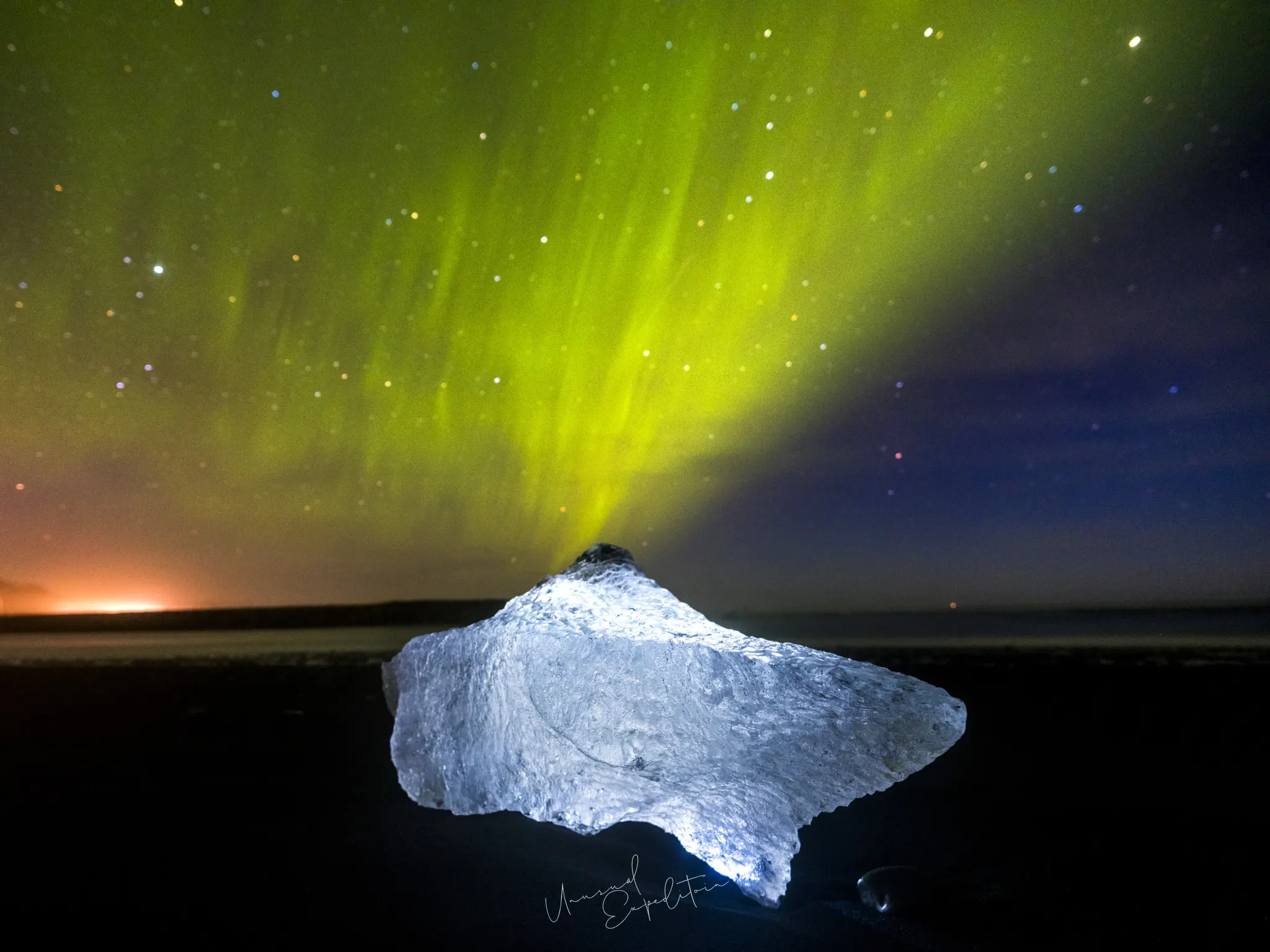
Diamond Beach Iceland northern lights pictures need a different approach. The beach faces south to the sea, while the aurora usually starts in the north, so on many nights you shoot with the bergs between you and the land, or wait for a strong display that spreads overhead and down to the southern horizon. Diamond Beach at night is dark and the surf is hard to see, so stay well back from the water. A block of ice lit very softly by a dimmed torch or by moonlight against a green sky is a striking picture; if others are shooting nearby, ask before you use any light.
Camera settings for the northern lights at Jokulsarlon
For the northern lights at Jokulsarlon, a fast wide lens on a solid tripod is the basic kit: a 14-24mm or 16-35mm at f/2.8 or wider. Start at ISO 1600 to 3200 and an exposure of around five to fifteen seconds, then adjust: shorten the exposure when the aurora moves fast so the curtains keep their shape, lengthen it when it is faint. Focus manually on a bright star or a distant light using live view, then tape the focus ring. Shoot raw. Keep spare batteries warm inside your jacket, because cold nights by the ice drain them quickly.
On the lagoon I never rush the first frames. Check the focus, check the horizon, and when the aurora comes overhead you are ready. The people who miss it are still looking for their headlamp.
Joseph Mak, tour leader, Unusual Expedition
Moonlight and the icebergs
Many people avoid the full moon for aurora, but at Jokulsarlon moonlight is useful. It lights the icebergs and the snow on the mountains so the foreground has detail without any artificial light, and the sky stays deep blue rather than black. The aurora looks fainter to the eye under a bright moon, but the camera still records it. A half moon is often the best balance. On moonless nights the bergs go dark, and a starry sky and the Milky Way in winter take their place.
Northern lights near the lagoon: farms and the sand plain
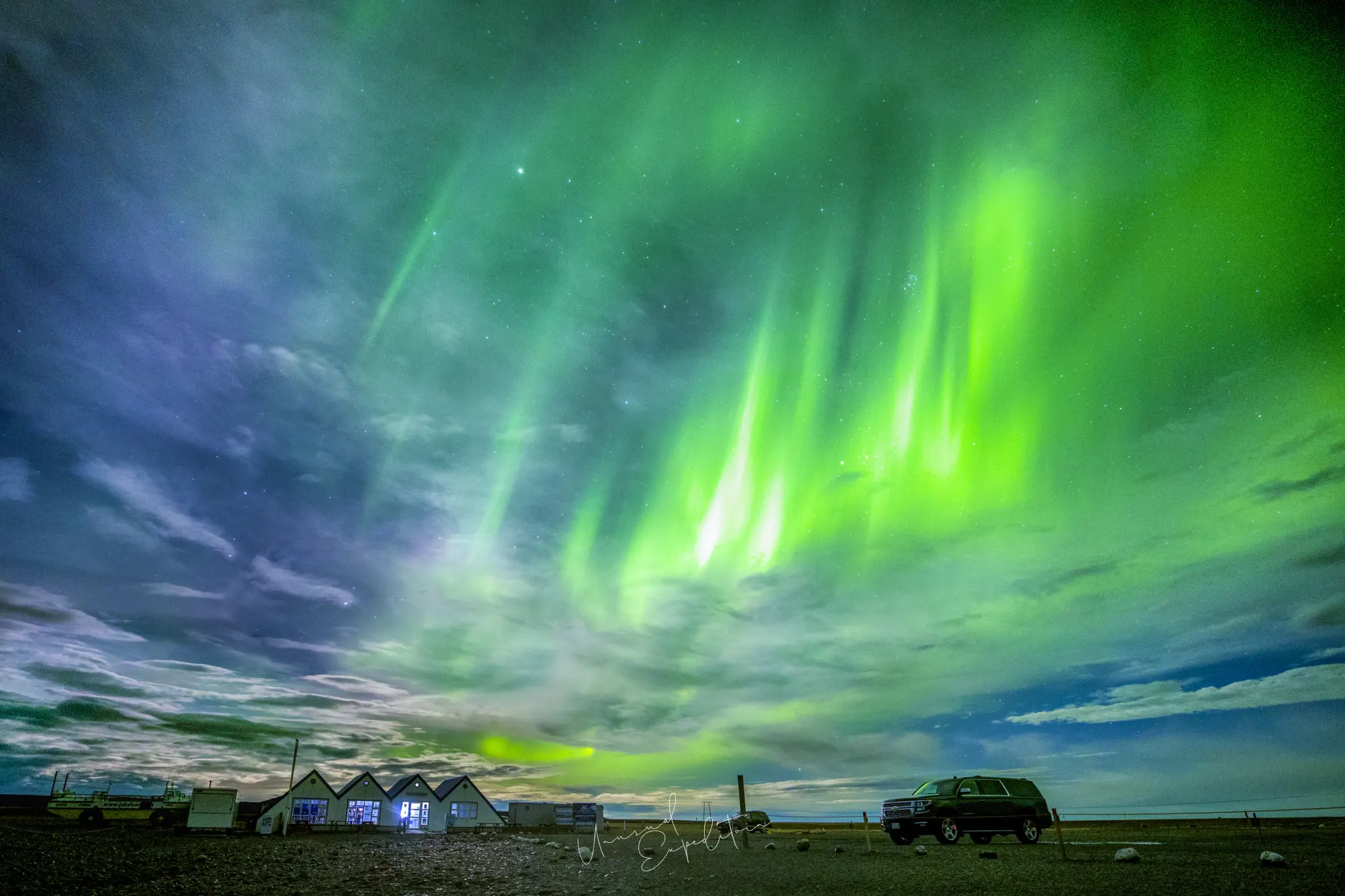
Not every aurora picture at Jokulsarlon has to include the lagoon. On the sand plain and the farmland along the south-east coast, lone farm buildings, a jeep or a line of tripods can make a foreground that tells the story of the night. Keep away from private land and switch off headlights before you set up.
When the aurora season starts and ends
The aurora is overhead all year, but you need darkness to see it, so in Iceland the season runs from late August or September to about mid April. Autumn gives aurora over open water; winter gives the longest nights and frozen lagoon foregrounds. In June and July the midnight sun means no aurora at all. Our best time to visit Jokulsarlon guide compares the seasons, and the Jokulsarlon sunrise and sunset guide covers the light before the night begins.
Chase the aurora at Jokulsarlon with us
Our scheduled Iceland Midnight Sun Photo Tour runs in summer, when there is no aurora. For the northern lights we arrange autumn and winter trips to Jokulsarlon as private tours, with nights built in for the weather. See the current departure on our Iceland photography tours page.
Ask us about the northern lights at Jokulsarlon
Join the Jokulsarlon photography tour
Iceland Midnight Sun Photo Tour departs 05 Jul 2027 To 18 Jul 2027, led by Joseph Mak. Small group, photography first. All Jokulsarlon photography tours.
Explore Jokulsarlon in depth
- Jokulsarlon Photography Tour Guide: Glacier Lagoon, Diamond Beach, Ice Caves and AuroraIceland
- Is Jokulsarlon Worth It? Getting There, Boat Tours, Seals and FeesIceland
- Jokulsarlon Ice Cave Photography: Season, Safety and Blue Ice SettingsIceland
- Jokulsarlon Sunrise and Sunset: Lagoon or Diamond Beach, Season by SeasonIceland
- Best Time to Visit Jokulsarlon for Photography: Winter, Summer or AutumnIceland
- Jokulsarlon Photo Spots: Lagoon Shore, Glacier Ridge, River Mouth and FjallsarlonIceland
- Diamond Beach Iceland Photos: Ice on Black Sand, Light and SettingsIceland
Upcoming Photo Tours
- Egypt Photo Tour – EgyptEgypt 12 Dec 2026 To 20 Dec 2026
- Inner Mongolia Winter Owl Photo Tour – ChinaChina 01 Jan 2027 To 04 Jan 2027
- Inner Mongolia Winter Photo Tour – ChinaChina 05 Jan 2027 To 11 Jan 2027
- Mekong And Central Highland Vietnam Photo Tour - VietnamVietnam 16 Jan 2027 To 24 Jan 2027