
Lake Baikal Views: Six Places for the Classic Shot on the Ice
Lake Baikal views for photographers: Olkhon's ice grottoes, Shaman Rock, the dragon's tail, hummocks and clear black ice.
The Lake Baikal views photographers come for are on the winter ice around Olkhon Island: the icicle-hung cliffs and grottoes of the island's shore, Shaman Rock at Khuzhir, Ogoy Island's dragon's tail rocks in the Small Sea, the hummock fields of turquoise slabs at first light, the clear black ice with its cracks and bubbles, and the rocky islets ringed by ice elsewhere on the lake. All of them are reached across the frozen lake with local drivers, and each has its own best hour.
This is a spot guide: where to stand, which light to wait for, which lens to carry. For the trip itself, start with our Lake Baikal photography tour guide; for a portfolio of the same places, see Lake Baikal photos.
Lake Baikal views at a glance
Lake Baikal is the oldest and deepest lake on earth, roughly 25 million years old and about 636 km long, and UNESCO has listed it as a World Heritage Site since 1996. In late winter the ice season turns it into a road, and the classic views cluster around Olkhon, the largest island, and the Small Sea between Olkhon and the western shore. The table is sorted by subject, not by any route.
| View | Main subject | Best light | Lens |
|---|---|---|---|
| Olkhon icicle cliffs and grottoes | Icicles, ice caves in the rock | Low sun into the cliff face | 16-35mm, 24-70mm |
| Shaman Rock, Khuzhir | Twin-peaked rock, prayer poles | Morning and late afternoon | 24-70mm, 70-200mm |
| Ogoy Island, dragon's tail | Rock fins on clear ice | Clear day, side light | 16-35mm |
| Hummock fields | Turquoise slabs, pressure ridges | Sunrise and sunset | 16-35mm, 24-70mm |
| Clear black ice | Cracks, methane bubbles | Bright overcast or midday | 24-70mm |
| Rocky islets | Rock and ice slabs together | Morning side light | 24-70mm |
The ice subjects reward the edges of the day; the clear-ice details are the one view that works at midday.
Olkhon's icicle cliffs and ice grottoes
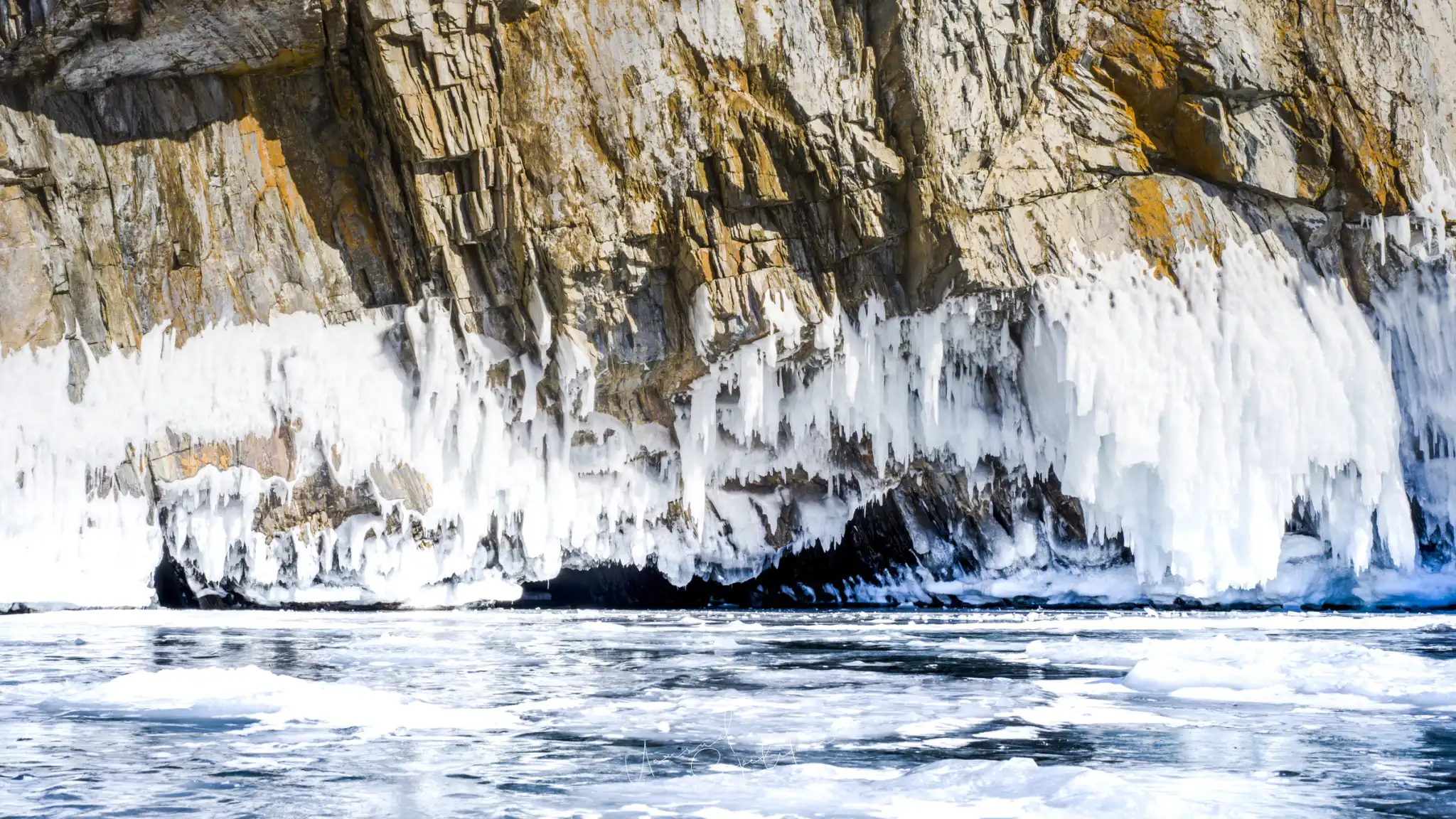
Along Olkhon's rocky shore, storms before the freeze throw spray against the cliffs, and it freezes into curtains of icicles and small grottoes in the rock. In late winter you walk straight across the ice to them. Inside a grotto, a wide lens looks out through the icicles to the frozen lake; from outside, a 24-70mm shows the whole cliff hung with ice. The best moment is when a low sun shines into the cliff face and lights the icicles from the front or slightly from the side, so ask your driver which stretch of cliff gets the light at the end of the day. The ice near cliffs is often thinner and broken, so stay where your driver says it is safe. Popular grottoes get busy with tour vans at the obvious hours; a few minutes' walk along the cliff usually finds an empty one.
Shaman Rock at Khuzhir
Shaman Rock, or Cape Burkhan, is the two-peaked rock beside Khuzhir, the main village on Olkhon, and it is sacred to the Buryat. The prayer poles on the headland, hung with coloured ribbons, are part of the view. From the headland itself you look down on the rock with the frozen Small Sea behind it; from the ice below you can frame both peaks against the sky. Morning and late afternoon give the rock some modelling; under snow and cloud it becomes a quiet, almost monochrome picture. Treat the site with respect: walk around the poles, do not climb the rock, and leave the ribbons alone. Our Olkhon Island photos article shows the island in more detail.
Ogoy Island and the dragon's tail
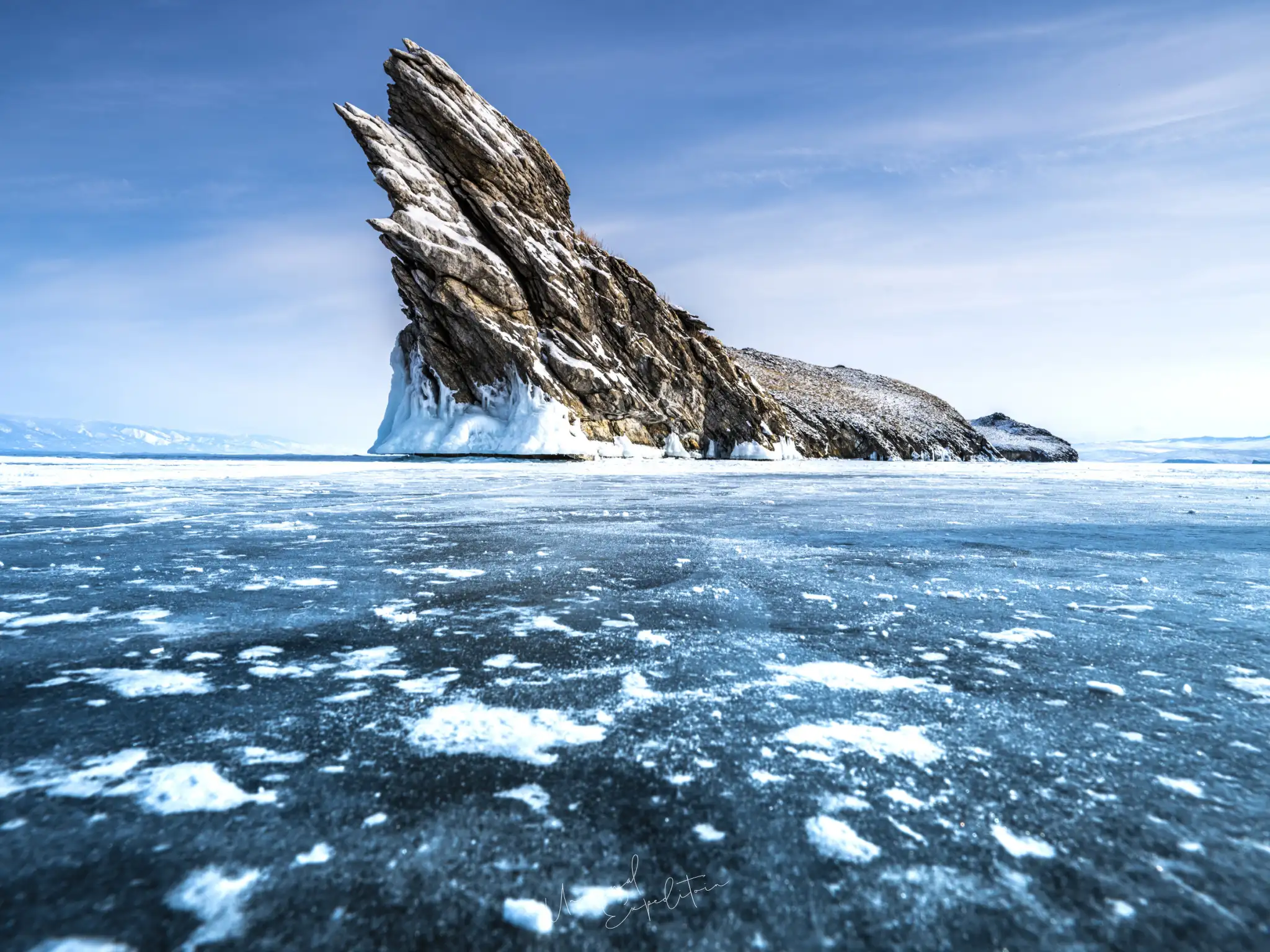
Ogoy Island sits in the Small Sea and carries a Buddhist stupa on its summit. Near it, fins of rock rise out of the ice in a ridge that photographers call the dragon's tail, and in a good year the ice around them is clear enough to show the dark water beneath. Get low with a 16-35mm so the rock fins stand over a foreground of clear ice, cracks and frozen bubbles. A bright day with the sun to one side gives the rock texture and turns the ice deep blue. Wind sweeps the snow off in some winters and piles it up in others, so the view changes from year to year: you only know what the ice looks like when you get there.
Hummock fields at sunrise and sunset
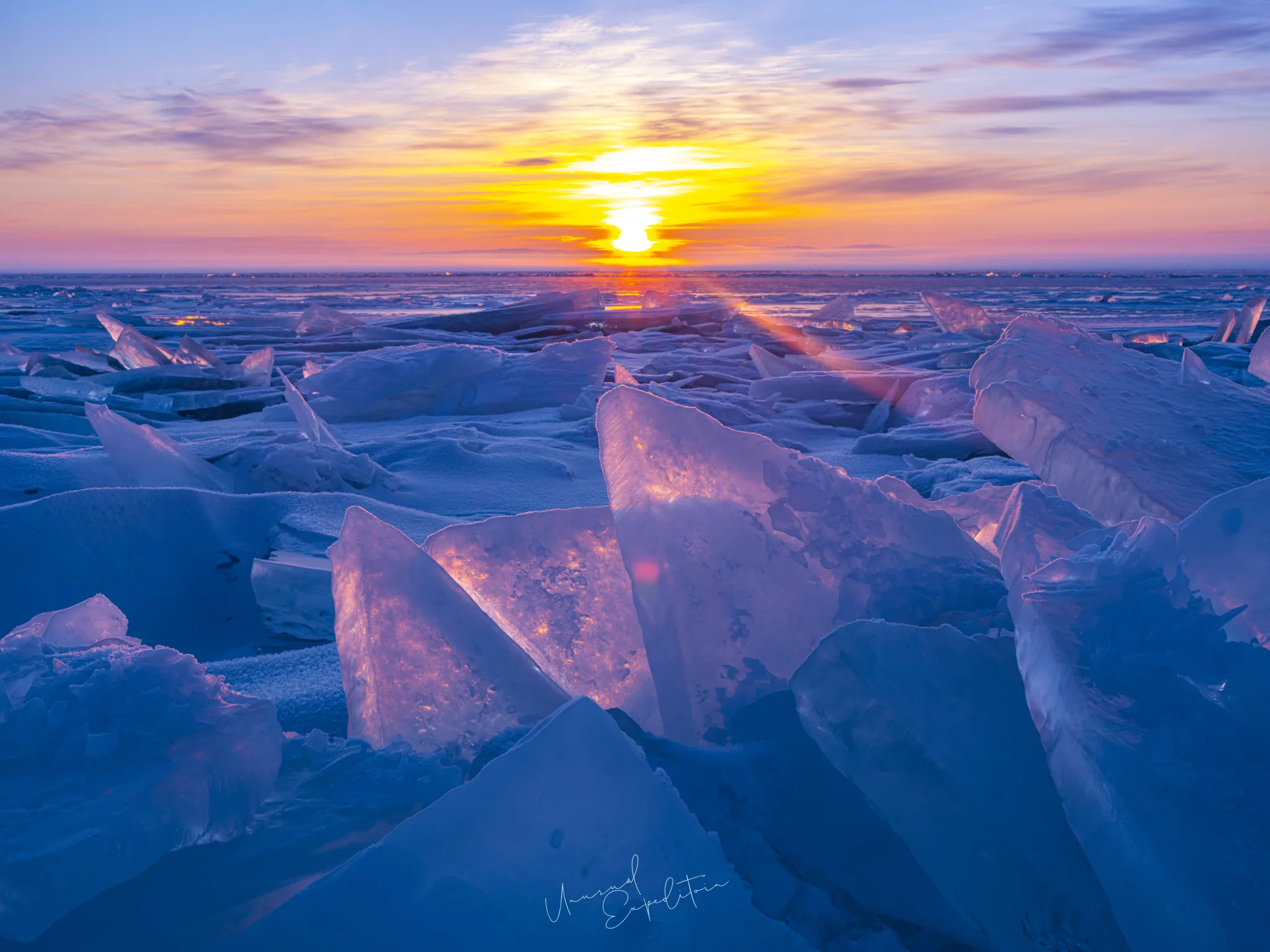
Where the ice sheets push against each other, slabs of turquoise ice are forced up into pressure ridges, which locals call torosy. Fields of them run for kilometres in places. At sunrise and sunset the low sun shines through the slabs and lights their edges gold and pink, while the shadows stay blue. A 16-35mm close to one slab, with the sun just behind its edge, is the classic frame; a 24-70mm picks out patterns in the wider field. Walking among hummocks is slow and slippery, so wear crampons or ice cleats and keep the tripod legs short. Our Lake Baikal ice photography guide covers exposure on the ice.
"On Baikal I walk slowly and look down. The famous rocks are a few minutes of shooting each, but the ice under your boots changes every few steps, and the best frame of the day is often a crack or a bubble nobody else stopped for."
Joseph Mak, tour leader, Unusual Expedition
Clear black ice, cracks and bubbles
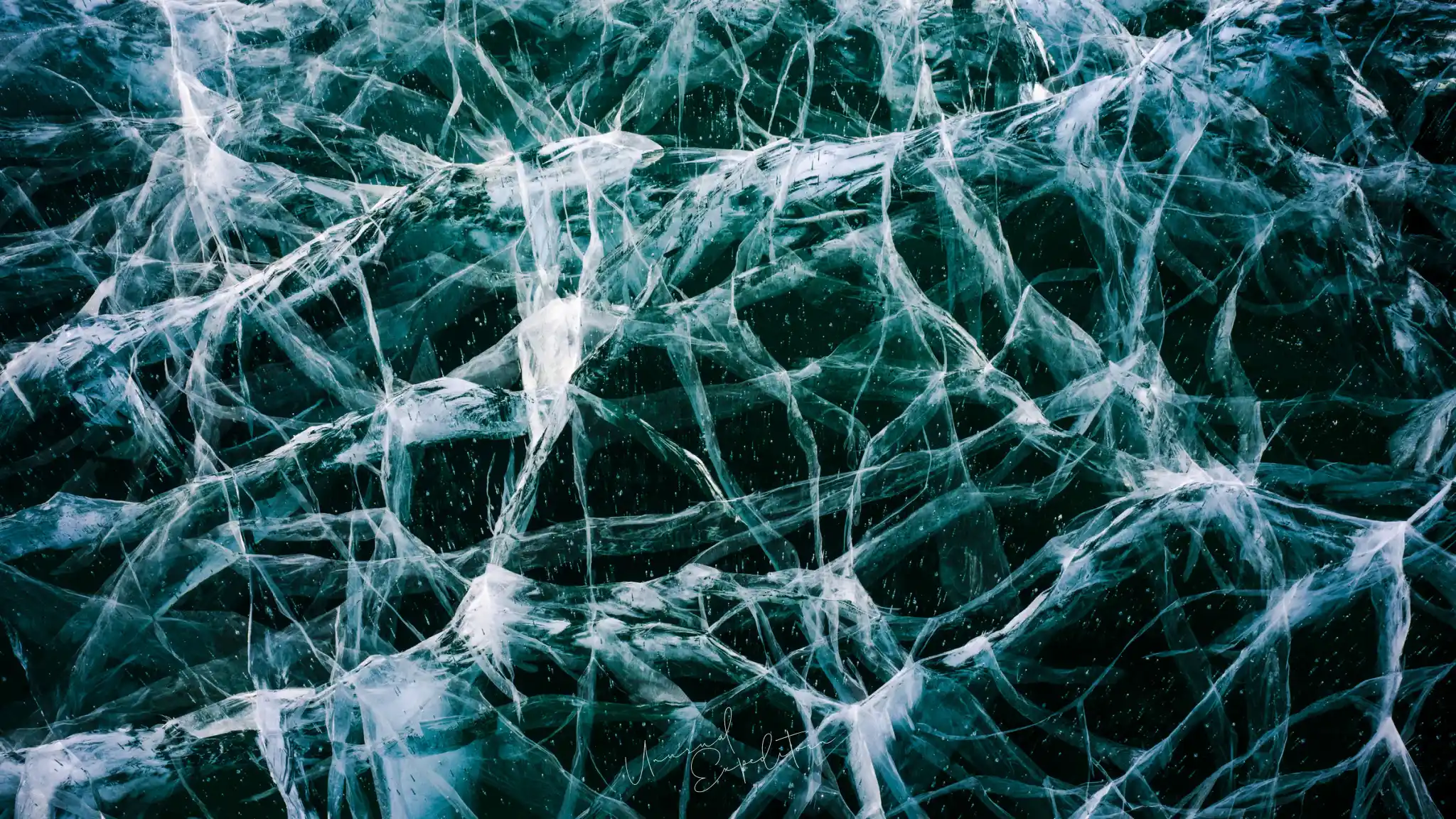
Wind and very pure water make parts of Baikal freeze clear, so the ice looks black over deep water. Cracks form constantly as the ice moves, and they draw white lines through it; in some bays frozen methane bubbles hang in the ice as white discs. This is the one Baikal view that works in flat light or at midday: shoot straight down with a 24-70mm, or lie flat for a low angle with a crack running into the frame. Sweep loose snow away with a glove. The cracks are a normal part of thick ice, but trust your driver on where to stop and where to walk.
Rocky islets ringed by ice
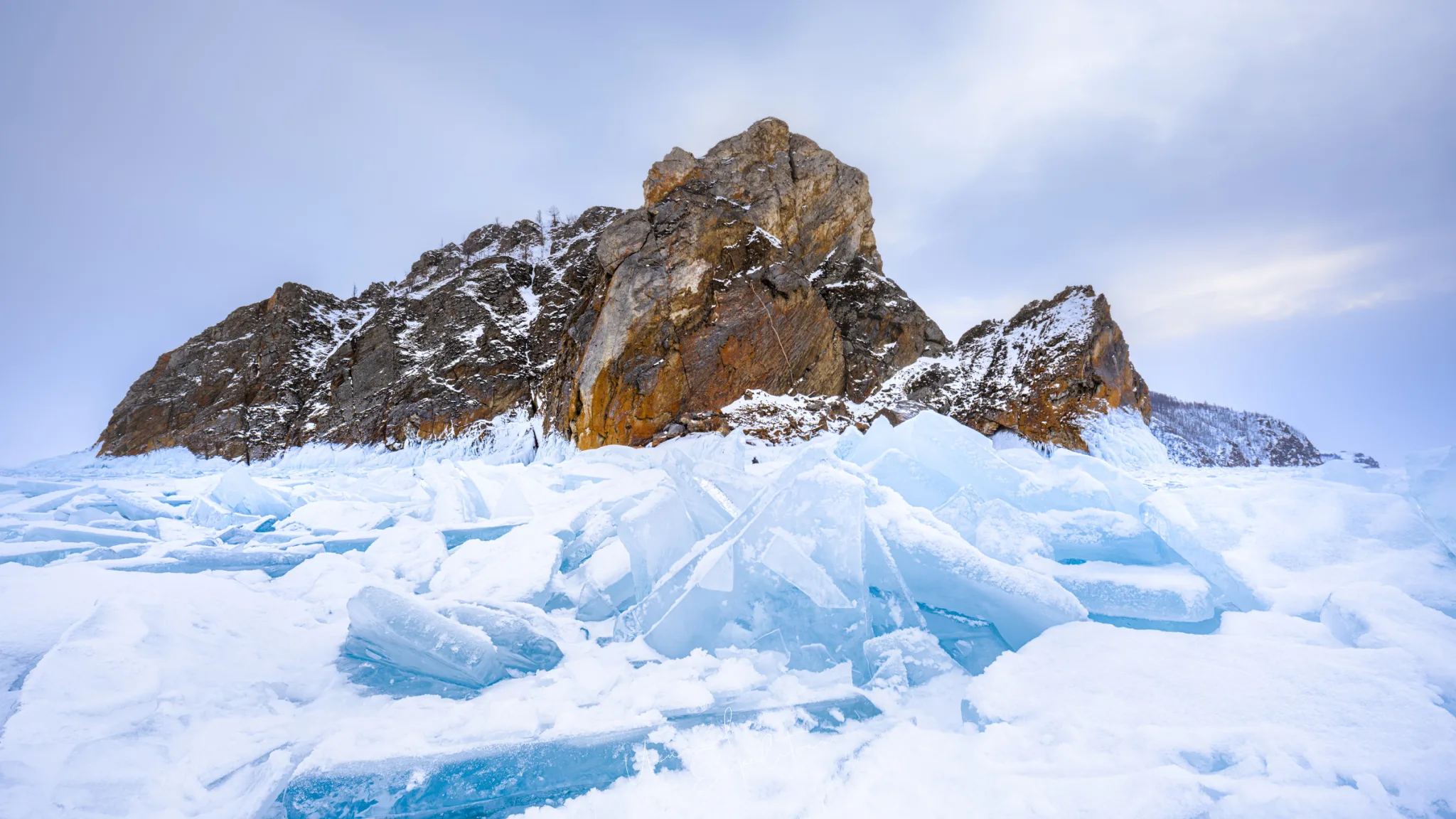
Small rocky islets stand out of the ice in several parts of the lake, and broken slabs of turquoise ice pile against their shores. They give the one view that puts warm brown rock and cold blue ice in the same frame. Morning side light shows the texture of both. Stand back with a 24-70mm so the islet sits on the horizon and the slabs fill the foreground. Like the cliffs, the ice near rocks can be broken or thin, so follow your driver's lead.
Listvyanka and the source of the Angara
Most trips start from Irkutsk, and Listvyanka is the village on the lake nearest the city, close to where the Angara, the only river flowing out of Baikal, leaves the lake. Because the current keeps it open, the water there often stays unfrozen through winter, and on cold mornings steam rises from it. We describe it in general terms here: it is a gentle first look at the lake, not one of the classic ice views above.
Practical notes for these Lake Baikal views
Official ice crossings open only when the authorities have measured enough thickness, and conditions change from week to week, so travel on the ice only with experienced local drivers. Nights in late February and early March are often between minus 15 and minus 25 degrees Celsius, and wind on the open ice makes it feel colder: carry spare batteries in an inside pocket and bag your camera before going back into a warm room. Sunglasses matter, because the glare off ice and snow is strong. For entry, money and flights, the Russia photography tour guide covers what applies across Russia.
See these Lake Baikal views with us
We have photographed Baikal on two late-winter trips, run privately. There is no scheduled Baikal departure at the moment: future dates appear on our Russia photography tours page, and a private ice trip can be arranged from there.
Lake Baikal photography tours
The next Lake Baikal departure is announced on the Lake Baikal photography tours page, with previous expeditions and all the planning guides.
Explore Lake Baikal in depth
- Lake Baikal Photography Tour: The Complete GuideRussia
- Olkhon Island Photos: Shaman Rock, Ice Caves and How to Get ThereRussia
- How to Get to Lake Baikal: Irkutsk, Russian Visa and Winter TravelRussia
- Lake Baikal Photos: What the Frozen Lake Really Looks LikeRussia
- Lake Baikal Photography Trip FAQ: Cold, Safety, Cameras and IceRussia
- Lake Baikal Ice: Photographing the Blue, Clear and Cracked IceRussia
- The Best Time to Photograph Lake Baikal IceRussia
Upcoming Photo Tours
- Egypt Photo Tour – EgyptEgypt 12 Dec 2026 To 20 Dec 2026
- Inner Mongolia Winter Owl Photo Tour – ChinaChina 01 Jan 2027 To 04 Jan 2027
- Inner Mongolia Winter Photo Tour – ChinaChina 05 Jan 2027 To 11 Jan 2027
- Mekong And Central Highland Vietnam Photo Tour - VietnamVietnam 16 Jan 2027 To 24 Jan 2027