
Mui Ne and Phan Rang Photography Tour Guide: Dunes, Fishing Coast and Cham Country
Mui Ne Vietnam and Phan Rang for photographers: dunes, the basket boat landing, Ke Ga lighthouse, sheep, Cham potters, when to go.
Mui Ne Vietnam and the Phan Rang coast to its north make up the driest, brightest stretch of the country and its richest photography outside the old towns: sand dunes that change colour through the day, a fishing fleet that lands its catch by basket boat at dawn, salt pans, fish drying yards, the Ke Ga lighthouse on its granite island, sheep in the riverbeds and the Cham potters of Bau Truc. Both of our scheduled Vietnam departures photograph it.
Entry, money and the other regions live in our Vietnam photography tour guide. Below we go through the south central coast place by place, what each one is good for, when the light works and how the eight articles on Mui Ne and Phan Rang fit together.
Mui Ne Vietnam: where the coast is and what it looks like
Mui Ne is a cape and fishing town on the coast east of Phan Thiet, roughly between Saigon and Nha Trang. Since the provincial merger of 1 July 2025, listed on the Vietnamese government portal, Mui Ne belongs to an enlarged Lam Dong province and Phan Rang to an enlarged Khanh Hoa, though most maps still say Binh Thuan and Ninh Thuan. Towards Saigon the country is green and wet like the rest of the south; from Mui Ne northwards it dries out into dunes, scrub, cactus fences, vineyards and salt flats, with granite headlands dropping into clear water.
Mui Ne sand dunes: red near town, white further out
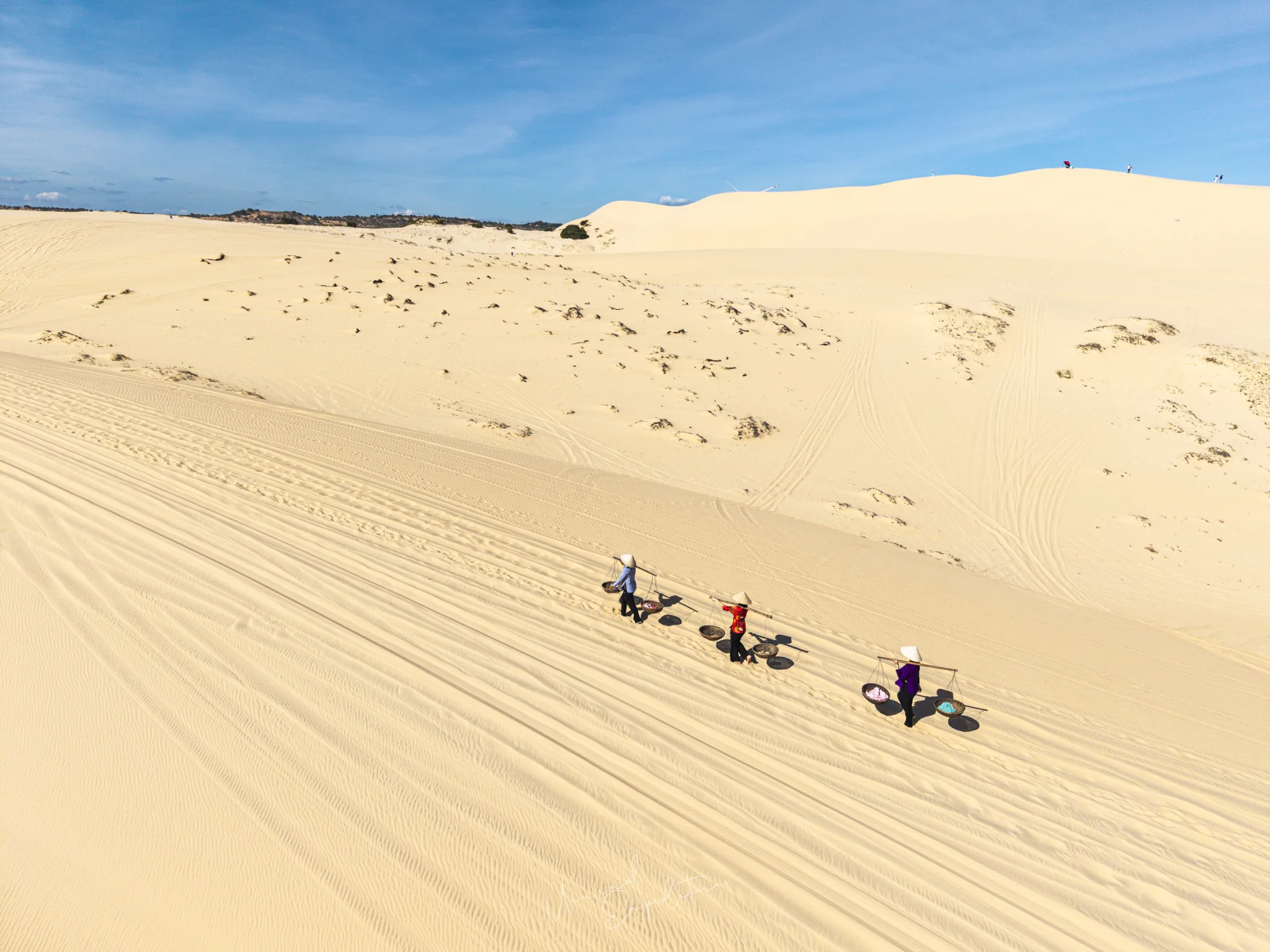
The Mui Ne sand dunes come in two kinds. The red dunes rise just behind the coast road near the fishing town, low and rounded, ochre in the late afternoon. The white dunes of Bau Trang lie further out to the northeast, much larger, pale as flour and ringed by a lotus lake; the Vietnam Airlines travel guide describes both as the area's signature sight. We go to the white dunes for sunrise, when the wind has smoothed the ripples overnight and the crowds have not arrived, and to the red dunes for a gentler evening. Our article on the Mui Ne sand dunes covers where to stand, wind, quad tracks and how we handle the arranged basket-carrier scenes that every photographer here has seen.
Mui Ne fishing village and the morning landing
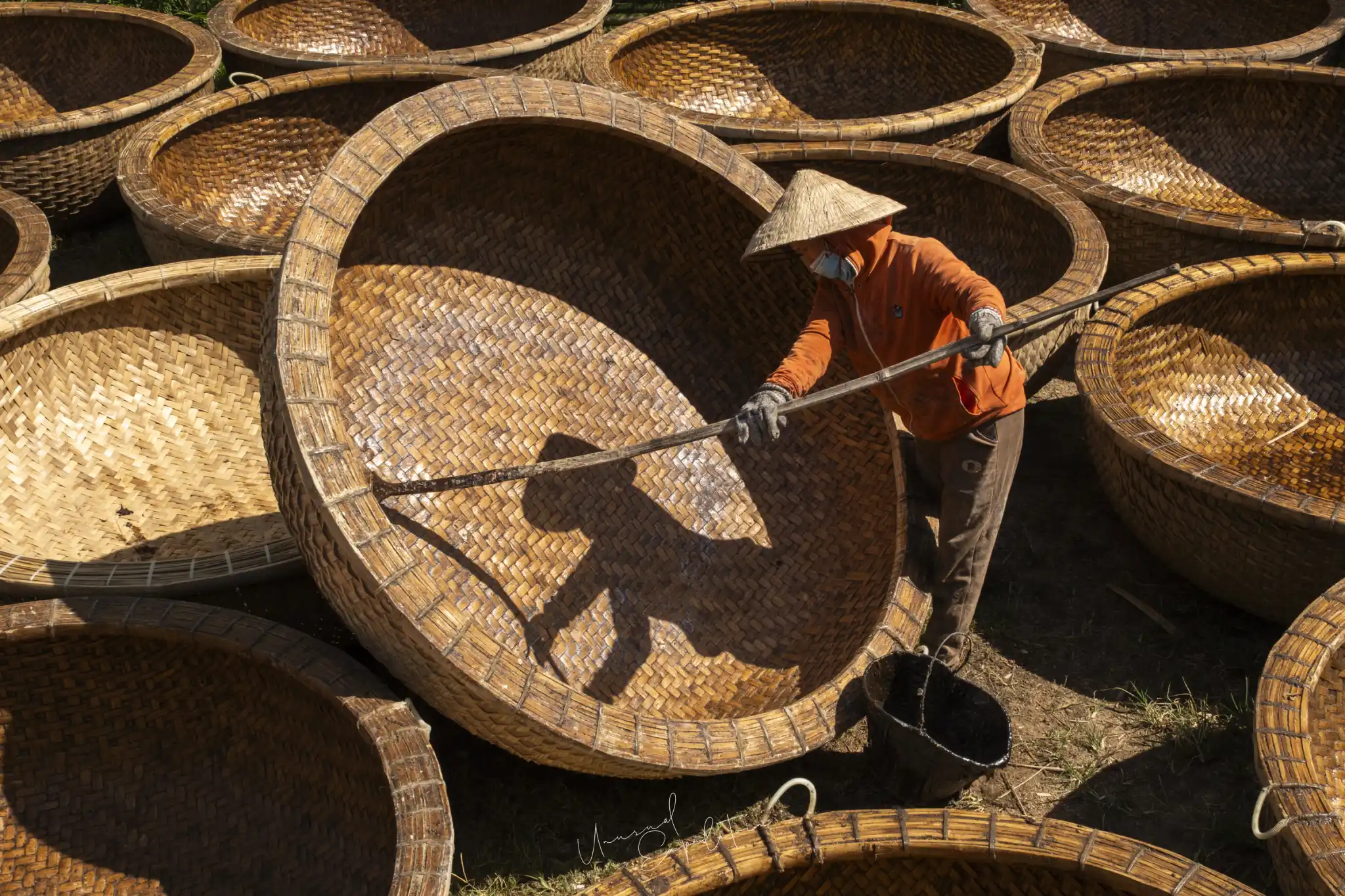
The bay in front of Mui Ne town holds one of the largest fishing fleets on this coast. The boats anchor offshore and the catch comes in by round basket boat before and around sunrise, when the beach turns into a market of buyers, ice, crates and motorbikes. The Mui Ne fishing village article explains how the landing works and how to photograph it without getting in the way. For the wider coast, with its salt fields and fish landing beaches beyond Mui Ne, see Vietnam salt fields and fishing villages.
Ke Ga lighthouse and the granite shore
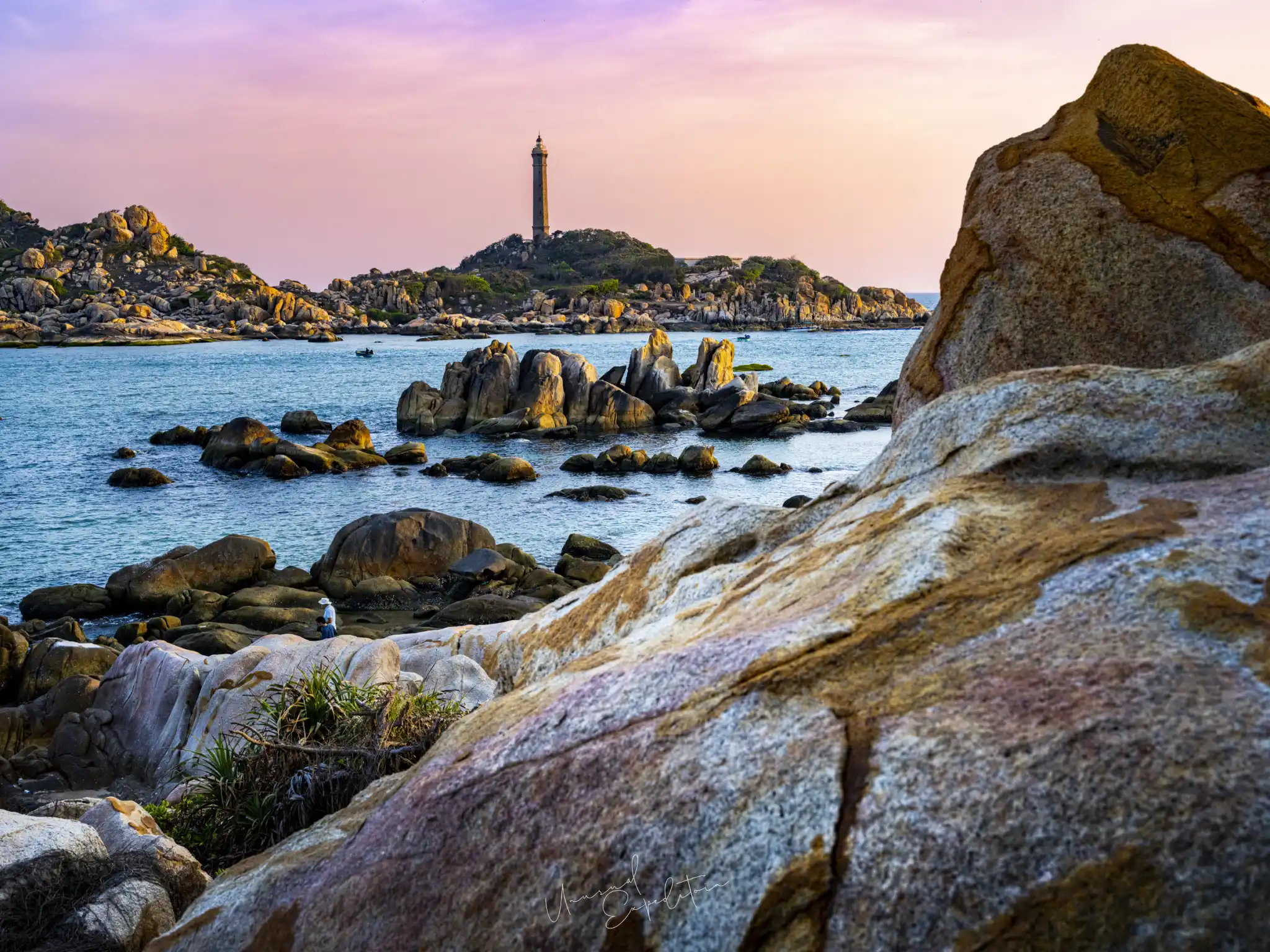
South of Phan Thiet, the Ke Ga lighthouse stands on a small granite island a short way off the cape. French engineers built it at the end of the nineteenth century, and Vietnamese tourism sources often call it the oldest lighthouse in the country. The rocks in front of it, streaked yellow, pink and grey, are the real photography: long exposures with the sea pulling around them and the tower as a small upright at the back of the frame. We have written a full Ke Ga lighthouse piece on angles, tides and the drone view.
Salt, fish drying and the working coast
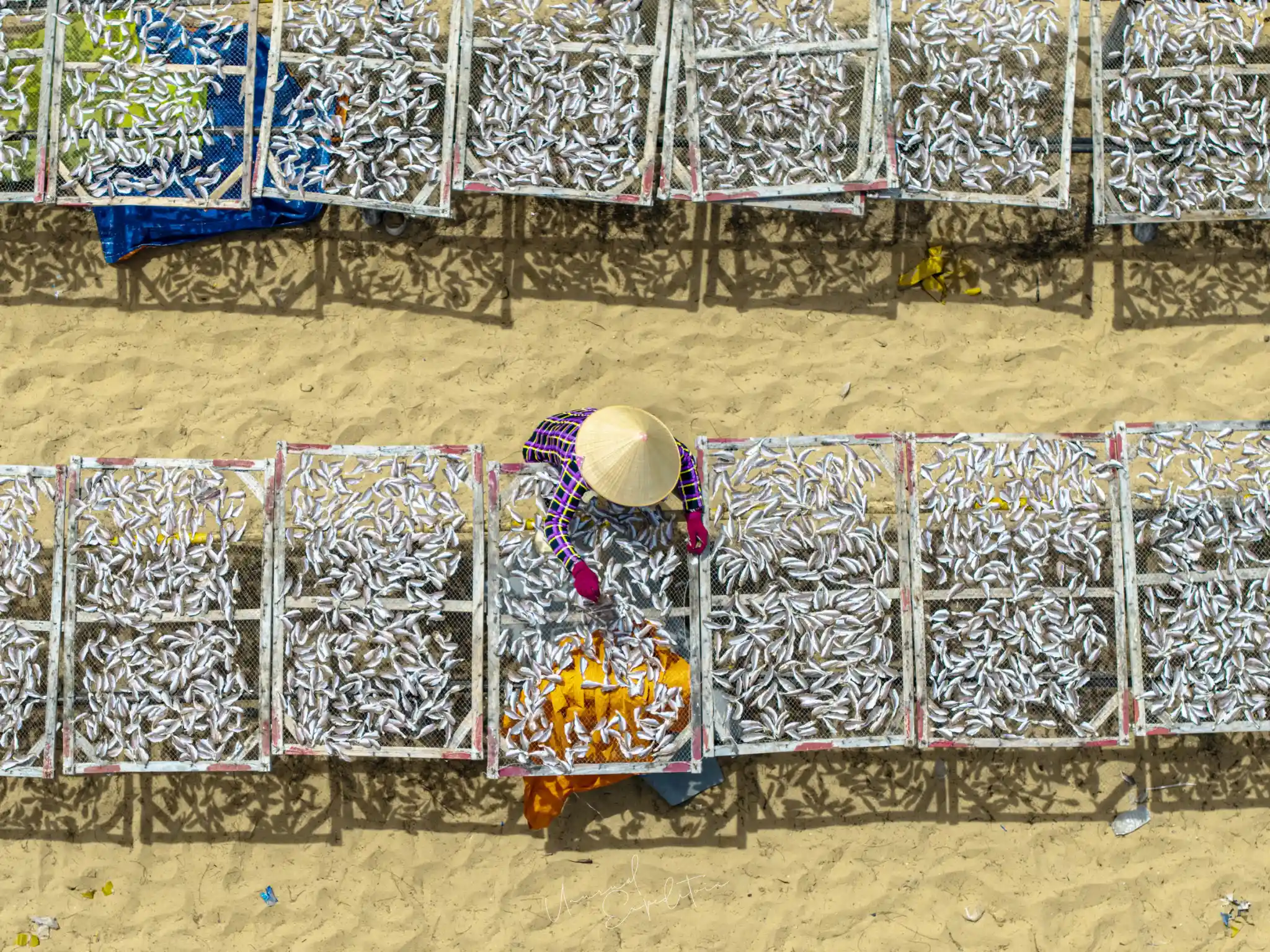
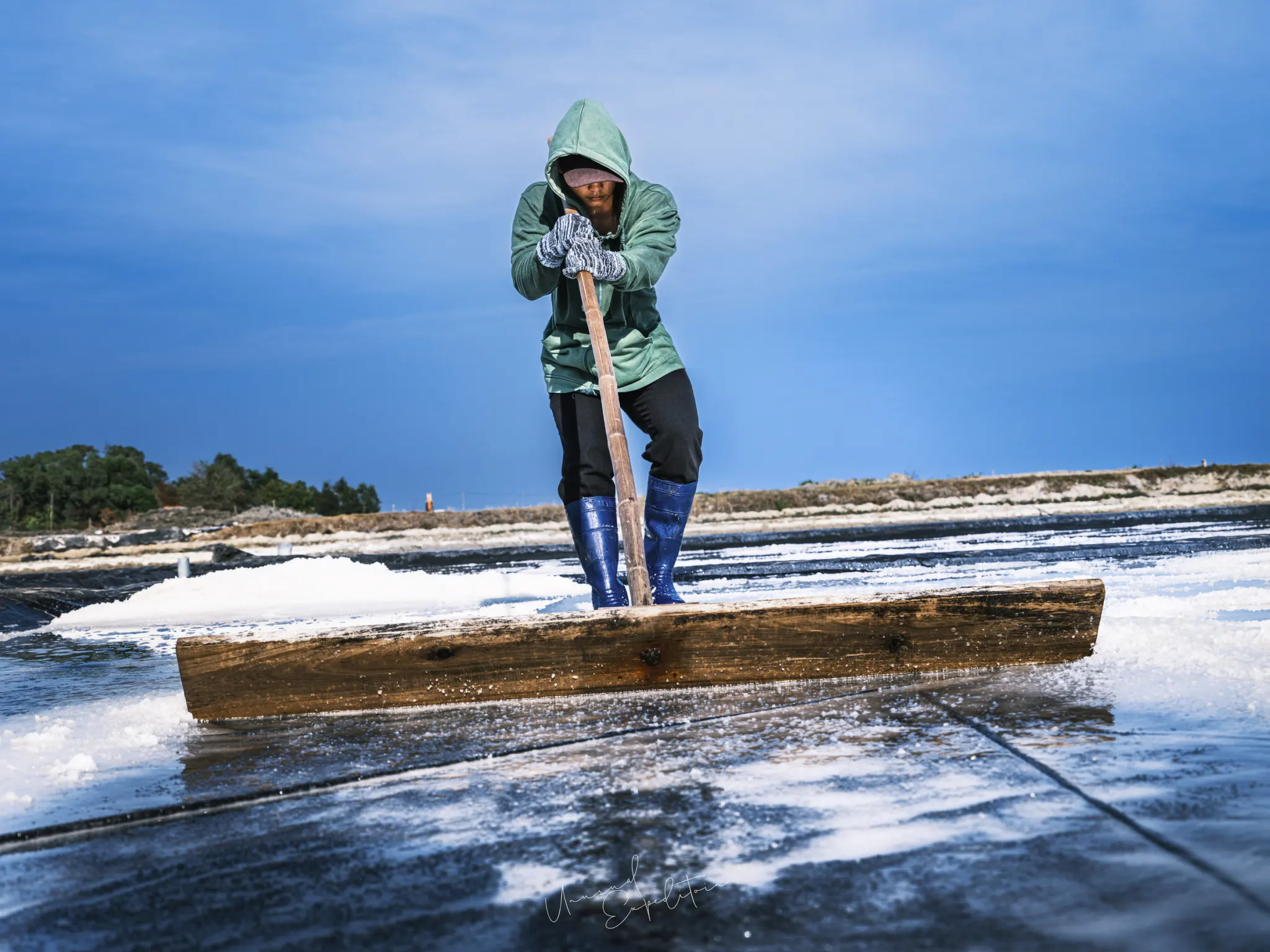
Between the dunes and the cape, the south central coast is a working landscape. Salt pans fill with seawater and are raked into white rows in the dry season; on the beaches, anchovy and small fish dry on raised racks of mesh, laid out and turned by hand. From the air both make strong patterns, and on the ground both give you people at work against a bright background. The salt harvest belongs to the early hours, before the glare.
Phan Rang Vietnam: sheep, Cham towers and the dry country
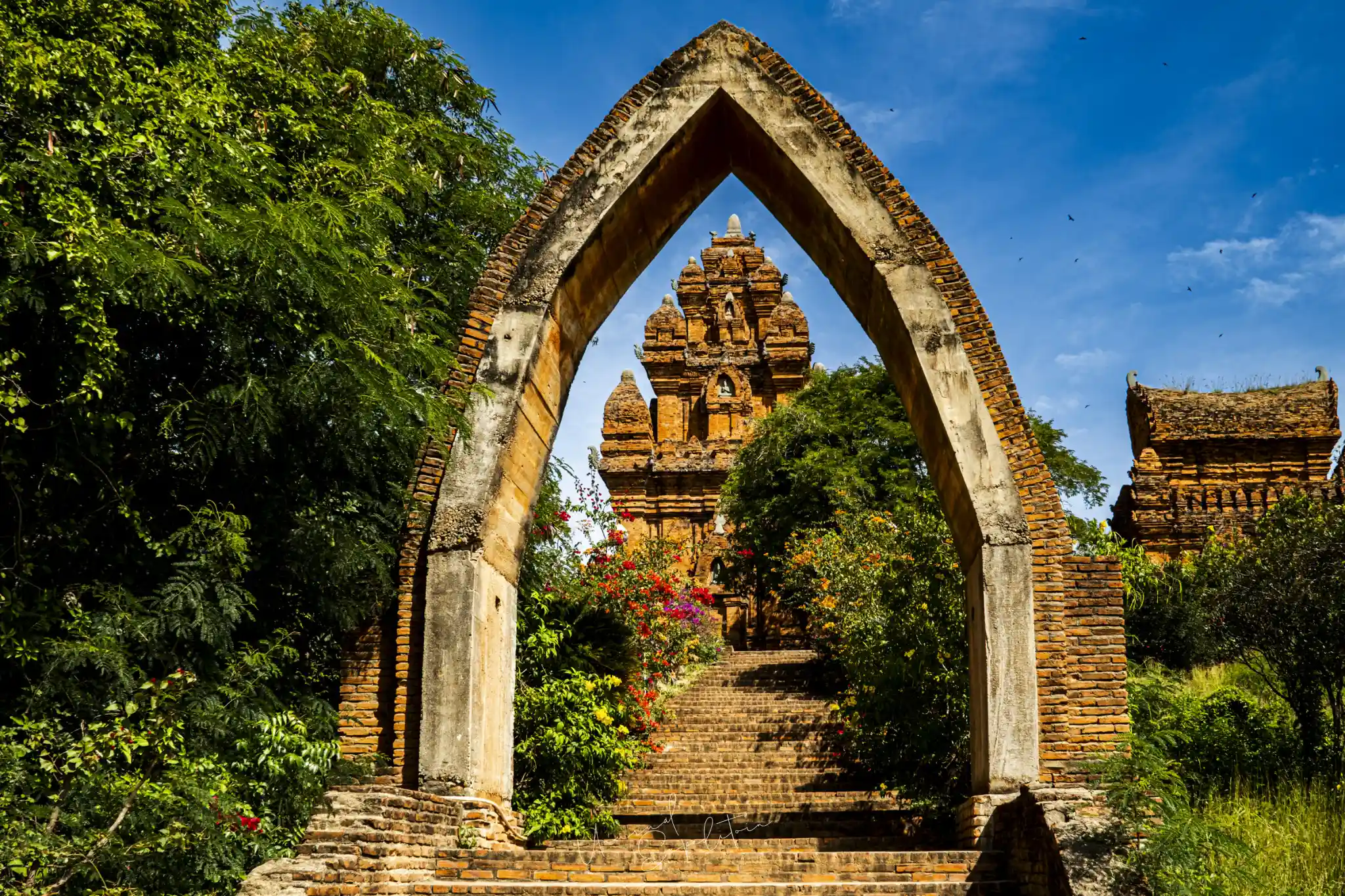
Phan Rang is the market town of the old Ninh Thuan province and the heart of Cham country in Vietnam. The Cham, whose kingdom of Champa once held this coast, still live in villages around the town, and their brick towers of Po Klong Garai stand on a hill just outside it. The land is the driest in Vietnam: herders walk flocks of sheep and goats through the shallow rivers, grapes grow on low trellises, and the hills behind are bare rock. Our Phan Rang Vietnam photos article covers the sheep, the rice paper workshops, a temple full of dragon mosaics and the fishing harbour at Vinh Hy, while Bau Truc pottery village covers the Cham potters and Po Klong Garai in detail.
Vinh Hy bay and the coast north of Phan Rang
North of Phan Rang the road climbs over Nui Chua, a dry, rocky national park that UNESCO named a world biosphere reserve in 2021, according to reporting in VnExpress. Vinh Hy bay is tucked into it: a deep, sheltered harbour of blue wooden boats under bare hills, at its best at dusk when the lights come on along the quay.
What to photograph where: a quick comparison
| Place | Main subject | Best light | Lens |
|---|---|---|---|
| White dunes, Bau Trang | Ripples, ridges, figures for scale | Sunrise | 16-35mm, 70-200mm |
| Red dunes, Mui Ne | Soft curves, warm sand | Late afternoon | 24-70mm, 70-200mm |
| Mui Ne fishing village | Basket boats, the catch, buyers | Dawn to early morning | 70-200mm, 24-70mm |
| Ke Ga lighthouse | Granite rocks, sea, tower | Dawn and dusk | 16-35mm, ND filter |
| Salt pans and fish drying | Workers, patterns from above | First light | 24-70mm, drone |
| Phan Rang countryside | Sheep, herders, vineyards | Morning and evening | 70-200mm |
| Bau Truc and Po Klong Garai | Potters, brick towers | Any light for potters, late afternoon for towers | 24-70mm |
| Vinh Hy bay | Harbour, boats, hills | Dusk | 24-70mm |
The only subjects that do not need an early start are indoors, which is how the middle of every day here gets used.
"Mui Ne and Phan Rang are where I send people who think Vietnam is all rice terraces and lanterns. The coast is dry and white and full of work. You can stand on a dune at sunrise and be in a basket boat crowd an hour later, and that range is what makes the trip."
Joseph Mak, tour leader, Unusual Expedition
Best time to photograph Mui Ne and Phan Rang
The south central coast is dry for most of the year. The settled spell runs roughly from the turn of the year into early summer, with strong wind around Mui Ne in the early months; the rains and the risk of storms come late in the year, and they are lighter here than further north. The salt harvest belongs to the dry months. Both of our departures cross this coast inside that window: the Mekong and Central Highlands tour on its way from the delta to Dalat, and the Central Vietnam tour on its way north to Hoi An and Hue. For the year-round picture across regions, read the best time to visit Vietnam for photography.
Is Mui Ne worth visiting for photographers?
Mui Ne has a beach-resort strip that most visitors never leave, and on its own that strip is ordinary. The reasons to come are a short way off it: the dunes at sunrise, the landing at the fishing village, the salt and the fish racks along the coast, and Phan Rang beyond. We weigh it up in is Mui Ne worth visiting, including what to skip.
Explore Mui Ne and Phan Rang in depth
- Mui Ne sand dunes: white dunes, red dunes and when to go
- Mui Ne fishing village: the basket boat landing at sunrise
- Ke Ga lighthouse: photographing the granite cape
- Phan Rang Vietnam photos: sheep, rice paper, temples and Vinh Hy
- Bau Truc pottery village and Po Klong Garai
- Is Mui Ne worth visiting?
- Vietnam salt fields and fishing villages
Photograph the south central coast with us
We run the coast as part of two scheduled Vietnam departures, small groups led by Joseph, indicatively S$2,700 to S$3,300 per person depending on the room. Photographers join from any country; we meet in Saigon. Current departures and the full programme are on the Vietnam photography tours page.
Join the Mui Ne and Phan Rang photography tour
Mekong And Central Highland Vietnam Photo Tour - Vietnam departs 16 Jan 2027 To 24 Jan 2027, led by Joseph Mak. Small group, photography first. All Mui Ne and Phan Rang photography tours.
Explore Mui Ne and Phan Rang in depth
- Phan Rang Vietnam Photos: Sheep, Rice Paper, Dragon Temples and Vinh Hy BayVietnam
- Mui Ne Sand Dunes: White Dunes at Sunrise, Red Dunes at SunsetVietnam
- Mui Ne Fishing Village: the Basket Boat Landing at SunriseVietnam
- Ke Ga Lighthouse: Photographing the Granite Cape at Dawn and DuskVietnam
- Is Mui Ne Worth Visiting? A Photographer's AnswerVietnam
- Bau Truc Pottery Village and Po Klong Garai: Photographing Cham Phan RangVietnam
- Vietnam Salt Fields and Fishing Villages: Photos from the South Central CoastVietnam
Upcoming Photo Tours
- Egypt Photo Tour – EgyptEgypt 12 Dec 2026 To 20 Dec 2026
- Inner Mongolia Winter Owl Photo Tour – ChinaChina 01 Jan 2027 To 04 Jan 2027
- Inner Mongolia Winter Photo Tour – ChinaChina 05 Jan 2027 To 11 Jan 2027
- Mekong And Central Highland Vietnam Photo Tour - VietnamVietnam 16 Jan 2027 To 24 Jan 2027