
Tsuru no Mai Bridge: Photographing Mount Iwaki and Japan's Longest Wooden Arch Bridge
Tsuru no Mai Bridge in Aomori: the triple-arch wooden bridge, sunset beside Mount Iwaki, blue hour, reeds, swans and the seasons.
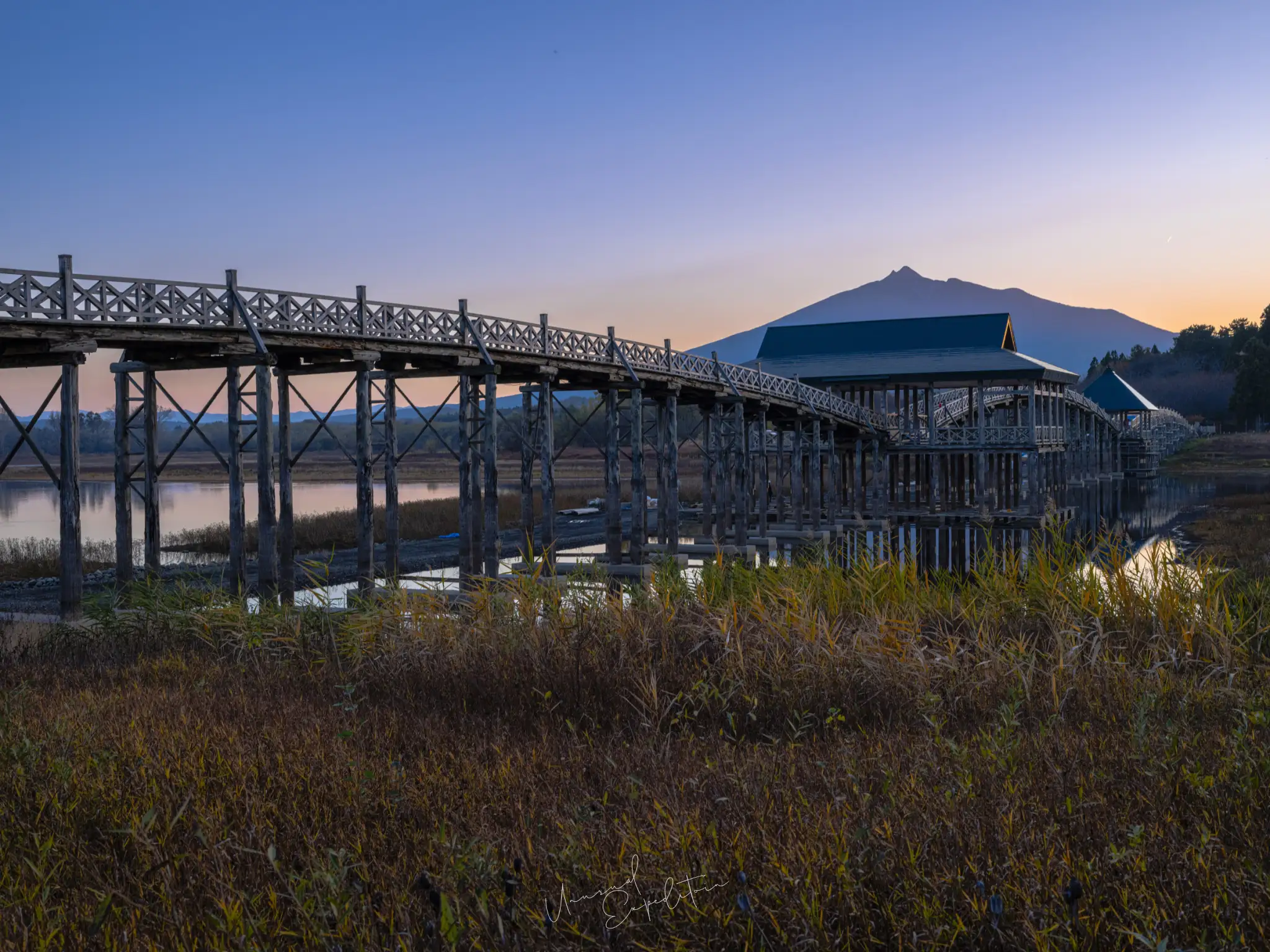
The Tsuru no Mai Bridge is a wooden footbridge about 300 metres long across Tsugaru Fujimi Lake in Tsuruta, Aomori, with three graceful arches said to recall a crane spreading its wings, which is what its name means. Built of local Aomori cypress, it is described as Japan's longest triple-arch wooden bridge, and it lines up with Mount Iwaki, the Tsugaru Fuji, which stands to the south-west, so in autumn the sun sets beside the mountain at the end of the bridge.
The bridge is one of the Tsugaru landscapes in our Aomori photography tour guide. These photographs are our own, from an autumn evening at the lake; we hold the rights to them, and the notes come from standing on its shore ourselves. Here we cover where to stand, the light from morning to blue hour, the seasons and the wildlife of the lake.
Tsuru no Mai Bridge: the bridge and the lake
The Tsuru no Mai Bridge was completed in 1994 and is built of Aomori hiba, the local cypress, according to Aomori Tourism and the government publication Highlighting Japan. It crosses Tsugaru Fujimi Lake, a reservoir in the rice country of the Tsugaru plain, and links the shore with a park on the other side. The bridge is open to walk across, and the deck itself makes a good leading line towards the mountain. Mount Iwaki, at 1,625 metres the highest peak in Aomori, rises alone from the plain to the south-west, and its symmetrical shape is why people call it the Tsugaru Fuji. The bridge, the lake and the mountain are what make this one of the most photographed views in the prefecture.
Sunset and sunrise at the Tsuru no Mai Bridge
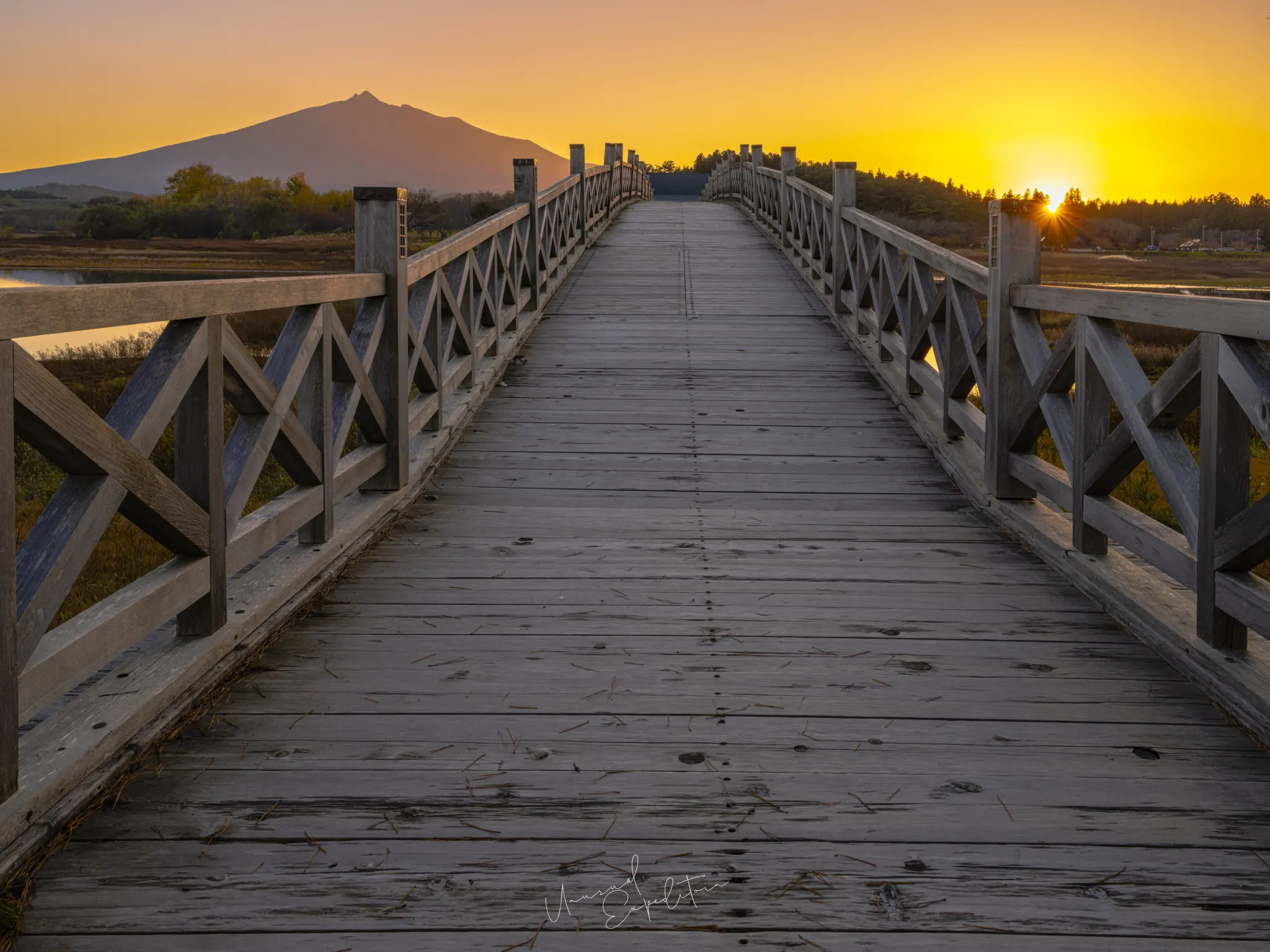
Mount Iwaki stands to the south-west of the lake, so the two ends of the day give two different pictures. In the late afternoon of autumn the sun goes down beside the mountain, and from the bridge deck you can frame the setting sun next to the peak at the end of the boards, then the arches and the mountain in silhouette against an orange sky. The blue hour after sunset, with the lake still holding the colour, is often as good as the sunset itself. In the morning the light comes from behind you, lighting the mountain and the arches from the front, and calm mornings bring reflections of the curves in still water. A tripod is essential for the low light, and bracketing helps balance the bright sky and the dark shore.
Where to stand: shore, deck and reeds
There are three main kinds of viewpoint. From the shore near the bridge, with a 24-70mm lens, the full sweep of the three arches leads towards the mountain. On the bridge deck itself, the boards and railings make strong lines towards the peak and the rising sun. From further along the shore, with a 70-200mm lens, you can compress the bridge, the lake and the mountain, and use the reeds and pampas grass of the shoreline as a soft foreground. In autumn the pampas plumes catch the light and frame the long low line of the bridge; in spring, cherry trees bloom in the park around the lake.
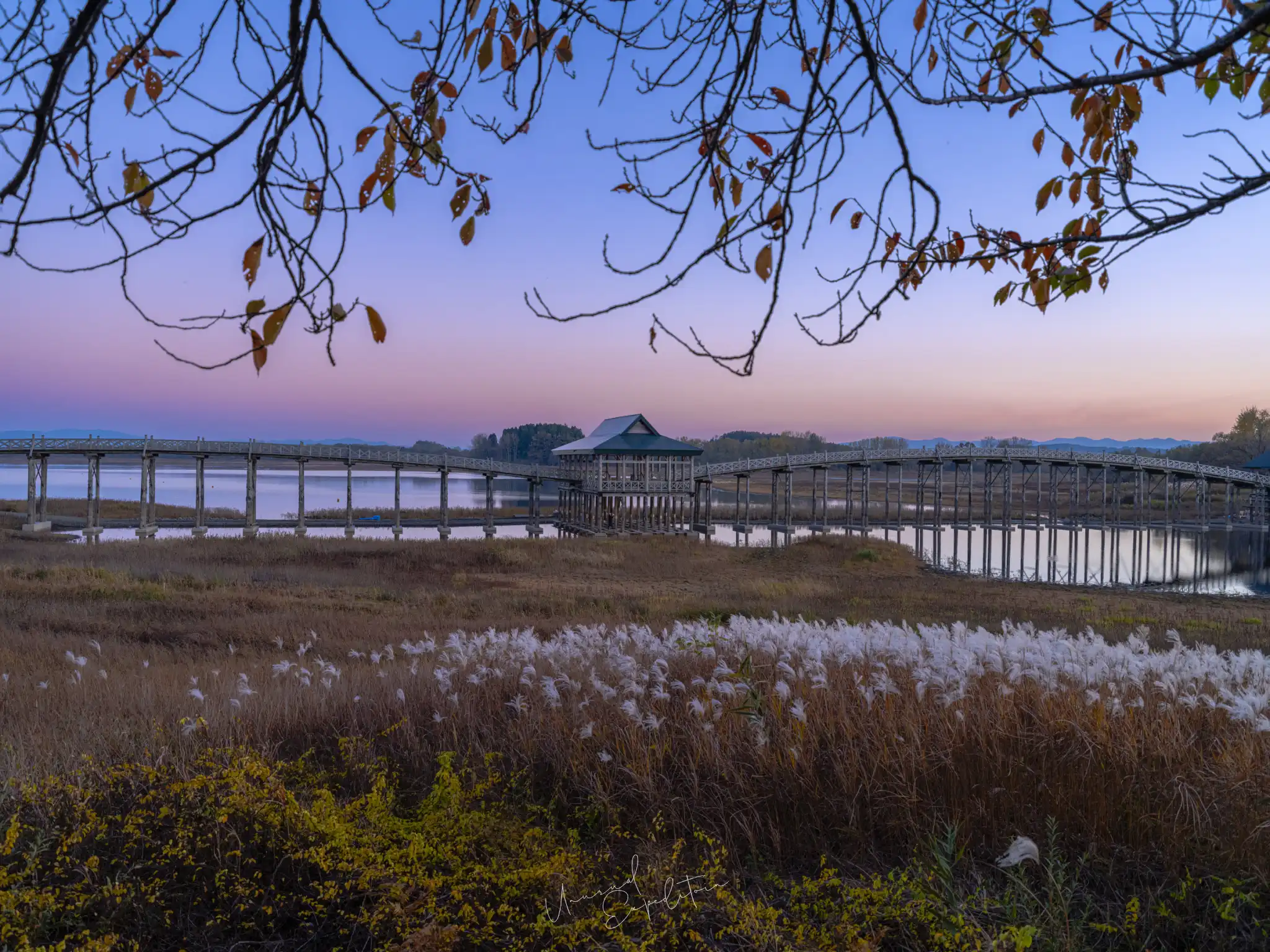
Stay after the sun has gone behind Iwaki. The crowd leaves, the sky turns from orange to blue, and the long line of the bridge over the water is at its most beautiful.
Joseph Mak, tour leader, Unusual Expedition
Mount Iwaki, the Tsugaru Fuji
Mount Iwaki is the backdrop to almost every picture of the bridge, and to much of the Tsugaru region. A single volcanic cone standing alone above the plain, it is visible from Hirosaki, from the apple orchards and from the coast, and its outline changes with the season: snow-capped in spring, dark green in summer, brown and rust in autumn and white in winter. Clouds often sit on the summit, so check the sky before you commit to an evening at the lake; a clear mountain matters more to this picture than anything else. A 70-200mm lens from the far shore makes the mountain larger behind the arches, while a wide lens on the deck makes it smaller but places it at the end of a long line of boards.
Swans and birds on Tsugaru Fujimi Lake
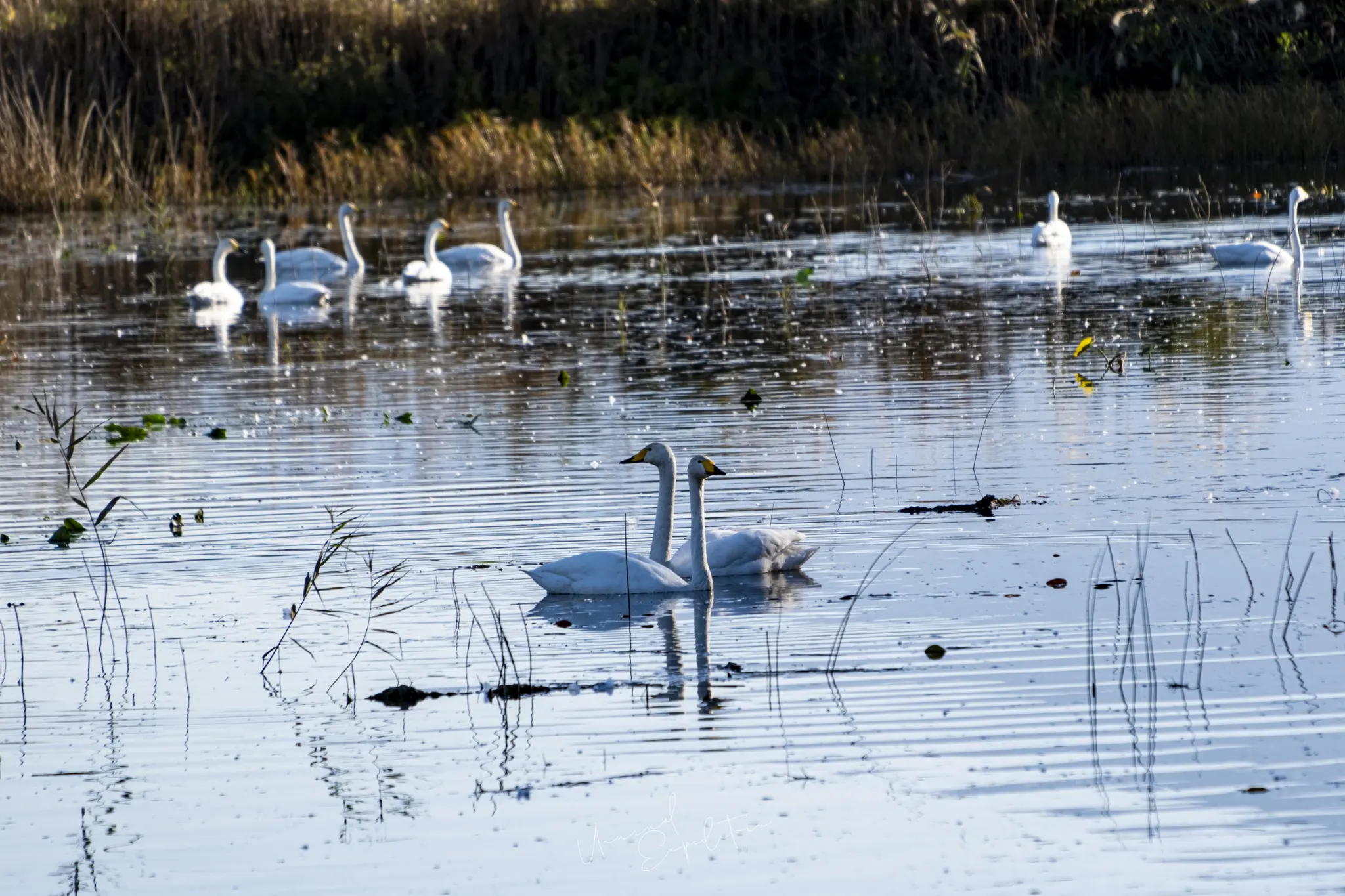
Tsugaru Fujimi Lake also attracts water birds. In the cooler months we have photographed whooper swans on the reedy water near the shore, and ducks and herons use the lake too. A 100-400mm lens is worth having in the bag, both for the birds and for picking out details of the bridge against the mountain. Keep a respectful distance from the swans, and do not feed them. If you want swans in larger numbers and closer, our Hokkaido trips visit the hot spring shore of Lake Kussharo in winter.
Tsuru no Mai Bridge through the seasons
| Season | What you see | Best light | Lens |
|---|---|---|---|
| Spring | Cherry blossom around the lake, snow on Iwaki | Calm morning, front light | 24-70mm, 70-200mm |
| Summer | Green fields and hills | Early morning | 24-70mm |
| Autumn | Golden reeds and pampas grass, swans | Sunset beside Iwaki, blue hour | 24-70mm, 100-400mm |
| Winter | Snow on the arches and the mountain | Soft light after snowfall | 24-70mm |
Clear, windless mornings matter more than the season, because the reflection is half of the picture.
Getting to the bridge and combining it
The bridge is in the countryside of Tsuruta Town, away from the main rail stations, so most photographers come by car, especially for the light at either end of the day. It combines well with the winding torii of Takayama Inari Shrine on the coast and with Hirosaki, covered in our Hirosaki cherry blossom and Hirosaki Castle autumn guides. Bring warm clothes, even in spring and autumn, since the lake shore turns cold quickly once the sun has gone.
Photograph the Tsuru no Mai Bridge with us
We include the bridge in private trips through the Tsugaru region on request, with a driver and all arrangements made for you; photography coaching can be added at extra cost. See our private tours and the Japan photography tours page.
Ask us about the Tsuru no Mai Bridge
Join the Aomori photography tour
Kyushu, Shikoku And Setouchi Photography Journey departs 25 Sep 2027 To 05 Oct 2027, led by Joseph Mak. Small group, photography first. All Aomori photography tours.
Explore Aomori in depth
- Aomori Photography Tour Guide: Hirosaki Blossom, Oirase Autumn and the Tsugaru CoastJapan
- Takayama Inari Shrine, Aomori: Photographing the Winding Torii of TsugaruJapan
- Oirase Gorge: Photographing the Stream, the Waterfalls and the Autumn ColourJapan
- Hirosaki Cherry Blossom: Photographing the Castle, the Moats and the FestivalJapan
- Hirosaki Castle in Autumn: Maples, the Keep, Saishoin Pagoda and Neputa VillageJapan
- Hachinohe Morning Market: Photographing the Tatehana Wharf on a SundayJapan
- Autumn in Aomori: Lake Towada, Towada Shrine and When the Colour ComesJapan
Upcoming Photo Tours
- Egypt Photo Tour – EgyptEgypt 12 Dec 2026 To 20 Dec 2026
- Inner Mongolia Winter Owl Photo Tour – ChinaChina 01 Jan 2027 To 04 Jan 2027
- Inner Mongolia Winter Photo Tour – ChinaChina 05 Jan 2027 To 11 Jan 2027
- Mekong And Central Highland Vietnam Photo Tour - VietnamVietnam 16 Jan 2027 To 24 Jan 2027