
Antananarivo Street Photography: A Day in Tana
A photographer's day in Antananarivo: the Rova and upper town, Analakely market, Lemur Park, dusk on the steps, rice terraces.
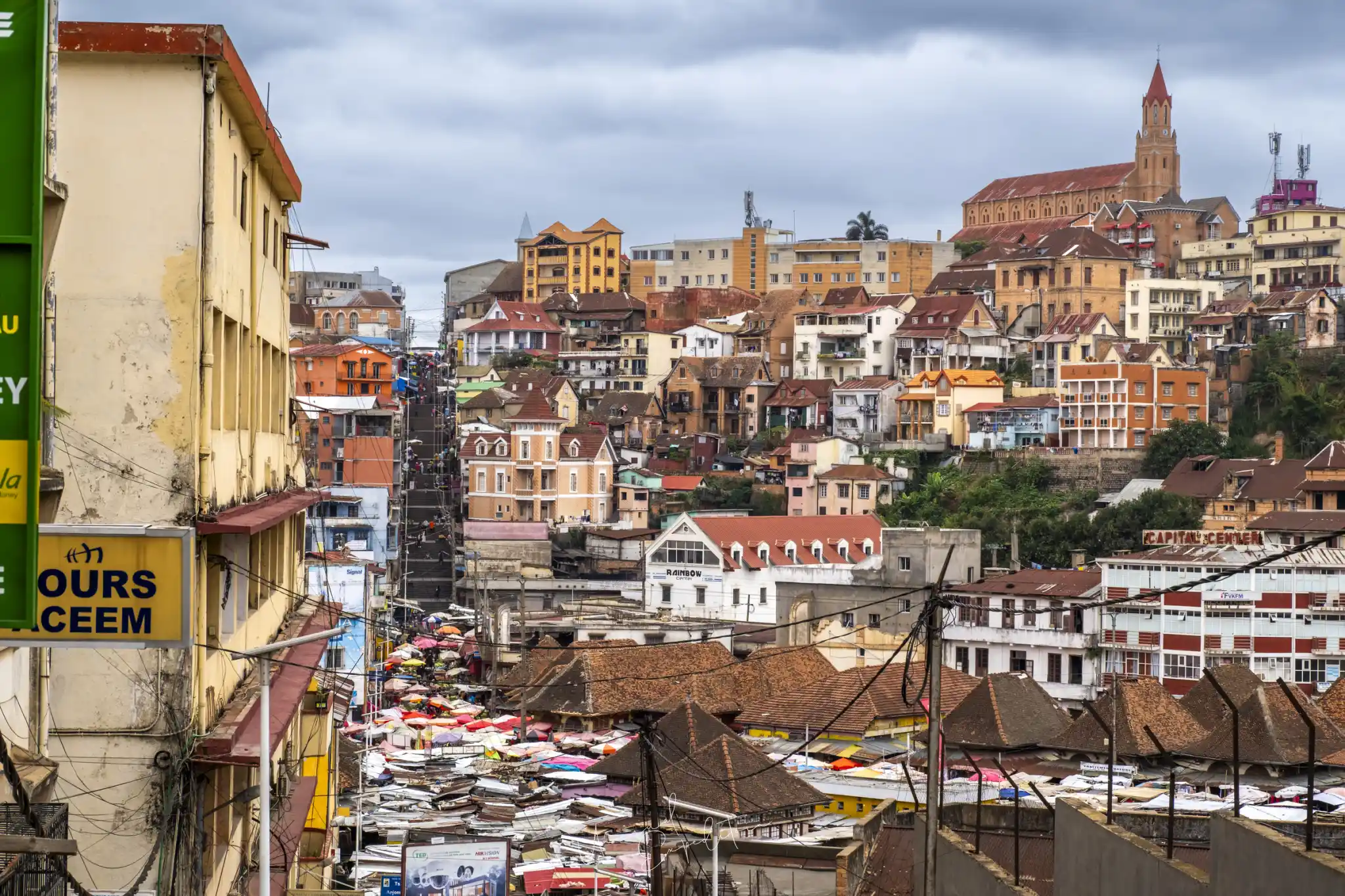
Antananarivo is a city of about three million people built across a dozen hills at 1,300 metres, with a royal palace on the highest, markets in the valleys and stepped streets between. Most tours use it as an airport. Our April trip gives it a full day, Day 5, between the west coast and the rainforest, and this guide is about using that day well: the Rova and the upper town in the morning, the markets through the middle, Lemur Park in the afternoon, and the streets in the last light.
It is the city chapter of the complete Madagascar photography tour guide.
Tana in one morning: the Rova and the upper town
The Rova of Antananarivo is the palace complex of the Merina kings and queens on the summit of the highest hill, rebuilt after a fire in 1995 and reopened in 2020. The point for a photographer is less the building than the position: from the terraces the whole city falls away in tiers of red-brick houses, tin roofs and church spires, with Lake Anosy and its jacaranda ring in the bowl below. Morning light comes from behind you and lights the city; afternoon light is in your face. Walk down from the Rova through the upper town, where the old Merina houses have wooden balconies and the streets are flights of steps, and where early light pours along the lanes between the shadows.
The markets
Tana's markets are where the day's people pictures come from. Analakely, in the lower town below the Avenue de l'Independance, is the big one: spices, baskets, cloth, meat, woodwork, with the sellers under umbrellas and the crowd moving through. The stairs down from the upper town to Analakely are lined with stalls and are a frame in themselves. Pochard market and the handicraft stalls near the Digue road are quieter and better for carved wood and raffia. Markets are busiest from 07:00 to 10:00. A 24-70mm or a 35mm prime is the lens, kept close to the body. Ask before a portrait; most sellers say yes, and a purchase afterwards is the courtesy. Keep the camera strap short and the bag in front of you. The city is safe by day for a group with a guide; it is not a place to wander alone with a camera after dark, as Is Madagascar safe? explains.

What makes Tana different to photograph
Three things. The hills, which put a background of houses behind every street scene and let you shoot down into crowds from above. The colour, which is red: brick, earth, the laterite of the walls, against which the printed cloth of the women stands out. And the mix of Asia and Africa in the faces, the food and the rice paddies that come right into the city, a reminder that the Malagasy came from Borneo as well as from the African coast. Street photography here rewards a wide lens used close and a willingness to climb.
"People hurry through Tana to get to the lemurs. I give it a day because it is the only big city on the trip and the pictures are nothing like anywhere else in Africa. Shoot it from above in the morning, from inside the markets at midday, and from the steps at dusk."
Joseph Mak, tour leader, Unusual Expedition
Lemur Park in the afternoon
At about 14:00 we drive 22 kilometres west of the city to Lemur Park, a private reserve along a river where ring-tailed lemurs, brown lemurs and sifakas range free among the trees. It is the first lemur encounter of the trip and the easiest, which is why it sits on the city day: a change of lens and subject after a morning of streets. The lemur sessions across the week are compared in Lemur photography at Andasibe.
Dusk on the steps
Back in the city for the last hour of light, the steps between the lower town and the upper town fill with people going home, and the sun comes low along the lanes from the west. Shoot into the light for silhouettes on the steps, or with your back to it for the glow on faces. Blue hour over Lake Anosy, with the city lights coming on in the tiers above, is the closing frame. Then dinner; the city after dark is for the hotel.
The rice terraces east of the city
The following morning, Day 6, the road to Andasibe climbs out of Tana past terraced rice paddies, red-brick villages and markets along the RN2. We stop. Terraces in flat morning light with workers in them, a polariser to deepen the water, and the long lens to compress the terraces into bands. This is the transition from highlands to rainforest, and the light changes with it, as Madagascar light and weather, region by region describes.
Lake Anosy and the jacarandas
Lake Anosy sits in the centre of the lower town, a heart-shaped artificial lake with a war memorial on an island and a ring of jacaranda trees around it. In October and November the jacarandas flower purple and the lake becomes the city's postcard; in April they are green, and the lake is a mirror for the hill of the upper town at blue hour. The walk around it is twenty minutes and safe in daylight with the group, and the path on the eastern side gives the view up to the Rova with the water in the foreground.
Practicalities for the city day
Comfortable shoes for steps, a small bag, water, and nothing valuable visible. Mornings in April are cool, around 15 degrees, afternoons warm and sometimes stormy. The hotel is central, and the day ends early enough to copy cards and charge before Andasibe, where power is less reliable.
Give the city its day
The Madagascar Photo Tour, 11 to 19 April 2027 spends Day 5 in Antananarivo and starts and ends there. It is a day most trips skip, and one of the reasons this one is different.
Join the Madagascar photography tour
Madagascar Photo Tour – Madagascar departs 11 Apr 2027 To 19 Apr 2027, led by Joseph Mak. Small group, photography first. All Madagascar photography tours.
Explore Madagascar in depth
- The Complete Guide to a Madagascar Photography TourMadagascar
- What to Pack for a Madagascar Photo TourMadagascar
- The Milky Way over the Baobabs: Night Photography in MadagascarMadagascar
- Madagascar Tour from Singapore: Flights, Visa and What to ExpectMadagascar
- Is Madagascar Safe? Health, Roads and Drones for PhotographersMadagascar
- What a Madagascar Photo Tour Costs, Line by LineMadagascar
- Twelve Questions Before You Book a Madagascar Photo TourMadagascar
- Madagascar or an African Safari for Wildlife Photography?Madagascar
- Madagascar Light and Weather, Region by RegionMadagascar
- Is Madagascar Worth Visiting for a Photographer? A Straight AnswerMadagascar
- Lemur Photography at Andasibe and BeyondMadagascar
- The Best Time to Visit Madagascar for PhotographyMadagascar
Upcoming Photo Tours
- Egypt Photo Tour – EgyptEgypt 12 Dec 2026 To 20 Dec 2026
- Inner Mongolia Winter Owl Photo Tour – ChinaChina 01 Jan 2027 To 04 Jan 2027
- Inner Mongolia Winter Photo Tour – ChinaChina 05 Jan 2027 To 11 Jan 2027
- Mekong And Central Highland Vietnam Photo Tour - VietnamVietnam 16 Jan 2027 To 24 Jan 2027