
The Milky Way over the Baobabs: Night Photography in Madagascar
Milky Way at the Avenue of the Baobabs: April timing and moon, settings, focusing in the dark, lighting the trees, the night walk.
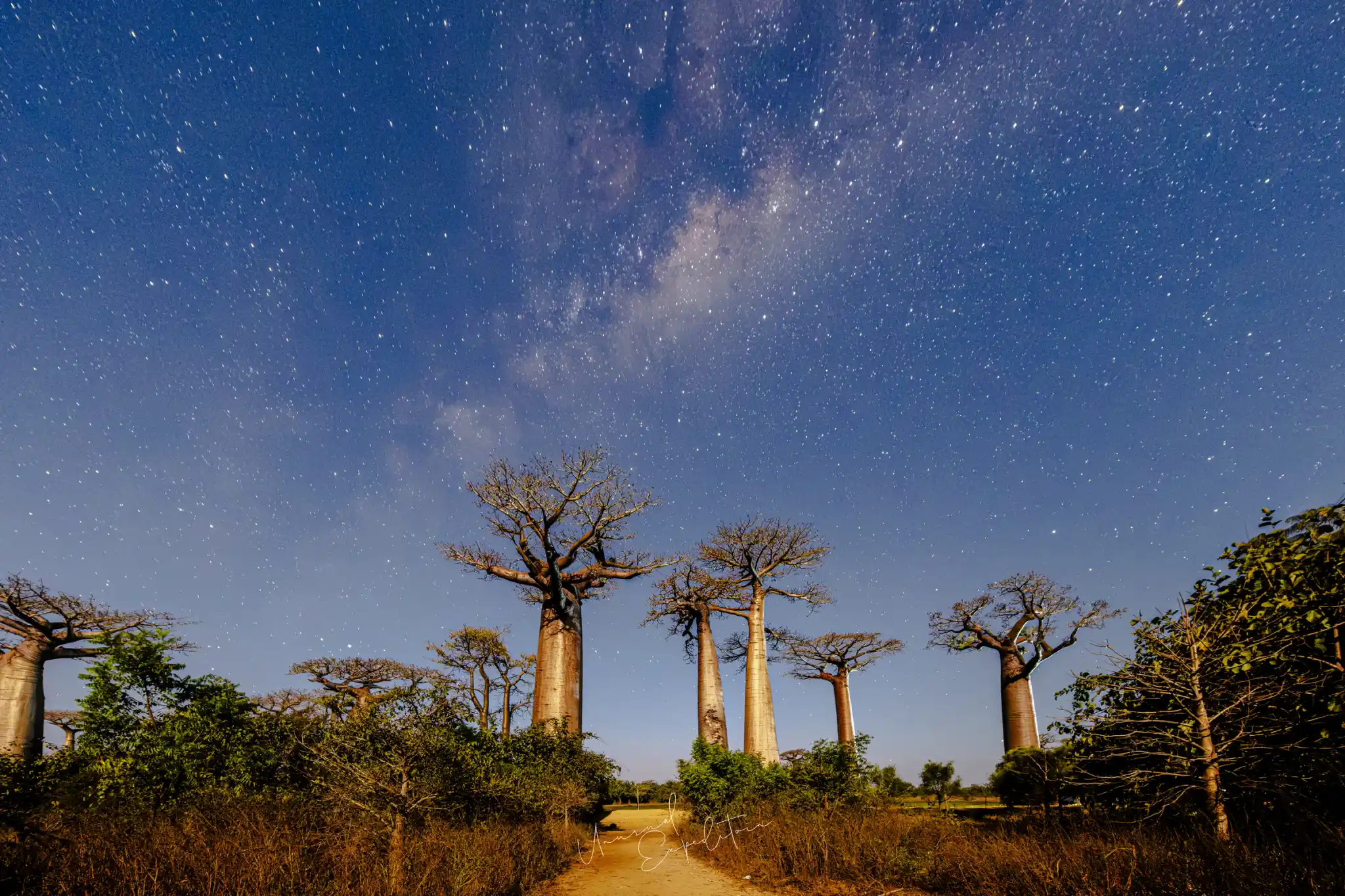
Photographing the Milky Way over the Avenue of the Baobabs is the night the whole west-coast leg is built around. The site is dark, the trees are the best foreground in Madagascar, and in April the galactic core rises after midnight and stands high before dawn. Our 2027 dates fall a few days after new moon, so the moon is gone by the small hours. Timing, settings, focusing in the dark, lighting the trees, and the second night of the trip, the forest at Andasibe, follow.
It is the night chapter of the complete Madagascar photography tour guide. The daytime sessions at the same trees are in Photographing the Avenue of the Baobabs.
Why the Avenue works at night
Morondava, the nearest town, is twenty kilometres away and small; the villages along the road have no electricity. The sky above the baobabs is as dark as a desert. The trees are thirty metres tall with bare, straight trunks and flat crowns, which read as clean silhouettes against stars in a way that a bushy tree never does, and the road gives a leading line into the frame. At 20 degrees south the galactic centre passes almost overhead, so the arch of the Milky Way spans the sky instead of skimming the horizon.
Timing on the April 2027 dates
In mid April the core of the Milky Way rises in the east after about 01:00 and is high in the south-east by 04:00, before astronomical twilight begins around 05:00. New moon is around 6 April 2027, so on the nights of 13 and 14 April the moon is a thin crescent that sets in the early evening. The practical plan is two visits: a late evening session after dinner for the stars without the core, when the arch is low and the trees are silhouetted against it, and a pre-dawn session from about 03:30 for the core overhead, running straight into the sunrise session. Guests choose one or both. The reasons the date was picked are in The best time for a Madagascar photography trip.

Settings that work
A wide prime, 14-24mm, at its widest aperture between f/1.4 and f/2.8. Shutter between 10 and 20 seconds; longer than that at 14mm and the stars begin to trail. ISO 3200 to 6400, higher on a modern full-frame body. White balance around 3,800 to 4,200 Kelvin to keep the sky neutral, not orange. Raw, always. Turn off long-exposure noise reduction, which doubles your time per frame, and shoot a dark frame at the end instead. A wide zoom at f/2.8 works; f/4 means ISO 12800 and noise, so borrow a prime if you do not own one.
Focusing in the dark
Autofocus will not lock on stars. Use live view at maximum magnification on the brightest star or a distant light, turn the ring until it is a point, and tape the ring. Do it before you leave the hotel if the lens has a hard infinity stop, and check it on the first frame at the Avenue; a frame that looks sharp on the back of the camera at normal size can still be soft. Focus once, then do not touch the lens.
"The mistake I see most at the Avenue is people lighting the trees like a stage. One sweep of a small torch, low power, for two or three seconds of a twenty-second exposure, is all a baobab needs. Any more and you have a tree with a floodlight on it and no stars."
Joseph Mak, tour leader, Unusual Expedition
Lighting the baobabs
Without light the trunks are black shapes, which is a legitimate picture. With a little light they have texture and the picture has depth. A small LED torch, warm rather than blue, swept once across the trunks from the side during the exposure is enough; practise the sweep on the first frame and reduce it. Keep the light off the ground in front of you or it blows out. Coordinate with the group: one person's torch is everyone else's ruined frame, so we light in turns. A red headtorch is for your own controls only.
Compositions
The receding avenue with the arch above it, from the southern end looking north. A single tree with the core directly over its crown, which in April means a pre-dawn frame looking south-east. The road as a leading line with two trees framing the sky. A low viewpoint with the camera almost on the ground so the trunks tower. Panoramas of the whole arch, shot as a row of vertical frames and stitched later. Put a person under a tree with a torch pointed upward for one frame, because it gives the scale that nothing else does.
The second night sky: Andasibe
The other night of the trip is a different kind. On Day 6 at Andasibe the sky is usually clouded and the subject is the forest floor: mouse lemurs, chameleons and frogs found by torchlight on a guided walk. It is macro photography with a flash or a small LED, not astrophotography, and the gear for both is in What to pack for a Madagascar photo tour. The two nights together are a large part of why the trip is a photography tour and not a sightseeing one.
Processing the frames
A single 20-second frame at ISO 6400 is noisy, and the fix is in the processing, not the camera. Shoot four to eight identical frames of each composition and stack them later with software that aligns the stars, which cuts the noise to a quarter without trailing. Keep one frame with the torch sweep for the trunks and blend it in. Set the white balance in processing, not in the field, and resist pushing the saturation; the Milky Way over the baobabs is pale and that is how it looks.
Comfort and safety at the Avenue after dark
Warm, dry, mosquitoes. Long sleeves, repellent, water, and a headtorch for the walk from the vehicle. The ground is flat and the guide and driver stay with the group. Nothing else is out there.
Come and shoot the sky
The Madagascar Photo Tour, 11 to 19 April 2027 gives the Avenue two night sessions on moonless skies. Bring the fast lens.
Join the Madagascar photography tour
Madagascar Photo Tour – Madagascar departs 11 Apr 2027 To 19 Apr 2027, led by Joseph Mak. Small group, photography first. All Madagascar photography tours.
Explore Madagascar in depth
- The Complete Guide to a Madagascar Photography TourMadagascar
- What to Pack for a Madagascar Photo TourMadagascar
- Madagascar Tour from Singapore: Flights, Visa and What to ExpectMadagascar
- Is Madagascar Safe? Health, Roads and Drones for PhotographersMadagascar
- What a Madagascar Photo Tour Costs, Line by LineMadagascar
- Twelve Questions Before You Book a Madagascar Photo TourMadagascar
- Madagascar or an African Safari for Wildlife Photography?Madagascar
- Madagascar Light and Weather, Region by RegionMadagascar
- Is Madagascar Worth Visiting for a Photographer? A Straight AnswerMadagascar
- Lemur Photography at Andasibe and BeyondMadagascar
- The Best Time to Visit Madagascar for PhotographyMadagascar
- Photographing the Avenue of the Baobabs: Sunset, Night and DawnMadagascar
Upcoming Photo Tours
- Egypt Photo Tour – EgyptEgypt 12 Dec 2026 To 20 Dec 2026
- Inner Mongolia Winter Owl Photo Tour – ChinaChina 01 Jan 2027 To 04 Jan 2027
- Inner Mongolia Winter Photo Tour – ChinaChina 05 Jan 2027 To 11 Jan 2027
- Mekong And Central Highland Vietnam Photo Tour - VietnamVietnam 16 Jan 2027 To 24 Jan 2027