
Lemur Photography at Andasibe and Beyond
Lemur photography in Madagascar: portraits at Lemur Park and Vakona, wild indri at Andasibe, mouse lemurs by torchlight, lenses.
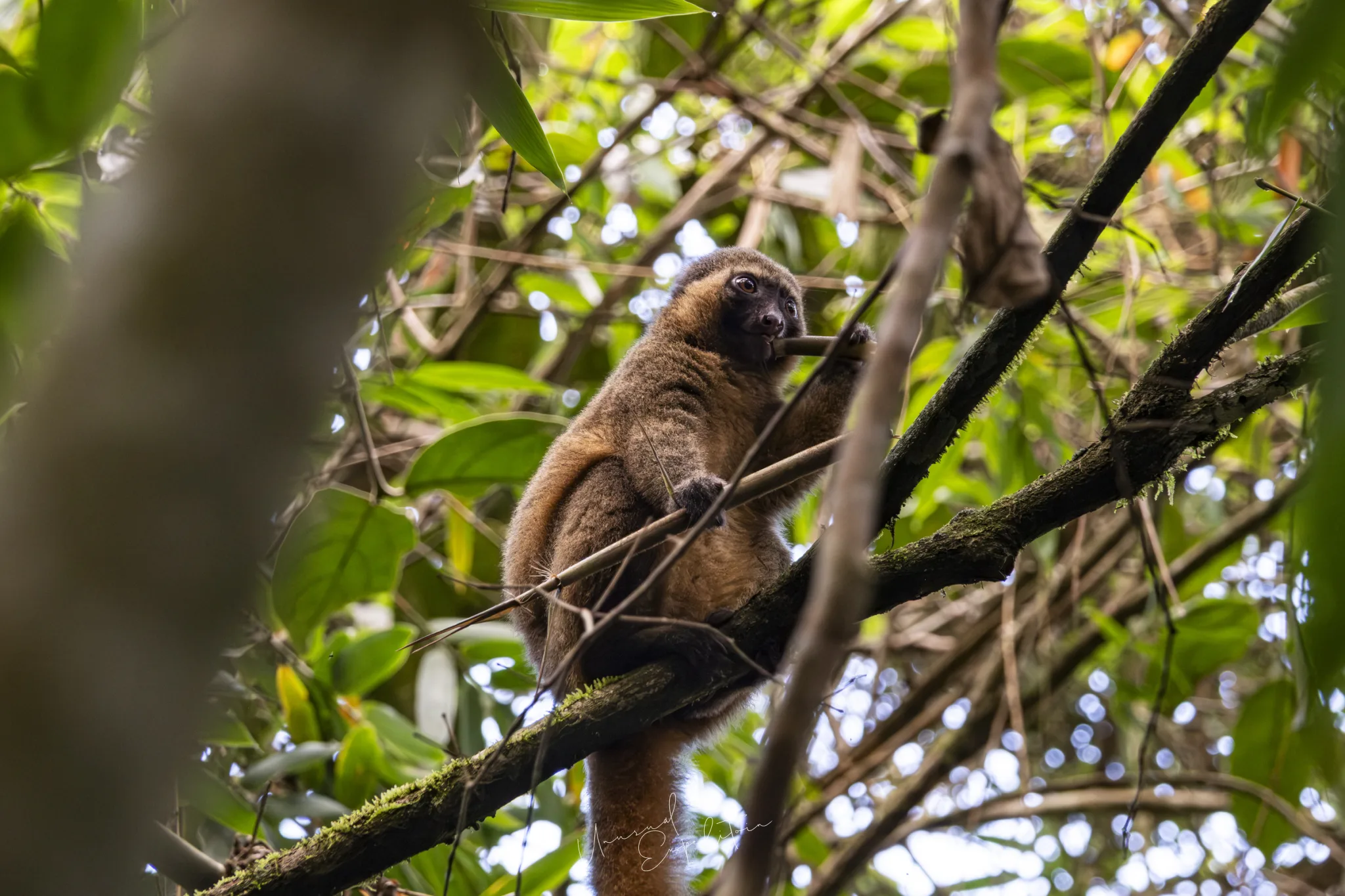
Lemur photography in Madagascar comes down to three situations, and our April tour covers all of them: habituated lemurs at close range at Lemur Park outside Antananarivo and on Vakona island near Andasibe; wild indri in the canopy of Andasibe-Mantadia National Park; and nocturnal mouse lemurs found by torchlight on a night walk. Each needs a different lens, a different distance and a different idea of what a good picture is. This guide takes them in turn.
It is the wildlife chapter of the complete Madagascar photography tour guide. When lemurs are easiest to see across the year is part of The best time for a Madagascar photography trip.
Why every lemur is Malagasy
Lemurs exist only on Madagascar and a few nearby islands, over a hundred species from the mouse lemur, which fits in a hand, to the indri, which is the size of a small child. They are primates, but the line split from monkeys and apes long before either existed, so they look at you with a face that is familiar and not. Most are threatened, mainly by forest loss, which is why the habituated reserves matter: they fund protection and they give visitors the close encounter that a wild forest rarely does.
Lemur Park, Antananarivo: the portrait session
Lemur Park is a private reserve about 22 kilometres west of the city with several free-ranging species, including ring-tailed lemurs, common brown lemurs and sifakas, on a few hectares of trees by a river. It is the afternoon of Day 5. The animals are used to people and will come within a metre, so this is where the portraits happen: a 70-200mm or the long zoom at its short end, f/4, eye-level, the face and the hands. The light under the trees is dappled; wait for an animal to move into a patch of even shade instead of fighting the hot spots. Ring-tailed lemurs sunbathe with their arms out in the morning, and the sifakas cross open ground with the sideways hop that gives them the name dancing lemur.

Andasibe-Mantadia: finding the indri
The indri is the largest living lemur, black and white, with no tail and a call that sounds like a whale and carries for three kilometres. Andasibe-Mantadia National Park, about 140 kilometres east of Tana, holds habituated family groups that the park guides track by that call, usually between 07:00 and 10:00. You walk muddy trails for an hour or two, then stand under a tree and shoot upward at animals ten to twenty metres up, often against a bright sky. The long zoom is the lens; the settings are ISO 1600 to 3200, f/5.6 to f/8, 1/250 to 1/500 of a second, and exposure compensation of plus one stop or more so the black fur holds detail and the sky blows out, which it will anyway. Wait for the moment they look down. Diademed sifakas and common brown lemurs are in the same forest.
"The indri picture is not the one from directly underneath with the white sky behind. It is the one where you have walked ten metres sideways to put a dark tree behind the animal and waited for it to turn its head. The guides know this and will move you if you ask."
Joseph Mak, tour leader, Unusual Expedition
Vakona island: close, fast and playful
Vakona Lodge's lemur island is a small private reserve reached by a short canoe crossing, where habituated brown lemurs, black-and-white ruffed lemurs and bamboo lemurs live without predators and treat visitors as furniture. They will land on your shoulder. This is the afternoon of Day 7. The pictures here are of behaviour and interaction: a lemur mid-leap between trees, one eating a banana held by the guide, the ruffed lemur's face in soft light. A standard zoom is more useful than the long lens because the distances are short; shutter speeds of 1/1000 of a second for the leaps. It is the easiest lemur photography in Madagascar and also the most staged, so shoot it for what it is.
The night walk: mouse lemurs by torchlight
On the evening of Day 6 a guide takes the group along the forest edge at Andasibe with torches. Mouse lemurs show as two orange eyes in the beam and then as a tiny body on a branch, often within a few metres. A standard or macro lens, a flash with a diffuser or a soft LED held to one side, f/8, and patience: the guide holds the torch, you focus on the eyes. The same walk produces sleeping chameleons, tree frogs, stick insects and leaf-tailed geckos, which is why the macro lens is in the bag, as What to pack for a Madagascar photo tour explains. Keep the flash off the lemurs' eyes at close range and keep it short.
Rules that keep the animals here
No feeding except where the reserve guides do it, no touching, no flash on nocturnal animals at close range, no leaving the trail in the national park, and the guide's distance is the distance. The reserves and the park depend on visitors behaving, and a calm lemur stays in the frame longer than a startled one.
How the three sessions fit the week
| Place | Day | Animals | Lens | Kind of picture |
|---|---|---|---|---|
| Lemur Park, Tana | 5 | Ring-tailed, brown, sifaka | 70-200mm | Portraits |
| Andasibe night walk | 6 | Mouse lemur, chameleons, frogs | Macro, standard | Torchlit close-ups |
| Andasibe-Mantadia | 7 morning | Indri, sifaka | 100-400mm | Wild, in the canopy |
| Vakona island | 7 afternoon | Brown, ruffed, bamboo | 24-70mm | Behaviour, leaps |
The week runs from easiest to hardest and back, with the wild indri in the middle.
Come and meet them
The Madagascar Photo Tour, 11 to 19 April 2027 has three lemur days inside its nine. The rest of the wildlife picture, and how it compares with an East African safari, is in Madagascar or an African safari for wildlife photography.
Join the Madagascar photography tour
Madagascar Photo Tour – Madagascar departs 11 Apr 2027 To 19 Apr 2027, led by Joseph Mak. Small group, photography first. All Madagascar photography tours.
Explore Madagascar in depth
- The Complete Guide to a Madagascar Photography TourMadagascar
- What to Pack for a Madagascar Photo TourMadagascar
- The Milky Way over the Baobabs: Night Photography in MadagascarMadagascar
- Madagascar Tour from Singapore: Flights, Visa and What to ExpectMadagascar
- Is Madagascar Safe? Health, Roads and Drones for PhotographersMadagascar
- What a Madagascar Photo Tour Costs, Line by LineMadagascar
- Twelve Questions Before You Book a Madagascar Photo TourMadagascar
- Madagascar or an African Safari for Wildlife Photography?Madagascar
- Madagascar Light and Weather, Region by RegionMadagascar
- Is Madagascar Worth Visiting for a Photographer? A Straight AnswerMadagascar
- The Best Time to Visit Madagascar for PhotographyMadagascar
- Photographing the Avenue of the Baobabs: Sunset, Night and DawnMadagascar
Upcoming Photo Tours
- Egypt Photo Tour – EgyptEgypt 12 Dec 2026 To 20 Dec 2026
- Inner Mongolia Winter Owl Photo Tour – ChinaChina 01 Jan 2027 To 04 Jan 2027
- Inner Mongolia Winter Photo Tour – ChinaChina 05 Jan 2027 To 11 Jan 2027
- Mekong And Central Highland Vietnam Photo Tour - VietnamVietnam 16 Jan 2027 To 24 Jan 2027