
Avenue of the Baobabs Facts: How Old the Trees Are and Their History
Avenue of the Baobabs facts: how old the baobabs are, the history of the road, the species, the baobabs amoureux and protection.
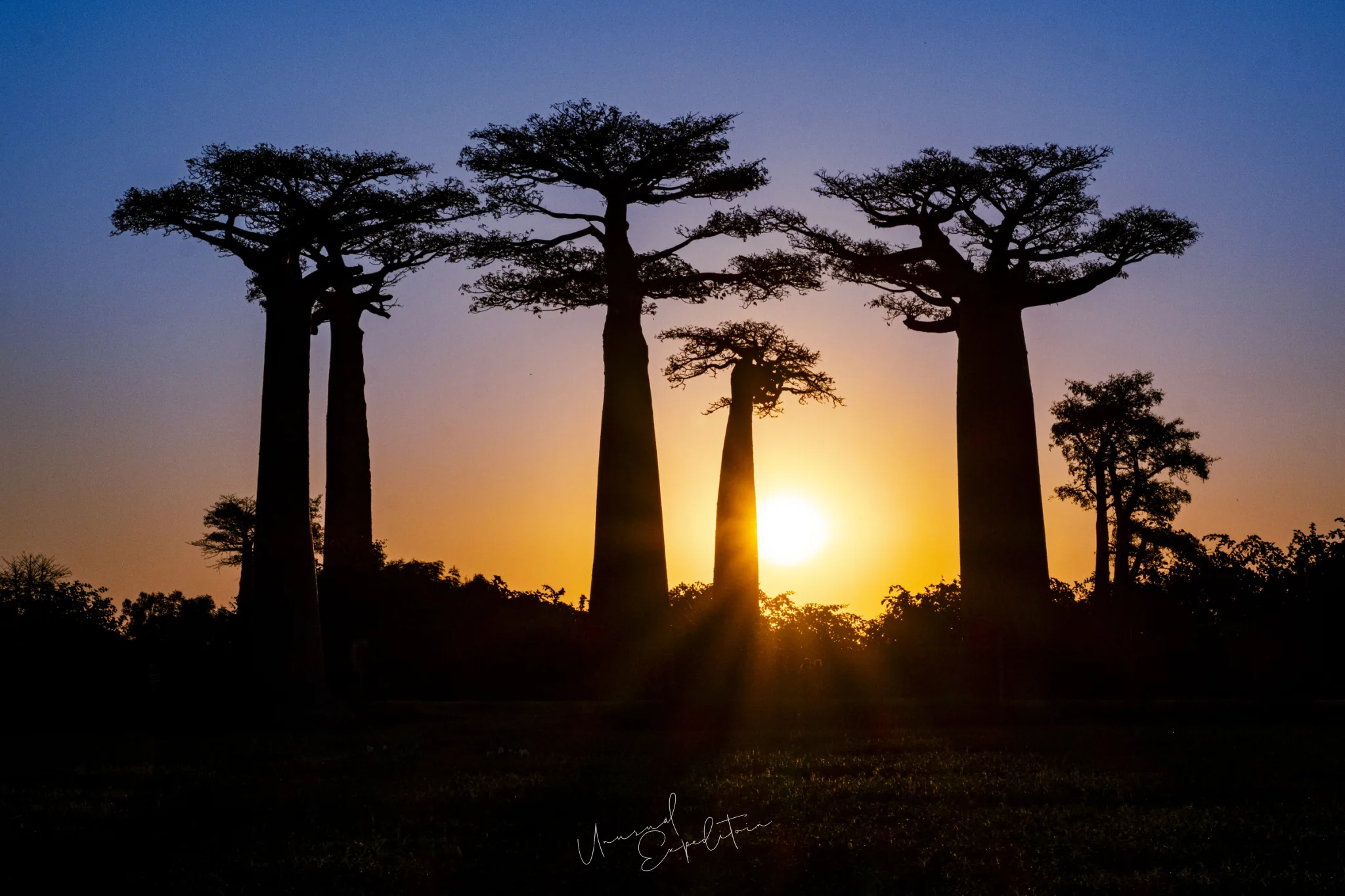
The core avenue of the baobabs facts: it is a 260 metre stretch of dirt road about 20 kilometres north of Morondava in western Madagascar, lined by 20 to 25 Grandidier's baobabs, Adansonia grandidieri, about 30 metres tall. The trees are survivors of a dry forest that was cleared for fields around them. Nobody has published a measured age for these particular trees, but radiocarbon studies of other Grandidier's baobabs have dated giants of the same species to well over a thousand years.
This page is the background to the place; where to stand and when is in Avenue of the Baobabs photo spots, and the whole area is introduced in our Morondava photography tour guide.
Avenue of the Baobabs facts at a glance
| Fact | Detail |
|---|---|
| Location | Road No. 8 between Morondava and Belon'i Tsiribihina, Menabe region, west coast of Madagascar |
| Length | About 260 metres of road |
| Trees on the road | 20 to 25 Grandidier's baobabs, with about 25 more in the paddies and meadows nearby |
| Height | About 30 metres |
| Species | Adansonia grandidieri, known locally as renala, "mother of the forest" |
| Conservation status of the species | Endangered on the IUCN Red List |
| Protection | Temporary protected status from July 2007, later a natural monument |
| Nearby | The baobabs amoureux, a pair of intertwined Adansonia za a few kilometres further on |
The figures for tree count, height and protection follow the Wikipedia summary of the Madagascar environment ministry's decision and the site's conservation history.
Avenue of the baobabs age: how old are the baobabs?
No published study has dated the trees of the Avenue itself. Baobabs do not lay down clear annual rings, so the usual method is radiocarbon dating of wood samples taken from inside the trunk. The team led by Adrian Patrut, which has dated baobabs across Africa and Madagascar, published results in 2015 for two very large Grandidier's baobabs elsewhere in Madagascar, Tsitakakoike and the so-called Pregnant baobab, and estimated both at between 1,300 and 1,500 years old from the oldest samples and the architecture of the trunks. A later study by the same group put a giant in the Andombiry forest at around 875 years. The Avenue's trees are tall rather than wide, and guides will quote you anything from several hundred to a thousand years; treat any single number as a guess.
Avenue of the baobabs history: how a forest became a road
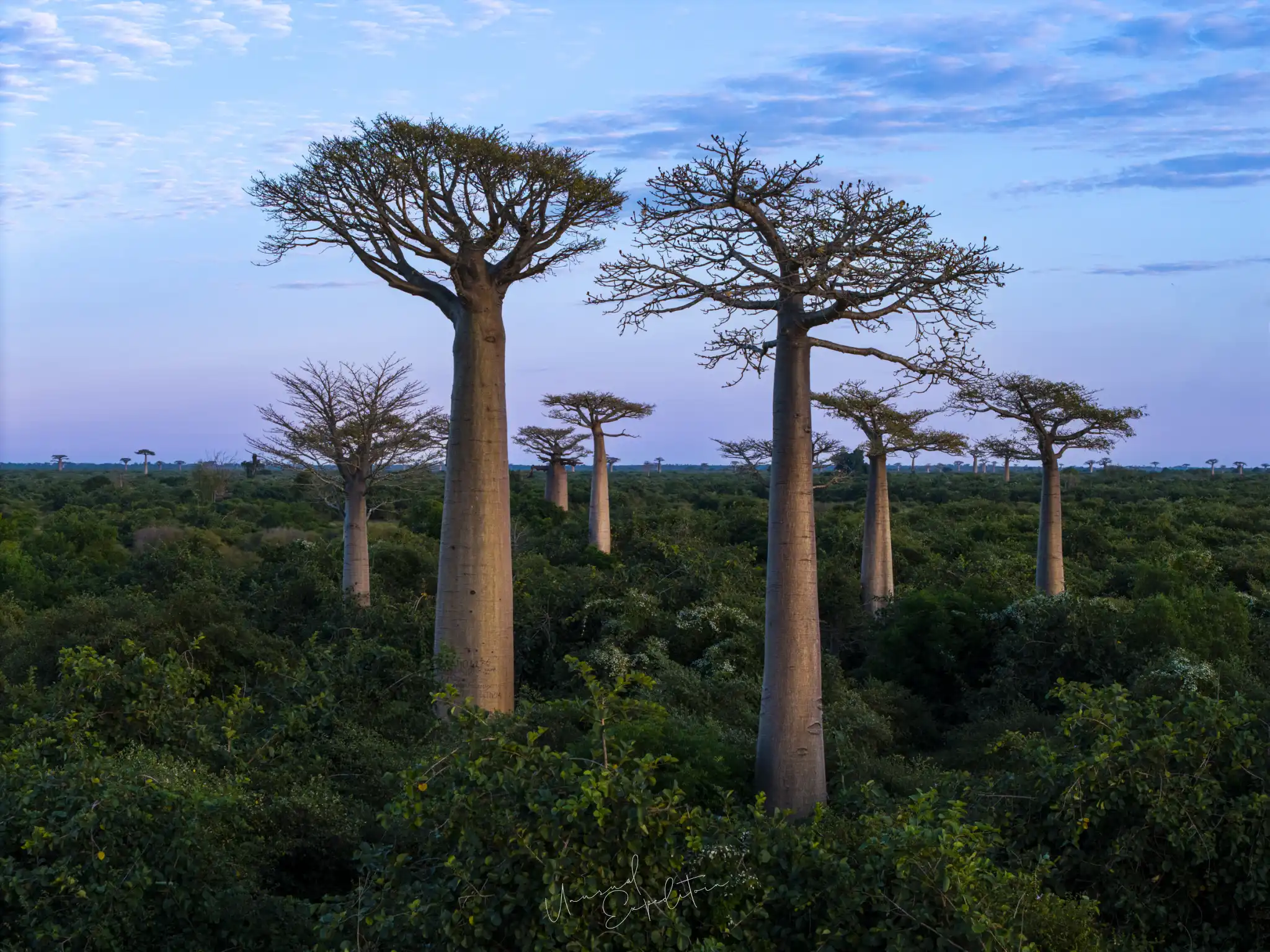
The Avenue of the Baobabs was not planted. The Menabe was once covered in dry deciduous forest with baobabs standing above the canopy. Over generations the land around Morondava was cleared for rice paddies, grazing and villages, and the baobabs, too big to fell easily and valued by local people, were left standing in the open. The road between Morondava and Belon'i Tsiribihina happens to run through one of the densest surviving groups, which is why the trees line it on both sides. You can still read that history from the air: the baobabs rise over a patchwork of scrub, fields and water, and the forest they grew up in has gone.
Which baobab grows on the Avenue?
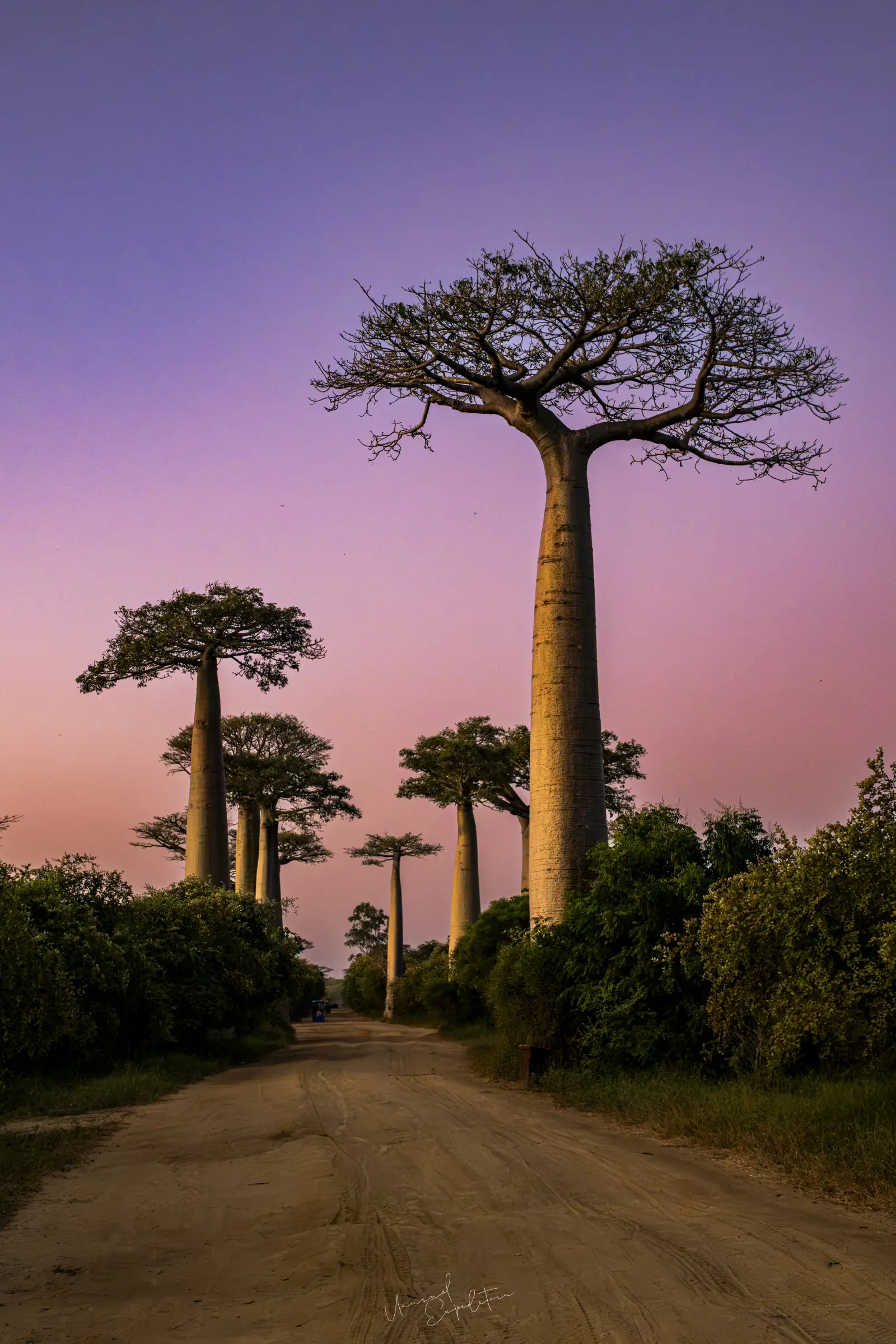
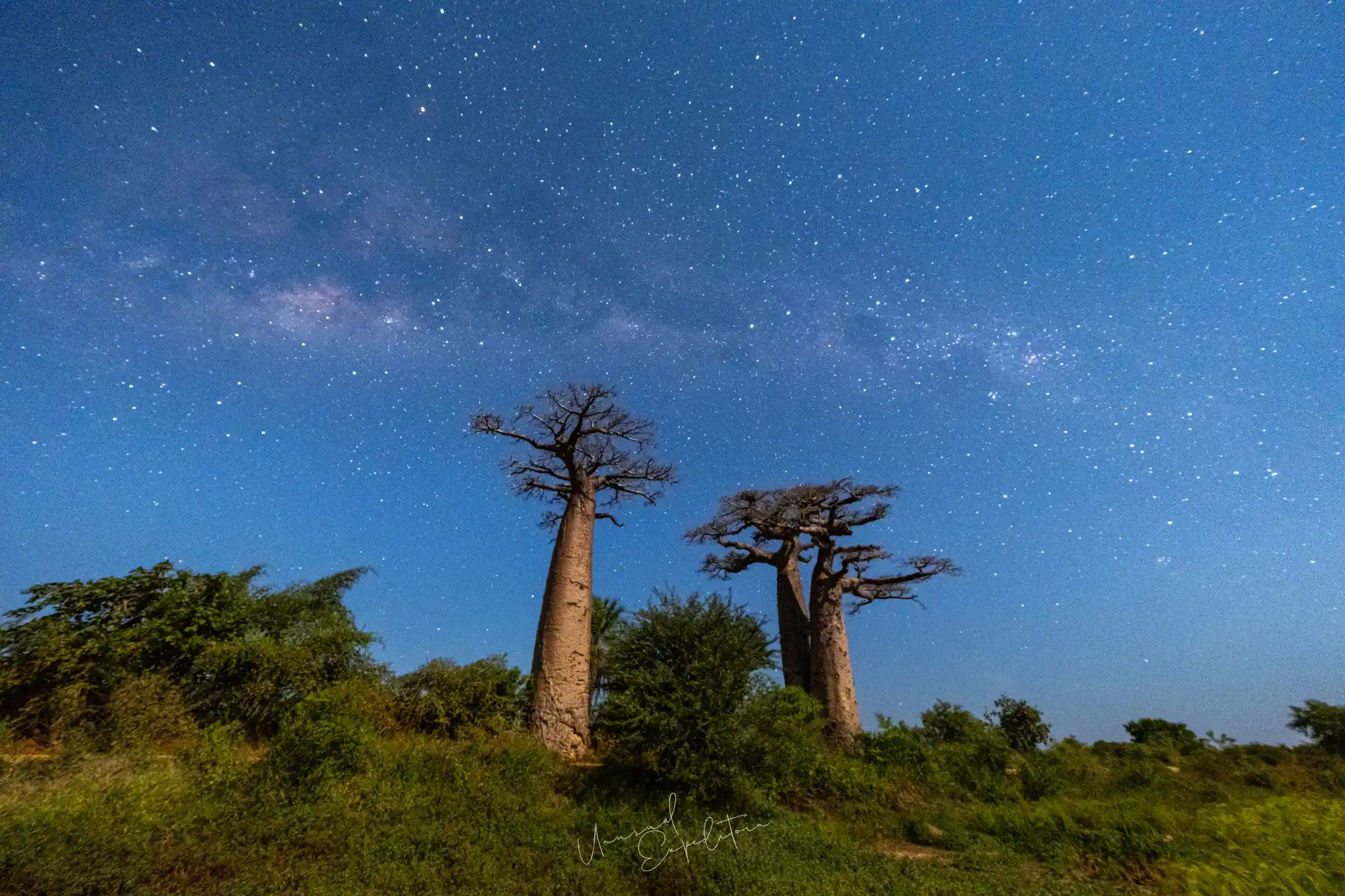
Every tree on the Avenue is Adansonia grandidieri, Grandidier's baobab, the tallest of Madagascar's baobabs, with a smooth reddish-grey trunk that rises bare to a flat crown of branches. The Malagasy name renala comes from reny ala, "mother of the forest". There are eight baobab species in the world, and six of them grow only in Madagascar; a 2024 genome study published in Nature, with researchers from the Royal Botanic Gardens, Kew and Queen Mary University of London, argued that the island is where the living baobab lineages began and called for closer attention to the conservation of Grandidier's baobab in particular.
The baobabs amoureux
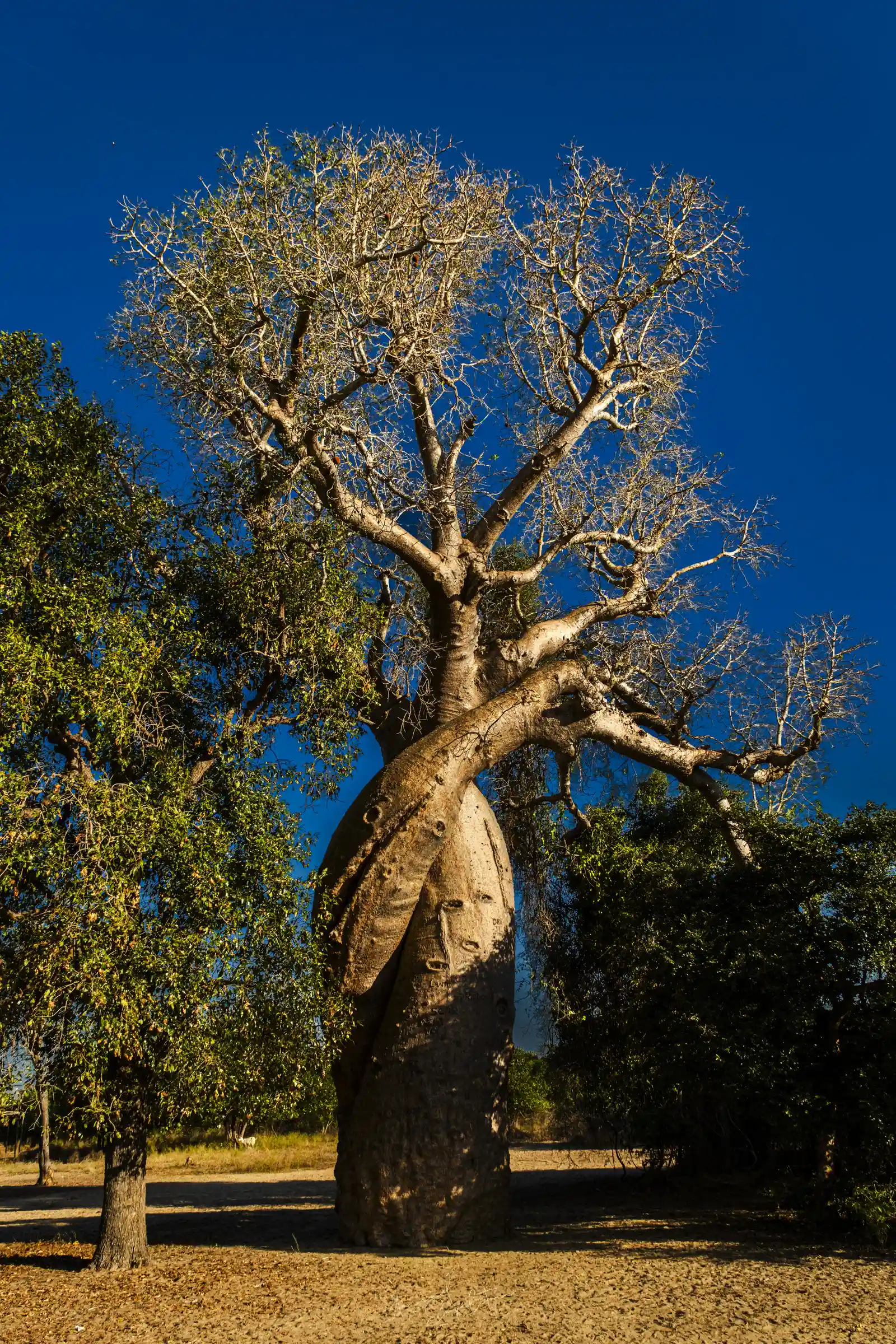
A few kilometres beyond the Avenue, two baobabs have grown twisted around each other. They are Adansonia za, a different species from the trees on the road, and local people call them the baobabs amoureux, the baobabs in love, and treat them with respect; do not climb on them. For a photographer they are a daytime subject: a clear sky and a person at the foot for scale.
Is the Avenue of the Baobabs protected?
Yes. Madagascar's environment ministry gave the Avenue temporary protected status in July 2007 as a step towards making it a natural monument, which it later became. The NGO Fanamby has worked with the local communities on an ecotourism project at the site, and a small parking or community fee is collected at the southern end. Protection covers the trees, not the land use around them: rice paddies come right up to the trunks, and conservationists name effluent from the paddies, bush fires and clearing as the main threats to the trees. Walk on the road and the bunds, keep off roots, and do not fly a drone without a permit, which Madagascar requires.
Where are baobabs found besides the Avenue?
Grandidier's baobab grows only in western Madagascar, in dry forest and scrub from the Menabe southwards. You will see it standing alone in fields all along the road from Morondava, and in larger numbers in the forests further north towards Kirindy. Other Malagasy species grow in the south-west, where the bottle-shaped baobabs of the spiny forest look nothing like the tall columns of the Avenue. The African baobab of the mainland savannah is another species again.
Guests always ask me how old the trees are, and I always say nobody knows for certain. It does not matter at the time. You stand at the foot of one with your neck bent back and the number stops being the point.
Joseph Mak, tour leader, Unusual Expedition
Turning the facts into pictures
The facts on this page are also the brief for photographing the Avenue of the Baobabs. Height needs scale, so put a person, a cart or a herd at the foot of a tree. The lost forest is best told from the air or from a rise, with the trees standing over open fields. The species' bare trunk and flat crown read clearest in silhouette, against a sunset or the night sky, and the bark texture in the low side light at dawn. The night session is covered in the Milky Way over the baobabs, and the three daily sessions in photographing the Avenue of the Baobabs.
Stand under the renala with us
Our Madagascar photography tour, the April departure led by Joseph Mak, gives the Avenue a sunset, an evening under the stars and a dawn. Dates, the current fare and every Madagascar guide are on the Madagascar photography tours page.
Join the Morondava photography tour
Madagascar Photo Tour – Madagascar departs 11 Apr 2027 To 19 Apr 2027, led by Joseph Mak. Small group, photography first. All Morondava photography tours.
Explore Morondava in depth
- Morondava Photography Tour Guide: the Avenue, Betania and the TownMadagascar
- Things to Do in Morondava with a Camera: Market, Waterfront and Pousse-PousseMadagascar
- Avenue of the Baobabs Photo Spots: Location and the Best PositionsMadagascar
- Morondava Photos: Sunset, the Fishing Village and the BeachMadagascar
- The Milky Way over the Baobabs: Night Photography in MadagascarMadagascar
- Photographing the Avenue of the Baobabs: Sunset, Night and DawnMadagascar
- A Day on a Madagascar Photo Tour: The Avenue of the BaobabsMadagascar
Upcoming Photo Tours
- Egypt Photo Tour – EgyptEgypt 12 Dec 2026 To 20 Dec 2026
- Inner Mongolia Winter Owl Photo Tour – ChinaChina 01 Jan 2027 To 04 Jan 2027
- Inner Mongolia Winter Photo Tour – ChinaChina 05 Jan 2027 To 11 Jan 2027
- Mekong And Central Highland Vietnam Photo Tour - VietnamVietnam 16 Jan 2027 To 24 Jan 2027