
Photographing the Avenue of the Baobabs: Sunset, Night and Dawn
How to photograph the Avenue of the Baobabs: getting there, sunset in five phases, the Milky Way, dawn, and the trees beyond.
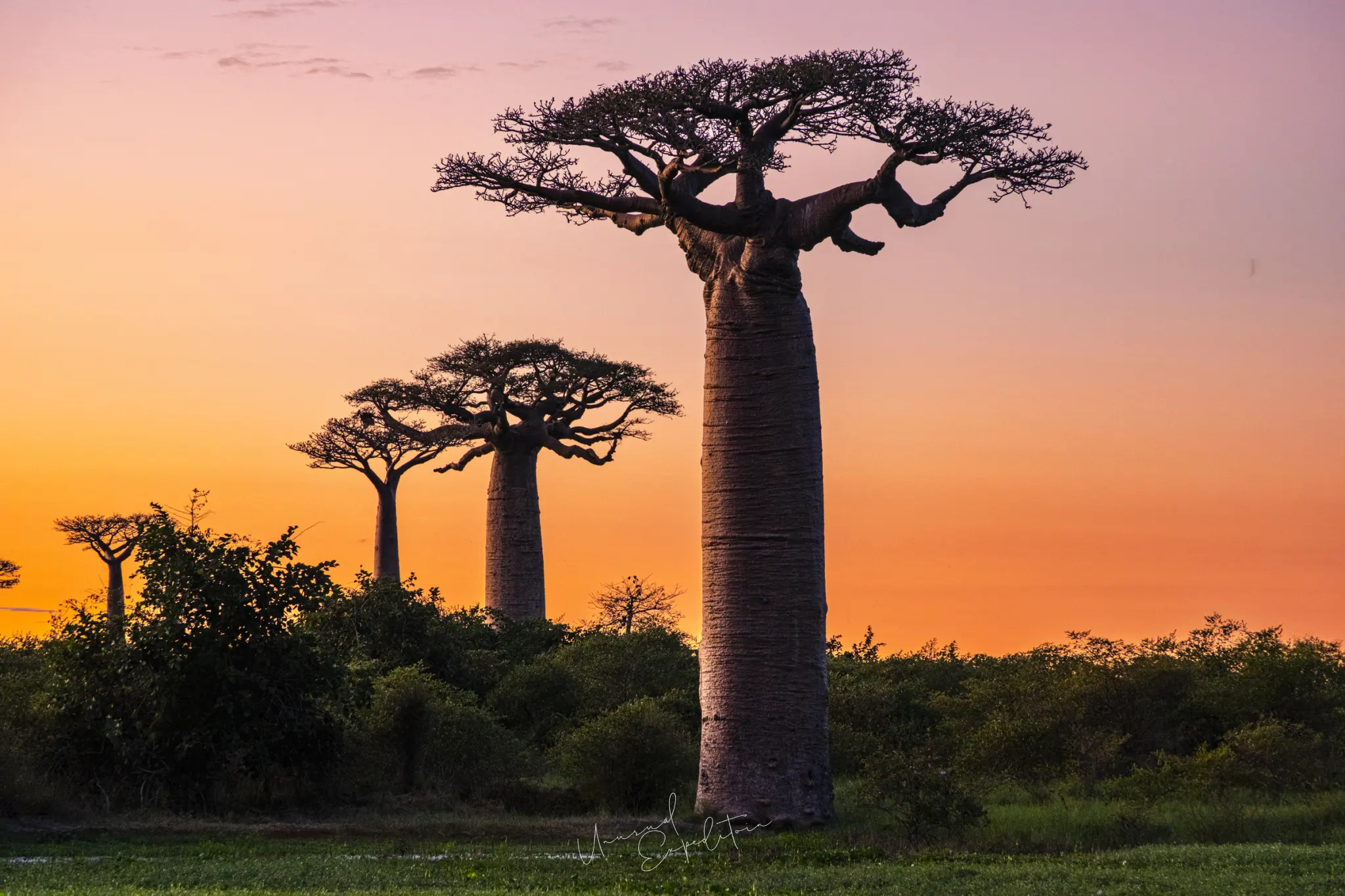
The Avenue of the Baobabs is a 260 metre stretch of dirt road about 20 kilometres north of Morondava on Madagascar's west coast, lined by a few dozen Adansonia grandidieri baobabs up to 30 metres tall and several hundred years old. It is the most photographed place in the country, and almost everyone photographs it once, at sunset, from the same spot. This guide is about doing it three times, at sunset, under the Milky Way and at dawn, and about the second avenue, the baobab "amoureux" and the villages that most visitors drive past.
It is the west-coast chapter of the complete Madagascar photography tour guide.
How to get to the Avenue of the Baobabs
From Antananarivo the practical route is the one-hour flight to Morondava, then 30 to 45 minutes by vehicle north on the road towards Belo sur Tsiribihina. Driving from Tana is possible and takes two days each way on the RN34 and RN35, which is why no photography itinerary does it. There is no entry fee as such, though the area has been a protected site since 2007 and a small community contribution is collected at the parking area. The trees are on both sides of a public road, so you can walk among them freely. Our tour spends the afternoon and night of Day 3 and the dawn of Day 4 here, with Belo sur Mer the day before; the order is explained in the hour-by-hour account of a day on the tour.
Is the Avenue of the Baobabs worth it?
Yes, and the question comes up because people have seen the sunset photograph a thousand times and wonder whether there is anything else. There is. The trees look different from the west side at dawn and the east side at dusk, the light goes through five distinct phases in each session, the sky at night is as dark as any you will find, and within a few kilometres there are baobabs standing alone in rice paddies and the pair of intertwined trees known as the baobabs amoureux. For a photographer, one sunset is not worth the flight. Two days are.

Sunset: the five phases
Arrive by 16:00. The first phase is low warm sidelight on the trunks, with the bark texture visible and the sky still blue; shoot from the eastern side looking west and keep the sun out of frame. Second, the sun drops into the band of haze near the horizon and the trunks go to silhouette; this is the postcard, and it lasts about ten minutes. Third, just after the sun has gone, the sky turns orange and the ground stays lit; this is the moment for a low viewpoint with a person or a zebu cart on the road for scale. Fourth, the afterglow, when the sky goes violet and the trunks pick up pink from the west; it needs a tripod and a few seconds. Fifth, blue hour, when the trees become shapes against a deep sky and the first stars appear. Most visitors leave after phase two. Stay.
Night: the Milky Way
After dinner in Morondava we go back. In April the core of the Milky Way rises after midnight and is high by 03:00, so the night session is either a late one for the arch low over the trees or an early one for the core overhead, and on the 2027 dates the moon has set by then. A fast wide prime, a tripod, manual focus and 15 to 20 seconds at ISO 3200 to 6400 does it. A single torch sweep across a trunk during the exposure gives the tree shape. The full method is in The Milky Way over the baobabs.
Dawn: the other side
Dawn is the quieter session, with a handful of people instead of a hundred. Be in place by 05:30. The light comes from the east, so now you stand on the western side looking back, and the trunks come up out of blue shadow with the crowns catching the first sun. Mist sometimes sits in the paddies behind the trees. This is the session for the textures, the elephant-skin bark and the roots, and for people: the villagers who walk the road to the fields pass through the frame between 06:00 and 07:00.
"At sunset there are a hundred people on the road and every one of them is standing in the same place. At dawn there are five. If you only get one session, take the dawn."
Joseph Mak, tour leader, Unusual Expedition
Composition in a place everyone has photographed
The trees are tall and the road is straight, so the two obvious frames are the receding avenue and the single tree against the sky. Beyond those: get low and let the road fill the bottom third; use the wide zoom at 16mm under one tree so the crown fans across the whole top of the frame; put a figure in, because without one the trees read as ordinary; and walk a few hundred metres off the avenue into the paddies, where single baobabs stand with water in front of them and a reflection at dawn. The long zoom compresses the row of trunks into a wall from the far end of the road. Resist the sun star; it has been done.
Beyond the Avenue
About seven kilometres further on are the baobabs amoureux, two trees that have grown twisted around each other, best in soft light. The road continues to the Kirindy forest, which is not on this itinerary but is where the sifakas and fossa live. Closer to Morondava is Betania, a Vezo fishing village on the far side of the channel, where pirogues come in through the morning and the beach is full of people; it is on the itinerary for the morning of Day 4, and the people side of the coast is covered in Belo sur Mer and the dhow builders.
What animals live in the Avenue of the Baobabs?
The baobabs are the only wildlife most people see at the Avenue, but the trees themselves host fruit bats at dusk, and the paddies around them hold herons and egrets at dawn. Lemurs are not here; they are in the Kirindy forest to the north and in the east, as Lemur photography at Andasibe describes.
Three sessions, one trip
The Madagascar Photo Tour, 11 to 19 April 2027 gives the Avenue a sunset, a night and a dawn. If you have photographed it once and want to do it properly, this is the trip.
Join the Madagascar photography tour
Madagascar Photo Tour – Madagascar departs 11 Apr 2027 To 19 Apr 2027, led by Joseph Mak. Small group, photography first. All Madagascar photography tours.
Explore Madagascar in depth
- The Complete Guide to a Madagascar Photography TourMadagascar
- What to Pack for a Madagascar Photo TourMadagascar
- The Milky Way over the Baobabs: Night Photography in MadagascarMadagascar
- Madagascar Tour from Singapore: Flights, Visa and What to ExpectMadagascar
- Is Madagascar Safe? Health, Roads and Drones for PhotographersMadagascar
- What a Madagascar Photo Tour Costs, Line by LineMadagascar
- Twelve Questions Before You Book a Madagascar Photo TourMadagascar
- Madagascar or an African Safari for Wildlife Photography?Madagascar
- Madagascar Light and Weather, Region by RegionMadagascar
- Is Madagascar Worth Visiting for a Photographer? A Straight AnswerMadagascar
- Lemur Photography at Andasibe and BeyondMadagascar
- The Best Time to Visit Madagascar for PhotographyMadagascar
Upcoming Photo Tours
- Egypt Photo Tour – EgyptEgypt 12 Dec 2026 To 20 Dec 2026
- Inner Mongolia Winter Owl Photo Tour – ChinaChina 01 Jan 2027 To 04 Jan 2027
- Inner Mongolia Winter Photo Tour – ChinaChina 05 Jan 2027 To 11 Jan 2027
- Mekong And Central Highland Vietnam Photo Tour - VietnamVietnam 16 Jan 2027 To 24 Jan 2027