
Avenue of the Baobabs Photo Spots: Location and the Best Positions
Avenue of the Baobabs photo spots: six positions, which side of the road at sunset and dawn, lens, crowd and the paddies reflection.
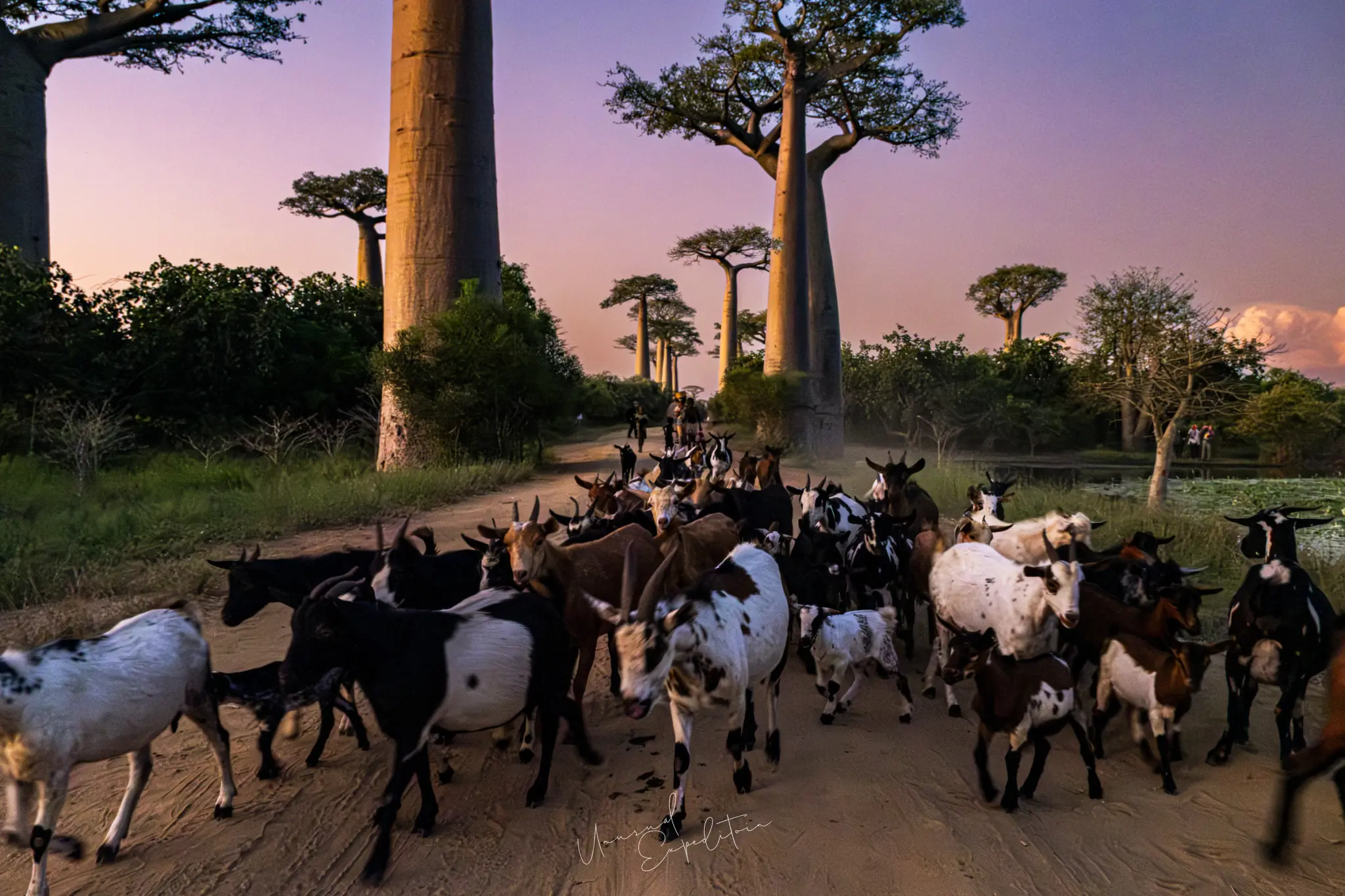
The Avenue of the Baobabs has about six photo spots that matter, and most visitors use one of them. The Avenue is a 260 metre stretch of dirt road about 20 kilometres north of Morondava on Madagascar's west coast, lined with Grandidier's baobabs up to 30 metres tall. What follows is a position guide: where to stand for each picture, which side of the road at which time of day, what lens, and where the crowd is not. The story of the place, and the sunset, night and dawn sessions as experiences, are in photographing the Avenue of the Baobabs.
Both pages belong to the complete Madagascar photography tour guide.
Avenue of the Baobabs location and layout
The road runs roughly north to south between Morondava and Belo sur Tsiribihina, and the Avenue is the section where the trees stand closest to it on both sides. There is a parking area and a few stalls at the southern end, where a small community contribution is collected; the site has been protected since 2007. Paddies and a shallow pond lie to the east of the road, dry scrub and more scattered baobabs to the west. Because the road runs north to south, the sun sets across it from the west and rises across it from the east, and that one fact decides every position below. Seen from above, the trees are a loose double line with the paddies as a mirror beside them.
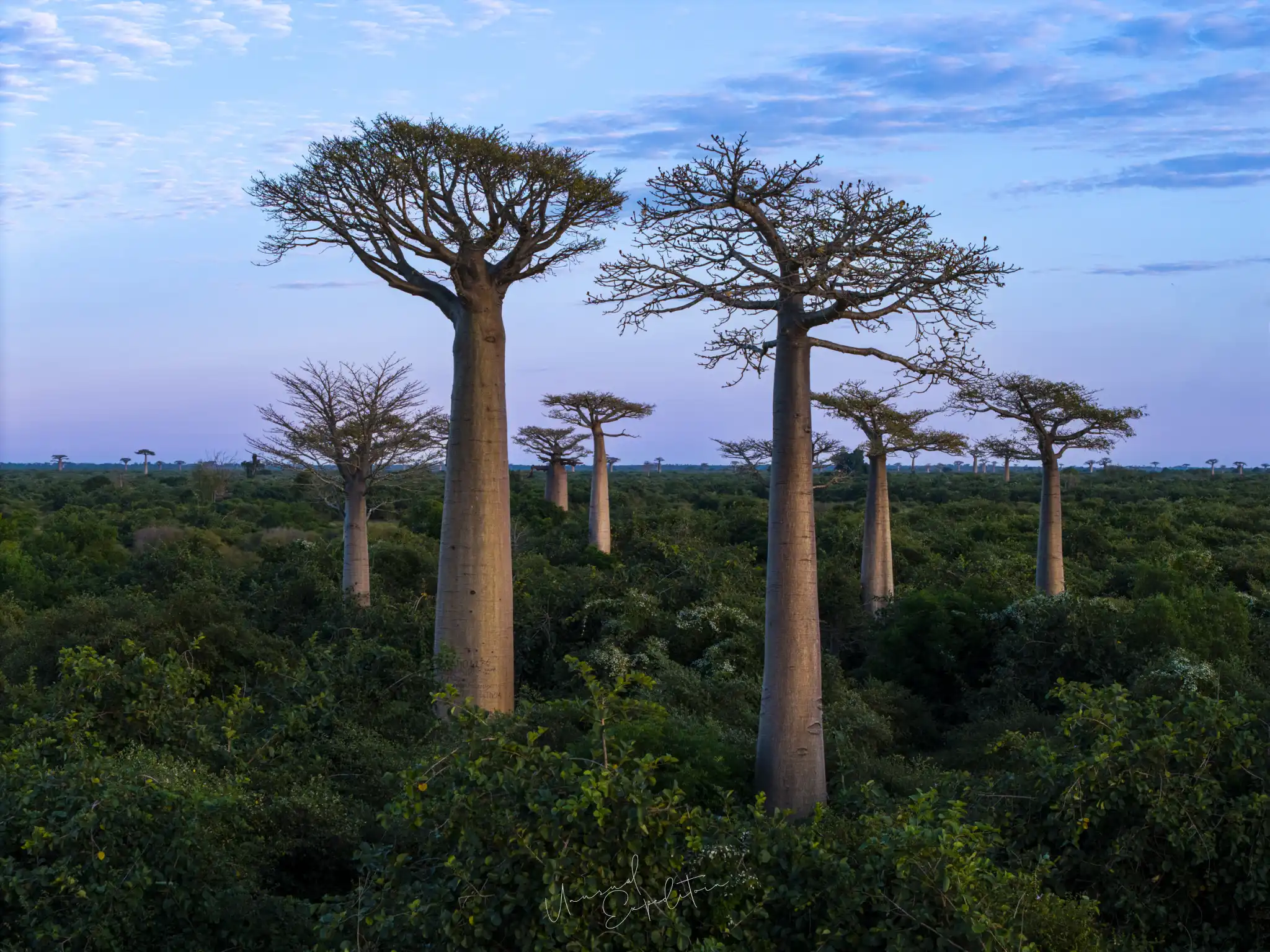
Photo spot 1: the classic, on the road looking north
Stand in the road near the southern end and look north so the trees recede on both sides. This is the postcard and the place the crowd stands at sunset. It works best in the twenty minutes after the sun has gone, when the sky behind the trees turns orange then pink and the road still holds light. Get low, let the road fill the bottom third, and wait for a zebu cart, a bicycle or a walking figure; without one the trees have no scale. A 24-70mm at the wide end, or a 16-35mm if you want the nearest crown fanning over the top of the frame. The spot is shared with everyone, so arrive early for a position at the edge where people will not walk through your frame.
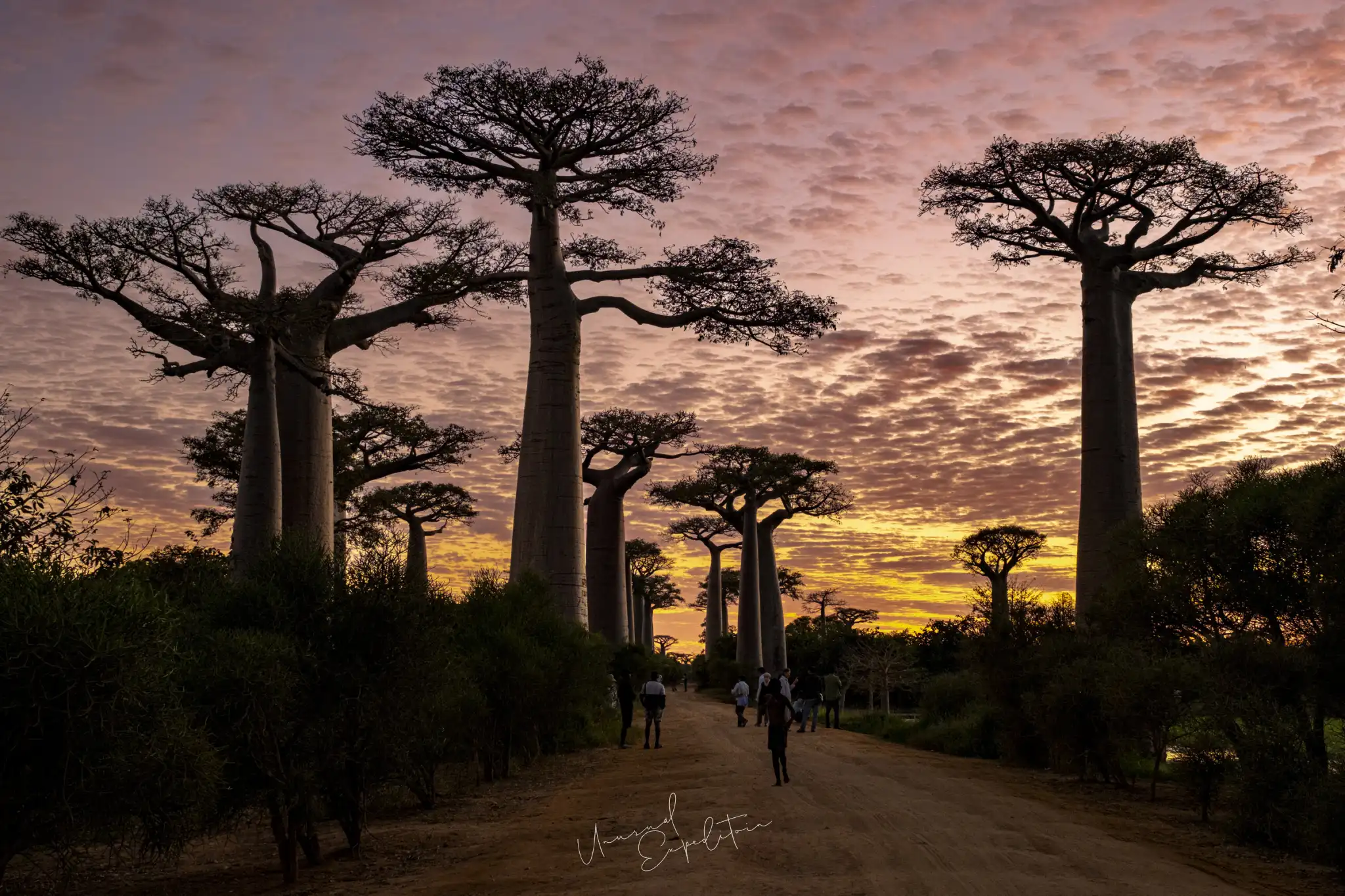
Photo spot 2: east side, sun between the trunks
Walk off the road to the eastern edge of the paddies and look west through the trees. In the last quarter hour before sunset the sun drops between the trunks and the trees go to full silhouette. Expose for the sky and let everything else go black. Shoot it with a 70-200mm to make the sun a disc and compress the trunks into a wall, or wide to get the whole row. Move a few metres left or right until the sun sits in a gap and not behind a trunk. This is the baobab avenue sunset most people mean when they say the words, and only a handful of them walk the fifty metres to find it.
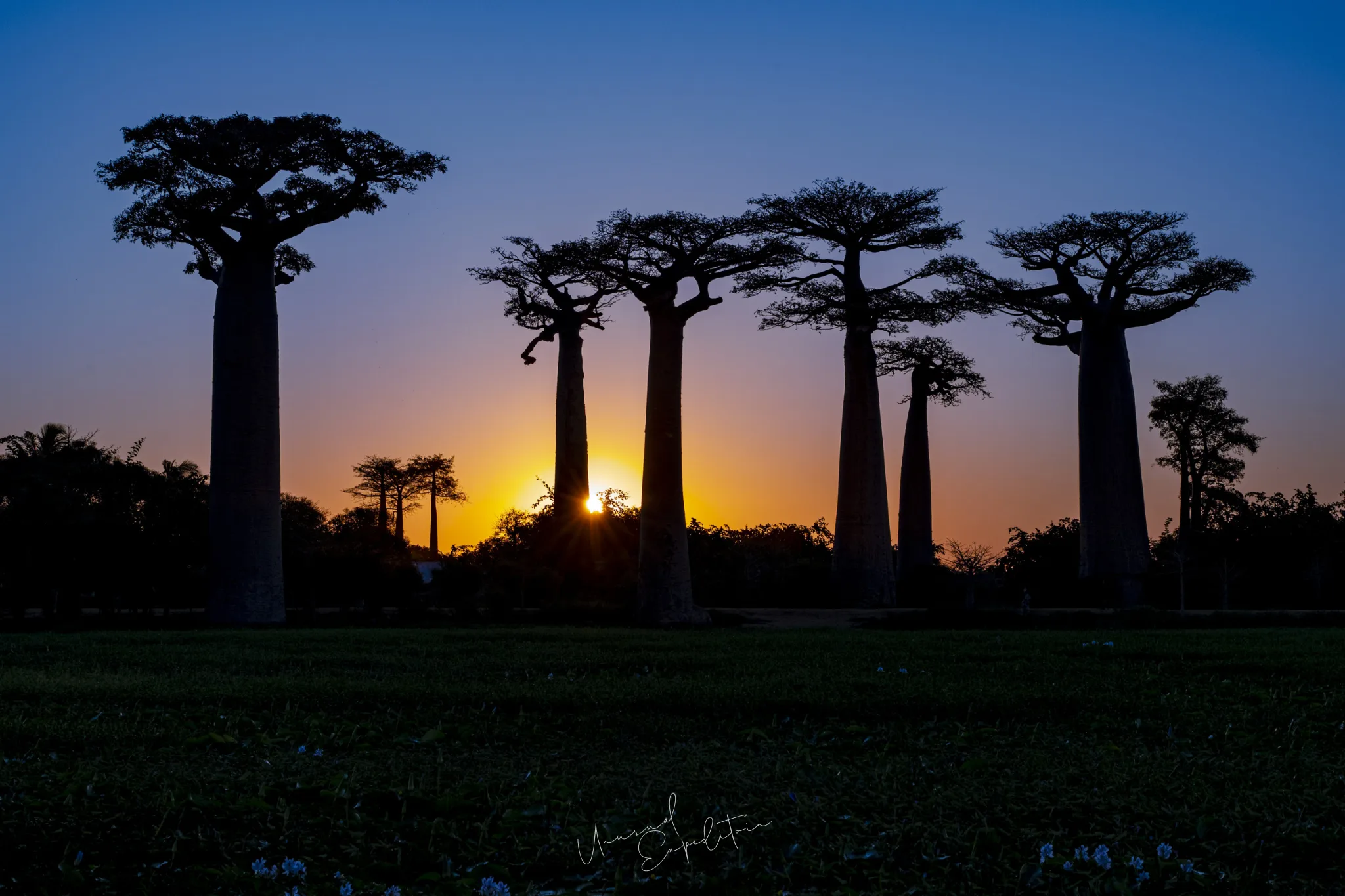
Photo spot 3: the paddies and the reflection
In April and May there is water in the paddies on the east side, and single baobabs and the end of the row stand in it. From the bund paths you can put the whole tree and its reflection in one frame, with a farmer or a child in the shallows for scale. It works at both ends of the day: at sunset the water takes the orange sky, at dawn the mist sits on it. Keep the horizon off the middle, use a polariser sparingly or you lose the reflection, and watch your feet, because the bunds are narrow and the paddies are someone's rice. By the middle of the dry season the water has gone and this spot with it, which is one of the reasons we travel in April.
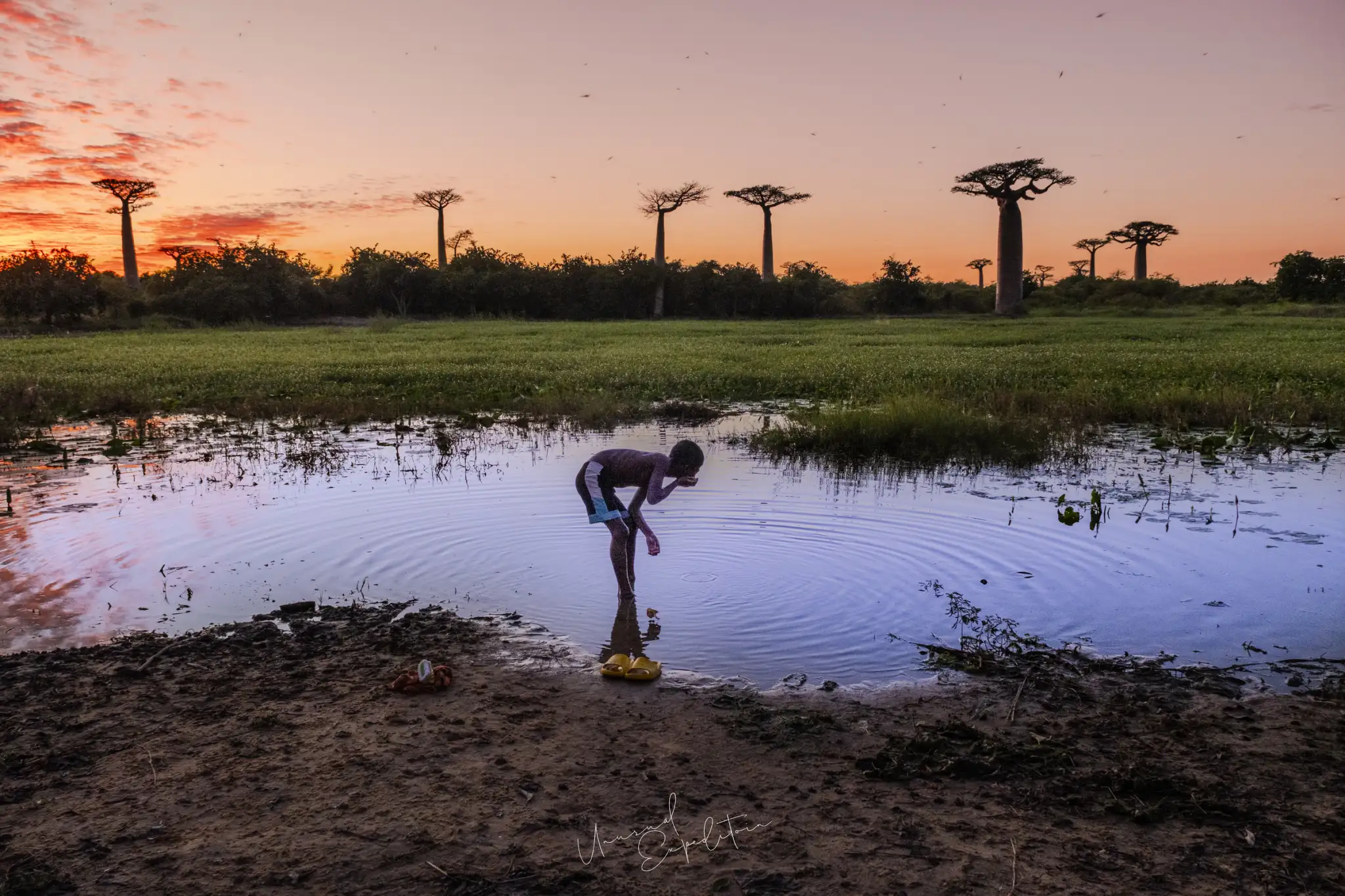
Photo spot 4: west side at dawn
Dawn reverses everything. The light comes from the east across the paddies, so you stand on the western side of the road and look back at the trees as the crowns catch the first sun while the trunks are still in blue shadow. There are a handful of people instead of a hundred. This is the session for bark texture, for the roots, and for the villagers who walk the road to the fields in the first hour of light and pass through the frame. A 24-70mm and a 70-200mm cover it. The Avenue cannot be reached before first light, so plan for sunrise itself rather than the dark before it; the night-sky session is an evening one, covered in the Milky Way over the baobabs.
Photo spot 5: the baobabs amoureux
About seven kilometres further along the road two baobabs have grown twisted around each other, the baobabs amoureux. They stand in a clearing with a small village beside them, and the frame is the pair against a clear sky with a person at the base for scale. Soft light suits them better than sunset does: the middle of the morning, or the hour before the Avenue session on the way out. The children from the village will walk into the picture; let them, ask the guide to translate, and show them the screen afterwards. Local custom treats the trees as sacred, so photograph without climbing on them.
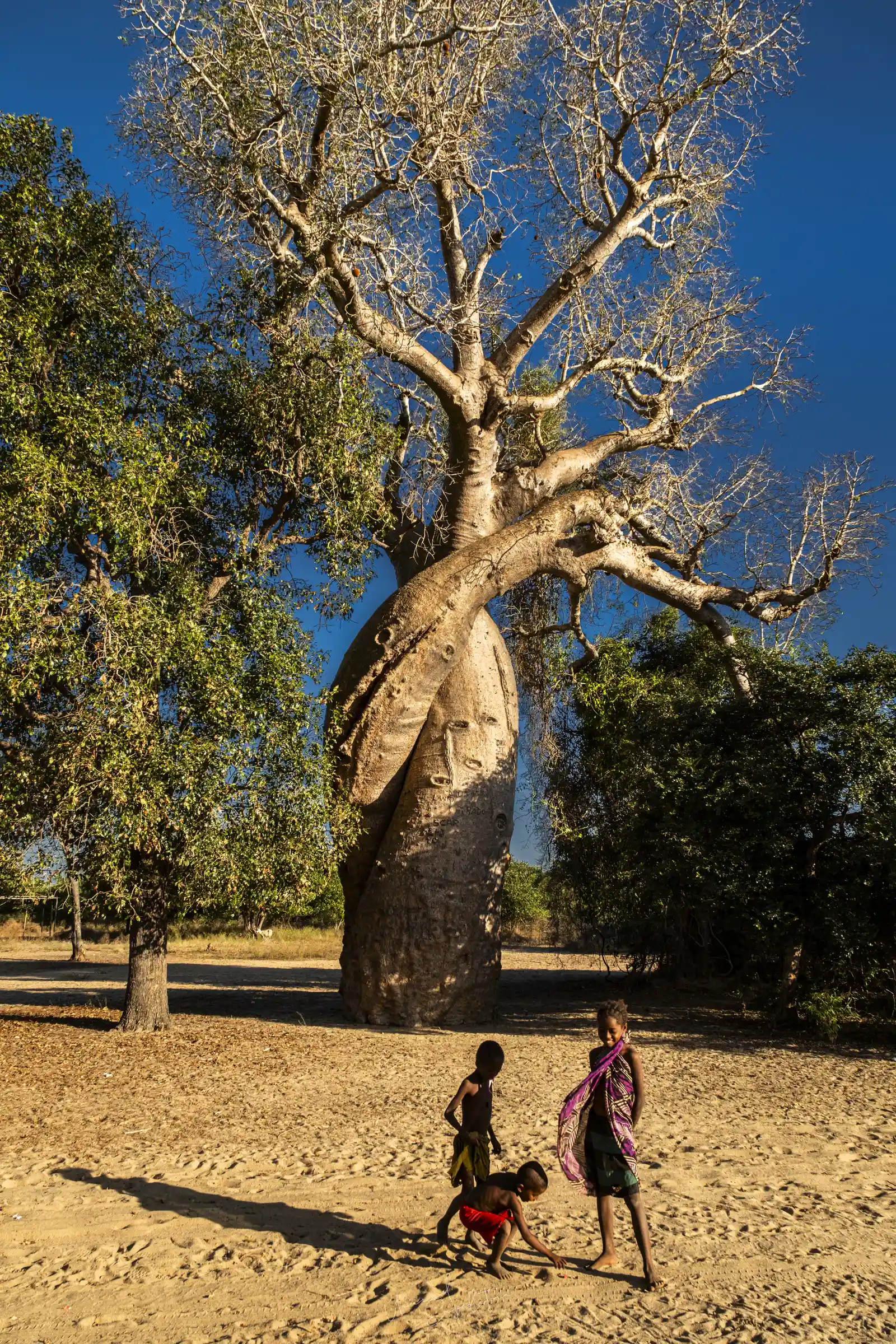
Photo spot 6: a lone tree on the road
Between Morondava and the Avenue the road passes single baobabs standing in fields and beside villages, and these are the pictures nobody else has. A lone tree with goats or zebu under it in the last light, a farmer walking home past one, a tree beside a Sakalava hut. Ask the driver to stop; he will know the trees. A lone tree solves the scale problem the Avenue has, because the animals and people stand right at its foot.
Which spot at which hour
| Spot | Side of the road | Light | Lens | Crowd |
|---|---|---|---|---|
| Classic road view | On the road, looking north | After sunset, blue hour | 16-35mm, 24-70mm | Heavy |
| Sun between the trunks | East edge, looking west | Last quarter hour of sun | 70-200mm | Light |
| Paddies and reflection | East, on the bunds | Sunset and dawn, April to May | 24-70mm | Light |
| Dawn from the west | West side, looking east | First hour of sun | 24-70mm, 70-200mm | Almost none |
| Baobabs amoureux | Seven kilometres on | Soft daytime light | 24-70mm | Light |
| Lone trees | Roadside, Morondava side | Late afternoon | 70-200mm | None |
Two sessions cover the first four; the last two are on the way there and back.
"The whole crowd stands in the road because that is where the car park is. Fifty metres into the paddies you are alone, the sun is between the trunks, and the picture is better. I have never understood why nobody walks."
Joseph Mak, tour leader, Unusual Expedition
Practicalities at the Avenue
The site is free to walk; a small contribution is collected at the parking area. There is no shade on the road and the afternoon is hot, so carry water. The light goes fast after sunset at this latitude, so have the tripod up before the sun touches the horizon. Dust is constant; change lenses in the vehicle. Drones need a permit in Madagascar and the site is a protected area, so do not assume you can fly one. The town at the other end of the road, with its own sunset over the sea, is in Morondava photos: sunset and the fishing village.
Shoot all six with us
The Madagascar photography tour, our April departure led by Joseph Mak, gives the Avenue a sunset, an evening and a dawn, which is enough time to work every position on this page instead of one.
Join the Madagascar photography tour
Madagascar Photo Tour – Madagascar departs 11 Apr 2027 To 19 Apr 2027, led by Joseph Mak. Small group, photography first. All Madagascar photography tours.
Explore Madagascar in depth
- The Complete Guide to a Madagascar Photography TourMadagascar
- Andasibe: Is It Worth Visiting, How to Get There, Lemurs and the Night WalkMadagascar
- Morondava Photos: Sunset, the Fishing Village and the BeachMadagascar
- Belo sur Mer Photos: Where to Shoot, the Beach and the WeatherMadagascar
- Madagascar Photos: What the Island Really Looks LikeMadagascar
- What to Pack for a Madagascar Photo TourMadagascar
- The Milky Way over the Baobabs: Night Photography in MadagascarMadagascar
- Madagascar Tour from Singapore: Flights, Visa and What to ExpectMadagascar
- Is Madagascar Safe? Health, Roads and Drones for PhotographersMadagascar
- What a Madagascar Photo Tour Costs, Line by LineMadagascar
- Twelve Questions Before You Book a Madagascar Photo TourMadagascar
- Madagascar or an African Safari for Wildlife Photography?Madagascar
Upcoming Photo Tours
- Egypt Photo Tour – EgyptEgypt 12 Dec 2026 To 20 Dec 2026
- Inner Mongolia Winter Owl Photo Tour – ChinaChina 01 Jan 2027 To 04 Jan 2027
- Inner Mongolia Winter Photo Tour – ChinaChina 05 Jan 2027 To 11 Jan 2027
- Mekong And Central Highland Vietnam Photo Tour - VietnamVietnam 16 Jan 2027 To 24 Jan 2027