
Cusco at Night: the Plaza de Armas, the Pachacuti Fountain and the Santa Ana Arch
Cusco at night: the lit Plaza de Armas, the Pachacuti fountain, the cathedral, the Santa Ana arch, settings, safety and weather.
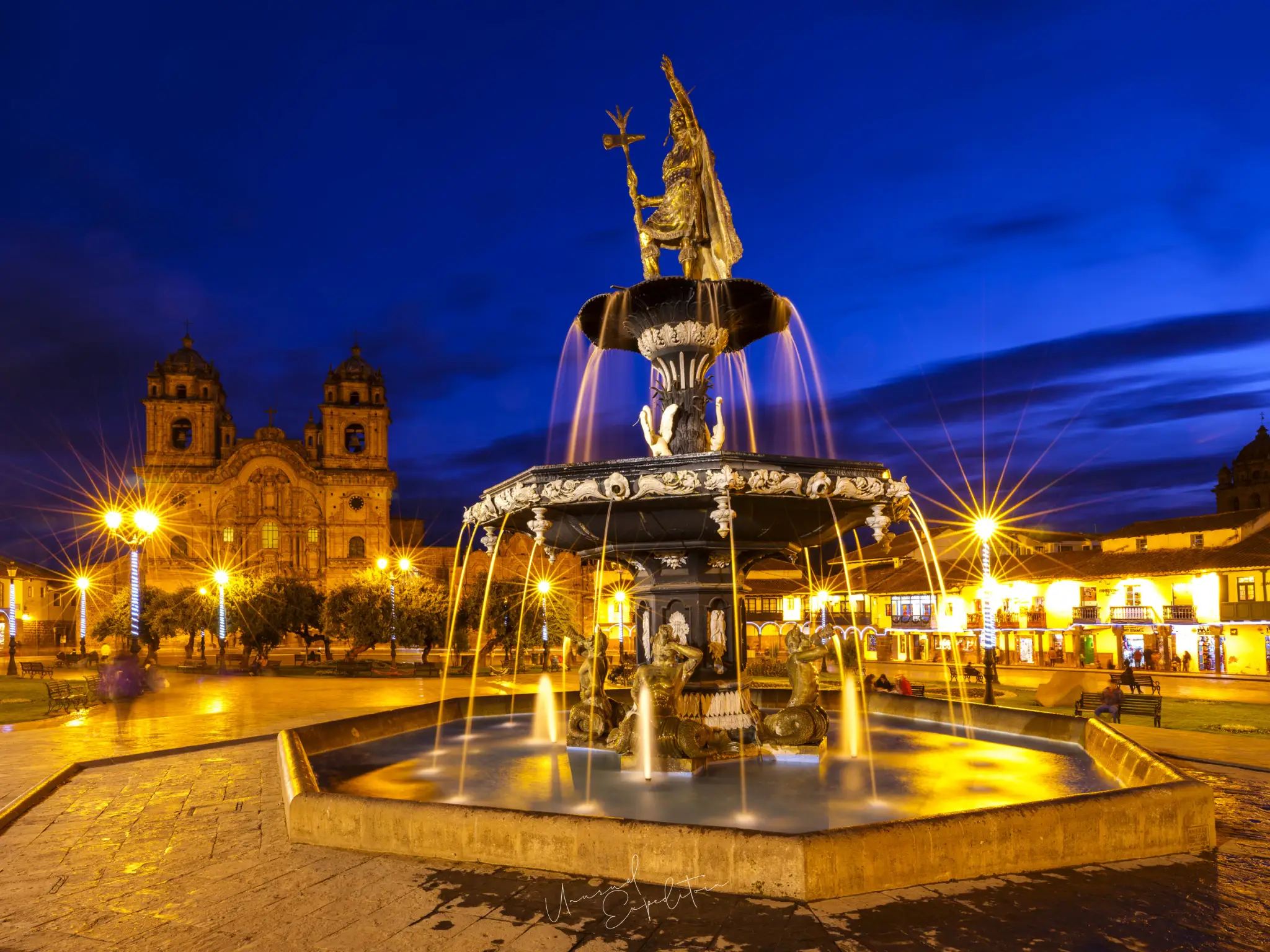
Cusco at night is one of the most photogenic old towns in South America: the Plaza de Armas lit gold around its gardens, the cathedral glowing against a deep blue sky, the Inca statue on the fountain lit from below, the arcades shining on wet cobbles, and the Santa Ana arch framing the lights of the city spread across the valley. The best time is blue hour, the short spell after sunset when the sky keeps its colour and the lamps come on.
This is the after-dark part of our Machu Picchu photography tour guide; for the daytime city, see our Cusco photo spots.
Cusco at night: why blue hour matters
Cusco at night is best photographed before it is fully night. At about 3,400 metres, according to the Peruvian government's traveller guide to the city, the air is thin and clear, and after sunset the sky over the Plaza de Armas goes through a deep, saturated blue that holds for a short while before it turns black. That is the window when the lit cathedral, the street lamps and the sky balance in one exposure. Arrive before sunset, pick your spot and watch the lamps come on. Once the sky is black, the lights burn out to white and the stone fronts lose their shape. In the rainy season, wet paving doubles every light, so a shower before dusk is good news.
Cusco Plaza de Armas fountain and statue
The fountain in the middle of the Plaza de Armas is topped by a statue of Pachacuti, the ninth Inca ruler, who is credited with turning Cusco into the capital of an empire. At night the statue and the jets of the fountain are lit, and with the cathedral or La Compañía behind, it makes the image most people take home from Cusco. A 16-35mm from close in, low, puts the statue against the sky with the church fronts behind. A small aperture turns the lamps into stars. The fountain is in the busiest part of the square, so expect people in the frame; a few seconds of exposure softens them into movement.
Cusco cathedral photos at blue hour
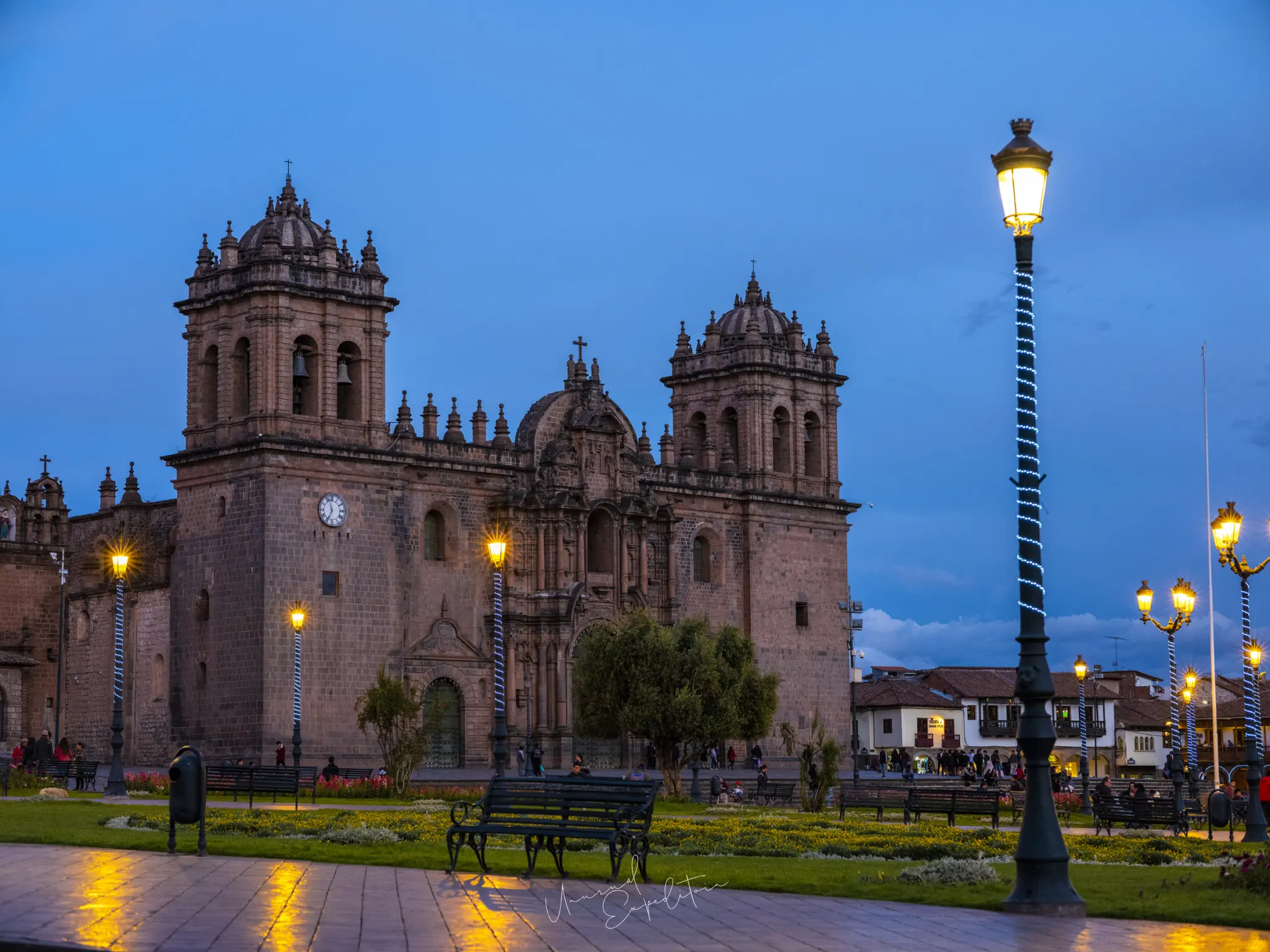
The cathedral of Cusco fills one side of the Plaza de Armas, and at blue hour its stone front and twin towers are lit warm against a cold sky. The best position is diagonally across the gardens, with one of the ornate lamp posts or a line of benches in the foreground. A 24-70mm at the wide end, a steady rest on a bench or wall and a shutter of a second or two give a clean frame. If you carry a small travel tripod, use it where it does not block anyone, and fold it when the square fills up. Bracket the exposures: the sky and the lit stone can be several stops apart.
Cusco Peru at night: arcades and wet streets
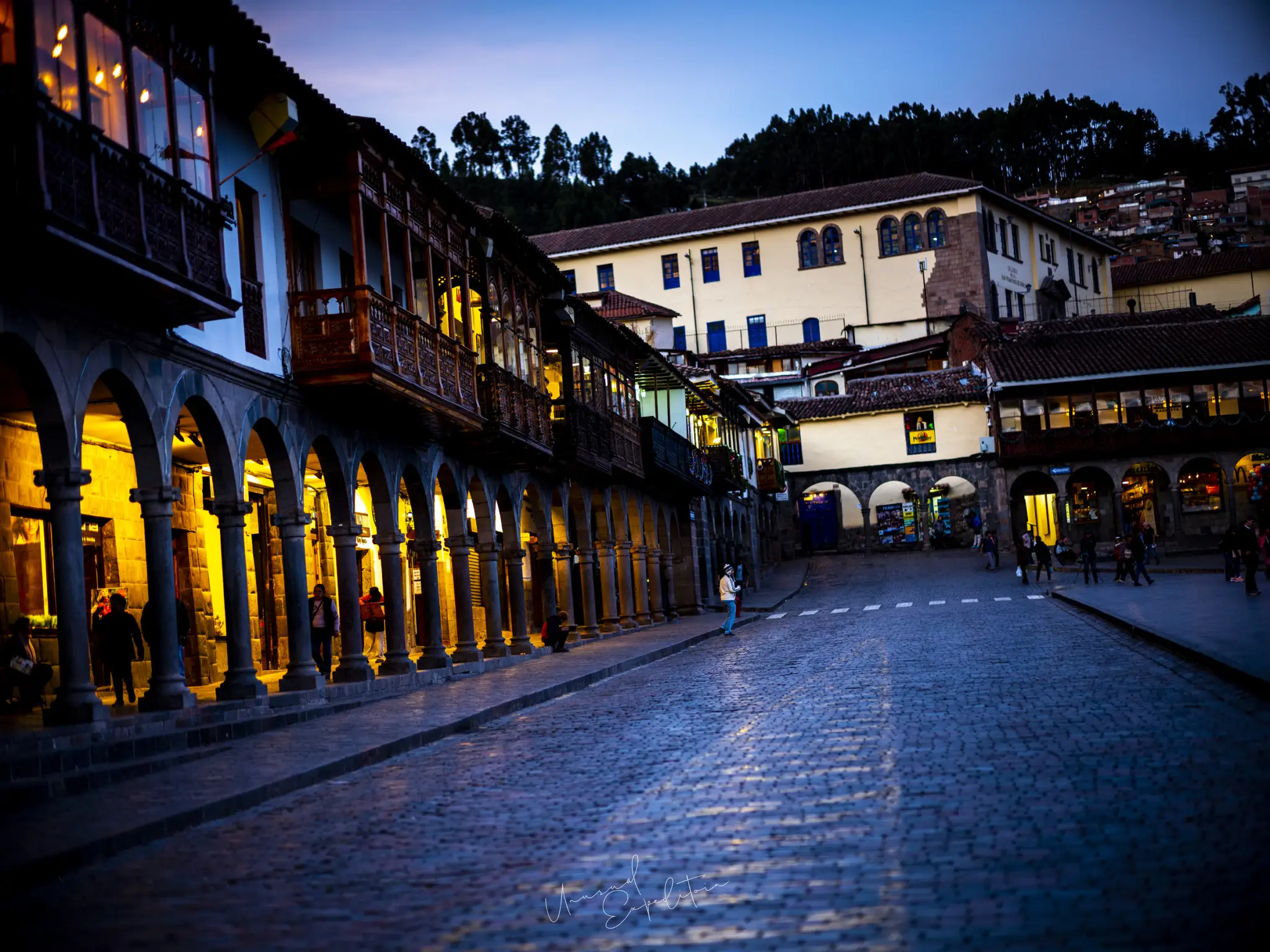
The arcades around the Plaza de Armas and the streets that lead off it are where Cusco at night feels most like a stage set. Wooden balconies hang over lit stone arches, the cobbles shine after rain, and the lights of the houses climbing the hills behind turn into a band of points above the rooftops. Stand at the corner where a street opens into the square and use the arcade as a leading line, with a 16-35mm or 24-70mm. Late in the evening the shops close and the arcades empty, which gives cleaner frames but a darker scene; the balance is usually best in the first part of the night.
The Santa Ana arch after dark
The Arco de Santa Ana at the top of the Cuesta de Santa Ana is our favourite night frame in Cusco. As the light goes, the arch is lit, the houses either side switch on their lamps, and through the opening the city spreads out as a field of lights. Cars climbing the steep street draw red and white trails if you use a shutter of a few seconds. Stand uphill of the arch, brace the camera on a wall or a small tripod, and keep a little blue in the sky. It is a residential street, so keep your voice down and stay on the pavement.
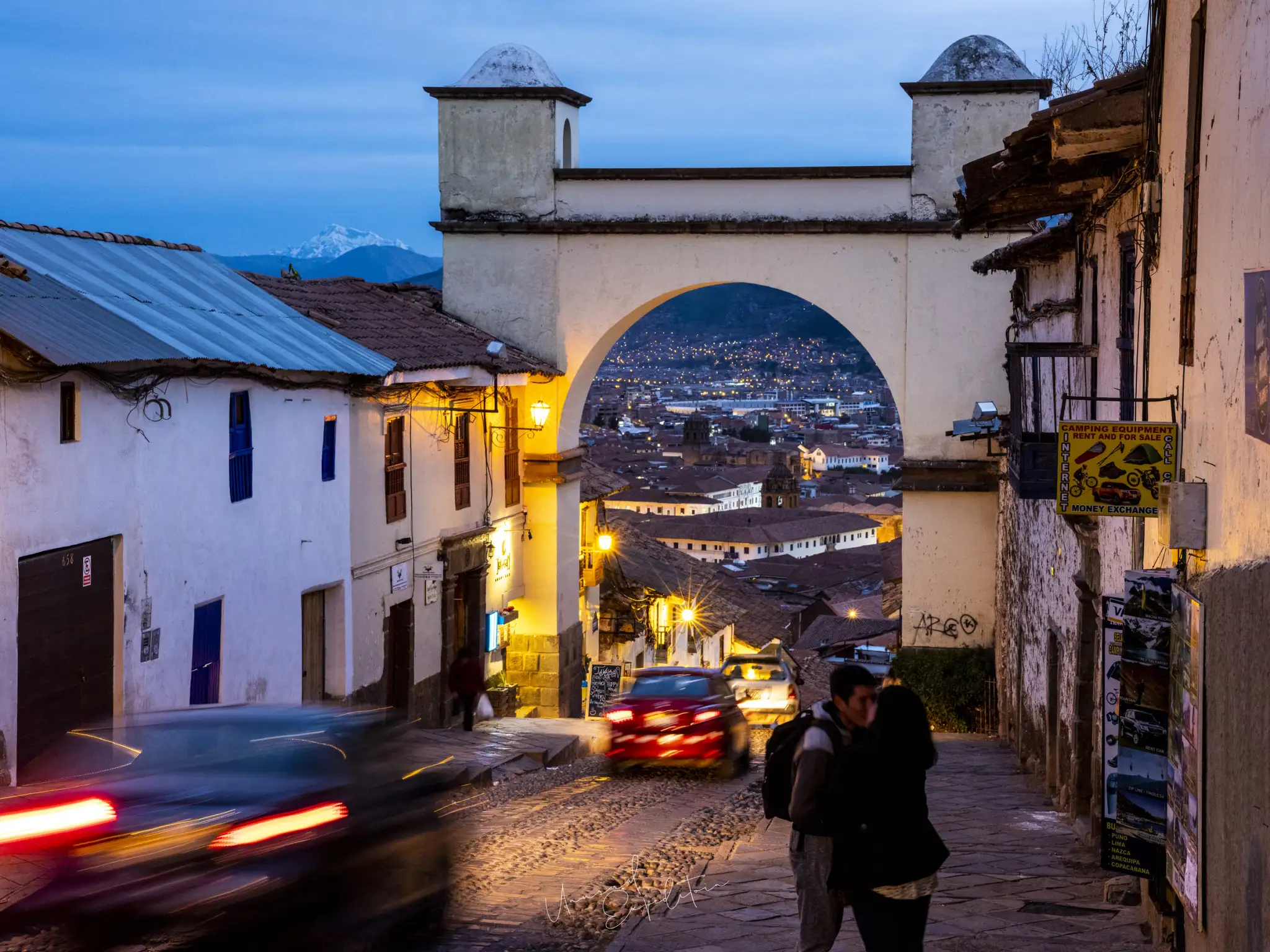
The best night pictures in Cusco happen in a very short window. I like to be at the arch or on the square with the camera set before the lamps come on, and to be done when the sky goes black.
Joseph Mak, tour leader, Unusual Expedition
Cusco night photography settings
| Subject | Lens | Settings | Tip |
|---|---|---|---|
| Pachacuti fountain | 16-35mm | f/11, 1 to 4s, ISO 100 | Get low, stars from the lamps |
| Cathedral at blue hour | 24-70mm | f/8, bracket, ISO 100 to 400 | Rest on a bench or wall |
| Arcades on wet cobbles | 16-35mm | f/8, 1/4 to 2s | Use the reflections as foreground |
| Santa Ana arch with traffic | 24-70mm | f/11, 4 to 15s | Wait for a car climbing the hill |
| Handheld street scenes | 35mm or fast prime | f/1.4 to f/2.8, ISO 1600 to 3200 | Use shop light on faces |
Most failed night frames here are taken too late, after the sky has gone black.
Is Cusco safe at night?
Cusco's centre is busy and well lit in the evening, and the main square and the streets around it are full of people well into the night. The UK Foreign, Commonwealth and Development Office notes that street crime, including thefts, is a problem in Cusco as in other Peruvian cities, and advises using licensed taxis booked by phone, app or your hotel rather than hailing one in the street. With a camera, that means the usual city sense: keep the bag closed and in front, carry one lens, not the full kit, avoid empty side streets late at night, and take a booked taxi back instead of walking up the darker hills. Check the current advice from the Singapore MFA and the FCDO before you travel.
Cusco weather at night
Cusco weather at night is cold for most of the year, because of the altitude. In the dry months the nights are clear and can drop close to freezing; in the rainy months they are milder but often wet. Dress in layers, bring gloves you can operate a camera in, and keep a spare battery in an inside pocket, since cold drains it faster. A shower in the late afternoon is often followed by a clearing sky and wet, reflective streets, which is the best night for photographs. For the seasons across the area, see our best time to visit Machu Picchu guide.
Spend the evenings in Cusco with us
We run Cusco and Machu Picchu as a private trip on request, with the evenings planned around blue hour and the logistics arranged for you; a photographer or coaching can be added at extra cost. See how private tours work, and every Peru destination guide on our Peru photography tours page.
Machu Picchu photography tours
The next Machu Picchu departure is announced on the Machu Picchu photography tours page, with previous expeditions and all the planning guides.
Explore Machu Picchu in depth
- Machu Picchu Photography Tour Guide: the Citadel, Cusco and the Sacred ValleyPeru
- Cusco People Photos: Portraits, Markets and Street Life in the AndesPeru
- Sacred Valley Photos: Moray, the High Plain and the Weavers of ChincheroPeru
- Cusco Photo Spots: the Plaza de Armas, the Santa Ana Arch and the Market StreetsPeru
- Is Machu Picchu Worth It? How to Get There from Cusco and What to ExpectPeru
- Machu Picchu Best Time to Visit: Dry Season, Rainy Season and the Best Time of DayPeru
- Machu Picchu Photo Spots: the Classic View, the Terraces and the Stone HousesPeru
Upcoming Photo Tours
- Egypt Photo Tour – EgyptEgypt 12 Dec 2026 To 20 Dec 2026
- Inner Mongolia Winter Owl Photo Tour – ChinaChina 01 Jan 2027 To 04 Jan 2027
- Inner Mongolia Winter Photo Tour – ChinaChina 05 Jan 2027 To 11 Jan 2027
- Mekong And Central Highland Vietnam Photo Tour - VietnamVietnam 16 Jan 2027 To 24 Jan 2027